
A Founder's Guide to Clear Branding and Messaging
- Jan 18
- 12 min read
Is your branding and messaging a bit of a mess?
It’s a common feeling. You’re working hard, but your message isn’t quite landing. Sales cycles feel longer than they should. The leads you get are lukewarm. If you ask five people on your team to describe what the company does, you get five different answers.
If that sounds familiar, you’re not crazy. It makes sense that you feel stuck.
This is a normal growing pain. It’s a sign your business has simply outgrown its original story. The scrappy, all-hands-on-deck approach that got you here is now creating confusion as you scale. The problem isn't a lack of effort; it's the lack of a clear, shared structure.
Why Your Branding and Messaging Feels Stuck
What worked when you were a team of five in one room doesn't work for a team of twenty spread across different departments. Those informal chats that kept everyone aligned have been replaced by silos. Now your company’s identity feels fragmented.
This internal confusion bleeds outwards, creating a brand that feels inconsistent to your customers. It’s why marketing campaigns feel like pushing a boulder uphill.
Most teams struggle here because they’ve never had someone step in to structure the work. They see the symptoms – low engagement, confused prospects – but can’t pinpoint the root cause. The issue isn’t a lack of effort; it's the absence of a clear foundation to build upon.
The way forward isn’t a flashier logo or a new tagline. It’s about building a solid framework that gives everyone in your business clarity and direction.
The Small Shift That Changes Everything
I remember working with an agtech founder who was convinced his high-tech sensor was the most important part of his business. But his message wasn't connecting with farmers. They were far more worried about profitability and farm succession, not the technical specs of his gadget.
The real problem was a disconnect between his brand (what he believed made them special) and his messaging (what his customers actually needed to hear).
The fix wasn’t to talk more about the technology. It was to first build a brand foundation around a genuine understanding of the farmer's world, then craft a message that spoke directly to those real-world pressures.
This is what regaining control looks like. It’s about bringing structure to the chaos and giving your entire team the confidence to move forward as one.
Your Brand Is the Foundation, Your Messaging Is the House
To fix a problem, you have to understand it first. Many founders use ‘branding’ and ‘messaging’ to mean the same thing, but that small mix-up leads to big headaches. They are two different layers of your business, and they need to be built in the right order.
Think of your brand as the foundation of a house. It’s the concrete slab and the structural supports you don’t see. It’s your core identity—your values, your personality, and your reason for existing. It’s the why behind what you do.
Your messaging is the house you build on top. It’s the walls, the rooms, and the colour of the front door. Messaging is how you talk about your brand to specific people, inviting them in to solve their specific problems.
Branding vs Messaging At a Glance
This table breaks down the core difference. Your brand is the stable, long-term identity, while your messaging is the active, adaptable communication you use every day.
Concept | Branding (The Foundation) | Messaging (The House) |
|---|---|---|
Purpose | To define who you are and what you stand for. | To communicate your value to a specific audience. |
Timeframe | Long-term and consistent. | Short-to-medium term and adaptable. |
Core Question | "Why do we exist?" | "What should we say to them, right now?" |
What it is | Your identity, purpose, values, personality. | Your value propositions, slogans, website copy, ad copy. |
Analogy | The architectural blueprint and concrete slab. | The rooms, furniture, and paint on the walls. |
Getting this distinction right is the first step toward clarity. You can’t build a clear message on a confusing identity.
Why Your Messaging Feels Unstable
When your message isn’t landing, the first instinct is to repaint the walls—tweak a slogan or rewrite the website. But nine times out of ten, the problem isn’t the house. It's the foundation.
If you haven’t done the hard work of defining your core brand, your messaging will always feel inconsistent.
When your brand is fragmented, it creates a ripple effect of pain that slows your whole business down. This is usually where a sprint approach creates clarity quickly. When we embed with a team, the first thing we fix is this exact gap. We don't touch a single word of messaging until we know the ground underneath is solid.
A Practical Example
Let’s make this concrete. Imagine a B2B SaaS company that helps logistics teams manage their inventory.
Their Branding (The Foundation): Their core belief is that small logistics businesses deserve the same powerful tools as industry giants. Their personality is pragmatic, reliable, and empathetic. Their purpose is to bring calm and control to a chaotic industry.
Their Messaging (The House): "Stop losing sleep over stocktakes. Our platform gives you a real-time view of your warehouse in under five minutes." See how this message is built on the brand foundation of empathy and control? It speaks directly to a specific pain point.
Without that solid brand foundation, they might just talk about their features, like "AI-powered inventory tracking." That’s just a description of the building materials; it doesn’t invite anyone inside or make them feel understood. You need to understand precisely why a strong brand identity is a non-negotiable first step.
Your brand gives you direction. Your messaging gives you a voice. You can’t have one without the other.
To get started on that solid foundation, check out these essential small business branding tips. Getting this foundational layer right is what allows all your marketing to land with confidence and clarity.
Three Questions That Define Your Brand
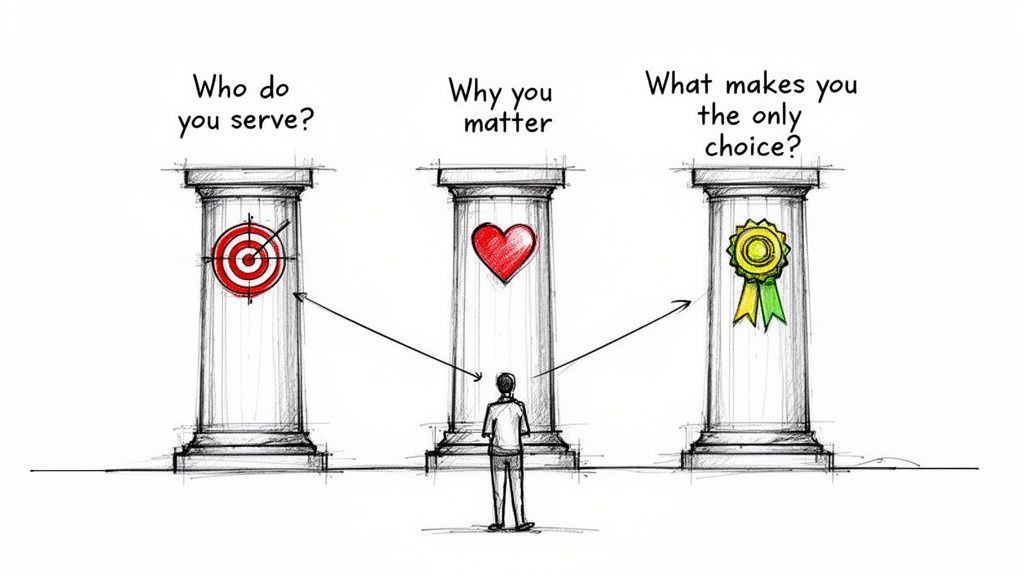
You’ve probably heard the advice to “find your why.” It’s a nice idea, but it’s often too vague to be useful for a founder steering a growing company.
A strong brand isn’t built on abstract feelings. It’s built on clear, pragmatic answers to three specific questions. Nailing these gives your team the direction and confidence they need.
Most teams get stuck here because they’ve never had someone step in to structure the work. They know something feels off, but they don’t have a framework to fix it. Let’s build that structure right now.
Question 1: Who Do You Truly Serve?
This goes deeper than a simple customer demographic. “Farmers aged 40-60” isn’t an answer; it’s a starting point. A strong brand is built on a deep understanding of your ideal customer’s mindset, their hidden frustrations, and the world they operate in.
Who are they, really? What keeps them up at night? What do they secretly wish would just go away?
When you can articulate their problem better than they can, you instantly earn their trust. This isn’t about creating a fictional persona. It’s about building genuine empathy that informs every decision you make.
Question 2: Why Do You Matter to Them?
Once you know who you serve, the next question is about relevance. Why should they care that you exist? This isn’t the place to list your features; it’s about defining the specific, tangible change you create in their world.
Does your software give them back four hours a week? Does your service remove a source of anxiety? Does your product make them feel more in control?
This is your core value. It’s the promise you make and the outcome you deliver, plain and simple. It shifts the conversation from what you do to what you make possible for them.
Your brand isn’t what you sell. It’s the positive impact you have on the people you’ve chosen to serve.
Question 3: What Makes You the Only Choice?
This is the hardest question, but it’s the one that carves out your space in the market. What makes you different isn't your list of features—competitors will copy those. Your real differentiator is your distinct point of view, your unique approach, or your specialised expertise.
It’s the one thing that only you bring to the table.
Maybe it’s your deep industry knowledge.
Perhaps it’s your commitment to a specific value, like transparency.
It could be your unique process for solving their problem.
This is where you move from being just another provider to being the only logical choice for the right customer. If you need more guidance on this, our deep dive on how to find your brand positioning offers a practical roadmap.
A founder we worked with in agtech thought his differentiator was his sensor technology. After we dug into these questions, we realised his true point of difference was a profound empathy for the emotional stress of farm succession planning. His tech was just the tool; his understanding of the human side of farming was what made him the only real choice.
That single shift in perspective reframed his entire brand, giving him immense clarity and confidence. Answering these three questions honestly gives you the foundational pillars for your brand. They provide the structure needed to build messaging that truly connects.
How to Turn Brand Positioning Into Clear Messaging
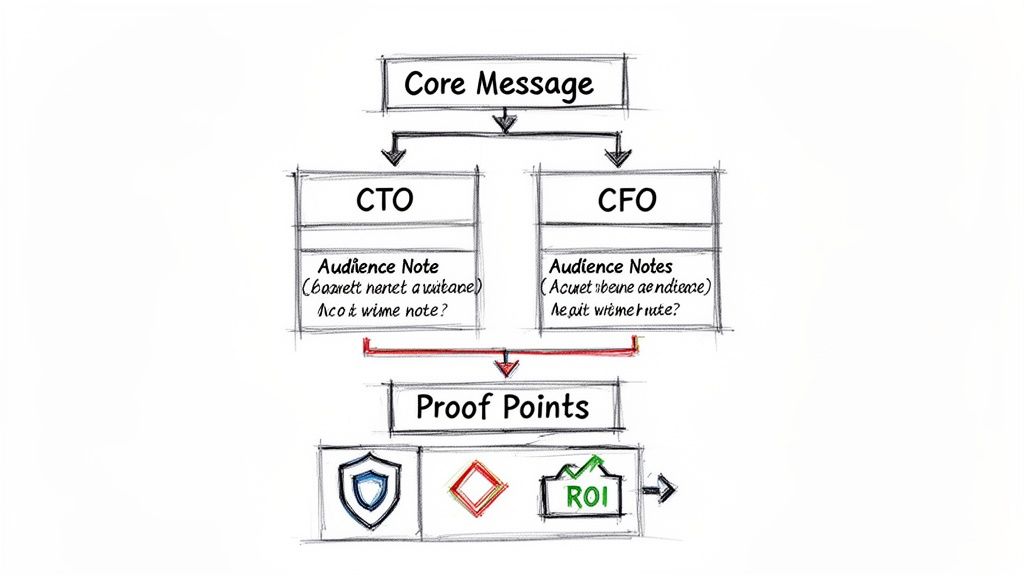
So, you’ve done the hard work. You’ve wrestled with the big questions and have a clear sense of who you are and why you matter. This is usually when a new kind of panic sets in: “Okay… so what do we actually say now?”
It’s a normal feeling. Turning a solid brand strategy into words that make people listen is another challenge. This is where your big-picture ideas have to become practical, everyday language your team can use consistently.
The key is to create a simple framework. This isn’t about chasing creative genius; it’s about translating your core identity into clear language for every audience.
Start With Your Core Message
Before you write a line of copy, you need to lock in your Core Message. This is the one big idea at the heart of everything you communicate. It's the simplest expression of the value you offer, drawn directly from your brand positioning.
Think of it as the headline for your entire company. It should be short, memorable, and make sense to someone who’s never heard of you.
For instance, a B2B SaaS company that helps businesses with regulatory headaches might land on a Core Message like: “Effortless Compliance.” It’s not a public tagline; it's an internal North Star that guides every other communication.
Build Your Audience Pillars
Your Core Message is your foundation, but you don’t speak to every customer in the same way. The next step is to create Audience Pillars—these are targeted versions of your message, fine-tuned for the specific needs and language of your different customer segments.
You’re not changing your core idea. You're just changing the lens you use to make it relevant.
Let's stick with our "Effortless Compliance" SaaS company. They sell to two very different people: the Chief Technology Officer (CTO) and the Chief Financial Officer (CFO).
Pillar for the CTO: The message needs to revolve around security, data integrity, and integration. The conversation is about technical reliability. "Our platform integrates with your existing tech stack in hours, not months, and meets the highest global security standards."
Pillar for the CFO: This message is all about risk reduction, cost savings, and ROI. The conversation is about financial prudence. *"Avoid hefty non-compliance fines and reduce your team’s admin overhead by up to 40%."*
Same core value, framed in a way that speaks directly to what each person cares about most. You can dive deeper into crafting these statements by exploring these eight positioning statement examples that provide brand clarity.
Back It Up With Proof Points
The final layer is the evidence. Proof Points are the hard facts, figures, and stories that make your claims believable. They are the "how" that validates your "what."
Without proof, your messaging is just empty promises. Your messaging makes a promise; your proof points make it credible.
For each Audience Pillar, you should have a bank of relevant proof points ready.
For the CTO: Proof points could be security certifications (e.g., SOC 2 Type II), testimonials from other tech leaders, or a case study detailing a complex integration.
For the CFO: Proof points might include an ROI calculator on your website, data showing the average cost of non-compliance fines, or a case study focused on financial savings.
This structured approach—Core Message, Audience Pillars, and Proof Points—gives your team a practical toolkit for communication. It takes the guesswork out and ensures every blog post, ad, and sales pitch is sharp, relevant, and perfectly on-brand.
Common Mistakes That Weaken Your Brand
It’s easy to get so caught up in the day-to-day that you don’t notice the small ways your brand is slowly coming apart. These aren’t dramatic failures. They're the quiet leaks that, over time, erode customer confidence and stall your momentum.
Spotting these patterns is the first step. Think of it as a calm diagnostic to see where things need shoring up. These issues almost always stem from a lack of internal structure, not a lack of effort.
Mistake 1: Leading with Features, Not Solutions
This is the classic trap for founders. You’re incredibly proud of your product’s architecture and all the clever things it can do. But your customers don't buy algorithms. They buy outcomes.
This happens because your team lives and breathes the product's mechanics. It feels natural to talk about the features you’ve built. The problem? You're forcing customers to do the mental gymnastics of translating your features into their benefits. Most won't bother.
The small shift that changes everything: Instead of talking about the feature, talk about the result it creates. Connect your ‘what’ directly to their ‘why’.
An agtech company we worked with was obsessed with their “proprietary soil nutrient sensors.” It sounded impressive, but farmers weren't biting. We helped them switch the message to: “Get a soil report you can finally trust.” The sensor was the proof, but the trust was the reason to care.
Mistake 2: Everyone Singing from a Different Song Sheet
Does your sales team describe the company one way, while marketing uses different language on the website? This isn't just a minor annoyance; it's a major crack in your brand’s foundation.
When customers hear different stories, it creates confusion and erodes trust. It makes you look disorganised.
This is usually a dead giveaway that there’s no single source of truth for your messaging. When we embed with a team, creating a structured messaging guide is one of the very first things we do to get everyone on the same page.
Mistake 3: Drowning in Vague, Generic Claims
Another common pitfall is leaning on broad statements that sound impressive but mean nothing. Phrases like “we’re the leading provider” or “we offer innovative solutions” are just background noise. They don’t give a potential customer a single concrete reason to choose you.
This usually happens when a brand’s core positioning is fuzzy. Without a sharp understanding of what truly makes you different, it's easy to fall back on safe, empty platitudes.
How to fix it: Go through your website and replace every vague claim with a specific proof point. Instead of “we help you save money,” try “Our clients cut their operational overhead by an average of 15% in the first six months.” Specificity builds credibility where generic language falls flat.
Clear messaging is becoming more critical as marketing channels evolve. Australian spending on influencer marketing is expected to hit US$589 million by 2025, showing the growing power of authentic voices. But if your core message is vague, even the most authentic channel can't save it. You can learn more about these social media trends.
These mistakes are subtle, but their combined impact is huge. By spotting them and making these small, deliberate shifts, you can restore the confidence and clarity your brand needs.
Your First Step Toward Brand Clarity
This guide is designed to help you cut through the noise, not add another impossible task to your to-do list. It’s easy to feel like you need to tear down your entire brand and start from scratch.
You don't. Let’s focus on one calm, confident next step.
Start with a 30-Second Audit
Instead of trying to boil the ocean, let's start with something small and practical. This quick exercise gives you an immediate dose of reality.
Grab five different pieces of your company's content:
The copy on your website’s homepage.
Your latest social media post.
The opening slide of your sales deck.
Your email signature.
A recent job ad.
Now, lay them all out and ask yourself one simple, honest question:
Could a complete stranger look at these and understand who we help and why we matter in under 30 seconds?
This little audit cuts through internal jargon and instantly shows you where the cracks are in your messaging. You don’t need a complicated framework to see if you’re being clear. This is the first step toward building a coherent identity. For more practical strategies to build brand awareness and cement that identity, this guide is a great resource.
If your answer feels messy, that’s normal. You’re not behind; you’ve just found your starting point. This is the perfect place to start building real clarity and get your momentum back.
A Few Final Questions
Before we wrap up, let's tackle a few common questions that pop up when founders start digging into their brand and messaging.
How Often Should We Revisit Our Branding and Messaging?
Think of it as a regular health check-up, not a complete overhaul every few months. Your core brand identity—your reason for existing—should be built to last.
However, your brand positioning and messaging are more dynamic. It’s a good idea to review them annually, or any time your business hits a major milestone, like launching into a new market or a significant product pivot. Your foundation stays put, but the way you present your story to the world needs to keep pace.
Can We Fix Our Messaging Without a Full Rebrand?
Yes, absolutely. In fact, this is almost always the smartest first step. A full-scale rebrand is a huge, expensive commitment, and often overkill.
Most of the time, the company's core identity is fine; the problem is that it’s not being communicated clearly. A focused messaging project can deliver a massive impact, fast, by getting your sales and marketing teams speaking the same language. If that process reveals a deeper issue with your brand, then you can consider a bigger project with confidence.
How Do We Get Our Whole Team to Use the New Messaging?
This is where even the most brilliant strategies fall apart—not in the creation, but in the rollout.
The secret is to create a single source of truth. Not a 50-page brand bible that gathers dust, but a simple, practical messaging guide that everyone can actually use. It needs your core narrative, your key message pillars for different audiences, and a handful of approved proof points.
Then, you have to actively weave this guide into your team's day-to-day work. Make it part of sales training. Build it into your content briefs. When the right words are easy to find, using them becomes second nature.
If this all feels messy, that’s normal. You’re not behind. You need structure. At Sensoriium, we help founders find that clarity, sharpen their message, and build the momentum their business deserves. You can learn more about how we help growth-stage companies.