
A Founder’s Guide to Mastering Tone in Writing
- Dec 18, 2025
- 13 min read
Getting the tone of your writing right feels like one of those things you should know how to do. You’ve probably stared at a blank page, wondering if your words sound confident or arrogant, helpful or condescending.
Is this too formal? Too casual? Does this sound like a real person or a marketing robot?
If you’ve felt that flicker of uncertainty, you’re not going crazy. It’s a frustrating loop, and it makes complete sense that you feel stuck. The problem isn’t a lack of skill; it’s the lack of a clear system. You’ve been told to “find your tone,” but no one explains how.
This guide will give you that system. It’s a calm, methodical way to move from guesswork to confidence, ensuring your writing builds trust with every word.
Why Getting Tone Right Feels So Impossible
Everyone tells you to “get the tone right,” but nobody explains what that actually means. So you’re left second-guessing every word.
This feeling is common. It doesn't come from a lack of writing ability; it comes from a lack of structure. Most founders and marketers struggle because they’ve been led to believe that tone is some mysterious art form.
The truth is, mastering your tone in writing isn't about being a creative genius. It’s about having a practical framework that gives you clarity.
From Guesswork to a Clear System
The real problem is that without a defined process, every single piece of writing becomes a new puzzle. Your website sounds different from your emails, which sound different from your social media posts. This inconsistency slowly chips away at your audience’s confidence.
They can’t get a clear read on who you are or whether you can genuinely help them. This is especially true if you haven't done proper target audience research to understand what they need to hear from you.
The solution isn’t to "try harder." It's to stop treating tone as a vague concept and start seeing it as a practical tool. When we embed with a team, this is one of the first gaps we fix.
This guide will show you how to move from chaotic guesswork to confident execution, giving you a repeatable system for getting your tone right, every single time.
The Simple Difference Between Voice, Tone, and Style
Let's clear this up. People get tied in knots over tone in writing because they treat ‘voice’, ‘tone’, and ‘style’ as if they all mean the same thing.
They don’t.
This mix-up is the root of so much confusion. You can’t get your tone right if you’re trying to reinvent your brand’s entire personality with every blog post. It’s exhausting for you and jarring for your audience.
The good news? The distinction is simple. Once you see it, this small shift in thinking gives you back control.
Your Voice is Your Personality
Think of your brand’s voice as its personality. It’s who you are. It’s consistent and stable. This personality shouldn’t change, whether you’re writing a quick tweet or a deep-dive report.
So, who is your brand? Is its personality:
Confident and direct?
Inquisitive and analytical?
Warm and supportive?
Whatever you land on, this is your anchor. Most teams stumble right here because they’ve never actually defined this, leaving every writer to guess what the company should sound like.
Your Style is Your Mechanics
Your style is about the mechanics of your writing. Think of it as your grammar and formatting rulebook - the set of choices you make to keep things consistent.
Style covers rules and preferences, like:
Do we use the Oxford comma?
How long are our sentences and paragraphs?
Are contractions like "you're" okay, or do we stick to "you are"?
How do we format headings?
These rules make your writing consistent and easy to read. Style provides the guardrails; your voice is the car driving between them.
Your Tone is Your Emotion for the Moment
This is the most crucial part. Your tone is the emotional inflection you apply to your unchanging voice to fit a specific situation. While your voice stays constant, your tone needs to adapt to the context and what your audience is feeling.
You wouldn’t use the same tone to announce a company milestone as you would to reply to a panicked support ticket. Your personality doesn't change, but your emotional expression does. That’s tone.
Think about how you talk in real life. You have one personality (your voice), but you naturally adjust your tone depending on whether you’re talking to your best mate, your boss, or your nan. It’s the same principle in writing.
A single brand voice can express itself through a range of tones:
Supportive Tone: For a customer service email to a frustrated user. ("We understand this is frustrating, and we're here to help sort it out.")
Authoritative Tone: For a technical white paper. ("Our research indicates a clear correlation between these data points.")
Enthusiastic Tone: For a new product launch. ("We’re thrilled to show you what we've been working on finally.")
Grasping this separation is the first step toward mastering your brand's communication. It gives you a simple, repeatable framework: start with your fixed voice, apply your style rules, and then choose the right emotional tone for the job.
This structure is what builds real confidence and momentum.
Voice vs Tone vs Style at a Glance
Concept | What It Is | Example Analogy | Does It Change? |
|---|---|---|---|
Voice | Your brand's core personality. | Who you are as a person. | No, it's consistent. |
Tone | The specific emotion you use in a situation. | Your mood in a conversation. | Yes, it adapts to the context. |
Style | Your writing rules and mechanics. | How you dress or the words you choose. | No, these are your consistent rules. |
Think of it this way: your voice is the person, your tone is their mood, and your style is their grammar. Once you have this framework, it's much easier to write with purpose.
Why the Wrong Tone Kills Trust
It’s tempting to think of tone as a ‘soft’ thing you’ll polish later. But in business, where credibility is your currency, a mismatched tone doesn’t just sound off - it actively sabotages trust.
You know the feeling. You land on a website for a brilliant new piece of software, but the writing is so dense and academic that it feels like a relic from 1998. Or a company handling your sensitive data tries so hard to be quirky that you question if they're taking their job seriously.
That flicker of doubt is a trust killer. Your brain picks up on the disconnect between what a company claims to be and how they sound.
The Real-World Cost of Getting It Wrong
This isn’t just about making your copy pretty. An inconsistent tone creates real problems that can grind your growth to a halt. Most teams trip up here not because they’re bad writers, but because they’ve never been given a clear playbook for their tone of voice.
When the tone is mismatched, you get:
Damaged Credibility: An overly formal tone can make innovative tech sound old-fashioned. A try-hard casual tone can make a serious solution feel flimsy.
Customer Confusion: If your website is confident but your sales emails are timid, prospects won't know who they're really dealing with.
Wasted Time: Your team ends up in endless loops of rewriting copy. Without a defined guide, everyone’s just guessing, which means rework and lost momentum.
Even governments understand how critical tone is. The Australian Government’s Style Manual, for instance, advocates for a standard tone that balances formal and informal language. Why? Because it’s easiest for most people to understand, which builds trust.
A Founder’s Story: From Technical Jargon to Customer Clarity
Here’s a practical example. Picture the founder of a new agtech SaaS platform. Their product is incredible, using machine learning to predict crop yields. Naturally, their first website was packed with phrases like “proprietary algorithms” and “data-driven optimisation.”
The tone was deeply technical and features-focused. It was written to impress other engineers.
The problem? Farmers weren't buying it. They were confused and intimidated. The tone was disconnected from their world - the mud on their boots and the unpredictable weather. It spoke at them, not to them.
The change that turned things around was small but profound. They didn't alter the product. They just changed their tone.
They shifted from a technical, self-congratulatory tone to an empathetic, problem-focused one.
Before: “Our platform leverages proprietary algorithms for data-driven optimisation of agricultural yields.”
After: “Get a clear picture of your Harvest weeks in advance. Our platform helps you make confident decisions to reduce waste and get a better price at the market.”
Feel the difference? The first version is about their tech. The second is about the farmer’s problem and the confidence they’ll feel. This wasn't about "dumbing it down"; it was about shifting the emotional spotlight from their product to their customer.
That simple adjustment in tone created a connection. It showed they understood the farmer's world, which is the foundation of trust. This is the kind of gap we see all the time when we first embed with a team - the bridge between what a product does and why a customer should care hasn't been built.
How to Map Your Brand’s Tones for Consistency
Okay, so you get the theory. How do you put it into practice? This is where most brands stumble. The idea of mapping out your tone feels like you're about to write a 50-page style guide that will gather dust.
Most teams don't need a massive document. They need a simple, usable tool that gives them structure right away. Just listing vague adjectives like ‘friendly’ or ‘professional’ isn’t enough - they leave too much room for interpretation.
Let's get practical and build something your whole team can actually use. This is about creating a single source of truth that removes the guesswork from writing.
Start with Scenarios, Not Adjectives
Here’s the most common mistake: brands create a list of tones - like ‘bold’ or ‘helpful’ - and assume everyone knows what that means in every situation. It never works.
A better approach is to start with the real-world scenarios your team writes for every day.
Instead of asking, “What should our tone be?” ask, “What’s the context here?”
That simple shift changes everything. It anchors your tone to a specific purpose and audience. Often, a quick sprint approach is all it takes to bring clarity to this process.
The Tone-Mapping Exercise
Here’s a straightforward exercise you can do in an afternoon. The goal is to create a simple map that connects your core brand voice to the different tones you need.
Grab a whiteboard or open a shared document and make four columns:
Communication Scenario: What are you writing? Think about common touchpoints: website copy, sales emails, support articles, social media updates.
Audience’s Mindset: For each scenario, put yourself in their shoes. Are they curious? Frustrated and looking for a fix? Sceptical and needing proof?
Our Goal: What do you want the reader to think, feel, or do? Is the aim to build trust, solve a problem, or inspire them?
Tone to Use: Now, and only now, you can assign a tone. Based on the audience’s mindset and your goal, what’s the right emotional flavour?
This exercise provides the framework most teams are missing. It creates a clear line between why you're writing and how you should sound, which is essential for true message alignment.
A Simple Tone-Mapping Template in Action
Let's pretend we're a B2B SaaS company with a core voice of Confident & Direct. Here’s what a small part of their tone map might look like.
Scenario | Audience’s Mindset | Our Goal | Tone to Use |
|---|---|---|---|
Pricing Page | Comparing options, cautious, looking for clarity. | Build confidence and make the decision feel simple and safe. | Reassuring & Clear |
Support Doc | Frustrated, stuck, needs a fast and simple solution. | Solve the problem efficiently and reduce their stress. | Supportive & Direct |
Blog Post | Curious, looking for new ideas, wants to learn. | Demonstrate expertise and build trust in our perspective. | Authoritative & Insightful |
See how that structure turns an abstract idea into a practical guideline? Anyone on the team can now look at this map and understand how to approach writing for a specific situation.
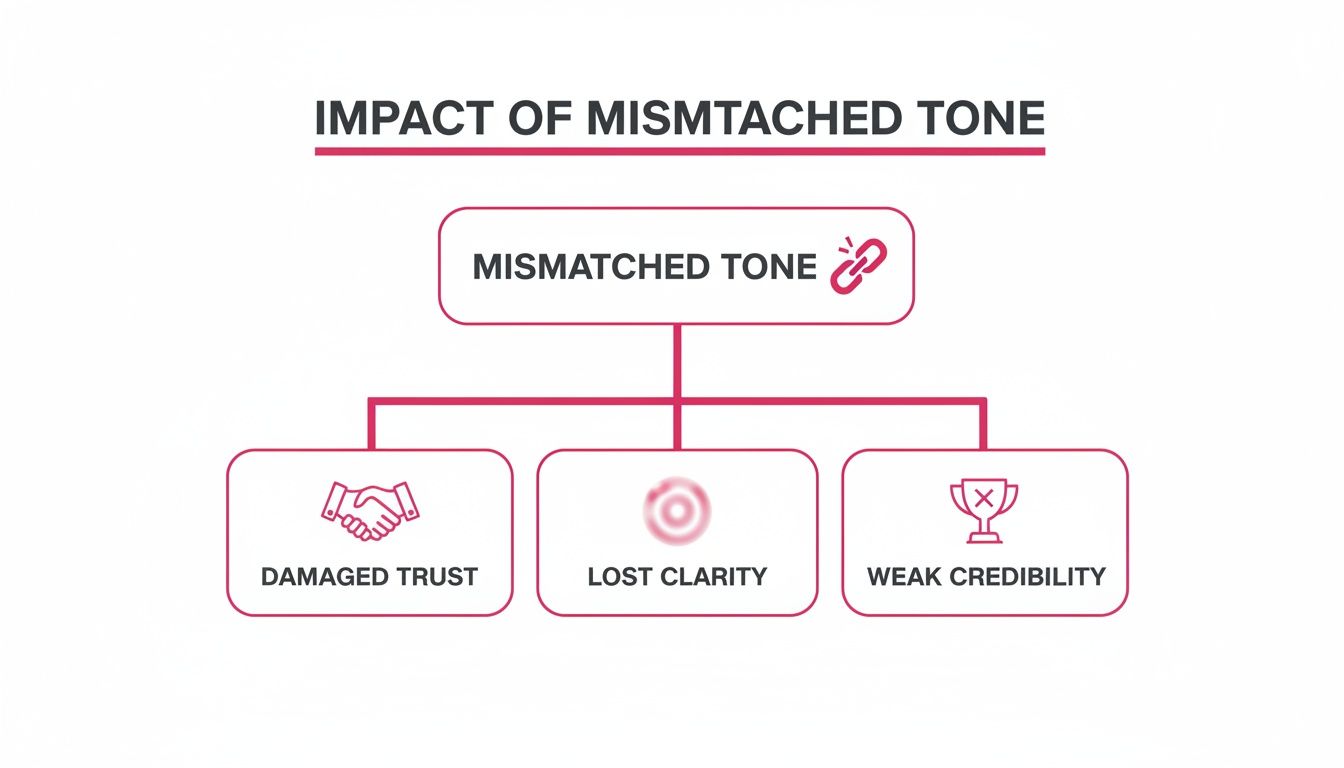
When your tone is mismatched, you risk losing clarity, which weakens your credibility and damages the trust you have with your audience.
Bring It to Life with Examples
The final step is to add simple ‘use this/not that’ examples. This makes a tone guide genuinely useful.
Let’s take that Supportive & Direct tone from our example:
Use this: "We understand this is causing a problem. Here are the two steps to fix it right now."
Not that: "We regret to inform you of the inconvenience you are experiencing. It has come to our attention that a potential issue may require a series of procedural adjustments on your part."
The difference is night and day. The first example gets straight to the point while acknowledging the user’s frustration. The second is corporate jargon that makes a stressful situation worse.
The power of adapting tone isn’t limited to business. The National Survey of Australian Book Authors shows how different genres need distinct tones to connect with readers - from the introspective style of literary fiction to the accessible feel of children's books. You can read more in the full industry brief from Macquarie University.
By mapping scenarios, defining goals, and providing clear examples, you’re building a system that empowers your team to write with consistency and confidence.
Putting It All Into Practice with Real Examples
So we’ve covered the theory and mapped out the templates. But what does great tone in writing look like in the wild?
It’s one thing to have a plan on paper; it's another to see how a confident, clear tone on a pricing page can build trust and get someone to pull out their credit card.
This is where most teams get stuck. They have the map, but no idea what the destination should look like. Let's fix that.
We're going to break down real-world examples from brands that nail their tone. We won’t just look at what they wrote, but why it works so well for that specific person. When we embed with a team, this is often the first thing we fix: bridging the gap between the plan and the real world.
Deconstructing Atlassian’s Confident Tone
Atlassian is a great example of a B2B tech company that strikes a perfect balance. They sound confident and human while staying direct and clear. They are credible enough for developers but accessible enough that a new user doesn't feel overwhelmed.
Take a look at how they describe their company values:
The tone here is unapologetically direct and human.
Phrases like "No bullshit" and "Don't #@!% the customer" cut through the corporate noise. It establishes a tone of transparency that builds trust with a tech-savvy crowd that has no patience for marketing fluff.
How Tone Adapts Across Different Channels
A great brand knows not to use the same tone everywhere. Just like a real person, they adapt based on the situation.
Let’s imagine how a SaaS company might adjust its tone.
1. The Website Pricing Page
Audience’s mindset: They’re cautious, comparing you to competitors and want clarity.
Your goal: Build their confidence. Make the decision feel simple and safe.
The right tone: Reassuring and Clear
In action: "Choose the plan that's right for you. You can change or cancel anytime, no questions asked. All plans come with our 30-day money-back guarantee."
See how that tone directly addresses the fear of commitment? It's calm, straightforward, and all about removing risk. That's what a potential customer needs to feel secure. Too many companies fail here; you can learn more about why your professional services website isn't winning you clients in our article.
2. A Customer Support Email
Audience’s mindset: They're frustrated, maybe stressed. They want a fast solution.
Your goal: Solve their problem quickly and show you care.
The right tone: Patient and Supportive
In action: "I'm sorry you're running into this issue - that sounds incredibly frustrating. I've looked into your account, and I can see what's happening. Here are the two steps to get it fixed right now."
The tone here is all about empathy and immediate action. It starts by validating their feelings ("that sounds incredibly frustrating") before giving them a clear path to a solution. It provides relief and shows you're on their side.
These examples make it clear that tone isn't about following rigid rules. It’s about making a conscious choice to meet your audience emotionally where they are.
That small shift turns generic communication into a real connection.
Your Next Step: A Simple Tone of Voice Guide
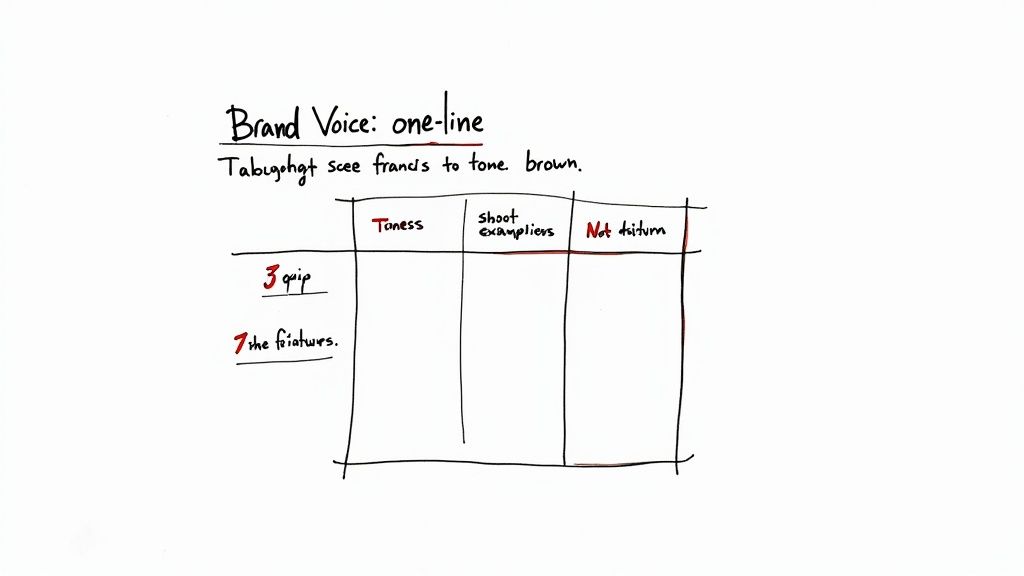
You understand what tone is and why it's so important. The next step is to put some structure around it. This doesn't mean writing a 50-page brand bible that will gather dust.
If this all still feels a bit messy, that’s normal. You’re not behind; you need a straightforward system. Most teams get stuck right here because they've never had a simple framework to guide them.
The goal is to create a practical, one-page guide that your team can start using this afternoon.
The Three Essential Elements
Let's keep it simple. A useful tone guide only needs three things to give your team the clarity they need.
A One-Sentence Voice Summary: Nail your brand’s personality in a single sentence. For example: "We are the confident, direct guide for founders who are tired of guesswork."
A Simple Tone Map: Use the table format we covered earlier. Map out 3-5 key tones against your most common communication channels - like pricing pages, support tickets, and blog posts.
"Use This / Not That" Examples: This is where it all comes to life. For each tone you’ve defined, show your team what you mean with clear, side-by-side examples. What does "Supportive & Direct" actually look like in a real sentence?
This isn’t just an abstract exercise. In Australia, a drop in students' persuasive writing skills has been linked to a weaker understanding of audience and tone. Getting this right is a fundamental skill, a finding you can dive into in the full research on Australian writing development.
Before you touch another piece of content, sort out this documentation. This simple guide is the foundation that gives you and your team the confidence to move forward consistently.
Common Questions About Tone in Writing
Even with a solid plan, a few questions always come up. Let's tackle them so you can move forward with confidence.
How Many Brand Tones Should We Have?
You don't need a dozen. Too many is just as messy as none at all. The aim is clarity, not complexity.
A great starting point is to define three to five core tones that map to the situations you encounter every day.
For a B2B SaaS company, that might look like:
An aspirational tone for your homepage.
A reassuring tone for the pricing page.
A supportive tone for help docs and customer support.
A direct tone for sales emails.
The specific number isn't what's important. What matters is that each tone has a clear job to do.
Can Our Tone in Writing Be Funny?
Yes, but walk carefully. Humour is subjective and can fall flat easily, especially in B2B, where trust is everything. What one person finds witty, another might see as unprofessional.
If humour fits your brand's personality, try it in lower-stakes situations first, like on social media. But for critical communications - like security updates or legal terms - always choose clarity and confidence over a cheap laugh. Being clever is often safer than trying to be a comedian.
How Do We Get the Whole Team on Board?
Consistency comes from good systems, not just good writers. A brilliant writer flying blind will still create content that feels out of sync.
The most powerful thing you can do is create the simple, one-page tone-of-voice guide we talked about. It needs to be practical, easy to find, and packed with clear examples. Most teams drift apart on tone because they’ve never had a single source of truth.
Don't just email the guide out and hope for the best. Weave it into how your team works.
Make it part of your process:
Onboarding: It should be one of the first things a new team member reads.
Content Briefs: Link to the relevant tone profile in every brief.
Feedback: When giving notes on a draft, refer back to the guide. This makes feedback objective rather than personal.
Having that shared reference point gives your team the structure and confidence they need to nail the tone, every time.
If this feels messy, that’s normal. You need structure. When you're tired of the guesswork and need clarity and momentum in your marketing, Sensoriium can help. We step in to fix what’s not working and build the systems you need to move forward with confidence.