
Direct Mail Solutions That Actually Get a Response
- Dec 21, 2025
- 12 min read
You’re sending more emails, running more ads, and posting constantly, but your engagement is flat. The pipeline is quiet. It feels like you’re doing all the right things, but nothing is connecting.
If this feels familiar, you’re not imagining it. It’s not a lack of effort. It’s the reality of digital overload, and it’s why even your best marketing campaigns can feel like they’re shouting into a void.
Why Your Digital Marketing Feels So Stuck

Your ideal customers are drowning in digital messages. They've become experts at tuning out the noise, which means your thoughtful email sequences and targeted ads often get ignored before they’re even opened.
This isn't a new problem, but the usual response - create more digital content and hope something sticks - isn't a strategy. It’s a recipe for burnout. It’s an approach that lacks structure and, as a result, drains your team’s confidence.
The Problem with the Digital-Only Playbook
The core issue is that purely digital outreach has hit a point of diminishing returns. When every company uses the same tactics, it’s almost impossible to build a genuine connection. This is often where we see teams struggle; they’ve never had someone step in to structure their work beyond the simple instruction to "do more online."
This usually leads to a few frustrations you might recognise:
Flat Engagement: Your open rates and click-throughs are stuck, no matter how many times you tweak your subject lines.
Ghosted Leads: High-value prospects show interest, then disappear without a trace.
A Disconnected Funnel: Your marketing activities feel completely separate from real sales conversations. Many founders describe this as having broken funnels that can’t convert good leads.
The answer isn’t to be louder online. It’s to be different. It's about finding a way to show up that is tangible, memorable, and creates a clear signal in all the digital chaos.
A Founder Moment: The Crickets
Imagine you’re trying to land a meeting with a key decision-maker at a major agtech firm. You’ve sent three thoughtful, well-researched emails. You’ve connected on LinkedIn. You’ve even run ads targeting their company. And the response? Crickets.
It’s probably not because your message is wrong. It’s because your contact is deleting dozens of similar emails before they’ve finished their morning coffee. All your effort gets lost in a crowded inbox. This is exactly where a more tangible approach, like thoughtful direct mail solutions, can provide the structure and cut-through you’re missing.
Let's Rethink What "Direct Mail" Means

When you hear “direct mail,” what comes to mind? For most people, it’s that pile of junk mail - pizza flyers and real estate ads - that goes straight into the recycling bin. If that's what you're picturing, it makes sense you’d dismiss it as a tool for a serious tech company.
But that old-school image is worlds away from what modern direct mail solutions are about.
Forget mass mailouts. Think of it as a targeted, physical touchpoint delivered with precision to the exact people who matter most. This isn't a blunt instrument; it’s a tool for building relationships. We’re not talking about sending something to thousands of people, but sending a carefully chosen package to the 10 key accounts you need to close this quarter.
It's a System, Not Just a Letterbox Drop
Today’s direct mail is an intelligent system designed to plug into your digital marketing stack, turning online data into tangible, real-world connections. The real power is unlocked when you connect it to your CRM.
Once it’s hooked up, you can use digital behaviour to trigger a physical action.
A high-value prospect from a target account visits your pricing page for the third time.
Your CRM catches this signal.
The next day, a pre-planned, personalised package arrives at their office.
This is where you bring structure to the chaos of digital outreach. Instead of sending another email that’s easy to ignore, you create a memorable experience that proves you’re paying attention. It’s a powerful signal that cuts straight through the online clutter.
This approach shifts direct mail from a shot in the dark to a deliberate, measurable part of building a marketing strategy that actually works, because it aligns physical actions with digital intelligence.
A Simple Scenario
Let's say you’re an agtech founder trying to get the attention of a director at a major farming co-op. Your emails aren't being opened. You could send a fourth, but what would change?
Instead, you use a direct-mail platform to send a high-quality field journal co-branded with both your logo and theirs. Tucked inside is a simple, handwritten note.
The package lands on their desk, not in their crowded inbox. It’s physical. It's useful. And it shows a level of thoughtfulness that a dozen emails never could. This is how modern direct mail opens doors and starts conversations, especially when digital efforts have hit a wall.
Putting Direct Mail into Action with Precision
It’s one thing to know direct mail can work; it’s another to use it with purpose, so you’re not just wasting your budget. The shift happens when you stop seeing mail as a standalone tactic and start treating it as a targeted solution for specific business challenges. It’s all about bringing structure to your outreach.
Most teams get stuck here. They’ve never had a simple framework to connect a physical mailer to a clear business goal. Let’s fix that. Here are three practical scenarios where direct mail can create real momentum.
Use Case 1: Account-Based Marketing
You're pursuing a handful of high-value, dream clients. Your emails are getting buried, and digital ads aren't sharp enough to grab the attention of that one C-suite decision-maker you need to reach.
Instead of sending another email, what if you used a direct mail solution to land a high-impact, personalised kit on their desk a week before your sales team calls?
A Founder Moment: Imagine an agtech founder sending a custom box to the Head of Innovation at a major farming co-op. Inside is a soil-testing kit, a beautifully printed report on regenerative agriculture (featuring their company's logo), and a simple, handwritten note: "Figured this might be more useful than another email. Let's talk next week."
That small, tangible gesture changes the dynamic. It’s not an interruption; it’s a memorable, valuable gift that opens the door for a real conversation.
Use Case 2: Lead Nurturing
What about those warm leads who showed real interest but have gone quiet? You've followed up digitally, but your messages have faded into the background. Pushing harder with more emails now usually does more harm than good.
This is the perfect moment to re-engage them in a way they won’t expect. A simple, well-timed mailer can bring your company back to the top of their mind without being pushy.
You could send them a high-quality, printed guide that goes deeper into a topic they were curious about. Or something small and genuinely useful, like a branded desk calendar. The goal is to be helpful and give them a physical reminder of the value you offer.
Use Case 3: Customer Reactivation
Winning back a customer who has left is almost always cheaper than finding a new one. The problem is, most reactivation campaigns rely on a generic "we miss you" email that gets deleted on sight. To get their attention, you need to show you’ve put some thought into it.
Sending a thoughtful package can break through that indifference. It might include a personal note acknowledging their departure, a quick summary of the new features you’ve added since they left, and a compelling, personalised offer to come back.
When we embed with a team, this is often the first gap we fix - aligning these simple, tangible actions with bigger strategic goals to create immediate traction. And the investment in this channel reflects its power; ad spending on direct mail in Australia is projected to hit US$1.32 billion by 2025, proving its impact in a world overloaded with digital noise. You can read the full research on Statista about Australian direct mail trends.
Connecting Mail to Your Digital Systems
It’s a familiar story. You’ve sent out a thoughtful direct mail piece, and then… silence. Did it arrive? Did anyone look at it? You're left guessing, feeling like you've just thrown your budget into a black hole.
This is where most direct mail campaigns fall apart. The power of modern direct mail solutions isn’t just in the physical item; it's in tying it directly to the digital marketing systems you already use. When your physical mail and digital channels are in sync, you create a seamless experience for your customer and get clear data for your team.
The aim is to build a single system where every channel reinforces the others. We often find that sorting out these disconnected systems is the first critical step to building measurable momentum.
Turning Digital Actions into Physical Touchpoints
Think of your CRM - be it HubSpot, Salesforce, or another platform - as the control centre for your direct mail. Instead of blasting mail based on a stale list, you can use real-time customer behaviour to trigger a physical response automatically.
It's a simple idea, but it changes everything. The system waits for the right moment to act, delivering your message with precision.
Here’s what that looks like in practice:
A lead hits a high score: Once a prospect shows they're highly engaged, the system can automatically send them a welcome kit. No manual work needed.
Someone keeps visiting your pricing page: They've been there three times this week. That's a huge buying signal. Your system can trigger a mailer with a case study tailored to their industry.
A user abandons their cart: A day or two later, a simple postcard arrives with a helpful reminder and maybe a small incentive.
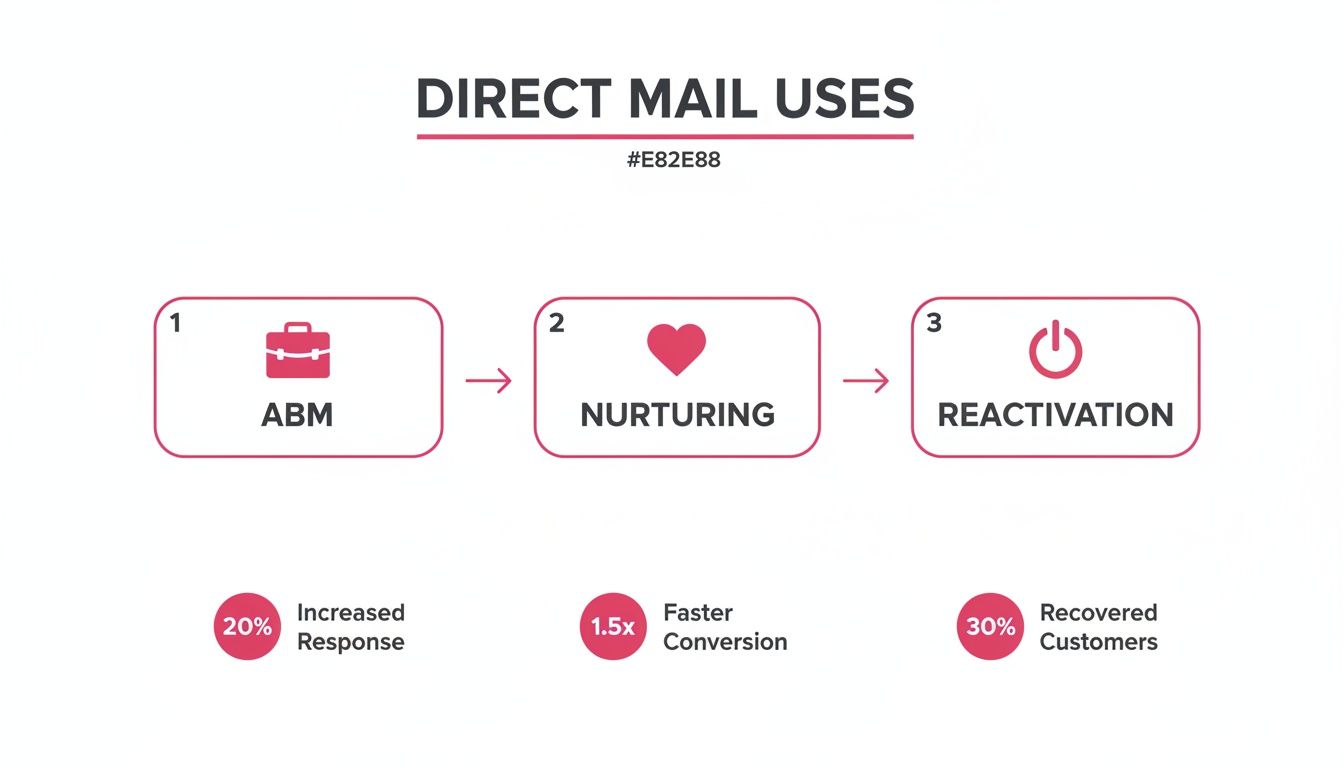
This diagram shows how direct mail integrates seamlessly with core strategies like account-based marketing, lead nurturing, and reactivation, all aimed at improving response rates and closing deals faster.
Closing the Loop with Tracking and Measurement
So, you’ve sent the mailer. How do you know it worked? You build a digital bridge to track engagement and attribute the results. It’s not as complicated as it sounds.
The trick is giving the recipient a simple, trackable way to respond online.
This is usually done with one of two tools:
QR Codes: A quick phone scan directs them to a dedicated landing page, instantly notifying your system of who they are.
Personalised URLs (PURLs): A unique web address printed on the mailer (like yoursite.com/jane-doe) gives you perfect accuracy in tracking who responded.
When someone uses their QR code or PURL, that action fires data straight back into your CRM. The loop is closed. You can see who engaged, what they did next, and calculate the actual ROI of your campaign. It’s how you bring accountability and confidence to a channel that used to feel like guesswork.
The table below shows a few more ways to link digital triggers to physical mail.
Integrating Direct Mail with Digital Triggers
Digital Trigger (Action in CRM/Website) | Automated Direct Mail Response | Desired Outcome |
|---|---|---|
New high-value lead signs up for a webinar | Pre-event "welcome pack" with notebook and agenda | Increase webinar attendance and initial engagement |
Key account goes inactive for 60 days | A "we miss you" box with a high-quality gift and a note | Re-engage a valuable account and restart conversations |
Prospect downloads a bottom-of-funnel eBook | A printed copy of a key industry report or a book | Build authority and prompt a sales call |
Customer anniversary (1 year since signing) | A thank-you card and company merchandise | Strengthen customer loyalty and encourage renewal |
These examples show how automation turns direct mail from a standalone tactic into a strategic, data-driven part of your marketing.
Measuring What Matters: Cost and Return
Talking about ROI can get overwhelming. You’ve sent out a direct mail campaign, and you’re left wondering, “Did that actually do anything?” Vague metrics don’t cut it; you need to know if your investment is genuinely moving the needle. It's a common frustration, but getting clarity is simpler than you think.
The key is to move past old-school metrics and focus on what truly signals success for your business. Instead of just counting raw response rates, let’s get specific. For a high-value B2B tech company, success might not be an immediate sale, but a measurable shift in the sales cycle.
When we work with a team, this is often where we provide the most immediate structure - building a simple framework to connect spend to results, so every dollar feels accountable.
From Vague Metrics to Clear Indicators
To get real confidence in your direct mail, you need to track outcomes that directly tie back to your business goals. It's time to ditch the guesswork and focus on tangible data.
Here are a few practical ways to measure what actually matters:
Influence on Sales Cycle Length: For your top target accounts, track the time from initial contact to a qualified meeting. Did the accounts that received a mailer move through your pipeline 20% faster? That’s a clear win.
Conversion Lift at Key Stages: Compare the conversion rates of leads who received a physical item with those who only received digital outreach. A lift from 2% to 5% in demo requests for a targeted group provides a rock-solid business case.
QR Code and PURL Engagement: Track exactly who scans the code or visits their personalised URL. This gives you direct, one-to-one attribution, showing which specific contacts are engaging.
The goal isn’t just to see if people responded. It’s to understand how a tangible interaction influenced their journey, giving you a crystal-clear picture of its value.
Simple Benchmarks for B2B Tech
Setting realistic expectations is everything. A direct mail campaign for a high-value SaaS product won’t generate thousands of responses, and it shouldn't. You’re aiming for quality, not quantity.
For a targeted B2B campaign aimed at C-level executives, a response rate of 1-3% is a solid benchmark. While that might sound low, remember the context. If you're chasing contracts worth tens of thousands of dollars, just one or two conversions can deliver a huge return.
The cost-per-touch might be higher than an email, but its impact on closing a major deal is where the real value is. This kind of thinking helps you invest with confidence, knowing exactly what a win looks like.
Your First Direct Mail Sprint: A Clear Path Forward
The idea of building a massive, enterprise-level direct mail system from the ground up can feel overwhelming. It sounds expensive, complicated, and a bit chaotic. If you’re feeling stuck just thinking about it, that’s normal.
The good news? You don’t need to solve everything at once. You need a clear, manageable first step.
This is where a sprint approach quickly creates clarity. Instead of trying to build the entire engine at once, we run a small, focused test. The goal is simple: build momentum and gather real-world insights without a huge upfront commitment.
A Simple Four-Week Sprint
When our team joins a project, this is often the very first thing we do. We bring structure to the chaos by breaking down a big idea into a small, achievable project. For a direct mail campaign, a four-week sprint could look something like this:
Week 1: Identify Your Audience. Don't mail everyone. Pick one high-value segment. This could be your top 10 target accounts or 20 promising leads who have gone quiet.
Week 2: Define the Goal and Concept. What's the one action you want them to take? Book a demo? Re-engage with your sales team? With that goal in mind, design a single, simple mailer concept to get that specific result.
Week 3: Organise the Logistics. This is the nuts and bolts. Clean up your contact data, confirm physical addresses, and get your mailer produced. Keep it simple.
Week 4: Send and Track. Get your mailers out the door. The crucial part is including a unique QR code or personalised URL (PURL) so you can track exactly who responds. The aim isn't a massive response rate on day one; it's to gather tangible data.
This small, structured effort is designed to give you immediate direction. It replaces confusion with a clear, actionable plan that quickly proves the channel's value.
If this still feels a little messy, that’s completely normal. You’re not behind. You need a sensible structure to get started, one that lets you move forward with confidence instead of guesswork.
Common Questions About Direct Mail Solutions
Even with a solid strategy, a few questions always come up when founders explore direct mail. It's normal to have reservations when you're adding a physical element to your marketing.
Let's tackle the questions we hear most often.
How Much Should I Budget for a Campaign?
Instead of getting stuck on a total campaign number, think in terms of cost-per-piece. For a high-impact B2B mailer, you're likely looking at a range from $15 to over $100 per person.
The mental shift here is to measure that cost against the customer's potential lifetime value. If you're selling a high-value SaaS contract, a $75 mailer that helps book a crucial demo is a tiny investment for a huge return. The best way to get a feel for this is to run a small, focused pilot campaign to set your own benchmarks.
What Are the Most Common Mistakes to Avoid?
The biggest mistake is treating direct mail like a bulk email blast. Sending a generic, untargeted piece to a massive list is the fastest way to burn through your budget and make your brand look thoughtless.
Here are three classic blunders we see all the time:
Generic messaging: You have to personalise the item, the note inside, or both. A one-size-fits-all approach doesn't work.
Poor data quality: Using an incorrect address or an outdated job title instantly kills credibility. It shows you haven't done your homework.
No tracking: If you don't include a measurable call to action, such as a unique QR code or a personalised URL (PURL), you'll have no idea whether it worked.
Can This Work for a Fully Remote Audience?
Absolutely. This is a common question now, and modern direct mail platforms are built to address it. The key feature to look for is address verification.
Here's how it works: before anything is shipped, your contact gets an email with a secure link. They click it and confirm their preferred shipping address. This simple step ensures your high-value item gets to the right person at their home office, respecting their privacy while creating that powerful, tangible connection. It removes all the guesswork.