
How to Create a Marketing Plan That Actually Works
- Jan 5
- 14 min read
Let's be honest. That feeling of just guessing your way through marketing is draining. You’ve tried a bit of everything—some social media, a few ads, maybe an email campaign—but it all feels disconnected. You're busy, but you're not sure if any of it is actually working.
If it feels chaotic, that’s because it is. You're not crazy. It makes sense that you feel stuck.
Most founders and teams I meet are in the same boat. They're trying to grow a business, and marketing feels like this big, messy puzzle with too many pieces. But the problem isn't a lack of effort. It's the absence of a clear, simple plan connecting what you do every day to what you actually want to achieve.
From Chaos to Clarity
A good marketing plan isn't another corporate document that gets filed away and forgotten. It's a tool for creating calm. It's a map that turns that scattered, anxious energy into focused momentum.
This guide will show you how to build that map. We’re not going to give you a long list of "top 10 tips." We're going to show you how to think about your marketing so that it finally clicks.
The goal is to give your team:
Clarity on what to do and why it matters.
Direction to guide every decision.
Confidence to move forward without second-guessing every step.
This is the journey from feeling overwhelmed to feeling in control. From random acts of marketing to intentional, measurable growth.
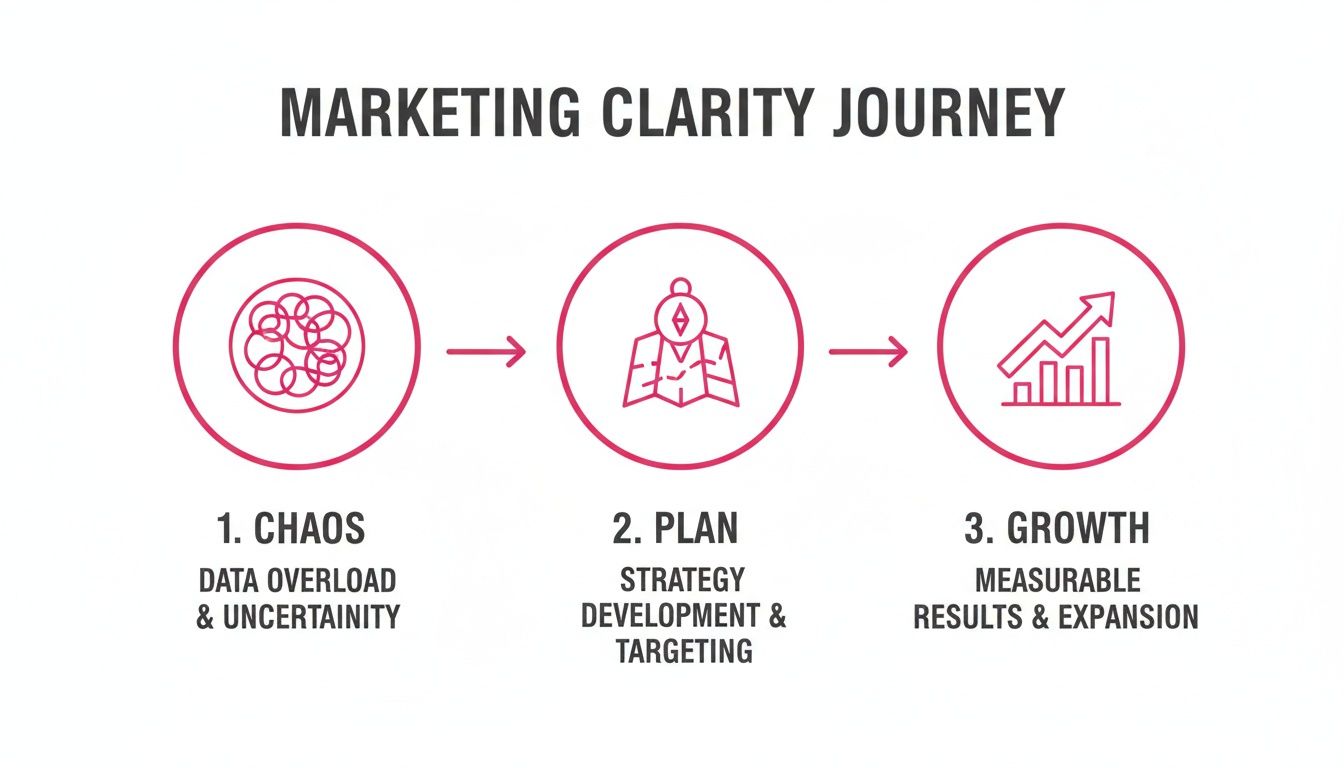
Think of the plan as the bridge. It connects all that activity to real growth, giving you the structure you need to move forward with purpose.
Start with Positioning Before You Do Anything Else
Want to know why most marketing plans fail? They skip the most important part.
It’s tempting to jump straight to the tactics—choosing social media channels, brainstorming content, maybe running an ad campaign. But this is where things go wrong. Without a solid foundation, all that activity is just noise. This is why so much B2B marketing feels ineffective.
The secret to a plan that works is getting your positioning right first.
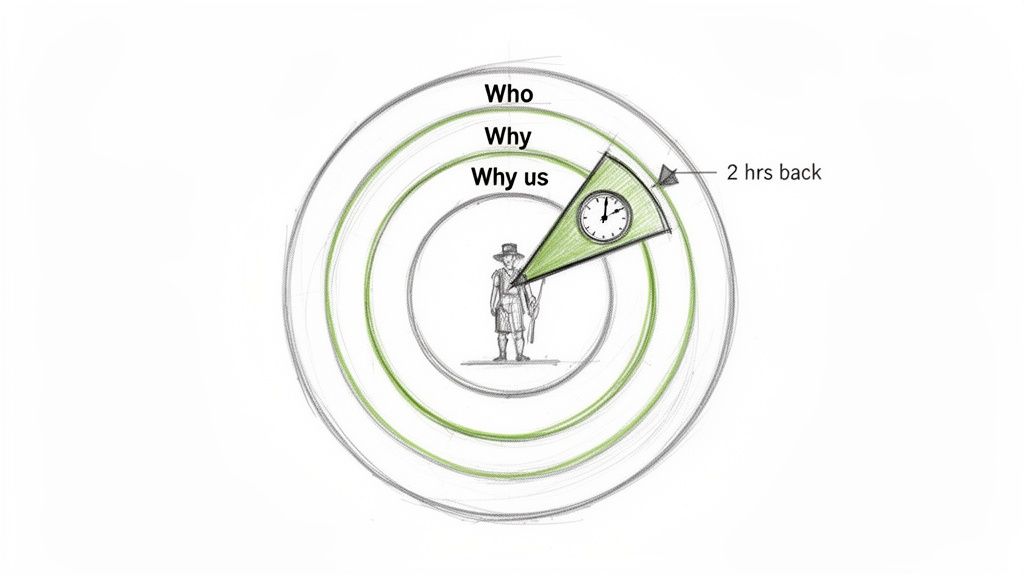
This isn't about a clever tagline. It’s about getting crystal clear on three simple questions. Answer these, and every other decision becomes a whole lot easier.
Who Exactly Do You Serve?
This sounds simple, but it’s where many founders get stuck. I don’t mean listing broad industries. I mean defining the specific person whose problem you solve so well that they’d genuinely miss you if you were gone.
Think smaller. Think deeper.
Instead of "mid-sized tech companies," get specific. Are you for the overwhelmed Head of People at a fast-growing SaaS startup who’s drowning in manual onboarding? Or the operations manager in a logistics company who’s losing sleep over fleet inefficiencies?
A core part of this is creating impactful buyer personas that go beyond job titles and get into real-world challenges. Once you know exactly who you're talking to, everything else clicks into place.
Why Do You Matter to Them?
This is where you have to stop talking about your product's features and start talking about outcomes. Your customer doesn’t really care about your "AI-driven analytics suite." They care about what it does for them.
Does it save them ten hours a week? Does it cut their financial risk in half? Does it make them look brilliant in front of their boss?
This is the classic shift from what you sell to what your customer buys. People don't buy a drill; they buy a hole in the wall. You have to talk about the hole, not the drill.
When we embed with a team, this is often the first thing we fix. They’ve been so focused on building a great product that they’ve forgotten how to talk about the problem it solves in a way that makes people listen. For a deeper dive, check out our guide with 8 positioning statement examples to give your brand clarity.
What Makes You the Only Relevant Choice?
Finally, you need to be honest about why someone should choose you over anyone else. And remember, "anyone else" includes their default option: doing nothing at all. This is your unique point of difference.
It’s rarely about being the cheapest or having the most features. More often, it’s about your specific approach, your deep expertise in a niche, or the way you deliver your service.
A Practical Example
We worked with a founder who had built a complex farm management software. He was trying to sell it as a "comprehensive, all-in-one system," but no one was listening. The message was generic.
We dug in and spoke to his best customers. It turned out the real value wasn't the bells and whistles—it was the time it saved them. We shifted his positioning to this: "The tool that gives grain farmers back two hours a day."
Suddenly, it was clear, specific, and valuable. It spoke directly to a painful problem and made his platform the only logical choice for a farmer whose most precious resource is time.
This lack of strategic groundwork is more common than you might think. Did you know that in Australia, a staggering 47% of companies still don’t have a structured marketing strategy? This absence of a clear plan, starting with positioning, leads directly to sluggish pipelines and wasted effort. For those businesses that do have a documented strategy, Australian data shows they can see up to 80% better brand awareness from their digital ads.
Before you touch channels, budget, or content, get these three questions answered. Write them down. Debate them with your team. This clarity is the single most important asset you have.
Define Objectives You Can Actually Measure
If your positioning answers the ‘who’ and ‘why’, your objectives nail down the ‘what for’. This is where you get really specific about what a win looks like. It’s also where many teams get stuck, chasing vague goals like “increase brand awareness” or “get more engagement.”
Let's be blunt: these aren’t real objectives. They are marketing activities disguised as business outcomes.
They give you a false sense of progress without telling you if you’re actually moving the business forward. It’s that feeling of being busy but having no idea if your work is making any real difference.
A solid marketing plan is built on clear, measurable goals that connect directly to business growth. It's time to shift the focus from vanity metrics to tangible outcomes.
From Vague Goals to Tangible Outcomes
Let's get practical. Instead of chasing abstract ideas, anchor your plan to concrete results. This simple shift brings immediate structure and clarity.
Here’s what that looks like:
Instead of: “Increase brand awareness.”
Try: “Generate 20 qualified sales leads per month from our target accounts.”
Instead of: “Boost social media engagement.”
Try: “Achieve a 5% conversion rate from our LinkedIn content to demo requests.”
Instead of: “Drive more website traffic.”
Try: “Reduce the sales cycle by 15% by creating better mid-funnel content.”
See the difference? The second set of goals gives you a clear target. You know exactly what you’re aiming for, which makes it much easier to decide what to do next. Once you have your objectives defined, understanding how to measure marketing ROI is critical for actually evaluating if your plan is working.
Leading vs Lagging Indicators
This is a small shift in how you think that changes everything. Most teams only track lagging indicators—the final result, like quarterly revenue or total new customers. These are important, but they only tell you what has already happened.
Leading indicators are the weekly activities that predict that final result. They are the inputs you can actually control.
A lagging indicator is the number on the scale at the end of the month. The leading indicators are how many times you went to the gym and whether you ate well each day. To change the outcome, you must manage the inputs.
For a B2B service business, a lagging indicator might be '10 new clients per quarter'. The leading indicators driving that result could be things like 'number of discovery calls booked' or 'proposals sent each week'.
This is usually where a sprint approach creates clarity quickly. By focusing on a handful of leading indicators you can track every week, it becomes easy to see if you’re on track and adjust your course, rather than waiting three months to find out you missed your target.
Getting this right is crucial for building momentum and confidence. We've put together a resource on how to define success so your team actually knows what a win is that can add more clarity here.
Choose Your Channels and Message
Okay, you've nailed down your positioning and set clear objectives. Now for the big question: "So, where do we actually show up, and what do we say?"
This is where many teams get it wrong. They feel the pressure to be everywhere at once, stretching themselves thin across every social platform and content format they can think of.
That’s a recipe for burnout, not results.
The goal isn't to do more; it's to make smarter, more focused choices. It's about picking one or two places where your ideal customers actually spend their time and crafting a message that speaks directly to their problems.
Go Where Your Audience Lives, Not Where It’s Loudest
Just because a new platform is trending doesn’t mean it’s right for your business. Your channel selection should flow directly from the work you did on positioning.
Where do your ideal customers go to learn? Who do they trust for advice? What communities are they already a part of?
For a tech business targeting enterprise CIOs, the answer is probably LinkedIn, niche industry publications, and executive events. It’s almost certainly not TikTok. For a company selling to farmers, it might be rural print media, specific Facebook groups, and field day events.
Don't ask, "What channels should we be on?" Ask, "Where is our ideal customer already paying attention?" This simple reframe cuts through the noise and gives you immediate clarity on where to focus your time and budget.
Most teams struggle here because they’ve never had someone step in to structure the work. They're trying to maintain a presence on five different platforms with a team of two, and nothing gets done well. The first thing to do is give yourself permission to stop. Choose your primary battlefield and focus on winning there first.
Choosing the right channels can feel overwhelming, so here’s a quick rundown to help you weigh your options for a B2B business.
Choosing the Right Channels for Your B2B Business
Channel | Best For | Potential Drawback | Founder Moment Example |
|---|---|---|---|
Reaching specific job titles, industries, and company sizes. Building professional authority. | Can be expensive for ads. Organic reach requires consistent, high-value content. | A cybersecurity founder sharing a personal story about a near-miss security breach and the lesson learned. | |
Email Marketing | Nurturing leads you already have. Delivering high-value content directly to an engaged audience. | Building a quality list from scratch takes time and a good reason for people to subscribe. | Sending a weekly insights newsletter to potential clients who downloaded an industry report from your website. |
Industry Blogs / Publications | Gaining credibility and reaching a targeted audience through guest posts or sponsored content. | Can be hard to secure spots. Often a longer-term play for building trust. | An agtech founder writing a guest article for a well-respected farming journal on "The Future of Water Management." |
Niche Communities (e.g., Slack, Reddit) | Engaging in genuine conversations, understanding customer problems directly, and building relationships. | Requires genuine participation, not just self-promotion. Can be very time-intensive. | A SaaS founder actively answering questions and offering advice in a Slack community for product managers. |
Picking just one or two of these to start with is far more effective than trying to do a little bit of everything. Go deep before you go wide.
Develop Your Core Messaging Pillars
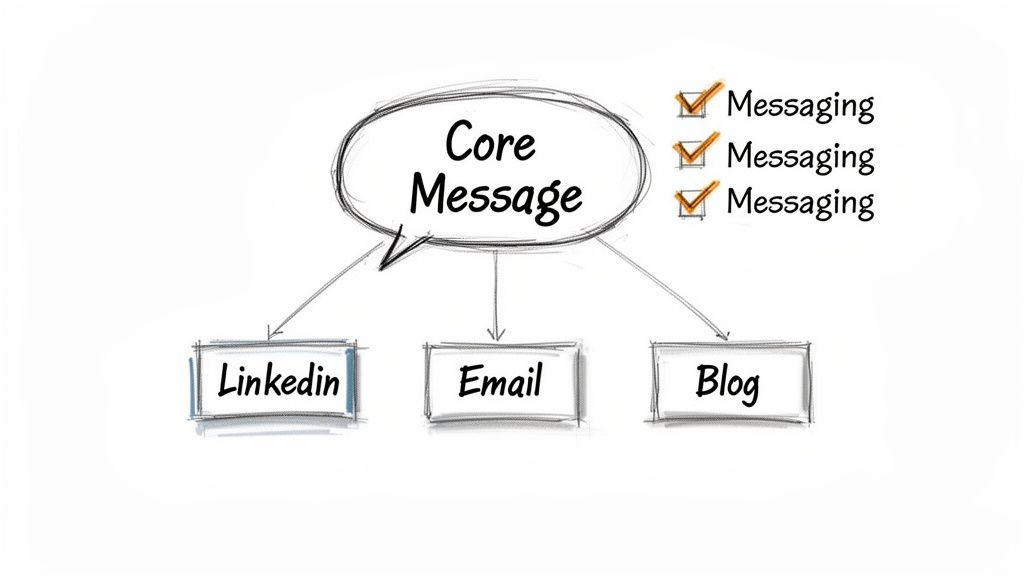
Your message is not a tagline. It’s the consistent story you tell across every channel, and it needs to be rooted in your positioning. This is how you ensure everything you create reinforces why you’re the right choice for your customer.
The simplest way to start is by creating three messaging pillars. Think of these as the core themes you'll return to again and again.
Practical Application
Let’s go back to our agtech founder who shifted their positioning to "giving farmers back two hours a day."
Their messaging pillars might look like this:
Pillar 1: Efficiency and Time-Saving. All content here would focus on practical ways to reduce manual work, streamline farm operations, and reclaim valuable time.
Pillar 2: Data-Driven Decisions. This pillar would cover how better data leads to more profitable choices, reduces risk, and removes guesswork.
Pillar 3: Simplicity and Usability. This would directly address the common fear of complex tech, highlighting the platform's ease of use and support.
With these pillars in place, creating content suddenly becomes much easier. A blog post could be "Three Ways to Automate Your Harvest Reporting" (Pillar 1). A LinkedIn ad could target farm managers with a case study on improving yield predictions (Pillar 2).
This structured approach lets you test different messages to see what resonates most, without getting locked into a huge, long-term campaign. It’s all about learning quickly and focusing on what actually works.
A methodical approach to channels and messaging also helps you understand where to invest. A B2B tech company with a clear message might find that short-form video on LinkedIn is incredibly effective for founder-led insights, especially with ad spend on social media projected to hit over AU$8 billion in Australia.
Ultimately, your channels and messaging must align with how your ideal customer discovers and evaluates solutions. If you want to dive deeper into this, our guide on what is customer journey mapping provides a practical framework for thinking this through.
Getting Real About Your Budget and Resources
This is where the plan gets real, and honestly, it’s the part that makes most founders nervous. The budget. It can feel like you're just guessing, assigning money to ideas on a page.
Most of us feel this way because we've never been taught how to think about it properly. That's why many teams end up with a number pulled out of thin air, which just leads to more chaos.
Think of your budget not as a restriction, but as a tool for creating clarity. It forces you to be deliberate about where you place your bets. It’s your best defence against chasing every shiny new marketing trend.
Two Simple Ways to Frame Your Budget
Before you get lost in spreadsheets, let's simplify. There are two straightforward ways to approach your budget, depending on where your business is at.
Goal-Based Budgeting (Best for startups or new projects) This is your go-to when you don't have past revenue figures to guide you. You start with a clear objective—say, "we need to generate 20 qualified sales leads per month"—and work backwards. What activities will get you there? What will each of those cost? Your budget is the total cost of those activities.
Percentage-of-Revenue (A solid choice for established businesses) If you've got steady revenue, earmarking 5-10% for marketing is a common and sensible starting point. If you're in an aggressive growth phase, you might need to push that closer to 15%. A more established business might sit comfortably at the lower end.
But the real insight here is that this isn't just about money. It's about your team's most finite resource: their time.
Your Team’s Time Is Your Most Valuable Asset
A budget on paper is meaningless if your team doesn't have the capacity to get the work done. The single biggest mistake I see is an ambitious plan that the team has no chance of executing. It's a fast track to burnout.
A Simple Scenario
I once worked with a founder whose plan looked great. It involved two blog posts, a weekly newsletter, and daily LinkedIn content. The problem? Their "team" was one junior marketer and a sales lead who could spare a few hours a week.
Two months in, everyone was exhausted and the quality of work was dropping. The plan wasn't failing because the ideas were bad; it was failing because they hadn't budgeted their time realistically.
The solution was simple. We did a quick audit of where their time was going and made a strategic call to outsource the blog content. This one move freed up their internal team to focus on the high-impact LinkedIn and newsletter activities they were best at.
It was a game-changer. The cost of outsourcing was a fraction of the cost of their team's burnout and the poor results they were getting.
When we embed with a team, the first thing we fix is this exact gap. It’s far better to do a few things exceptionally well than many things poorly. For some, this clarity clicks when they see the numbers. For example, Australian businesses are on track to spend $1.5 billion on SEO services in 2025 because they understand that every dollar invested can bring back over $22 in value. It’s about making smart, focused bets. You can read more about the 2025 digital marketing statistics businesses must focus on.
Having a predictable budget also removes financial anxiety. It’s why a fixed-fee sprint model can be so calming. It gets you away from the chaos of open-ended agency retainers, giving you certainty over your investment so you can act with confidence.
Your Calm, Confident Next Step
You’ve made it this far. You're probably thinking your next move is to write a 50-page marketing bible, the kind with complex charts and five-year projections.
Please, don't do that.
The point of this is to reduce chaos, not create another overwhelming document that gathers dust. A massive plan nobody reads is just a fancy way to procrastinate.
Start by Fixing This One Thing
Forget about channels, tactics, and budgets for a moment. Your most critical task is to nail your positioning. Everything else in your marketing plan depends on it.
If your positioning is even slightly off, you'll end up on the wrong channels, your messaging will fall flat, and your budget will disappear with nothing to show for it. I've seen it happen time and again. Teams run in circles for months, executing perfectly on a flawed foundation.
If this feels messy, that’s normal. You’re not behind. You need structure. Getting your positioning right is how you bring order to the chaos.
So here’s what to sort out first. Go back to those three core positioning questions we talked about.
Who exactly are you helping?
What specific problem do you solve for them?
How are you the only logical choice?
Grab a pen and write down the answers. Talk them over with your team. Let that clarity be the starting point for your next action. That's how you build a marketing plan that actually works—one clear, confident step at a time.
Got Questions? We've Got Answers
Even with a detailed guide, a few questions are bound to pop up. That's a good thing—it means you're thinking critically about how this applies to your business. Here are a few common questions we get from founders and marketing leaders when they're in the trenches building their first proper plan.
How Often Should I Revisit This Plan?
Think of your marketing plan as a living, breathing document, not something you carve in stone and forget about. A plan that just gathers dust on a server is worse than useless. Its real power comes from using it day-to-day to guide your decisions and, just as importantly, adapting it as you see what's actually working.
A quarterly review is a solid rhythm to get into. It’s frequent enough to let you make meaningful tweaks based on real data, but not so often that you’re constantly second-guessing yourself and changing direction.
Plan for a major overhaul once a year. You should also do a full refresh whenever your business hits a major milestone, like launching a new product, targeting a completely new market, or a big pivot in your company goals.
What’s the Difference Between a Marketing Plan and a Marketing Strategy?
Ah, the classic question. It's a common point of confusion, but the distinction is actually pretty simple and incredibly helpful.
Your strategy is the big picture, your North Star. It answers the fundamental questions: Who are we trying to reach? What problem do we solve for them better than anyone else? How will we position ourselves to win? It’s your overarching theory of success.
Your marketing plan is the boots-on-the-ground roadmap. It’s the tactical stuff. It answers the practical questions: What exactly are we going to do? When are we going to do it? And how will we know if it’s working? The plan is what brings your grand strategy to life, one campaign at a time.
My Team Is Tiny. How Do We Actually Execute This Without Burning Out?
For small teams, focus is your secret weapon. The single biggest mistake I see small marketing teams make is trying to be everywhere at once. A broad, scattered plan that’s executed poorly will always lose to a narrow, focused plan that’s executed brilliantly.
Go back to your positioning and your customer personas. Where do they really spend their time? Pick the one or two channels where your ideal customer is most active and make a commitment to absolutely dominate that space.
It’s far, far better to be a must-follow voice on LinkedIn than to post mediocre content across five different platforms.
Most teams get overwhelmed because they try to boil the ocean. Resist the temptation to add more to the plan. Instead, get ruthless about doing less, but doing it exceptionally well.