
How to Scale a Business Without Guesswork
- Daryl Malaluan
- Dec 31, 2025
- 12 min read

Growing a business often feels like you’re trying to solve a puzzle in the dark. You know there are pieces missing, but you can’t figure out which ones. One month, things feel like they’re clicking; the next, you’re back to wondering if any of it is actually working.
If you’re feeling stuck, you’re not crazy. It makes sense. The scrappy, reactive approach that got you off the ground is now the very thing creating all the chaos. The good news is, there's a path forward. It’s about replacing that constant guesswork with structure and clarity.
Why 'Stuck' Is a Sign You Need Structure, Not More Hustle
If your days are full but you can’t see real progress, you know the feeling. The initial excitement of starting up has been replaced by the weight of managing a hundred moving parts. Decisions pile up, your team looks to you for everything, and it feels like you're the only one pushing the boulder up the hill.
This is a normal stage. It doesn’t mean your business is broken; it means the systems you're using are. The hustle and gut-feel decisions that were essential for survival are now your biggest bottlenecks.

The Founder Bottleneck
Let's be honest. Does every small decision still have to run past you? A social media post, a minor website change, a new sales email? When the founder is the final checkpoint for everything, the entire business slows down.
This isn't a leadership strength; it's a structural weakness. It disempowers your team, who end up waiting for your approval, while you drown in low-impact tasks. This is where most teams struggle because they’ve never had someone step in to structure the work.
From Random Acts to Repeatable Systems
The way out isn’t more marketing campaigns or working longer hours. That just adds noise. The only path to sustainable growth is to stop the random acts of marketing and build simple, intelligent systems that work for you.
Scaling is less about adding more and more about making what you already have work better. It’s a shift from brute force to intentional design.
Think of it like this: your early growth was like building a raft. It was messy, but it got you across the river. Now you need to cross an ocean. The raft won't cut it. You need a ship—a structured vessel with clear roles, reliable navigation, and an engine that runs even when you’re not paddling.
When we embed with a team, the first thing we fix is this exact gap. We help founders move from being the engine to being the captain, steering a business that has the structure to move forward on its own. The goal is to lower your shoulders and replace guesswork with confidence. You’re not behind; you just need a clear map.
Tighten Your Positioning Before You Do Anything Else
When you’re ready to grow, the temptation is to go broader—more ads, more outreach, a wider net. But if your positioning is even slightly fuzzy, all you're doing is burning cash and confusing people. It’s the most common and expensive mistake founders make.
It feels counterintuitive. Your gut says to appeal to more people to find more customers. The reality is the opposite. Vague positioning doesn’t just confuse your buyers; it confuses your own team. Marketers don't know which message to use, and salespeople struggle to explain what makes you different.
Growth doesn't come from being a good option for everyone. It comes from being the only option for a specific someone.
Why Your Vague Message Is Holding You Back
When you try to speak to everyone, you end up speaking to no one. This is especially true in the crowded Australian market. With over 2.7 million actively trading businesses, a generic message is just noise. You can see the scale of the competition in the ABS data on Australian business growth.
A broad position forces your customer to do all the work. They have to figure out if your product is for them and why they should choose you over a competitor who seems to ‘get’ them better. Most people won’t bother.
A strong position acts like a filter. It actively pushes away bad-fit customers while pulling in the exact people who need you most. This isn't about shrinking your market; it's about owning your corner of it.
When we start working with a team, this is almost always the first thing we fix. Getting your positioning right isn't a branding exercise; it's the foundation for every sales and marketing decision you'll make. For a deeper look, our article on what brand positioning is and how to find yours is a good place to start.
A Practical Example: From Vague to Valued
I once worked with a SaaS founder whose platform helped ‘small businesses’ be more efficient. The idea was sound, but the message was so broad that their marketing felt generic and their sales cycles were painfully long.
We looked at their best customers—the ones who stayed longest and were easiest to sell to. A clear pattern emerged: they were all service-based businesses managing remote teams. This group had a specific, urgent problem the software solved perfectly.
The shift was simple but powerful. We focused their positioning entirely on this niche.
Their website headline: Went from "The All-in-One Tool for Small Business" to "Effortless Project Management for Remote Service Teams."
Their content: Switched from general productivity tips to articles about managing remote client work.
Their sales pitch: Opened with, "We help service businesses like yours solve the chaos of managing projects from anywhere."
This focus changed everything. Their pipeline filled with qualified leads because the message finally connected with an audience feeling a specific pain. They went from being another tool to the obvious solution for a clear group. This is what gives your entire go-to-market strategy clarity and momentum.
Build Repeatable Systems, Not Random Campaigns
You've tightened your positioning. Now what?
This is where many businesses get stuck. They take their sharp new message and plug it back into the old, chaotic way of doing things: a series of disconnected, random campaigns. A webinar here, a flurry of social posts there.
It’s exhausting, and it’s why you feel like you’re constantly pushing a boulder uphill. Each campaign provides a short-term bump, but the moment you stop pushing, the momentum dies.
Sustainable growth isn’t built on isolated wins. It’s built on simple, repeatable systems that generate demand predictably. It’s about creating an engine that runs for you, not one you have to crank by hand every day.
The Shift: From One-Offs to Lasting Assets
The most important change is a mental one. Stop thinking about marketing activities as one-off campaigns and start seeing them as long-term assets.
A campaign is something you run. An asset is something you build.
A classic campaign is a webinar you promote heavily for two weeks, then forget. A system takes that same webinar recording and builds a simple process around it to bring in leads for the next six months.
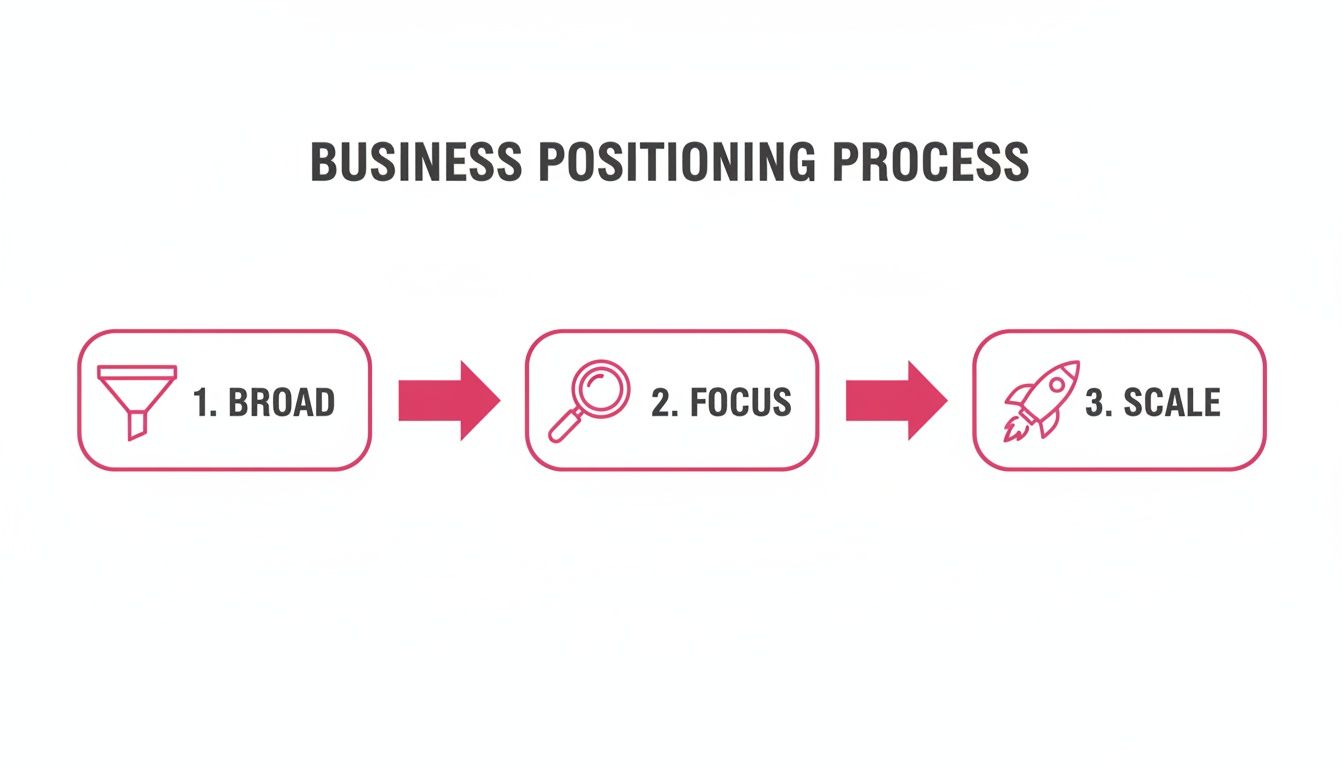
True scale comes from that focused middle step, where you build powerful, repeatable systems.
This is usually where a sprint approach creates clarity quickly. Instead of chasing a dozen ideas, you focus on designing one small, efficient go-to-market system with three parts:
A way to capture interest: A single piece of high-value content that addresses your ideal customer's biggest problem.
A way to nurture trust: A simple, automated follow-up that educates prospects and builds credibility.
A clear handover to sales: A defined trigger that signals when a lead is ready for a conversation.
This transition from ad-hoc tactics to a structured system is how you scale without burning out your team.
Characteristic | Ad-Hoc Campaigns ('Stuck' Phase) | Scalable Systems (Growth Phase) |
|---|---|---|
Focus | Short-term spikes in activity. | Long-term, predictable pipeline growth. |
Effort | High effort for each campaign. | High upfront effort, then low maintenance. |
Mindset | "What are we doing for marketing this month?" | "How does this activity build our asset base?" |
Measurement | Vanity metrics (e.g., likes, attendees). | Business metrics (e.g., qualified leads, pipeline). |
Predictability | Unpredictable, lumpy lead flow. | Consistent, forecastable results. |
Longevity | Impact dies when the campaign ends. | The asset generates value for months or years. |
Moving from the left column to the right is the secret to getting off the marketing hamster wheel.
Founder Moment: A System in Action
I saw this problem with an AgTech company. Their marketing was a collection of well-intentioned but disconnected activities—a field day here, a print ad there. They were always busy, but nothing was predictable.
Instead of launching more campaigns, we built one system. Their customers were farmers, and their expertise was in soil health data. We helped them build their first asset: a 45-minute webinar called "The 5 Soil Data Metrics That Directly Impact Your Yield."
The goal wasn't just to run a webinar. It was to build a lead-generation machine that could work for them 24/7, turning their expertise into an asset that consistently attracts the right people.
Here’s how the system worked:
Capture: We ran small, targeted ads to a landing page where farmers could watch the on-demand webinar.
Nurture: Afterwards, they received a sequence of three simple emails over ten days. Each email shared another practical tip, building trust.
Handover: The final email asked, "Would you like a free analysis of your farm's soil data?" Anyone who clicked was flagged as a warm lead for sales.
This single system became their lead generation engine for the quarter. It brought predictability to their pipeline and took the guesswork out of growth. Crafting a process like this is a core part of a strong go-to-market plan; you can get more guidance on fixing your go-to-market strategy.
This is what scaling with clarity looks like. You build a few simple, powerful systems that deliver results reliably.
How to Get Your Team Pulling in the Same Direction
Growth doesn't just stall because of a bad strategy; it often grinds to a halt when your sales and marketing teams operate in different worlds.
You’ve seen it. Marketing generates leads, sends them to sales, and later hears they were all junk. Meanwhile, sales feels like they’re chasing shadows, convinced marketing has no clue what a good lead looks like.
This friction feels like a people problem, but it's a system problem. The finger-pointing is a symptom of a business that lacks a shared definition of success. Without it, your two most critical growth engines are pulling in opposite directions.

From Blame to Collaboration
The fix isn’t complicated. It’s about creating a single source of truth that both teams agree on and use.
When we parachute into a team facing this, we don't start with new software. We start by getting the heads of both departments in a room to build one simple document.
This isn’t about a long service-level agreement (SLA) no one reads. It’s about getting clear on three things:
A Shared Goal: What is the one number both teams are responsible for hitting this quarter? (e.g., number of qualified opportunities).
A Clear Definition: What, specifically, makes a lead "sales-qualified"? Write it down in plain English.
A Simple Handoff: What is the exact process for passing a lead from marketing to sales, and what is the required follow-up time?
This exercise forces a conversation that should have happened months ago. It shifts the dynamic from "your leads are bad" to "how do we hit our shared number together?"
The Power of a Shared Dashboard
Once you have an agreement, you need a simple way to track it. Forget complex reports. You need a shared dashboard with no more than 3-5 metrics that matter to both teams.
A shared dashboard isn’t just for tracking numbers; it's for shaping conversations. It moves the focus from personal opinions to objective data, creating a common ground for problem-solving.
We recently helped an agtech company struggling with this. We built them a dashboard that tracked just three things:
Marketing Qualified Leads (MQLs) generated this week.
Sales Accepted Leads (SALs) from those MQLs.
The MQL-to-SAL Conversion Rate.
That’s it. If the conversion rate dipped, it wasn’t an accusation; it was a conversation starter. Did the lead source change? Was the messaging off? This simple setup gave them the clarity to fix problems together, fast. If you're struggling to define success, you can learn more about setting clear team goals in our guide.
The 20-Minute Weekly Check-In
The final piece is a disciplined, 20-minute check-in every week with key people from both teams.
The agenda is always the same:
Review the shared dashboard (5 mins): What do the numbers say?
Discuss what's working and what's not (10 mins): Any roadblocks?
Agree on one action for next week (5 mins): What’s the most important adjustment we need to make?
One founder we advised added a "Lead Quality Score"—a simple 1-5 rating that sales gave every marketing lead. It instantly transformed their check-in. Instead of arguing, they were analysing patterns, giving marketing real-time feedback to refine their targeting.
It’s this kind of practical structure that creates momentum.
So, What's the First Thing to Fix?
Reading a guide like this can feel overwhelming. We've walked through positioning, systems, and team alignment. It probably feels like you’ve just uncovered a dozen things that need fixing right now.
That's normal. But the point isn't to give you a long to-do list; it's to give you a map so you know exactly what to do next. You don't have to fix everything at once. You just need to fix one thing first.
The single most powerful move you can make is to pause and get brutally honest about your positioning. Everything else flows from this.
Your Next Move
Before you build a new system or try to align your teams, you have to be sure about the foundation you’re building on. Is your positioning truly sharp? Not just a clever tagline, but a clear, shared understanding across the entire company.
This is almost always the hidden crack that makes everything else a struggle. When we embed with a team, this is the first knot we untangle, because a crystal-clear position brings focus and structure to every decision that follows.
The path to scale isn’t about more hustle; it’s about more clarity. Nailing your positioning is the fastest way to get there.
Get your team together and ask these simple questions:
Can everyone on our team describe our ideal customer in one sentence?
Do our sales decks and marketing emails use the exact same language to talk about the problem we solve?
If a new hire asked what makes us different, would they get the same answer from three different people?
If the answer is a hesitant "no" or "sort of," you’ve found your starting point. You don’t need a huge budget to fix this. You just need to create clarity. If this feels messy, that’s normal. You’re not behind. You just need structure.
Start by fixing this one thing before you touch anything else. Get that right, and you’ll find that building systems and aligning your team becomes dramatically simpler.
Common Questions About Scaling a Business
Founders often ask us the same things when they start thinking about growth. Here are some straight answers.
What’s the very first system I should build?
Start with your lead capture and nurture process.
Don't overcomplicate it. Pick one high-value piece of content—a webinar, a guide, a simple tool. Then build a short, automated email sequence that follows up with anyone who accesses it. The goal is to build trust by offering more value, not to sell hard. This simple engine turns interest into conversations and gives you momentum.
How do I know if my positioning is strong enough?
Here’s a simple test. Ask five different people on your team to describe your ideal customer and the problem you solve for them.
If you get five different answers, your positioning isn't tight enough. It’s still open to interpretation, which means your marketing and sales efforts are pulling in different directions.
Strong positioning isn’t clever; it’s consistent. It’s a message your entire organisation can deliver simply and clearly, every single time. A great position should also actively repel bad-fit customers.
If you hear different descriptions, your most important job is to get everyone in a room and agree on a single, shared definition. Without that clarity, scaling just means you’re amplifying confusion.
When is the right time to scale?
The right time to scale isn't when you hit a certain revenue number. It's when your business is stable and predictable, even if it’s on a small scale.
You're ready when you have two things:
Clear product-market fit. You have happy customers who get real value from what you do.
A repeatable sales process. You have a way of winning customers that works more than once. It might be manual, but you understand the steps.
If you know you can bring in new business predictably, you have a solid foundation to build on. Scaling before this point just means you’ll burn through cash and make existing problems bigger.
Can I really scale without a huge budget?
Yes. The idea that you need a massive cash injection to scale is a myth.
Scaling isn't just about throwing money at ads. At its core, it’s about creating operational efficiency.
The key strategies we've talked about—tightening your positioning, building simple systems, and aligning your teams—are all low-cost, high-impact moves. They don't require a huge budget; they require focus.
Sharpening your positioning makes every dollar you already spend more effective.
Building a simple nurture system turns a one-off piece of content into a long-term asset.
Aligning your sales and marketing teams stops expensive leaks in your pipeline.
Smart structure is more powerful than a big budget. It makes every dollar you spend go further, creating confident, sustainable growth.
If this all feels messy, that’s normal. The path to scale isn’t about more hustle; it’s about structure. Sensoriium steps in to provide that clarity, untangling the knots and building the simple systems you need to grow with confidence. If you're ready to stop guessing, let's talk.
Find out how we can help at https://www.sensoriium.com.