
What Are Web Care Plans And Why Your Business Needs One
- Jan 6
- 15 min read
That nagging feeling in the back of your mind. Is the website okay? Did someone update that plugin? What happens if it goes down during our big campaign?
If you’re a founder, that low-grade anxiety is probably familiar. Your website is the heart of your business, but it feels fragile, like it could break at any moment. You’re trying to build something, and the last thing you have time for is a technical meltdown.
This feeling isn’t a sign you’re failing. It’s a sign your business has outgrown the ‘set it and forget it’ phase. The worry comes from a simple, fixable problem: a lack of structure for looking after your most important digital asset.
The Real Cost of Neglect: Why ‘Later’ Becomes ‘Too Late’

Putting off website maintenance isn't a passive decision—it's a gamble. Every day you go without a proper system, you're hoping for the best. The true cost isn't just fixing what breaks; it's the lost momentum and the erosion of trust when things eventually go wrong.
When your website finally gives out, the fallout is swift:
Lost leads: Your sales pipeline slams shut.
Damaged credibility: Potential customers see a broken error page instead of your polished brand.
Wasted ad spend: All the money you're pouring into driving traffic goes straight down the drain.
Emergency costs: You end up paying a premium for a developer to drop everything and fix a crisis that was completely preventable.
Most teams get stuck in this reactive loop. They treat their website like a painting they hung on the wall, not the living, breathing part of the business that it truly is.
Shifting from Chaos to Confidence
This is precisely where web care plans provide clarity. A web care plan isn't just another IT expense; it’s a system that replaces chaos with calm. It’s a structured, forward-thinking approach that handles all the technical grunt work, so your website stays secure, fast, and dependable.
Think of it like this: you wouldn't run a critical piece of factory equipment without a regular servicing schedule. A web care plan is precisely that—proactive, scheduled maintenance for your most important digital asset.
It’s about building a foundation of stability. This frees you up to focus on your growth strategy without constantly worrying that your website is a ticking time bomb. This shift—from reactive panic to proactive confidence—is what turns your site from a source of stress into a reliable engine for your business.
What On Earth Is a Web Care Plan?
So, what exactly is a 'web care plan'? Let's cut through the jargon. Think of it as having a dedicated pit crew for your company's website.
It’s a straightforward, ongoing service that takes care of all the technical nuts and bolts. The goal? To keep your site secure, lightning-fast, and dependably online. This frees you and your team up to focus on growing the business, not stressing about whether your site will crash during a product launch.
It's More Than Just Insurance
A great way to think about it is like servicing a car. You wouldn't buy a brand new vehicle and then just ignore the scheduled tune-ups, right? Waiting for the engine to blow up before you call a mechanic would be chaotic and incredibly expensive.
A web care plan is that proactive service schedule for your website. It’s a system built to catch small glitches before they turn into major meltdowns.
This structured approach stops those frantic, last-minute scrambles that drain your team's energy and kill momentum. It’s the same principle we follow in our own work—when we embed with a team, the first thing we fix is this exact gap causing reactive chaos. You can see more about the common problems we fix for growing businesses.
So, what does this 'servicing' actually look like in practice? It's a blend of proactive maintenance and on-call support, all designed to give you peace of mind. Here’s a quick breakdown of what you should expect.
Core Components Of A Web Care Plan
Component | What It Means For Your Business |
|---|---|
Maintenance | Regular checks and tune-ups to prevent small issues from becoming big problems. |
Security | Active monitoring and hardening to protect against hackers and malware. |
Backups | Consistent, reliable copies of your site, ready to restore if anything goes wrong. |
Performance | Optimisations to ensure your site loads quickly for every visitor. |
Updates | Keeping all software, plugins, and themes current to patch vulnerabilities. |
Support | A direct line to an expert when you need help, have a question, or need a quick fix. |
These components work together to form a safety net, ensuring your website is always an asset, not a liability. For a deeper dive, you can explore the essentials of comprehensive web maintenance and support.
A Practical Example: Launch Day Drama
Let’s make this real. Imagine your SaaS company is about to launch a major new feature. Your marketing team has a huge campaign ready to go live. Then, on launch day, a security vulnerability is announced for a critical plugin on your website.
Without a web care plan, you probably wouldn't even know about the threat until it’s too late. Your site could be hacked, forced offline, or start glitching right as thousands of potential customers are trying to sign up. What follows is a high-stress, frantic search for a developer who can drop everything to fix a mess that was completely avoidable.
Now, let’s replay that with a proper web care plan. Your provider's team is already on it. They were monitoring for that vulnerability, tested the security patch on a staging site, and then rolled it out to your live website—likely while you were sleeping.
You and your team simply get a notification that the issue was handled. The launch goes off without a hitch. No panic. No emergencies. No lost sales. Just quiet, consistent competence keeping things on track. That’s the difference between operating in chaos and operating with a solid structure. It’s the confidence you get from knowing your foundation is strong.
The Three Pillars Of A Strong Web Care Plan
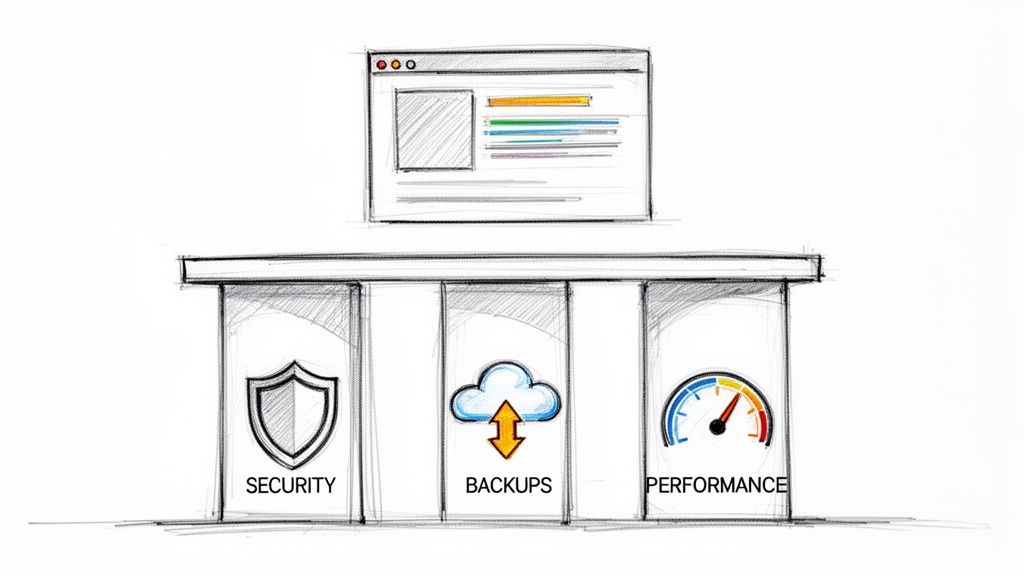
A good web care plan isn’t just a random list of technical jobs. It’s a structured system built on three absolute must-haves. For a scaling tech business, nailing these fundamentals means you can finally stop worrying about your website and focus on actual growth.
These pillars work together, creating a stable and reliable foundation for your online presence. Get them right, and you gain the confidence to roll out your marketing and sales plans without that nagging fear of a technical meltdown.
Let’s break down exactly what they are and why they matter so much.
Pillar 1: Security Monitoring
Think of security monitoring as your website’s 24/7 digital watchdog. It’s a mix of smart software and expert human oversight, constantly scanning for suspicious activity, potential threats, and known weak spots. This isn’t a one-and-done task; it’s a continuous process of defence.
As your business grows, your website becomes a bigger target for automated attacks hunting for outdated plugins or weak passwords. Without active monitoring, you’re basically leaving the digital front door unlocked. A solid security pillar hardens your site, blocks malicious traffic, and pings an expert the second something looks off. This is what stops a minor vulnerability from snowballing into a major data breach.
Founder Moment: Imagine your team just landed a huge feature in a national publication. Traffic is surging, and leads are pouring in. But overnight, your site gets hit with malware that redirects all that hard-earned traffic to a sketchy-looking website. Your reputation takes an instant hit, and all that momentum vanishes.
This isn’t just a scare tactic; it’s a real structural risk. When we embed with a team, these foundational gaps are one of the first things we look for. A proper web care plan closes this gap by having someone watch the walls, so you don’t have to. You can see more on how we tackle this by building a solid marketing base with the Foundations Fix.
Pillar 2: Regular Backups
If security is your watchdog, then regular backups are your iron-clad insurance policy. A backup is simply a complete copy of your entire website—all the files, the database, everything—stored safely in a totally separate location. It’s your get-out-of-jail-free card when the worst happens.
And things do go wrong. A software update might break your site, a simple human error could delete a critical page, or a security breach might corrupt your files. Without a recent backup, you could be looking at a full rebuild from scratch, a process that can take weeks and cost a fortune.
A strong backup strategy is more than just having a backup; it’s about having frequent, reliable, and easily restorable copies. A good web care plan automates this, often taking daily backups and storing multiple versions off-site. This means if your site goes down at 3 PM, you can restore it to how it was that very morning, not three weeks ago. This kind of robust data management is why proactive solutions like reliable managed backup services are so crucial for ensuring integrity and quick recovery.
Founder Moment: Your marketing assistant is cleaning up old blog posts and accidentally deletes a vital product page filled with hundreds of customer testimonials. You don't realise until a day later when a customer points out the broken link. Without a recent, accessible backup, you’re stuck rebuilding the page and trying to piece together that priceless social proof from memory.
With a proper backup system, this is just a minor hiccup, not a disaster. Your web care provider can simply restore the page from yesterday’s backup in a matter of minutes. Problem solved.
Pillar 3: Performance Optimisation
This third pillar is all about one thing: speed. Performance optimisation is the ongoing process of making your website load as fast as humanly possible for every single visitor, no matter what device they’re on. This covers everything from compressing images and tidying up code to fine-tuning your server settings.
In a world of shrinking attention spans, speed is non-negotiable. Slow websites don’t just frustrate people—they actively drive them away. Even a one-second delay in page load time can cause a huge drop in conversions. On top of that, Google uses site speed as a key ranking factor, which means a sluggish site will always struggle to get seen in search results.
A web care plan makes performance a constant priority. It involves regular speed audits to identify bottlenecks and roll out fixes that keep your site running like a well-oiled machine. This ensures you’re not only delivering a fantastic user experience but also keeping the search engines happy.
Founder Moment: You’ve invested thousands in a paid ad campaign for your new SaaS demo. The ads are getting plenty of clicks, but your sign-up rate is mysteriously low. After some digging, you find out your landing page is taking more than six seconds to load on mobile, and over 50% of your potential leads are bailing before the page even finishes loading.
A proactive performance plan would have caught this ages ago. It’s all about making sure the technical foundation of your site is strong enough to support your marketing goals. When all three pillars—Security, Backups, and Performance—are firmly in place, your website stops being a source of anxiety and becomes a reliable, powerful asset for your business.
How to Choose the Right Web Care Partner
Picking a web care partner can feel like just another complicated decision you don't have time for. Most founders get stuck comparing feature lists and pricing tables, but the real difference between a great partner and a bad one is rarely found there. It’s about structure, communication, and ultimately, your peace of mind.
The right partner doesn’t just fix things when they break; they bring clarity. They lift the mental load of constantly wondering if your most important digital asset is safe, secure, and ready for your next big push. Getting this decision right means finding someone who can bring genuine discipline to the technical side of your business.
Look Beyond The Checklist
Just about every provider will promise updates, security scans, and backups. Those are table stakes. But for a scaling tech business, you need to dig deeper and understand how they work, not just what they do. The wrong partner ends up creating more work for you—more emails, more chasing, more confusion. The right one makes your life simpler.
Here are the critical questions you should be asking to get a true feel for their approach:
Communication: How do we actually talk day-to-day? Is there a dedicated Slack channel for quick questions, or is every request funnelled into a slow email ticketing system?
Process: Can you walk me through your exact process for handling a critical security patch? What happens from the moment it's announced to the second it's fixed on my site?
Proactivity: How do you get ahead of problems? Do you perform regular performance audits, or do you just wait for me to report that the site is slow?
Support: What does support look like on a weekend or a public holiday if my site goes down? What are your guaranteed response times?
These questions are designed to reveal their structure and reliability. A good partner will have clear, confident answers because they've built solid systems to handle these situations. This is a core part of our philosophy; you can learn more about how our sprint-based approach creates clarity and momentum.
Good Answers vs. Vague Promises
The quality of their answers tells you everything. You’re looking for someone who has genuinely thought through their processes, not someone who's making it up on the spot.
Let's use a practical example. You ask: "What's your process for handling a critical security patch?"
A vague answer might sound like this:"Oh, we monitor for those things and our team gets them updated as soon as possible. We’re really on top of security."This response is all fluff and no substance. It gives you zero confidence because there's no clear process. It’s a huge red flag for a reactive, unstructured approach that will likely leave you chasing them for updates when something actually goes wrong.
Now, compare that to a structured, confident response.
A good answer sounds like this:"Great question. We get an immediate alert from our security feeds. The patch is first applied and tested on a staging copy of your site to ensure it doesn't break anything. Once confirmed, we schedule the update for your live site during a low-traffic period, usually overnight. We then run a full scan to confirm the fix, and you receive a short email summary in the morning letting you know it's all been handled."
See the difference? The second answer gives you a clear, step-by-step process. It demonstrates foresight, risk management, and proactive communication. It shows there’s a system in place, not just good intentions.
As Australia's Digital Care Management market grows, with projections showing user penetration climbing to 18.38% by 2030, the need for this level of professional reliability is becoming non-negotiable for tech companies. A stable, secure website is essential for capturing this opportunity. You can read more about these market insights on Statista.com.
Choosing the right partner is really about finding the team that can give you this kind of calm, structured confidence so you can get back to what you do best: building your business.
Understanding The Cost Of A Web Care Plan
Let’s talk about the money. Seeing another recurring fee can make any founder hesitate. It’s easy to look at the monthly cost of a web care plan and see it as just another expense on an already long list. You’re trying to budget strategically, and the value isn't always immediately obvious.
This feeling is completely normal. You’re not just trying to cut costs; you’re trying to make smart investments. The key is to shift your mindset: stop thinking of a web care plan as an operational expense and start seeing it for what it truly is—a fixed investment in stability and risk mitigation.
The Real Cost Is Unpredictability
The true financial danger isn’t the predictable monthly fee of a web care plan. It’s the unpredictable, chaotic, and often catastrophic cost of an emergency. When your website goes down, the meter starts running, and it runs fast.
A single emergency fix for a hacked or broken website can easily run into thousands of dollars. And that’s just the direct cost of getting a developer to drop everything and clean up the mess. It doesn’t even touch on the secondary costs that really hurt a growing business:
Lost Revenue: Every hour your site is down, your sales grind to a halt.
Wasted Ad Spend: The money you’re paying to send traffic to a broken site is completely wasted.
Damaged Trust: Customers who land on an error page lose confidence, and they may never come back.
Team Disruption: Your own team gets pulled away from their actual work to manage the crisis.
This is the chaos most teams get stuck in because they haven't put a structure in place to prevent it. A web care plan replaces that huge, unknown financial risk with a modest, predictable monthly cost.
Common Pricing Models In Australia
So, what should you expect to pay? Pricing for web care plans in Australia typically falls into a few common models, each designed for different business needs.
Basic Maintenance Plans (approx. $150 - $400/month): These plans cover the absolute essentials. Think core software updates, daily backups, and security monitoring. They’re a good starting point for smaller sites that don’t need a lot of hands-on support.
Standard Care Plans (approx. $400 - $800/month): This is the sweet spot for most growing businesses. On top of the basics, these plans often include performance optimisation and a set amount of monthly support time for small content updates or minor tweaks.
Comprehensive Retainers (approx. $800+/month): For larger, more complex websites or e-commerce stores, these plans offer a much higher level of support. They might include advanced security features, priority support with faster response times, and more dedicated hours for development tasks.
The goal isn’t to find the cheapest option. It’s to find the plan that gives your business the right level of structure and confidence, allowing you to plan your budget without fearing a sudden, massive bill.
This flowchart breaks down the hierarchy of what to look for when choosing a web care partner.
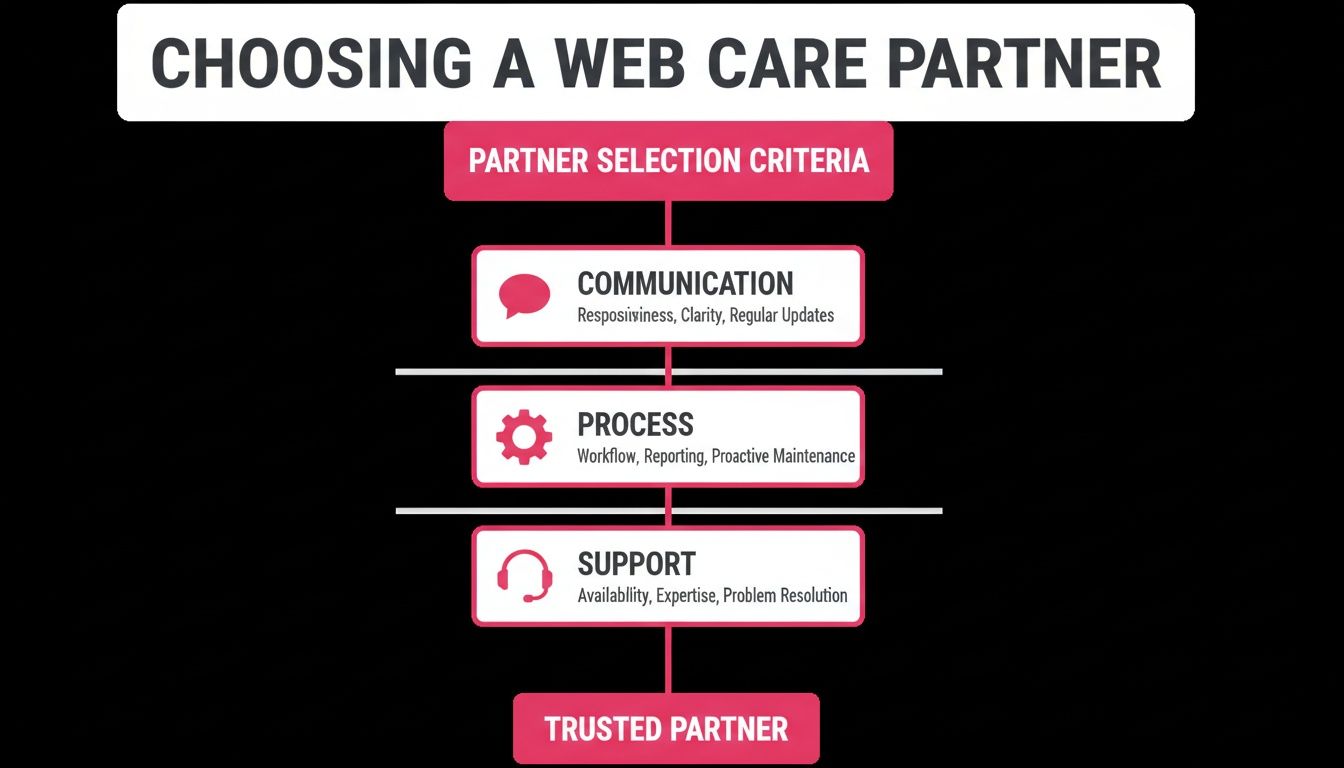
As you can see, clear communication, a documented process, and reliable support are the foundations of a valuable partnership. These things matter far more than the price tag alone.
The importance of this digital reliability is only growing. In the Australian healthcare landscape, for instance, virtual care services surged from 11.9% in 2018–19 to 23.5% in 2023–24. For tech and agtech firms, this digital shift means their website is no longer just a brochure but a core service delivery channel. A robust web care plan ensures this critical infrastructure remains reliable, allowing businesses to confidently serve this growing market. You can find out more about the rise of virtual care in Australia.
Ultimately, the right web care plan moves your website from the 'liability' column to the 'asset' column on your mental balance sheet. It’s a deliberate choice to invest in calm, clarity, and momentum.
Your Calm Next Step To A More Reliable Website
If you're feeling a little overwhelmed by the nitty-gritty of web care plans, don't worry. That's a completely normal reaction. You're trying to scale a business, not become a cybersecurity expert overnight. The idea here isn't to pile another complicated task onto your plate; it's to replace that nagging background anxiety with a single, clear action.
The way forward starts with clarity, not chaos. Before you even think about looking for a provider or comparing pricing tables, you need to know where you stand right now.
Do A Simple Health Check
Your first move is a quick audit of your own website. This isn't about creating more work. It’s about getting a clear picture of your current situation so you can make a confident decision down the track.
Start by asking two straightforward questions:
When was our last full website backup? Can you pinpoint the exact date and time? And is that backup stored somewhere safe, completely separate from your main web server?
When was our core software last updated? This means your content management system (like WordPress) and any essential plugins. Can you find this information easily?
Just getting clear answers to these two questions is the first step toward creating structure. It gives you a baseline.
What Your Answer Tells You
If you can track down this info in under five minutes, you’re in a better spot than most. But if this simple task feels messy, or if you don’t even know where to begin looking, that’s okay. It’s not a failure; it’s a clear signal that you have a gap in your process that needs plugging.
This is a common blind spot for growing companies. Most teams get stuck because they've never had someone step in to formalise the work, turning vague worries into a clear, managed process.
The point isn't to fix everything yourself. The point is to gain clarity on your risks. Knowing where you stand is what allows you to build momentum, one calm step at a time.
This need for structure isn't just a website thing. A national study found that only 33% of Australians have engaged in advance care planning, and a tiny 12% have involved a healthcare professional. This highlights a huge gap where structured digital tools can provide clarity and confidence. For tech companies serving these needs, a website that is consistently online, secure, and trustworthy is absolutely essential for building that user trust. You can discover more insights from the study on advance care planning prevalence.
Your website is the foundation for that trust. If this initial health check feels confusing, that’s your sign. You're not behind; you just need a plan.
A Few Common Questions About Web Care Plans
It’s completely normal to have a few questions, even after getting the rundown. You're trying to make a smart decision for your business without getting lost in the technical weeds. Let's tackle some of the most common things we hear from founders.
Can’t My Original Web Developer Just Handle This?
It's a fair question. The developer who built your site did a fantastic job, but their skills are usually geared towards project-based work—building something from the ground up.
Ongoing web care is a different beast entirely. It’s all about proactive, preventative maintenance, which requires different systems, processes, and a completely different mindset. A dedicated provider is built for constant monitoring and quick responses. Most developers simply aren't set up for that; their real value lies in creating, not maintaining.
What's The Difference Between Web Hosting And A Web Care Plan?
This is probably the most common point of confusion, and it’s an important one to get right. Let's use a simple analogy.
Web hosting is like the plot of land your house is built on. It gives you the space and the connection to the grid. A web care plan is the team of tradies and specialists who keep the house itself in top shape—they check the locks, fix leaky pipes, repaint the walls, and make sure everything is secure.
You absolutely need both, but they serve two distinct purposes. Your host provides the server space, while your care plan provider looks after the actual website living on that server.
How Much Support Time Is Usually Included?
This can vary wildly from one provider to another, so you really need to read the fine print. A basic, entry-level plan might just cover the essential maintenance and security scans, with any extra support requests billed by the hour.
More premium web care plans often bundle in a set amount of time each month for small tasks—things like updating text, swapping out an image, or making minor design tweaks. It’s vital to get clarity on this from the get-go to make sure the plan fits your day-to-day needs and you don't get hit with unexpected invoices.
If you're tired of the guesswork and need structure that goes beyond just website maintenance, Sensoriium can help. We step in to give your business the clarity, direction, and momentum it needs to grow with confidence. Find out how we can fix what's not working at https://www.sensoriium.com.