
Why Content Writing and SEO Feels So Messy
- Feb 15
- 13 min read
It’s a common feeling. You’ve been told you need both content and SEO, so you spend time and money writing blog posts. But when you check the numbers, there’s nothing. Traffic is flat, no new leads are coming in, and it honestly feels like you’re shouting into an empty room.
If this sounds familiar, you’re not crazy. It makes sense that you feel stuck. It’s usually the result of a disconnect between what you’re writing and how people actually find things online.
Most advice treats content writing and SEO as two separate jobs. So you hire a great writer for the articles and an SEO expert for the technical bits. This almost always leads to one of two outcomes:
Beautifully written articles that are completely invisible to search engines.
Perfectly optimised pages that sound robotic and are a chore for any human to read.
This guide is built to fix that gap. We’ll connect the dots and give you a clear, structured way to think about content writing and SEO, so your hard work finally starts building real momentum.
The Real Reason Your Content and SEO Are Disconnected
That feeling of writing into a void isn't your fault. It’s what happens when content writing and SEO are treated like two completely different jobs, often done by different people at different times. It’s a structural problem, not a creative one.
Think of it this way: content writing is the art of creating something valuable and making a genuine connection with the person on the other side of the screen. SEO is the technical framework that lets search engines find and understand that story.
When these two jobs are separate, you end up with frustrating results. It’s the chasm between what you’re writing and what your ideal customers are actually looking for.
Why This Split Happens in Most Teams
This disconnect isn’t a sign of a lack of talent. It’s usually because no single person is responsible for structuring the work from start to finish. Without someone to bridge that gap, the whole process fragments.
A writer gets a brief like, "write a blog post about our new software feature." Meanwhile, an SEO person gets a separate goal: "rank for 'cloud management solution'."
The writer crafts an insightful article, but it doesn’t quite line up with the words people use when they’re trying to solve a problem. The SEO expert then comes in later and tries to shoehorn keywords into the text, making the language clunky. The original clarity is gone.
This is usually where a sprint approach creates clarity quickly. By creating a unified strategy from the beginning, we ensure every piece of content is designed with search intent from the very first draft, not as an afterthought.
This broken approach is incredibly common. It’s a system almost designed for inefficiency, creating confusion and weak results. For many businesses, it’s just one of the many symptoms of disconnected systems in marketing that hold back growth.
The Real Cost of a Divided Strategy
The true cost here isn't just wasted time or money. It's the missed opportunity to build a powerful, long-term asset for your business. A properly integrated content writing and SEO strategy creates a library of resources that consistently pulls the right people towards your business. It builds authority and trust long before a potential customer is even thinking about buying.
And the stakes are only getting higher. As Australia’s digital economy grows, so does the investment in organic search. Businesses are projected to spend $1.5 billion on SEO services in 2025—a 12% increase from the year before. It's clear that sustainable growth from search is a major focus.
For the small and medium businesses that make up 97% of our economy, organic search already drives a massive 53% of all website traffic, making it an absolutely critical channel for growth. You can find more insights on SEO trends for Australian businesses on netstripes.com.
Without a unified approach, you're not just failing to compete; you're actively working against yourself. The way forward isn't about doing more work. It’s about introducing structure where there is chaos, creating a clear process that aligns your writer’s creativity with your SEO’s technical insight. This provides the direction needed to turn your content from an expense into a reliable engine for growth.
The Small Shift That Changes Everything
If your content feels like it's not hitting the mark, the solution isn't another complicated tool or a bigger budget. The most powerful change you can make is a subtle shift in your thinking: move from being a ‘publisher’ to becoming a ‘problem-solver’.
Most marketing teams work like publishers. The week starts and the first question is, “What blog post are we publishing this week?” This leads to a content calendar packed with topics that are interesting to the business but disconnected from what a customer actually needs.
It's the difference between writing an article about your product's shiny new features, versus writing one that answers the urgent question your ideal customer is typing into Google at 10 PM.
Start with the Problem, Not the Topic
The shift is simple: stop asking, “What should we write about?” and start asking, “What problem is our customer trying to solve right now?”
This simple reframe anchors your entire content writing and SEO strategy to customer intent. When you solve a genuine problem, you instantly build trust and relevance. Your content stops feeling like marketing and starts feeling like genuine help.
A huge part of this is making sure your content is genuinely useful and original. For any writer, it’s worth getting familiar with the principles in this E-E-A-T Manifesto for Content Creators, which is all about demonstrating real experience and authority. This is how you move from just publishing stuff to creating truly valuable resources.
Founder Moment: A Practical Example
Picture the founder of an agtech SaaS platform that sells advanced soil sensor technology.
Working with a publisher mindset, their content plan probably looks something like this:
"The Top 5 Features of Our New Sensor"
"Our Company's Journey in Agtech Innovation"
"Why Soil Data Is the Future of Farming"
These topics are all about the company. They're announcements, not answers.
Now, let's flip to the problem-solver mindset. The team does a little research and uncovers what their ideal customers—busy farm managers—are actually searching for. They find phrases like:
"how to reduce crop irrigation costs"
"best way to improve fertiliser efficiency"
"early detection of crop stress"
These aren't product names; they're urgent, real-world problems that need solving. This is where everything clicks into place. Instead of chasing vague ideas, you’re building content that meets a clear and present need.
Shifting From Publisher to Problem-Solver
This small shift changes absolutely everything because it aligns your work with the natural journey of your customer. You stop interrupting them with marketing and start becoming the exact answer they were looking for all along. This is the foundation of creating content that doesn't just rank, but creates genuine momentum for your business.
Aspect | Publisher Mindset (Common Mistake) | Problem-Solver Mindset (Effective Approach) |
|---|---|---|
Starting Question | "What can we publish this week?" | "What problem can we solve for our customer?" |
Content Focus | Features, company news, broad industry trends. | Customer questions, pain points, specific challenges. |
Goal | To fill the content calendar and stay "active". | To become a trusted resource and build authority. |
SEO Approach | Keywords are added to content after it's written. | Content is built around the language of the customer's problem. |
Result | Low-engagement articles that feel like advertising. | High-value content that attracts qualified traffic and builds trust. |
This is the foundation of creating content that doesn't just rank, but creates genuine momentum for your business.
A Practical Example of Building Content That Works
Theory is great, but let's make this real. Seeing how strategy works in practice is where the lightbulb moments happen.
Imagine a B2B tech company in Sydney that helps businesses manage their compliance. For months, they’ve been firing off random blog posts—one about a new feature, another celebrating a company award. The result? Flat traffic and a growing sense that nobody is listening.
They finally decide to switch gears, moving from a ‘publisher’ to a ‘problem-solver’. This is the point where a little structure brings a whole lot of focus.
Step 1: Identify the Core Problem
Instead of guessing what to write, they start by listening. They chat with their sales team and sift through customer support tickets. A clear pattern jumps out. Their ideal customers—operations managers—are all wrestling with one major headache: "staying updated on workplace safety regulations in Australia."
This isn't just a vague topic. It's a specific, urgent problem with real-world consequences. Just like that, they’ve found their anchor.
Step 2: Build a Pillar Page, Not Just a Blog Post
With a clear problem to solve, they resist the old habit of writing a quick blog post. Instead, they commit to building a comprehensive ‘pillar page’—a single, authoritative guide designed to be the best resource on that topic.
This page isn't a sales pitch. It’s a genuinely useful resource that explores the topic from every angle. It immediately signals to both customers and search engines that this company knows what they're talking about.
This simple diagram shows how the structure works, starting with a central problem that blossoms into a core piece of content supported by more specific sub-topics.
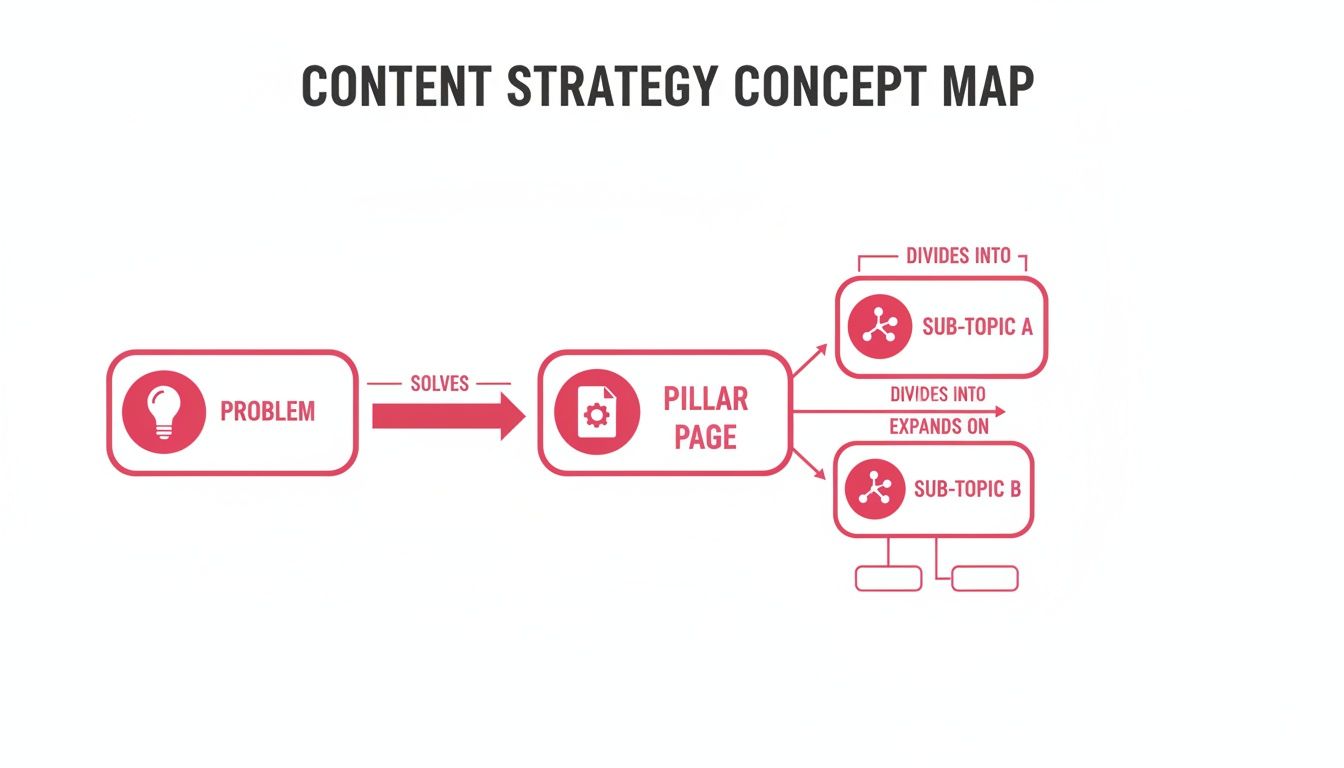
This strategic thinking ensures every piece of content has a job to do and connects back to solving that one, crucial customer problem.
Step 3: Map Out the Sub-Topics
Creating a massive guide can feel daunting, so they break it down. The team brainstorms all the smaller, related questions that fall under their main topic.
Their list of sub-topics looks something like this:
A simple checklist for risk assessments.
How to conduct effective toolbox talks.
Key changes to Safe Work Australia guidelines this year.
Common compliance mistakes small businesses make.
Templates for incident reporting.
Each of these is a piece of the puzzle, designed to answer specific searches like "workplace risk assessment checklist template". This is where smart content writing and SEO really click—the content’s structure is guided by how real people actually search for information.
Step 4: Write with Clarity and Optimise Naturally
Now, the writing starts. The focus is on plain, direct language. No jargon, no fluff—just clear, helpful answers. SEO isn't bolted on at the end; it’s woven into the fabric of the content from the beginning.
Their main keyword, "workplace safety regulations," appears naturally in the title and key headings. The long-tail keywords they found earlier become the subheadings (H3s) for each section. This creates a logical flow for the reader and sends all the right signals to Google.
This human-first approach is more critical than ever. AI has certainly changed the game, with an estimated 12.7 million Aussies using AI tools by 2025. But Google’s recent updates are pushing back hard against low-quality, AI-generated content, causing 40% of AI-heavy sites to see their rankings tank. The sweet spot is blending human insight with AI's efficiency to create something genuinely helpful. For a deeper dive, you can check out the latest Australian SEO statistics on sixgun.com.au.
The outcome is a powerful asset. It's a single page that attracts a consistent stream of high-quality traffic from people actively searching for solutions. It positions the company as the go-to expert, building trust long before a sales conversation ever happens.
This isn’t about just creating more content. It’s about creating the right content, built on a clear structure that gives you the confidence you’re building something that will deliver results for years to come.
Four Technical Layers That Give Your Content a Fighting Chance
So, you’ve done the hard work. You’ve shifted from publisher to problem-solver and written something genuinely helpful. And yet... nothing. The content isn't getting the attention it deserves.
This is where many founders get stuck. It can feel like there’s some secret, technical language you’re meant to speak.
The good news? You don’t need to become a technical wizard. You just need a basic handle on four simple layers that give your content the best possible chance of being found. Think of them as the foundations of a house. If they're shaky, it doesn't matter how beautiful the house is – it’s not going to stand strong.
Layer 1: On-Page SEO Basics
This is the most straightforward layer. On-page SEO is really just about structuring your content so that it’s dead simple for both people and search engines to understand. It’s all about clarity and signposting.
Forget complex theories and just nail these three things:
Your Title Tag: The headline in Google's search results. It needs to clearly say what the page is about and include the main problem you're solving.
Your Headings (H1, H2, H3): Use these to create a logical flow. Your main title is your H1. Sub-topics get H2s, and smaller points within those are H3s. This makes the text scannable.
Internal Links: Link to other relevant articles on your own website. This shows Google how your content fits together and helps keep readers on your site for longer.
That’s it. Getting these basics right provides the simple, clean structure that most businesses are missing. When we embed with a team, the first thing we fix is this exact gap.
Layer 2: A Clean User Experience
How your content feels to read is just as important as what it says. If someone lands on your page and sees a giant wall of text, they're going to click away. Google sees this and thinks, "Maybe this page isn't so helpful."
The biggest shift is to write for a mobile-first world. Most people will be reading on their phone.
What looks like a normal paragraph on a desktop can feel like an endless scroll on a mobile screen. Your job is to make the experience feel light, clear, and digestible.
This means using short paragraphs – one to three sentences, max. Break up ideas with bullet points and lists. You aren’t dumbing down your content; you’re respecting your reader’s time.
Layer 3: Structured Data
Okay, this one sounds more complicated than it is. Structured data is basically a snippet of code you add to your website that acts like a set of labels for Google. It helps the search engine understand your content on a deeper level.
For instance, you can use it to tell Google:
"This page is a recipe, and the cooking time is 45 minutes."
"This is an article, and the author is Jane Smith."
"This is a product, and its price is $99."
While you might need a developer to help, just knowing it exists is half the battle. It's one of those small technical details that can give your content an edge, helping it show up in more interesting ways in search results.
Layer 4: Mobile and Voice Search
How we look for information is changing. We're not just typing questions into a browser anymore. We're asking our phones for directions and our smart speakers for answers.
This ties right back to user experience and writing in a clear, conversational tone. People don't speak to their voice assistants in clunky sentences. They ask natural questions.
By 2025, the impact of mobile and voice search in Australia will be impossible to ignore. Already, 65% of Aussies use voice search weekly, and mobile page speed is everything – a load time of over three seconds can increase your bounce rate by a massive 90%.
To get this right, focus on writing that answers questions directly. A simple Q&A format often works brilliantly. When you make your content easy for a person to understand, you also make it easy for a voice assistant to read aloud.
These four layers aren't about adding more work. They're about making sure the work you've already done gets the chance it deserves.
Your Calm and Confident Next Step
If you’ve made it this far and your head is spinning a little, take a breath. That’s a completely normal reaction. If this feels messy, that’s normal. You’re not behind. You need structure.
The goal isn't to tackle everything at once. The real aim here is to build a little bit of momentum.
Your first step should be simple and focused.
Do This One Thing First
For the next 30 days, forget about publishing anything new. Put a pause on the content machine. Instead, pick your single most important service or product page. This is the page that, if it pulled more weight, would make the biggest difference.
Got it? Okay, now review that one page through the 'problem-solver' lens.
Ask yourself one simple question: "Does this page answer the real-world problems our best customers have, or is it just talking about us?"
Be honest. Is it crammed with jargon and a list of features, or does it speak directly to a customer's pain point in a way that feels genuinely helpful?
Your only task is to rewrite that single page. Your mission is to make it the most useful, insightful resource you possibly can for a customer trying to solve that specific problem. Pour all your energy into making that one page exceptional.
This small, focused action does more than just improve a page. It gives you a sense of clarity and control. It’s the first practical step in building a content writing and SEO engine that actually creates value.
This is how you move forward with confidence. It starts right here, with one page and one problem.
A Few Common Questions
Even with a solid plan, it’s natural to have questions. Clearing up a few common sticking points can give you the confidence to move forward.
How Long Does This Stuff Actually Take to Work?
This is usually the first thing people ask. Unlike paid ads, which give you an instant (but temporary) result, content and SEO are about building a long-term asset.
Generally, you can expect to see the first signs of life within 3 to 6 months – like seeing your pages start to rank for a few specific keywords. But for the kind of results that really move the needle, you’re typically looking at 6 to 12 months of consistent work.
The key is momentum. It’s about methodically building a library of genuinely useful content that cements your authority over time. This is why a structured, sprint-based approach is so effective—it stops you from the common cycle of starting and stopping, which kills results.
Should I Hire a Content Writer or an SEO Specialist First?
This question gets to the core of the problem. Thinking of it as an either/or choice is a trap.
Think about it: a brilliant writer who knows nothing about SEO will create beautiful prose that no one will find. An SEO technician who isn't a great communicator will produce optimised pages that fail to connect with a person. You end up with content that's either invisible or unreadable.
Most teams struggle here because they’ve never had someone step in to structure the work. The only way to win is to find a partner or build a system where these two skills are woven together from the very beginning.
What's the Biggest Mistake I Should Avoid?
Easy. The single biggest mistake is writing for keywords instead of for people. So many businesses get fixated on ranking for a specific term that they churn out sterile, unhelpful content that sounds like it was written for a machine.
Google’s algorithms are now incredibly sophisticated. They're built to reward content that genuinely helps someone solve a problem.
Always start with the human problem.
Before a single word is written, ask these simple questions:
What does my customer really need to figure out?
What question are they actually trying to answer?
How can I give them that answer with the most clarity?
When you make solving the reader’s problem your main goal, the SEO elements fall into place in a much more authentic and effective way. It's a small mental shift, but it changes absolutely everything.
If you're tired of the guesswork and ready to build a marketing function that delivers clarity and momentum, Sensoriium can help. We provide the senior leadership and hands-on support to cut through the complexity and give your business a clear path forward.
Find out how we work at https://www.sensoriium.com.