
Your B2B Tech Marketing Feels Disconnected. Here’s How to Fix It.
- Dec 24, 2025
- 11 min read
It’s a familiar feeling for founders. Your team is busy. They’re creating content, running ads, and sending emails, but it all feels… scattered. The bold vision on your website seems worlds away from the technical details in your sales deck. Your latest webinar has a totally different vibe from your LinkedIn posts.
If you’re nodding along, you’re not crazy. It makes sense that you feel stuck.
This isn’t just inefficient; it’s confusing for your customers. When every touchpoint sends a slightly different signal, it creates a jarring experience that kills momentum. This is the classic symptom of marketing without a central, guiding plan, a collection of separate activities instead of a single, coherent story. This sense of fragmentation is a huge sign that your internal systems and messaging are out of alignment, a challenge we explore in our guide to fixing disconnected systems.
Why Your Marketing Feels Chaotic
Let's be clear: this chaos is rarely anyone's fault. It’s the natural result of a growing team moving fast without a shared map. You have talented people working hard, but without an agreed-upon structure, things get messy.
Sales vs. Marketing: Your sales team is in the trenches, focused on practical, feature-driven conversations, while marketing is painting the big-picture vision.
Channel Silos: The person running social media has entirely different goals than the person writing your technical blogs.
No Core Message: Without a single source of truth for your positioning, everyone invents their own version of the company’s story.

The Path to Clarity and Structure
Creating an integrated marketing communications plan isn’t about writing a rigid, 50-page document that gathers dust. It’s about making sure the hard work you're already doing actually connects. It provides the simple, unifying structure needed to bring order to the chaos.
An IMC plan ensures every tweet, blog post, and sales call tells the same clear, confident story. It’s about building momentum through consistency, not just activity.
When we embed with a team, this is often the very first gap we fix. Putting a unified plan in place immediately reduces wasted effort. More importantly, it gives everyone from marketing and sales to the leadership team the confidence that they are all on the same page, telling the same story, and driving towards the same destination.
Find Your Starting Point: A Simple Audit
Before you build a cohesive plan, you need an honest look at where you stand. This isn't about getting lost in spreadsheets. It's a quick, focused check-in to see your marketing through a customer's eyes and spot the gaps that create confusion.
A lot of teams struggle here. They’ve never had someone step in to structure the work, so it feels big and messy, and it often gets skipped. But without this clarity, you're just building on shaky foundations.

What Are You Actually Saying Out There?
Let’s try a simple exercise. Don't overthink it. Just pull up a few of your key assets side by side and see how they feel together. Your goal isn't to judge, just to observe. What's the main message in each place? Who are you talking to? What problem are you promising to solve?
Here’s a practical list to look at:
Your website homepage: Read the headline and the first few paragraphs. What's the considerable promise?
Your last three marketing emails: What was the core call to action? What story were they telling?
Your company's LinkedIn profile: Check the "About" section and the last five posts. What's the tone like?
A recent sales deck: How does the sales team describe the solution when talking to a prospect?
By simply comparing these, you’ll start to see where the story breaks. This is the exact process we use in our Foundations Audit because it gives a rapid, unfiltered view of what your customers actually experience.
Founder Moment: An agtech founder we worked with did this and had a huge realisation. His website was all about "sustainable farming innovation," but his sales team was leading with "reducing operational overheads by 15%." Both messages were true, but they were aimed at completely different parts of a customer’s brain. This disconnect meant qualified leads were dropping off because the story kept changing.
From Disconnect to Direction
Once you've got your examples, look for patterns. This is where you shift from observing to gaining real insight, turning a jumble of marketing materials into a clear path forward.
Ask yourself these straightforward questions:
Is our tone consistent? Is your website formal, while your social media is full of casual slang?
Are we solving the same problem? Are you talking about saving time in one place and increasing data accuracy in another?
Is the customer the same? Does one channel speak to the CFO while another speaks to the hands-on operator?
You’re looking for the most jarring inconsistencies, the ones that would make a potential customer pause. These gaps aren’t failures; they're your road map. They show you exactly where to focus to align everything, giving you the clarity and confidence to build a plan that actually works.
Define a Core Message Everyone Can Follow
That audit probably felt a bit messy. Seeing your own inconsistencies laid out can be confronting, but it’s a necessary first step. You now have a clear view of the problem: when your team doesn’t have a single source of truth for your message, they're forced to invent their own.
This is where you build that source of truth, a core message that everyone can understand and use. This isn't about creating a fluffy "value proposition" that gets buried in a forgotten slide deck. It's about nailing down the essential ideas a customer must grasp to see your real value.
When we embed with a team, this is the first thing we fix. Establishing this messaging foundation brings immediate structure and stops the guesswork that causes so much internal friction.
From Complex Features to a Simple Story
Most B2B tech companies are brilliant at explaining what their product does. They can list every feature in their sleep. Where they often struggle is explaining why any of it matters in simple, human terms. The goal is to distil all that technical complexity into a clear and powerful story.
Start by answering these three questions in the plainest language possible:
What problem do we really solve? Be specific. "Streamlining workflows" is generic. "Eliminating the 10 hours of manual data entry your finance team hates every month" is a real problem.
How do we solve it differently? This isn't about claiming to be the "best." It’s about what makes your approach different. Is it your process, your technology, your service model?
What does success look like for the customer? Paint a vivid picture of the outcome. What will they be able to do, feel, or achieve with your solution?
These three answers become the pillars of your core message. They provide the DNA for every single piece of marketing you create from this point on.
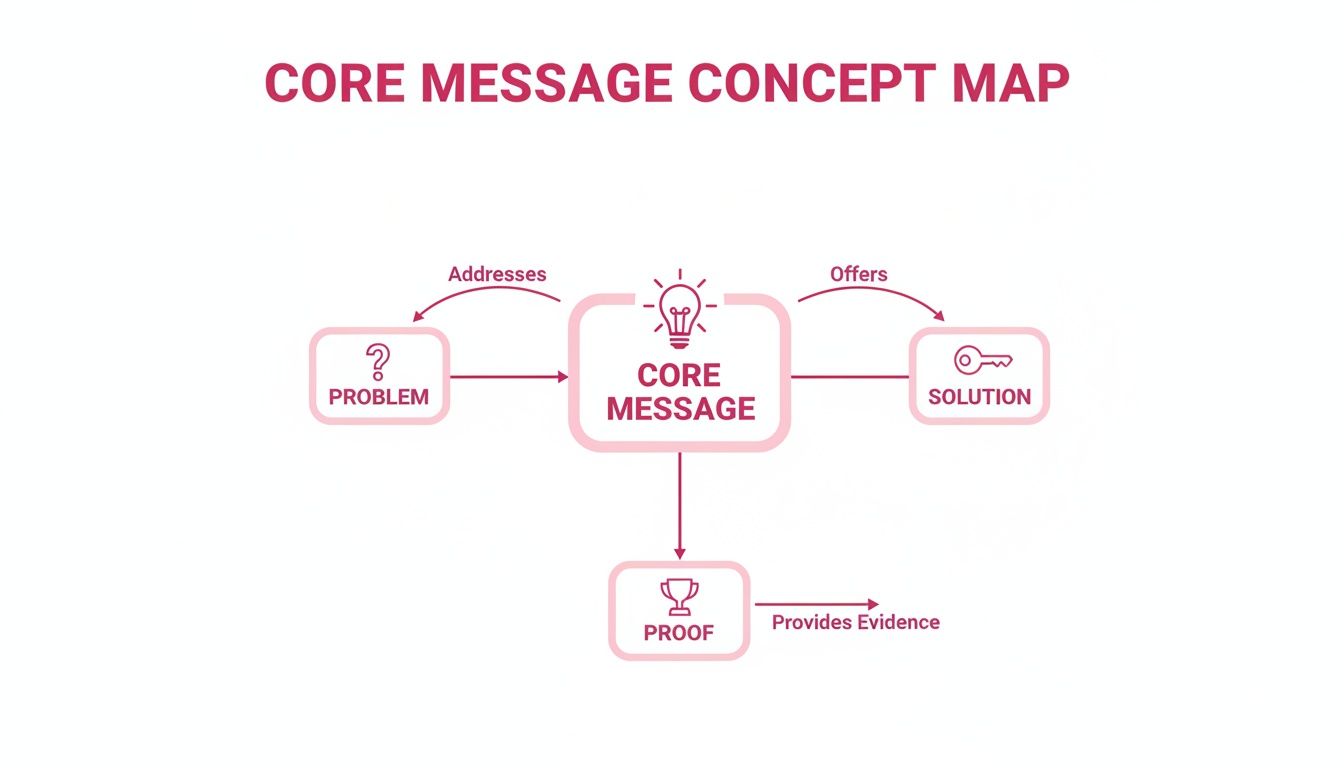
Practical Application: A SaaS company we worked with had incredibly complex software for supply chain logistics. Their website was a wall of technical jargon.We sat them down and focused on those three simple questions. They realised the core problem they solved wasn't logistics; it was "the fear of stockouts for high-value goods." Their unique solution was "predictive analytics that flags risks 90 days in advance," and the customer outcome was "complete confidence in their inventory."Suddenly, they had a story: "We use predictive analytics to eliminate the fear of stockouts, giving you complete confidence in your inventory." This simple narrative transformed everything from their ad copy to their sales conversations overnight.
Make Your Core Message Usable
Once you have your messaging pillars, turn them into practical tools for your team. Don't just announce the new message in an email and hope for the best. For a deeper dive, our message alignment guide offers a structured approach.
Here’s how to make it stick:
Create a one-page summary: A simple document with the core problem, solution, and outcome clearly stated. Think of it as a cheat sheet.
Develop 3-5 key talking points: the go-to bullet points for sales and marketing to use in emails, on calls, and in social posts.
Update your key assets first: Start with the highest-impact places on the website homepage, your company's LinkedIn "About" section, and the first slide of your sales deck.
This process gives your team the solid ground they've been missing. It replaces confusion with clarity and provides the confidence to communicate your value consistently.
Choose Your Marketing Channels with Purpose
You’ve got your core message. Now for the question that trips up so many founders: “Okay, so where do we actually put this?”
The immediate reaction is often to be everywhere at once. LinkedIn, SEO, email, ads, events. But this approach is a trap. It spreads your time, energy, and budget so thin that nothing really makes an impact. It’s exhausting, and it rarely works.
Innovative marketing isn't about being everywhere; it's about being in the right places, at the right time.
Match the Channel to the Customer's Mindset
Different channels do different jobs. The key is to map your channels to where your customer is in their journey. Someone just realising they have a problem behaves very differently from someone actively comparing solutions.
When they're just becoming aware of a problem: Your goal is to attract people who know they have an issue but aren't looking for your solution yet. Think in-depth blog posts (SEO), insightful LinkedIn content, and industry reports. These help you become a trusted resource.
When they're considering their options: Now you're engaging prospects who are actively researching. Your goal is to show them why your approach is different. This is the perfect place for webinars, case studies, and targeted email sequences.
When they're ready to make a decision: You're guiding qualified leads towards a purchase. Your job is to make it easy for them to choose you. This is where personalised demos, sales calls, and customer testimonials shine.
A Practical Example: A Deliberate Sequence
Let's see how this plays out. Imagine an agtech company selling crop monitoring software. Their resources are tight, so being "everywhere" is off the table.
Instead of randomly posting on social media, they build a deliberate sequence:
They start with helpful SEO content. They discover farm managers are searching for "improving crop yield analytics." So, they create genuinely helpful blog posts on these topics, positioning themselves as experts. Given that the Australian SEO market is set to hit $1.75 billion by December 2025, this is a decisive opening move. You can learn more about the state of SEO in Australia.
They capture leads with a valuable guide. At the end of each blog post, they offer a download: "The Farm Manager's Guide to Data-Driven Crop Health." This turns anonymous traffic into identifiable leads.
They nurture with a targeted webinar. Once they have a list of engaged leads, they invite them to a webinar titled "How to Use Predictive Analytics to Prevent Crop Loss," demonstrating the value of their software.
They close with a sales conversation. Only the most engaged webinar attendees get a personal invitation for a one-on-one demo. By this point, the lead is warm, educated, and qualified.
See the slight shift that changes everything? It’s not a complex framework; it’s a logical flow. They used a broad channel (SEO) to build awareness, a more focused one (webinars) to gauge interest, and a high-touch one (sales) to close the deal. This is how you stop random acts of marketing and build a predictable system for winning customers.
Bring Your Plan to Life with a Simple Calendar
A brilliant strategy is useless if it just sits in a document. The momentum dies because big ideas never get translated into real, tangible actions the team can follow.
If you feel stuck here, you’re not alone. The good news is, you don’t need a complex, 12-month chart. You need a simple way to turn your strategy into a weekly rhythm.
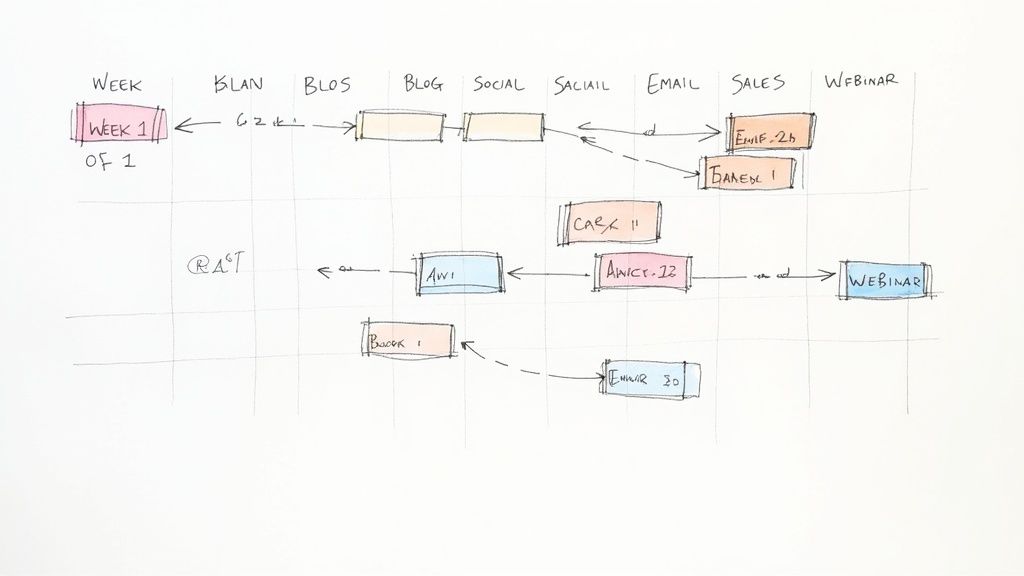
Ditch the Annual Plan for 90-Day Sprints.
Long-term annual marketing plans are often a waste of time. They’re rigid and quickly become outdated. A much better approach is to plan in focused, 90-day sprints.
This shorter timeframe gives you clarity without locking you into a path that might be irrelevant in six months. It lets you set clear, achievable goals, execute, and then pause to learn and adjust. This is usually where a sprint approach quickly creates clarity, replacing overwhelming annual goals with manageable objectives.
Your 90-day plan should focus on a core theme. For example:
Theme for Q1: Launch our new software feature.
Theme for Q2: Build our email list with high-value leads.
Theme for Q3: Drive registrations for our annual online summit.
This theme becomes the filter for every activity. If a task doesn't support that quarter's theme, it gets put on the back burner. This simple discipline stops the team from getting distracted.
Connect Your Channels Around One Initiative
The real power of an integrated plan comes alive when you orchestrate your channels around a single initiative. Instead of thinking, "What are we posting on LinkedIn this week?" you start thinking, "How does LinkedIn support our feature launch this week?"
It’s a slight mental shift that changes everything.
Let's use the example of launching a new feature. An integrated approach maps it out as a coordinated effort:
SEO & Content: Publish an in-depth blog post explaining the problem the feature solves. This becomes your long-term asset.
Social Media: Create a week-long series of posts. A teaser video on Monday, a "behind-the-scenes" look on Tuesday, the official announcement on Wednesday, and a customer testimonial on Friday. With Australian businesses projected to spend AU$7.5 billion on social media ads in 2025, coordinating these efforts is crucial. You can find more details in these recent Australian marketing statistics.
Email Marketing: Send a targeted email to existing customers showing them exactly how to use the new feature.
Sales Team: Equip them with updated talking points and a one-page summary to confidently discuss the new functionality.
See how this works? It's not about doing more. It's about making your existing marketing work together. One initiative, amplified across multiple channels, creates a wave of momentum that isolated activities never could. This tactical calendar gives everyone the structure and clarity they need to move forward with confidence.
Feeling Overwhelmed? Here’s Where to Start.
If reading this has your shoulders tensing up, that’s normal. Laying out all the pieces of a proper integrated marketing plan can feel like a lot, especially when you’re already juggling a thousand other priorities. It’s easy to look at the gap between where you are and where you want to be and feel like you’re behind.
The goal isn't to create a perfect plan overnight. It's about finding one small bit of clarity you can build on. Most teams get stuck because they try to boil the ocean instead of just making one delicious cup of tea.
Find Your First, Smallest Win
Forget overhauling everything for a moment. Let's make this much more straightforward. Remember that quick audit we talked about?
Block out one afternoon this week. Just one. And do this:
Open your website's homepage.
Pull up your last three marketing emails.
Look at your company’s LinkedIn page.
Now, for each one, write down the core message in a single sentence. Are they telling the same story? Are they solving the same problem for the same person?
If the answer is no, congratulations you’ve found your starting point. You don't need to look any further. Fixing that single messaging gap is the most powerful thing you can do right now.
This small act of forcing alignment does more than just tidy up your copy. It introduces a single, solid piece of structure into what might feel like chaos. It’s a calm, deliberate action that builds the confidence and clarity you need to figure out what comes next.
This isn’t about some massive transformation. It’s simply about making one small part of your business make more sense today than it did yesterday. That’s where real progress begins.
Common Questions, Answered Plainly
How often should we look at our IMC plan?
Your big-picture strategy is suitable for about a year. But your tactical plan for the 90-day sprints needs a monthly check-in. This keeps you agile enough to respond to what’s working without getting derailed from your primary goals. A plan should be a living guide, not a stone tablet.
What's the biggest mistake companies make with this?
Hands down, it's when marketing builds the plan in a vacuum. If you create an integrated marketing communications plan without involving sales, product, and customer support, it's dead on arrival. Real integration is a company-wide commitment, not just a marketing task. Most teams struggle here because they’ve never had someone step in to structure the work across departments.
Can a small team with a small budget do this?
Absolutely. In fact, a tight budget makes an IMC plan more critical, not less. It stops you from wasting precious dollars. Instead of spreading your funds thinly across a dozen channels, a solid plan forces you to focus on the one or two that will genuinely make a difference. It’s not about having more money; it's about being smarter with what you've got.
If you’re tired of the guesswork and ready for your marketing to click into place finally, Sensoriium provides the structure and clarity you need. We untangle complexity to forge a clear path forward. Find out how we help.