
Your Marketing Feels Disconnected. Here's the Fix.
- Jan 14
- 15 min read
Ever get that nagging feeling as a founder? You’re running campaigns, your team is pushing out content, and everyone seems busy, but it all feels… a bit disjointed. Sales calls don't quite land the same way every time, your ad copy feels generic, and the website doesn't truly nail what makes you special.
You're not imagining things. And it makes perfect sense that you feel stuck.
This isn't a red flag signalling failure; it's a classic symptom of a missing foundation. The problem usually isn't the marketing activities themselves, but the absence of a strong, central idea holding them all together. Without a core marketing positioning statement locked down, you just have a bunch of puzzle pieces that don't form a clear picture.
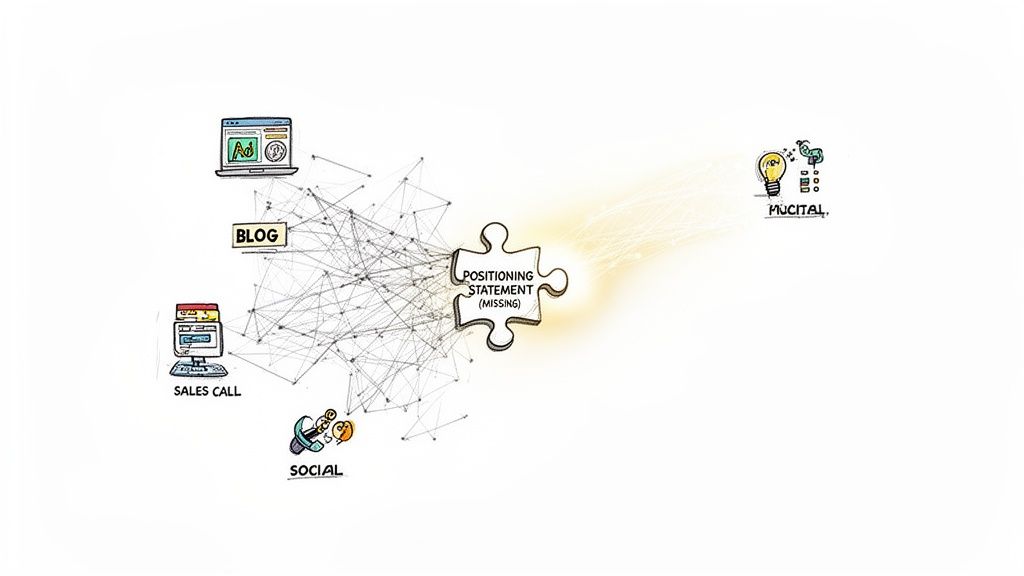
The Source Code for Your Marketing
A marketing positioning statement is the single sentence that can fix this mess. Think of it as the source code for your entire marketing and sales operation. It’s not a catchy tagline for your customers; it's a powerful internal tool that gives your team the rails they need to run on with focus and purpose.
When you don't have one, your team is forced to guess, which leads to a whole host of problems:
Inconsistent messaging pops up everywhere—social media sounds different to your website, which sounds different to your sales emails.
Vague ad copy that doesn't connect because it's trying to be everything to everyone.
Wasted effort on marketing that fails to drive home what actually makes you the best choice for your customer.
This is a struggle we see all the time. Teams have never had someone come in and properly structure the work, so they end up with a collection of well-meaning but disconnected systems. A sharp positioning statement clears away all that guesswork.
Bringing Clarity and Confidence
Picture this: your head developer trying to write code without any architectural design. Or a building crew trying to put up a house without a blueprint. The result would be a chaotic mess, endless rework, and a final product that just doesn't work. Marketing is exactly the same.
Your positioning statement is that blueprint. It’s the single source of truth that ensures everyone—from the person writing your next blog post to the sales lead on a demo call—is telling the same powerful story.
This isn't about piling on more marketing. It’s about making every piece of marketing you’re already doing count. It builds clarity, confidence, and the momentum you need to stop feeling disconnected and start making a genuine impact.
It's Your Compass, Not Your Tagline
Let's clear up one of the biggest points of confusion that gets founders stuck. Your marketing positioning statement is not the catchy slogan you plaster all over your website. It’s not your tagline. It’s not even meant for your customers to see.
This is an internal tool. Think of it as a strategic compass for your entire organisation, guiding every single decision your marketing, sales, and even product teams make.
While your tagline is what you say to the world, your positioning statement is the private agreement you make with your team about who you are, who you serve, and why you matter. Grasping this simple distinction is a small shift that changes everything. Once it clicks, the chaos of inconsistent messaging just starts to fade away.
The Blueprint vs. The Finished House
Imagine you’re building a house. Your positioning statement is the architect's detailed blueprint. It specifies the materials, the room dimensions, and the electrical layout—everything needed to build a sound structure.
No one actually lives in the blueprint. It's not the beautiful front door or the inviting living room. But without it, the builders, plumbers, and electricians would all be working from different, conflicting plans. The result would be an absolute mess.
This is exactly what happens when a business operates without a clear positioning statement. Marketing writes ads based on one idea, sales pitches another, and product development builds features for someone else entirely. When we embed with a team, untangling this is often the first gap we fix. It’s usually where we see the first big ‘aha’ moment.
Clearing Up the Confusion: Positioning vs. Everything Else
A positioning statement is often mixed up with other critical brand assets. Each has a distinct job to do, and understanding the difference brings immediate clarity. Your positioning statement is the strategic foundation that informs all the others.
Here's how they differ:
Mission Statement: This is your ‘why’. It’s your company's core purpose and reason for existing, aimed at inspiring your team and stakeholders. It’s broad and aspirational.
Value Proposition: This is your ‘what’ and ‘how’. It's a clear, external-facing promise of the specific value a customer will get from your product or service.
Tagline: This is your ‘hook’. It's a short, memorable, customer-facing phrase that captures the essence of your brand.
Your positioning statement underpins all of these. It provides the strategic logic for your mission, the specific benefits for your value proposition, and the core idea that sparks your tagline. It’s a crucial piece of the puzzle for any business serious about consistent brand creation and development.
To make this crystal clear, let’s look at a simple breakdown.
Positioning Statement vs. Other Brand Messages
This table lays out how these different assets work together, showing their unique purpose and audience.
Asset | Primary Audience | Purpose | Example Focus |
|---|---|---|---|
Positioning Statement | Internal Team | To align all marketing, sales, and product decisions with a single, clear strategy. | "For [target customer] who [has a specific need], our [product/service] is a [market category] that [provides a key benefit]." |
Mission Statement | Internal & External | To state the company's purpose and guide its culture and long-term vision. | "To organise the world's information and make it universally accessible and useful." (Google) |
Value Proposition | External (Customers) | To explain the specific benefits customers will get from your product or service. | "The easiest way to send, spend, and manage your money." (PayPal) |
Tagline | External (Public) | To create a memorable and catchy brand association. | "Just Do It." (Nike) |
Once you see them laid out like this, the role of the marketing positioning statement becomes obvious. It isn't just another piece of marketing fluff; it’s the structural beam that holds the entire house up. It gives your team the direction and confidence it needs to build something that lasts.
The Four Parts of a Powerful Positioning Statement
A truly powerful marketing positioning statement doesn't just appear out of thin air; it’s carefully assembled from four non-negotiable parts. Getting each one right is what separates a vague, useless sentence from a statement that gives your team genuine clarity and direction.
I’ve seen so many founders get stuck here. They try to write something that sounds clever but end up with a collection of buzzwords that mean nothing. The key is to see it not as a creative writing exercise, but as a formula that demands ruthless specificity.
Think of it as a structure that turns a generic idea into a powerful tool for making decisions on everything from your product roadmap to your next ad campaign.
Part 1: Your Target Audience
This is the most critical element, and frankly, it's where most positioning statements fall apart. "Small businesses" or "marketing managers" are not target audiences; they are vague categories. You need to get uncomfortably specific.
Who are you really for? What does their world look like? What specific frustration keeps them up at night? The tighter your definition, the sharper your entire marketing becomes. Before even attempting to write your statement, you have to deeply understand who you're talking to. This guide on how to identify your target audience can help you dig much deeper than just surface-level demographics.
Instead of: "Founder-led businesses."Try: "Founder-led Australian agtech companies struggling with manual data entry."
That level of detail gives your team a real person to picture, making it far easier to create messaging that actually connects. This is a foundational step in our target audience research because it provides the context for everything that follows.
This infographic shows how your positioning statement sits right at the top of your messaging hierarchy, influencing everything else you communicate.
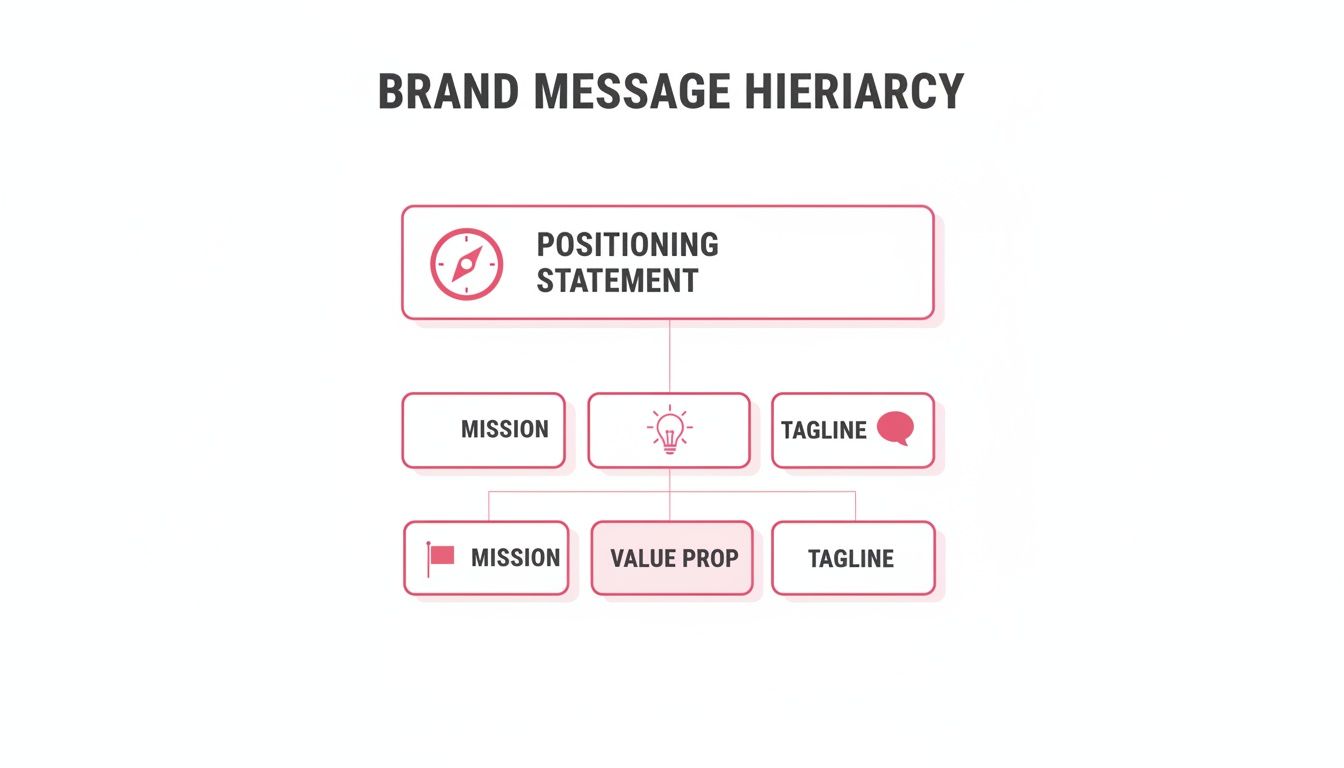
As you can see, if the positioning statement is fuzzy, every message that flows from it—your mission, value proposition, and tagline—will also lack focus.
Part 2: Your Market Category
This element grounds your audience. It tells them what box to put you in so they can immediately understand what you are. It’s the frame of reference they need to make sense of your offer.
Don't overcomplicate this. Are you accounting software? A project management tool? A leadership consultancy? State it plainly. Trying to invent a new category is a common mistake that just confuses potential customers.
The goal here isn't to sound unique; it’s to provide instant context. You can’t be different until people first understand what you are.
For example, calling your product a "workflow optimisation platform" might sound impressive, but "CRM for tradespeople" is instantly understandable. Be clear, not clever.
Part 3: Your Point of Difference
Now you can get to what makes you unique. This is your core differentiator—the one thing you do better than anyone else for your specific target audience.
This isn't a laundry list of all your features. It’s the singular, compelling benefit that solves their primary problem in a way your competitors don't. This is usually the hardest part to get right because it forces you to make a choice. You can't be the fastest, cheapest, and most comprehensive. You have to pick your lane.
What is the one promise you can make that truly matters to them?
Is it speed?
Is it simplicity?
Is it a unique methodology?
Is it a specialised integration?
This is where you need to be honest about your most defensible advantage.
Part 4: Your Reason to Believe
Finally, you need to back up your claim. This is the proof that makes your point of difference believable. A bold promise without any evidence is just empty marketing speak.
Your "reason to believe" can be a specific feature, a proprietary process, a unique dataset, or even social proof. It’s the tangible thing that turns a sceptical prospect into a confident buyer.
Here’s a simple template that pulls these four parts together into a logical structure, giving you a solid foundation to build your own statement.
For [your specific target audience]
Who [have a specific problem or need]
[Your Brand] is the [your market category]
That [provides a unique benefit/point of difference]
Because [your reason to believe/proof].
Using this structure provides the guardrails you need to move from a vague idea to a sharp, functional marketing positioning statement that gives your entire team confidence and direction.
Positioning Statement Examples from B2B and SaaS
Theory is one thing; seeing it work in the real world is what really makes it click. It’s easy to talk about target audiences and points of difference, but the true test is translating those components into a sharp, functional statement that gives your team a clear direction.
A lot of founders get frustrated at this stage. They follow the formula but end up with something that still feels generic or weak. It’s a common hurdle, and it’s usually because the statement isn’t specific enough to be truly useful.
Let’s look at some practical examples from the B2B and SaaS world. We’ll break down a "before" and "after" to show how a vague idea can be sharpened into a powerful tool.
From Vague Idea to Actionable Tool
Most positioning statements start life as a broad, well-meaning sentence. They capture a general ambition but lack the teeth needed to guide actual business decisions.
A common 'before' example:
"We help businesses grow with our innovative software."
This feels okay at first glance, but it’s practically useless. Who are these businesses? What kind of growth? What does the software actually do? Your team can’t build a marketing campaign, write an ad, or qualify a sales lead based on this.
This is where structure brings much-needed clarity. By applying the four-part formula—target audience, market category, point of difference, and reason to believe—we can transform it.
An effective 'after' example:
"For mid-stage B2B SaaS companies in the UK struggling with subscriber churn, [Our Brand] is the customer success platform that identifies at-risk accounts before they cancel by using a proprietary predictive analytics engine that tracks over 50 engagement signals."
Suddenly, everything is clearer. The marketing team knows exactly who to target (mid-stage UK SaaS), what pain point to focus on (churn), and what makes the product special (a predictive engine). This isn't just a sentence; it's a strategic directive. This is usually where a sprint approach creates clarity quickly.
Deconstructing a SaaS Example
Let's pull apart another strong marketing positioning statement for a hypothetical SaaS company in the project management space.
For project managers in creative agencies who are overloaded with client communication,
[ProjectFlow] is the all-in-one project management tool
That centralises client feedback and approvals directly on design assets, eliminating confusing email chains,
Because it is the only platform with built-in, version-controlled visual annotation tools.
Notice the specificity. It doesn't just say "agencies"; it says "project managers in creative agencies". It doesn’t just promise "efficiency"; it promises to eliminate confusing email chains by centralising feedback. That level of detail gives your team everything they need to build a compelling story.
A B2B Services Example
This structure isn't just for software companies. It works just as well for service-based businesses that need to carve out a clear space in a crowded market.
In Australia, the strength of a marketing positioning statement increasingly determines whether brands can make an impact. With 73.1% of the AUD $19.9 billion ad spend going to digital channels, vague positioning means your message is simply lost. For tech and service companies, a tight, evidence-based statement is less of a branding exercise and more of a survival tool. As you can find out from social media statistics in Australia, it dictates which few words are worth paying to put in front of high-value buyers.
Let's apply this to a B2B consultancy.
For Australian-based agtech startups preparing for their Series A funding round,
[AgriScale Advisory] is the specialist growth consultancy
That builds investment-ready financial models and connects founders with a network of vetted agtech investors,
Because our partners are ex-VCs with a decade of direct experience funding agricultural technology.
This statement immediately answers the most important questions for the marketing and sales teams:
Who do we target? Australian agtech startups getting ready for a Series A round.
What is our core offer? Building financial models and providing investor connections.
Why are we the best choice? Because our team is made up of former VCs from the industry.
This clarity prevents the team from wasting time on prospects that aren't a good fit and equips them with a powerful, confident message for those who are. This is how you move from feeling scattered to feeling focused and in control.
Common Mistakes That Make Positioning Statements Useless
We’ve all seen it happen. You spend hours, maybe even days, wordsmithing the perfect marketing positioning statement. You follow the formula, get the team to sign off, and it gets filed away in a brand document. Then… crickets. It never sees the light of day again and provides zero practical value.
If this sounds familiar, it’s not because you failed. It’s a sign the statement fell into one of several common traps that render it useless. It might look right on paper, but it doesn’t provide any real clarity or direction for your team.
Most teams get stuck here because they’ve never had someone show them how to structure the work properly. Let's look at the pitfalls so you can create a statement that actually gets used.
The "We Are the Best" Trap
This is easily the most common mistake. It’s so tempting to claim you’re the "highest quality," "most innovative," or "world-class" solution. These claims feel great to write, but they’re impossible to prove and mean absolutely nothing to a customer.
Your positioning needs to be built on a specific, defensible difference—not a vague boast about being the best. Instead of just saying you’re superior, show how you’re different in a way that truly matters to your specific audience.
Being Everything to Everyone
A positioning statement that tries to appeal to the entire market ends up appealing to no one. If your target audience is "small businesses" or "all marketers," you’ve already lost. That lack of focus leads to generic, watered-down messaging that never connects with anyone.
The power of a positioning statement comes from the markets and customers you intentionally choose to exclude. It’s a tool for focus, and focus requires making hard choices about who you are not for.
This forces you to be specific, which is the only way to create something that resonates.
Using Empty Jargon
It's a crowded market out there. By 2025, around 74% of Australian businesses reported having a documented content marketing strategy. With over 9,500 marketing agencies, countless brands are competing with remarkably similar claims. This creates a “positioning inflation” problem where words like 'customer-centric' and 'innovative' have lost all meaning. Dig into more Australian marketing statistics and you'll see just how noisy the space is.
The brands that win are the ones that can translate their strategy into a single, testable positioning statement that they execute consistently. Ditch the buzzwords and use plain language to describe what you do.
Making Claims You Can't Prove
Your point of difference must be backed up by a solid "reason to believe." If you claim your software is the "fastest," you need data to prove it. If you say your service is "simpler," you must have a specific feature or process that actually makes it so.
Without a credible reason to believe, a positioning statement is just a hollow marketing slogan. It lacks the substance needed to give your team—and your customers—real confidence.
Here are a few other common missteps to watch for:
Confusing it with a tagline: Remember, this is an internal tool for alignment, not a catchy phrase for your website.
Focusing on features, not benefits: Customers don’t buy features; they buy the better outcome those features deliver.
Never reviewing it: Markets shift, and competitors adapt. Your positioning is a living document that needs a check-up to ensure it still holds true.
By knowing what these pitfalls look like from the start, you can craft a marketing positioning statement that provides genuine clarity and becomes a core part of your team's toolkit.
How to Test and Validate Your Statement
So, you’ve crafted a marketing positioning statement. Great. But don’t go carving it in stone just yet. Think of it as a strong hypothesis—an educated guess about your place in the market that now needs to face the real world.
It’s a step too many founders skip. They treat their statement as a finished product, only to discover months down the track that it just doesn't connect with actual customers. If that sounds a bit daunting, don't worry. You're not being asked to launch a massive research project. The goal is simply to get some real-world evidence, quickly and cheaply, so you can move forward with confidence.
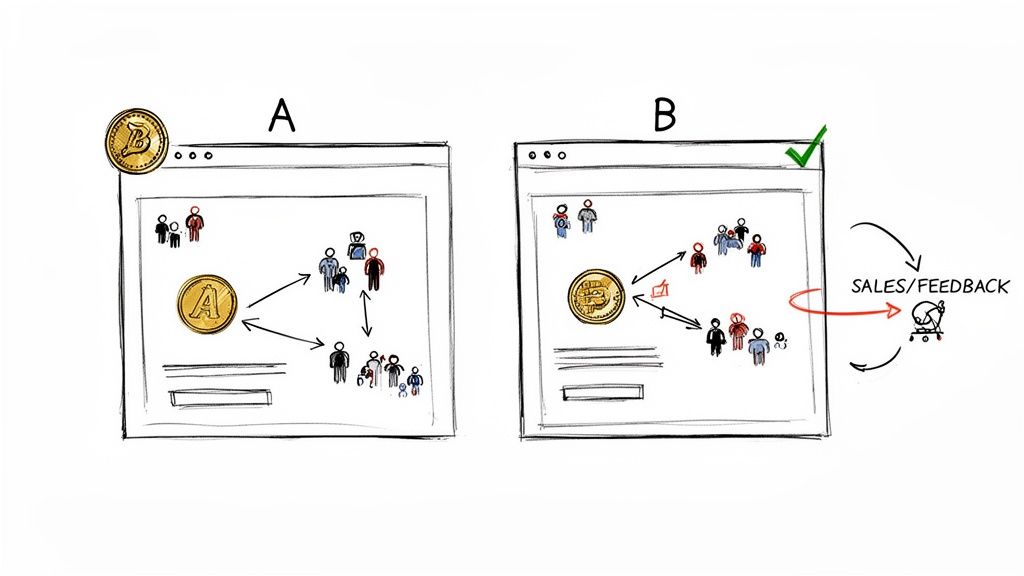
This is where a focused, sprint-based approach brings clarity without the chaos. You’re not guessing anymore; you’re running small, controlled experiments to see what truly resonates.
Simple Ways to Get Real-World Feedback
You don’t need a huge budget or a data science team to check if your positioning is on the mark. All you need is a structured way to listen to the right people.
Here are a few practical methods to get you started:
Chat with Your Best Customers: Grab five of your ideal customers for a quick chat. The trick here is not to ask them if they like the statement. Instead, use its core ideas to describe what you do. Watch their reaction. Do their eyes light up? Does it mirror the value they feel they get from you? The language they use in response will tell you everything.
Get Feedback from the Sales Team: Your sales team is on the front line every single day, so their input is gold. Run the new positioning by them. Does it give them a clearer, more powerful story to tell? If they feel more confident using it, that’s a massive green flag.
Run Landing Page A/B Tests: This is the most direct way to pit your message against the market. Create two simple landing pages, each with a headline reflecting a slightly different positioning angle. Drive a small amount of targeted traffic to both and see which one gets more sign-ups or demo requests. It’s that simple.
This agile way of validating is fast becoming the standard, and for good reason. Recent trends in Australia show that treating a positioning statement as a live hypothesis directly boosts marketing effectiveness. Running small paid traffic tests on two different positioning angles can give you solid directional evidence in just a few days, for a fraction of what a full campaign would cost. You can get more practical ideas on how to validate positioning with target audiences to see how this works in action.
What to Listen For
As you collect feedback, you're not just looking for a simple "yes" or "no." You need to tune your ear to specific signals that show you’re heading in the right direction.
Pay attention to those moments of instant connection. When a customer says, "Yes, that's exactly our problem," or a sales rep says, "Finally, that's what I've been trying to say," you know you're getting close.
Listen for these three signs of a winning statement:
Clarity: Do people immediately "get it" without you needing to give a long-winded explanation?
Relevance: Does the message speak directly to a real pain point your target audience actually cares about?
Differentiation: Does it clearly set you apart from the other options they might be looking at?
Remember, testing isn’t about chasing the "perfect" set of words. It's about making sure your core message gives your entire organisation the clarity, direction, and confidence it needs to move forward as one.
What to Do Next With Your Statement
So, you’ve wrestled with your brand and finally nailed down a sharp, validated marketing positioning statement. That’s a massive win. But here’s the thing: if it just gets filed away in a Google Doc, it's completely worthless. Its real power is unleashed when it becomes the compass for everything you do.
If you’re looking at all your marketing materials and feeling a bit overwhelmed, don't sweat it. That’s normal. The goal isn't to trigger a chaotic, company-wide rebrand overnight. Instead, think of it as a series of small, deliberate tweaks that build momentum.
Start With Your Homepage
Before you dive into anything else, zero in on the most valuable piece of real estate you own: your website's homepage hero section. This is your digital front door, where first impressions are made in seconds.
Take a hard look at your headline and sub-headline. Do they perfectly echo your new positioning? Is your main call-to-action crystal clear and in sync with the value you just defined? Fixing this one thing forces you to translate your internal strategy into a compelling external message. With your positioning locked in, you have the building blocks for effective website copywriting that hits the mark every single time.
Align Your Key Assets
Once your homepage is sorted, you can move through your other critical assets methodically. Don't try to boil the ocean. Just tackle the high-impact stuff first.
Your Sales Deck: Do the first three slides instantly communicate who you are, who you serve, and why you’re different?
Your Ad Campaigns: Is your ad copy speaking the language of your ideal customer, focusing on the single biggest problem you solve for them?
Your Sales Training: Can every person on your sales team confidently and consistently explain your unique value in a 30-second chat?
If this all feels a bit messy, that’s normal. You’re not behind. You just need structure. Start by fixing your homepage copy. Once that's aligned with your positioning statement, everything else will start to fall into place.