
A Brand Management Strategy Template for Tech Companies
- Jan 26
- 18 min read
Think of a brand management strategy template as your company's North Star. It's the single, go-to framework that outlines how your brand looks, sounds, and feels, ensuring everyone is on the same page, every single time. It provides a repeatable structure for defining, applying, and measuring your brand’s performance across every single touchpoint.
That Feeling of Brand Chaos Is Real—and It’s Not Your Fault
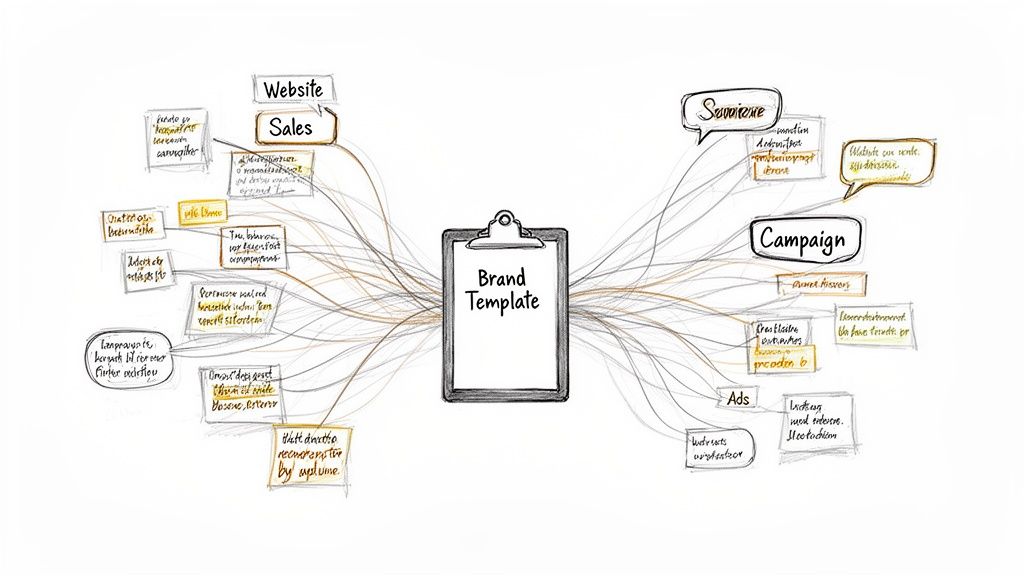
Does it ever feel messy? Because it probably is. One day your messaging hits all the right notes, and the next, it’s a jumbled mess of technical jargon that even your engineers wouldn't say out loud.
You're not imagining the inconsistency. Your sales team describes the business one way, the website says something else entirely, and the latest marketing campaign feels like it was cooked up by a completely different company. This isn't a sign of failure; it’s a totally normal growing pain when you don’t have a central playbook.
I've seen so many founders and marketing leaders hit this exact wall. The scrappy, make-it-up-as-you-go branding that got you off the ground eventually starts to create friction, slows down decisions, and leaves customers scratching their heads. You're not crazy for feeling stuck.
Why Brand Inconsistency Sneaks In
This chaos is a natural side effect of scaling up. As your team expands, more people have their hands on the brand every single day—from writing social media posts to building sales decks. Without a shared reference point, everyone’s interpretation of the brand naturally starts to drift apart.
It usually happens because no one has had the bandwidth to step back and put a structure around the work. Decisions are made in isolation, leading to a brand experience that feels fragmented. It’s exactly why so many B2B tech marketing efforts feel disconnected—a problem that’s fixable with the right framework.
The end result? A brand that feels slightly different depending on where a customer runs into it. This creates a subtle but persistent drag on both trust and momentum.
The goal isn’t to lock down creativity with rigid rules. It's to build a single source of truth that gives everyone the clarity and confidence they need to move in the same direction—quickly and consistently.
Structure Is the Way Forward
The good news is you don’t need a massive, six-month project to get this sorted. The solution is much simpler: a straightforward brand management strategy template.
Think of it less as a restrictive document and more as a tool for alignment. It captures the DNA of your brand in one place so that everyone—from product to sales to marketing—is telling the same, powerful story. This simple shift from constantly putting out fires to having a proactive structure is what finally tames the chaos and builds lasting brand confidence. You’re not behind; you just need a better system.
The Four Elements Your Brand Strategy Must Define
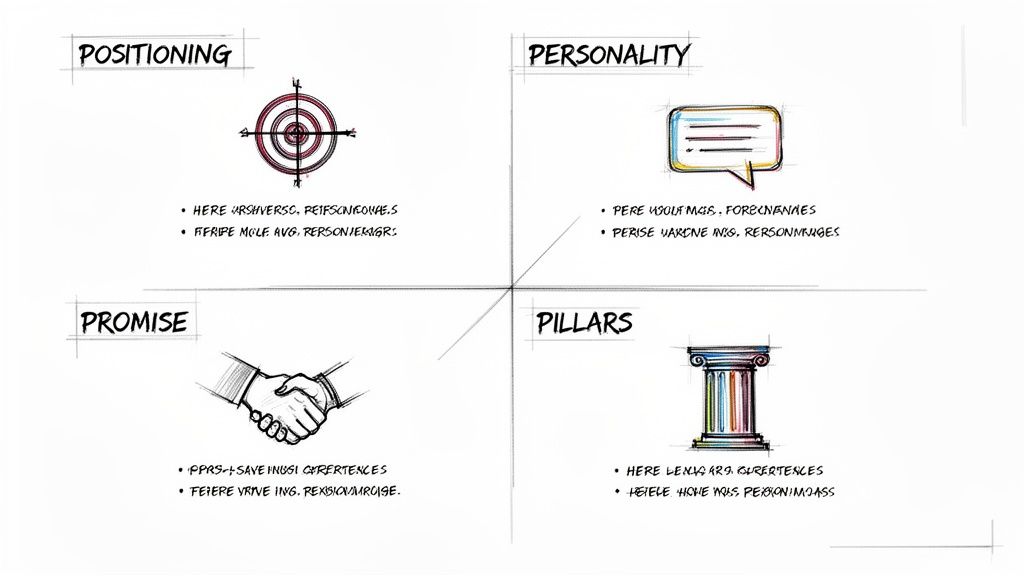
Before you can even think about managing a brand, you need to define its foundation. It's so tempting to get bogged down in complicated frameworks and endless workshops, but honestly, that’s where most teams get stuck. The reality is much simpler.
You only need to get four core elements right. This isn’t about writing a novel; it’s about making clear, confident decisions that give your entire team a reliable compass to follow. Getting this foundational work right is often the first thing we fix when we embed with a team because it solves countless arguments and inconsistencies down the line.
When these elements are clear, the value you create becomes undeniable. It's no surprise that Australian brands are seeing serious growth, with the top 40 reaching a combined value of US$156 billion in 2025—that's a 25% jump since 2023. This isn't just luck; it’s the direct result of brands knowing precisely who they are and what they stand for. That’s exactly what a strong brand management strategy delivers. You can see how leading brands are pulling this off in Kantar's BrandZ report.
Let's break down the four pieces that form the bedrock of your brand.
Your Positioning
Positioning is all about owning a specific piece of real estate in your customer’s mind. It answers the crucial question: "For our ideal customer, why are we the only logical choice?" This isn't just some fluffy tagline; it's a hard-nosed strategic decision about who you serve, what problem you solve for them, and how you do it better than anyone else.
Most teams stumble here because they try to be everything to everyone. Real clarity comes from being specific. You need to define your audience so tightly that you know exactly what keeps them awake at night.
To really nail your positioning, ask these three questions:
Who is our ideal customer? Get ruthlessly specific. Not just "farmers," but "tech-savvy macadamia farmers in Northern NSW managing over 500 hectares."
What is their core problem? Focus on the tangible frustration. "They struggle to accurately predict irrigation needs, leading to wasted water and inconsistent crop yields."
How are we uniquely equipped to solve it? This is your secret sauce. "Our soil-moisture sensors use predictive AI to deliver centimetre-accurate irrigation schedules, cutting water usage by 30%."
For a deeper look, check out our guide on what brand positioning is and how to find yours.
Your Personality
If your brand walked into a room, who would it be? Your personality is the character and voice that brings your brand to life. It’s what makes your emails, website copy, and social media posts all feel like they come from the same place.
This is about defining how you show up. Are you the authoritative expert, the supportive partner, or the innovative challenger? Defining this stops your brand from sounding prim and proper on your website but overly casual on social media.
Think in terms of a simple spectrum:
Funny vs. Serious: Where do you land?
Formal vs. Casual: How do you speak?
Expert vs. Enthusiast: What's your dominant tone?
Just decide on three to five core personality traits that feel true to your company. This gives your team a clear filter for every single piece of communication they create.
Your Promise
Your brand promise is the single most important commitment you make to your customers. It’s the value they can consistently expect to receive every single time they deal with you. It’s not about what you sell; it’s about the outcome you deliver.
A great promise is simple, believable, and genuinely meaningful to your customer. It’s the real reason they choose you and the reason they'll stick around.
A brand promise isn’t a marketing slogan. It's an internal commitment that should shape your product roadmap, your customer service policies, and even your hiring decisions. It’s the heart of the entire customer experience.
For example, Volvo’s promise isn’t "we sell cars"—it’s safety. Amazon’s isn’t "we sell everything"—it’s convenience and reliability. Your promise needs to be just as focused.
Your Pillars
Think of your pillars as the three or four key messages that support your brand promise. If your promise is the roof over your customer's head, your pillars are the load-bearing walls holding it all up. These are the core themes you'll return to again and again in your marketing, sales conversations, and content.
These pillars provide the structure for all your communication. Instead of scratching your head wondering what to post on LinkedIn or what your next blog post should be about, you just look to your pillars. They give you consistent themes to talk about, building recognition and trust over time.
Each pillar should be a distinct idea that proves your overall promise and reinforces your positioning. This is how you show, not just tell, that you can deliver on your commitment.
At its core, a brand strategy just needs these four defined elements to work. To show you how it all fits together, here’s a quick summary table.
The Four Core Pillars of Your Brand Strategy
Pillar | What It Defines | The Key Question It Answers |
|---|---|---|
Positioning | Who you serve and why you are the only choice. | For whom are we the best in the world? |
Personality | The distinct voice and character of the brand. | If our brand were a person, who would it be? |
Promise | The core commitment you make to customers. | What outcome can our customers always expect? |
Pillars | The key messages that support your promise. | What are the core themes we always talk about? |
Getting these four points down on paper provides instant direction for everything else you do.
Founder Moment: A Practical Application
Let’s imagine the founder of a fictional AgTech SaaS company, "Terra AI." She feels her message is getting lost because while they sell advanced soil sensors, so do a dozen competitors. By taking an hour to define these four elements, she gets immediate clarity.
Positioning: "For large-scale Australian macadamia growers, Terra AI is the only platform that uses predictive AI to deliver precise irrigation plans, reducing water waste and increasing yield."
Personality: Practical, expert, and straightforward. (She decides to drop the "techy" and "disruptive" jargon.)
Promise: "Smarter irrigation, guaranteed." (It's simple, confident, and focuses on the outcome.)
Pillars: 1. Precision Water Management, 2. Data-Driven Yield Optimisation, 3. Sustainable Farming Practices.
Suddenly, her marketing has a clear direction. The next blog post is about Pillar 2, the sales deck leads with the promise, and all the website copy is rewritten to reflect that expert, straightforward personality. This is how a simple structure creates powerful momentum.
Turning Your Brand Strategy Into Actionable Guidelines
It’s a familiar story. The team spends weeks mapping out the perfect brand strategy, full of sharp insights and big ideas. Everyone feels energised. Then the document gets saved to a shared drive, and slowly but surely, it’s forgotten.
A strategy is only as good as your team’s ability to use it every single day. If it’s not practical, it’s just theory. This is where most brand work falls over—not in the thinking, but in the translation. The goal isn't to create a hundred-page brand bible no one will ever read. It's to build a simple, one-page guide that empowers your team, not restricts them.
This is the point where structure creates momentum. Instead of the founder constantly acting as the ‘brand police’, you give everyone the confidence to create on-brand materials without needing constant approval.
From Strategy to Simple Rules
The key is to boil down your high-level strategy (Positioning, Personality, Promise, and Pillars) into a handful of simple, actionable rules. These guidelines become the filter for every headline, every sales deck, and every social media post.
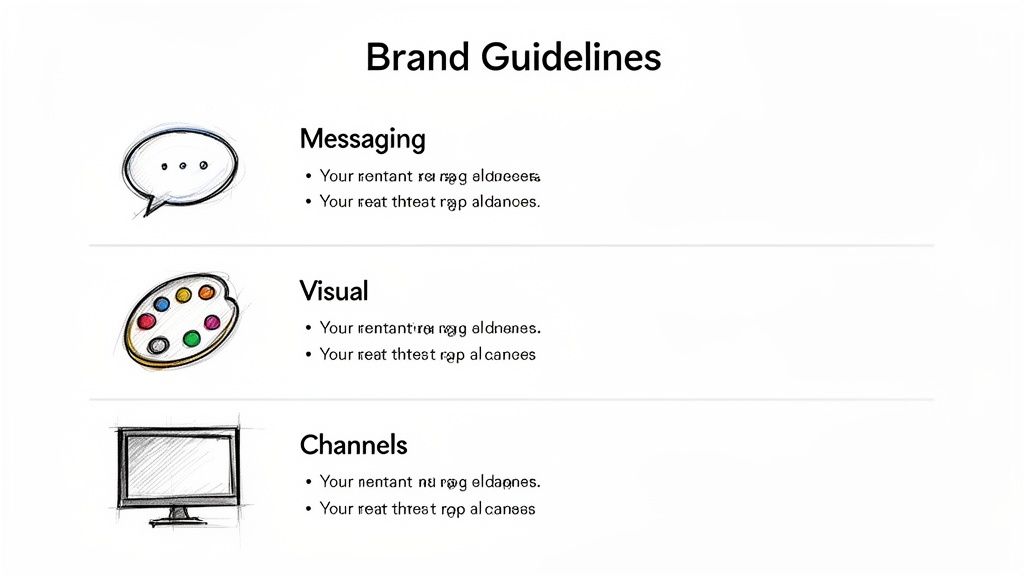
We’ll break it down into three practical areas: messaging, visuals, and channel-specific rules.
Messaging and Copy Guidelines
This is all about defining how you sound. Your brand’s voice is one of its most powerful assets, and getting it right means going beyond a simple list of adjectives. You need to provide clear examples that show your team what ‘on-brand’ copy actually looks like. An effective brand strategy often includes developing clear branded content strategies to engage your audience and build your narrative.
Your guidelines should answer these questions:
Headlines: What’s our formula? Do we lead with the customer’s problem or our solution? Are they short and punchy or more descriptive?
Calls to Action (CTAs): What do we want people to do? Do we say "Learn More" or "See How It Works"? Define your top three to five standard CTAs.
"Words We Use" / "Words We Avoid": This is a simple but powerful list. For a SaaS company, it might be: We use "simple" and "straightforward." We avoid "seamless" and "robust."
This is a common gap we see when we start working with a team. Without clear direction, everyone defaults to their own writing style, which is why a company’s messaging can feel so fragmented. Building a simple playbook for message alignment is one of the quickest ways to create consistency.
Visual Identity Guidelines
This goes way beyond just your logo. Your visual identity is the entire look and feel of your brand. A common mistake is to make these rules too technical or complicated for anyone outside the design team to use. Keep it simple and focus on the elements your team will use most often.
Include clear, visual examples for:
Logo Usage: Show the right and wrong ways to use your logo. Include rules for clear space around it and minimum size.
Colour Palette: Don't just show the colours; define their roles. Specify your primary colour (for headlines and CTAs), secondary colour (for accents), and neutral colours (for text and backgrounds).
Imagery Style: This is crucial. What kind of photos do you use? Are they bright, candid shots of people, or clean, abstract product graphics? Show three to four "best practice" examples.
A great one-page guideline doesn’t just tell people the rules; it shows them. The goal is for a new team member to glance at it and immediately get a feel for the brand without having to read pages of text.
Channel-Specific Rules
Your brand shouldn't be a monolith; it needs to adapt to different environments. How you show up in a formal sales proposal should feel different from how you appear on LinkedIn. These guidelines give your team the confidence to tailor the brand correctly for each channel.
This isn’t about creating totally different brands, but about adjusting the tone and format.
Website: The primary home for your full brand story. Here, the tone might be more comprehensive and expert-led.
Sales Deck: This is focused on a specific buyer's problem. The messaging should be direct, concise, and centred on outcomes.
LinkedIn: Your professional persona. The tone is often more conversational and geared towards industry insights and discussion.
By defining these small but important distinctions, you remove guesswork and help your team communicate effectively everywhere.
A Practical Example: A B2B Tech Service
Here’s how a company like "ClearPath Analytics" might summarise their guidelines on a single page:
Messaging: * Headlines: Always start with the customer's question (e.g., "Tired of messy data?"). * CTAs: Use "Get Your Demo" and "See Pricing." * We Say: "Clear insights," "simple reports." * We Don't Say: "Synergy," "data-driven paradigms."
Visuals: * Colours: Deep blue for primary, bright orange for accents. * Imagery: Clean vector illustrations and charts. No stock photos of people in suits.
Channels: * Website: Confident and educational. * Sales Deck: Direct and benefit-focused. * LinkedIn: Helpful and inquisitive.
This isn’t complicated, but it’s incredibly effective. It turns a dusty strategy document into a living, useful tool that brings clarity and structure to everyone in the company.
Measuring Brand Health and Connecting It to Growth
How do you actually know if any of this brand work is paying off? It’s a fair question, and honestly, it’s one that trips up a lot of founders. You're told to "build the brand," but when you push for what that means in terms of results, you often get fuzzy answers about "awareness" or "engagement."
This is exactly where brand strategy can feel disconnected from the day-to-day business. If you can’t measure it, you can’t justify spending time or money on it. That feeling of just throwing things at the wall and hoping something sticks is a common frustration, but it's entirely fixable.
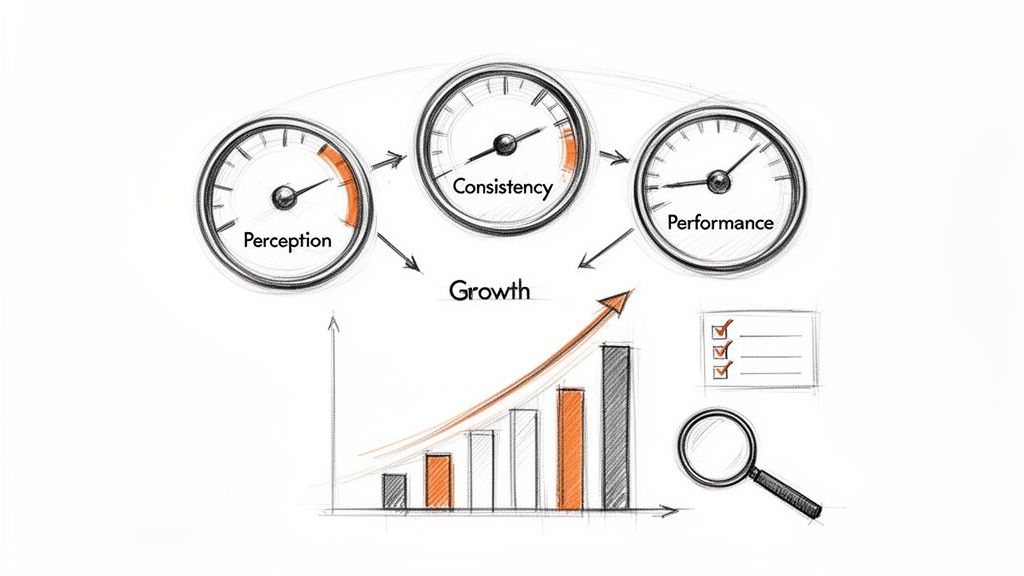
The solution isn't some ridiculously complex dashboard with a hundred different metrics. It's about zeroing in on a few key indicators that tie your brand’s health directly to business growth. Let's break it down through three simple lenses: Perception, Consistency, and Performance.
Are People Getting the Right Idea About You?
This is all about Perception. It's about figuring out if the message you think you're sending is the one being received out in the real world. Vague metrics like website visits won't tell you this; you need to find out what people actually think and feel.
Many teams struggle here simply because they’ve never had a straightforward way to gather this kind of feedback. It doesn’t need to be complicated.
Customer Surveys: Run a simple Net Promoter Score (NPS) survey but tack on one open-ended question: "What’s the first thing that comes to mind when you think of our company?" The answers you get are pure gold.
Social Listening: Keep an eye on mentions of your brand name. Are people talking about the key benefits you want to be known for, or are they confused about what you actually do? Look for patterns in the language they use.
These qualitative insights are vital. They give you a real, unfiltered sense of whether your positioning is landing or if it needs to be sharpened. If you're looking for more ways to check if people know you exist, there's a practical guide on how to measure brand awareness that offers some great starting points.
Is Your Story the Same Everywhere?
Next up is Consistency. An inconsistent brand slowly erodes trust, often without anyone being able to put their finger on why. This part is all about auditing whether the brand you’ve defined in your brand management strategy template is showing up the same way across all your key touchpoints.
This is something you can easily track with a simple quarterly audit.
Founder Moment: Pull up your website's homepage and your main sales presentation. Put them side-by-side. Do they look and sound like they came from the same company? If the answer is no, you’ve just found your starting point.
This audit gives you a tangible consistency score. Are your core message pillars present? Is the tone of voice on point? Is the visual style aligned? A simple checklist can turn this from a vague gut feeling into a measurable KPI.
Is It Actually Helping You Grow?
Finally, and most importantly, we have Performance. This is where you connect brand health to the hard numbers that really matter: revenue, sales efficiency, and customer value. This is how you prove the ROI of your efforts.
Instead of getting bogged down trying to attribute every single sale to a specific brand activity, look for correlations over time.
Lead Quality: As your brand becomes clearer, you should see an increase in marketing-qualified leads (MQLs) that are a much better fit for your business. Track the conversion rate of MQLs to sales-qualified leads (SQLs).
Sales Cycle Length: A strong, clear brand answers a lot of questions for prospects before they even hop on a call. Over time, this should shorten the average time it takes your team to close a deal.
Customer Lifetime Value (LTV): A brand that consistently delivers on its promise creates loyal customers who stick around. Tracking LTV can show the long-term financial impact of a powerful brand experience.
By tracking just one or two metrics from each of these three areas, you can transform brand management from a fuzzy concept into a measurable part of your growth engine. It gives you the structure and confidence to know what’s working and where to focus your energy next.
Keeping Your Brand Strategy Alive and Relevant
So, you’ve done the hard work. The positioning is sharp, the messaging is clear, and the guidelines are all in place. It's so tempting to tick the box, call it done, and move on to the next fire. But a brand strategy isn't a one-off project; it’s a living thing that needs to be woven into the very fabric of your company.
If it’s not actively used, I guarantee it will be forgotten within weeks. This is the moment where many teams stumble—not because the strategy is wrong, but because they don't structure the follow-through.
A brilliant strategy collecting dust is useless. It’s time to give it a heartbeat.
Creating a Simple Governance Model
"Governance" sounds heavy and corporate, I know. But it’s really just about creating a simple, low-effort system for keeping your brand on track. Without it, you’ll find yourself right back in that state of brand chaos within six months.
All you need is clarity on three basic questions.
Who is the Brand Owner? This is the single person ultimately accountable for the brand’s health and consistency. In a smaller company, it might be the founder or CEO. As you grow, this role usually shifts to the Head of Marketing or a dedicated Brand Manager. They don’t have to approve everything, but they own the strategy document and the review process.
Who are the Key Stakeholders? These are the people who need to be consulted on any significant changes to the brand strategy. Typically, this includes the heads of Sales, Product, and Customer Success. They don't have the final say, but their input is crucial because the brand impacts their teams directly.
What’s the Process for Updates? Define a simple trigger for reviewing the strategy. Maybe it's a major product launch, entering a new market, or a significant shift in the competitive landscape. This prevents the strategy from becoming outdated.
This simple structure provides just enough oversight to maintain integrity without creating bureaucratic bottlenecks that slow everyone down.
Rolling Out the Strategy to Your Team
The rollout is your best chance to get everyone genuinely on board. Please, don’t just email the document out. A "here’s the new brand, now follow the rules" approach never works. It feels like a lecture, not a moment of shared clarity.
Instead, run a short, empowering session that focuses on how this new structure makes everyone’s job easier.
Explain the 'Why': Start by outlining the problems the old, inconsistent brand was causing—confused customers, longer sales cycles, wasted marketing spend.
Show, Don't Tell: Walk them through the one-page guidelines, using practical examples. Show them the "before and after" of a sales slide or a website headline.
Focus on Empowerment: Frame it as a tool that gives them the confidence to move faster. No more second-guessing copy or asking for design approval on every little thing.
This is what turns a top-down mandate into a shared playbook that people actually want to use. It builds the momentum you need for the long term.
A brand strategy lives or dies based on team buy-in. If you can show them how it removes friction from their day, they will become its biggest champions.
The Quarterly Brand Review
Your market, customers, and competitors are constantly changing. Your brand strategy must keep pace.
A quarterly brand review is a simple, effective way to ensure your brand management strategy template remains relevant. This doesn’t need to be a massive all-day workshop. Often, a focused 90-minute sprint is all it takes.
The agenda is straightforward: review your core strategy against what’s happening in the business right now. Has a new competitor changed the game? Is customer feedback telling you something new? Are your message pillars still landing?
This proactive approach is essential. Australian businesses are quickly updating how they manage their brands, with 73% planning to increase their marketing technology investments in 2025. With 43% of Australian marketers already using AI for content creation, keeping your strategy current is more critical than ever.
It makes business sense, too. Companies that focus on customer experience report 1.9x higher revenue growth, linking structured brand governance to real results. You can find more details in this report on Australian marketing trends.
These regular check-ins ensure your brand never drifts too far from reality, keeping it a powerful and effective tool for growth.
Your Next Step Is Fixing Just One Thing
Reading a guide like this can be a bit overwhelming. It’s easy to spot all the gaps in your own brand and suddenly feel like you’ve got a mountain to climb. Trust me, that feeling is completely normal, but it’s not the whole story. You don’t need to tackle everything at once.
The best way to start is to cut through the noise and fix the most glaring problem first. Before you do anything else, try this simple exercise: open your website's homepage and your latest sales presentation side-by-side.
Do they tell the same story? Do they even feel like they come from the same company? If you spot even a tiny disconnect, you’ve found your starting point. This single act of alignment will create more clarity and build more momentum than a dozen strategy meetings ever could.
Why This Small Fix Changes Everything
That gap between what your marketing shows and what your sales team says is where trust starts to erode and deals begin to slow down. When a prospect lands on your website, they form an impression of who you are. If they then get a sales deck that looks or sounds different, it plants a small seed of doubt. It just feels a bit unprofessional.
Fixing this isn't just about making things look nice; it’s about building confidence. It ensures the first impression you make online is the exact same one your sales team reinforces in a meeting. Most teams struggle with this because their marketing and sales assets have grown up in separate silos. Bringing them together is the first real step toward creating a brand experience that feels solid and dependable.
If your brand feels a bit messy right now, it’s not a sign that you're failing. It's a sign you’ve simply outgrown your old way of working and need a new structure to support your growth. The way forward is through small, deliberate steps, not a massive, stressful overhaul.
From Chaos to Calm Momentum
Don't get bogged down trying to create the perfect brand management strategy template from scratch today. Just focus on that one point of friction between sales and marketing.
Your only job right now is to get your website and your sales deck speaking the same language. Take your core promise, your key messages, and your brand's personality from one, and make sure the other reflects it perfectly.
Once they match, you'll feel an immediate sense of control. You’ll have carved out a small but powerful pocket of consistency. That kind of clarity is contagious. It will make the next step—and every step after that—feel calmer, easier, and far more achievable. You've just laid the first solid brick in your foundation.
Got Questions About Your Brand Strategy?
Even with a template in hand, it’s completely normal to have a few questions buzzing around. Building a brand strategy is a big deal, and it’s easy to second-guess whether you're on the right track.
Let's tackle a few of the most common questions we hear from founders and marketing leaders who are right where you are now.
How Often Should I Actually Update This Thing?
Forget the idea of a massive overhaul every year. Your brand strategy should be a living document, not something you carve in stone. A quarterly check-in is the perfect cadence.
This isn’t about starting from scratch. It’s more of a 90-minute sanity check where you ask some pointed questions:
Does our positioning still ring true?
Have any new competitors shown up that change the game?
Is our customer feedback pointing to a gap in our messaging?
Making small, consistent adjustments every quarter is so much more powerful than hitting the brakes for a huge, disruptive project every couple of years. It’s how you stay sharp and relevant without losing all your momentum.
Who Needs to Be in the Room for This?
If you’re an early-stage company, this has to start with the founders. Period. The vision, the deep market insights—it’s all in their heads. They should bring in their key people from sales and product to make sure the strategy isn’t just an idea, but something that actually works for real customers.
Once you start to scale, a marketing lead can take the reins and drive the process. But—and this is a big but—leadership from across the business still needs to be involved. This is where we see things go off the rails all the time. When a brand strategy is cooked up in a marketing silo, it’s disconnected from the rest of the business and getting buy-in becomes an uphill battle. It has to be a team sport.
A brand strategy isn’t a marketing document; it’s a business document. If it doesn’t have fingerprints from product, sales, and leadership, it’s just a theory.
How Do I Get the Rest of the Team on Board?
Whatever you do, don't just drop a finished document into Slack and expect everyone to cheer. The secret is to involve key people from the get-go. Run a workshop, do some one-on-one interviews. It's human nature: people always support what they help create.
When it’s time for the big reveal, position the strategy as a tool that empowers everyone, not just a new set of rules to follow. You have to show your team how these guidelines actually make their jobs easier. Explain that it gives them the clarity to make smart decisions and move faster. Once they see it as a system that takes the guesswork out of their work, they’ll become its biggest fans.
If your brand feels like it's pulling in different directions and you need a clear path forward, Sensoriium can help. We step in with focused sprints to give your business the structure, clarity, and confidence it needs to grow. Learn more about how we work.