
A Brand Strategy Template That Actually Builds Clarity
- Jan 31
- 12 min read
That brand strategy template you downloaded was supposed to fix everything, wasn't it? You blocked out the time, filled in the boxes for 'mission' and 'vision', and felt that brief flicker of progress.
And then... nothing.
The document sits in a folder. The website copy still feels like a guess. You’re second-guessing every marketing move, wondering if you’re connecting with anyone at all.
If this feels familiar, you’re not going crazy. It makes sense that you feel stuck. The problem isn’t your effort; it’s that most templates are just checklists in disguise. They don't give you a way to think, just boxes to fill.
Why Most Brand Strategy Templates Fall Flat
The reason that template ended up gathering digital dust is simple: it’s a passive document. It asks what your values are but offers no structure for figuring them out. It prompts you for a mission but leaves you staring at a blank page, wondering how to write one that doesn't sound like corporate fluff.
This is the exact gap we see when we first embed with a team. They’re often drowning in documents but have no real, shared structure for making decisions.
A good brand strategy isn't about filling in blanks; it's a thinking process. It’s a framework that forces the right conversations and gets everyone aligned on what truly matters.
The real power of a brand isn’t just signalling things to other people. The more powerful story—the one that really shapes behaviour—is the story we tell ourselves. Getting this right internally gives you the confidence to project it externally.
From Document to Engine
A well-structured template moves you past abstract ideas and grounds your brand in practical reality. It should force you to answer the critical questions that build real momentum:
Who are we really for? Not vague demographics. I’m talking about the specific mindset and problem you are uniquely positioned to solve.
What do we want to be known for? If you could own one idea in your customers’ minds, what would it be?
How do we talk about what we do? This is about finding a simple, human way to explain your value that everyone on the team can use consistently.
This is how a template stops being a document and becomes an engine. It stops being a "marketing exercise" and becomes the tool that drives your sales conversations, your product roadmap, and even your hiring process. It provides the direction you’ve been looking for.
Your Practical Brand Strategy Template Download
Right, let's get you unstuck. Staring at a blank page when you're trying to define your brand is one of the most frustrating things a founder can face. That’s why we’ve put together a brand strategy template designed to give you structure and momentum—not more busywork.
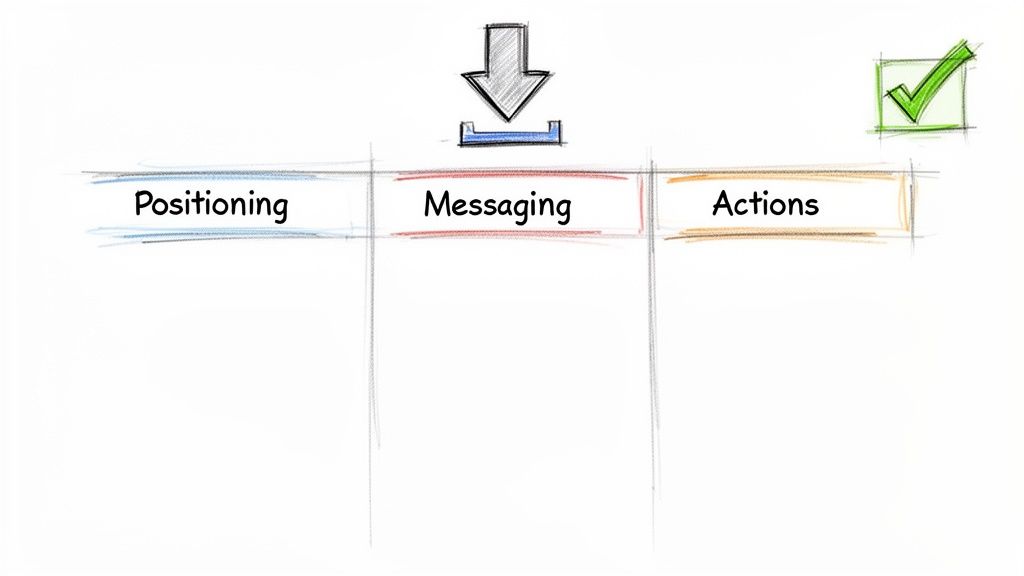
This isn’t another fluffy PDF full of abstract marketing jargon. It’s a dead-simple framework built on the three pillars that actually matter for growing tech, agtech, and B2B service businesses. The whole point is to give you a tool that feels light and manageable, so you get an immediate sense of direction.
It’s the exact same structured approach we use to bring clarity to teams quickly. Before you dive in and download the template, let’s take a quick look at what’s inside and why each part is so critical.
What The Template Helps You Clarify
This framework is built to get your entire team aligned on the absolute essentials. It’s designed to pull you out of scattered ideas and create a single source of truth.
Each section builds on the last, creating a logical flow from high-level strategy right down to your day-to-day work.
Here's a quick overview of what each section helps you figure out.
Template Sections and Their Purpose
Template Section | Core Question It Answers | Business Outcome |
|---|---|---|
Brand Positioning | Who are we for and why do we matter? | A sharp focus that attracts ideal customers and guides product decisions. |
Brand Presence | How do we sound, look, and feel? | Consistent messaging and visuals that build recognition and trust. |
Go-To-Market Actions | How will we build trust and create demand? | A simple plan to reach the right people without wasting time or money. |
This structure ensures you know exactly what you’re working toward before you even begin, turning a big, intimidating task into a series of clear, achievable steps.
Getting Clear On Your Brand Positioning
If you feel like you’re constantly fighting to explain what you do, the problem almost always starts here. Positioning isn't marketing jargon; it's the foundation for everything. Get this wrong, and every part of your business feels like an uphill battle.

This is where most teams get tangled. In an effort not to miss any potential customers, they try to be everything to everyone. The result? Generic, forgettable messaging that connects with no one.
The first part of the brand strategy template is designed to pull you out of this haze. It forces you to get incredibly specific about who you serve, the precise problem you solve for them, and what makes your approach different. It’s about making confident choices.
A Founder Moment: The Agtech Startup
I remember working with an Australian agtech startup. They had brilliant soil sensors, but their sales cycle was painfully slow. Their pitch was all about "improving farm efficiency"—a claim every single one of their competitors was also making. They were stuck.
So we took a step back and got focused. They decided to target one very specific audience: large-scale wheat farmers in Western Australia.
Then, they defined a single, measurable problem they could solve better than anyone else: reducing water usage. Their new position became razor-sharp: "We help large-scale wheat farmers reduce water usage by 15%."
That one small shift in clarity changed everything. Their sales team suddenly had a concrete, compelling hook. Their marketing team could create content that spoke directly to a specific group. This is the kind of clarity we always fix first when we embed with a team. Without it, you're just adding to the noise.
The Three Core Questions For Positioning
Your template will guide you through this, but it all boils down to answering three fundamental questions. Don't rush these. Debate them with your team until the answers feel simple, clear, and true.
Who is your ideal customer? Go beyond demographics. What is their mindset? What pressures are they under?
What is their specific, urgent problem? Focus on the pain you solve, not the features you offer. Be as specific as the agtech startup.
What makes you the only logical choice? This is your differentiator. It could be your technology, your process, or your deep expertise in a tiny niche.
Getting this right isn't just about external marketing. The most powerful story is the one a team tells itself. When your own people are crystal clear on why the business matters, that confidence naturally extends to your customers.
To really nail this, understanding the core of market positioning strategy is essential. It provides the framework for carving out a unique space in the minds of your audience.
From Vague Claims to Sharp Focus
Let's make this even more practical. Most companies start with generic statements. The point of positioning work is to move from the left column to the right.
Vague & Generic (Before) | Sharp & Specific (After) |
|---|---|
"We are a SaaS platform for businesses." | "We are a compliance automation platform for Australian financial services firms." |
"Our software improves productivity." | "Our software cuts project reporting time in half for engineering managers." |
"We offer expert consulting services." | "We help B2B tech companies build their first repeatable sales process in 90 days." |
See the difference? The statements on the right give you immediate direction. You know who to talk to, what to say, and what to build next. That’s the power of a structured approach—it replaces guesswork with clarity.
Defining Your Brand Presence and Messaging
Once you’ve nailed your positioning, it’s time to build a presence that reflects it. This is where you translate that sharp, strategic focus into the words, personality, and ideas your brand will become known for.
A lot of founders get stuck here. They’ve sorted their positioning, but defining a "brand voice" feels abstract and a bit fluffy. The temptation is to dive straight into writing website copy, but that’s like trying to build a house without a blueprint.
This part of the brand strategy template is about creating that blueprint. It’s not about chasing a clever slogan. It’s about establishing a consistent, human language that builds trust.
Moving Beyond Jargon to a Human Voice
Most B2B companies fall into the same trap: they adopt a professional but sterile voice. They load up on jargon, thinking it makes them sound credible. In reality, it just makes them sound like everyone else.
The goal is to define a personality that feels authentic to your team and connects with the people you’re trying to help.
A simple way to get started is to choose three to five adjectives that describe how you want your brand to sound. Are you:
Confident, direct, and pragmatic?
Curious, insightful, and supportive?
Witty, challenging, and energetic?
These aren't just buzzwords to bury in a document. They become a practical filter for everything you create. Before you publish anything, ask: "Does this sound direct and pragmatic?" This simple check is often the first step toward a consistent and memorable brand.
A Founder Moment: The SaaS Company Finds Its Voice
I once worked with a founder-led SaaS company that had an incredibly powerful data analytics tool. The problem? Their website was impenetrable. Just walls of technical jargon. Prospects were dropping out because they couldn't figure out what the product actually did.
In a workshop, we landed on three simple words for their personality: clear, confident, and practical.
That small shift became their new north star.
Instead of trying to sound "innovative," they focused all their energy on sounding "clear." That one word forced them to simplify their language and talk like a helpful expert, not a robot.
The result? They rewrote their homepage and stripped down their sales decks. Their demo request conversion rate doubled in two months. Why? Because prospects finally understood them. This shows how a structured approach turns an abstract idea into something that gets real results. For more on this, check out our guide on how to build clear branding and messaging.
From Personality to Core Messages
Once you’ve found your voice, you need to define your core messages. These are the one to three big ideas you want to own in your market. They are the recurring themes that will show up everywhere.
For that SaaS company, their pillars might have looked something like this:
Data Clarity, Not Complexity: We turn messy data into simple, actionable insights.
Faster Decisions, Better Outcomes: Our platform helps you make confident choices in minutes, not days.
A Practical Partner for Growth: We provide hands-on support to ensure you get value from day one.
These pillars provide the structure you need to keep all your content on-message. It’s no surprise that a whopping 74% of Australian businesses now have a documented content marketing strategy; this trend is directly tied to the need for frameworks that connect clear messaging to promotion.
When you combine a clear message with the AU$7.5 billion projected to be spent on social media ads in 2025, you can see how a disciplined brand strategy creates a powerful engine for your business.
Planning Your Go-To-Market Actions
A brilliant brand strategy is useless if it just sits in a folder. It’s only valuable when it informs what you actually do. This is where your clear positioning and sharp messaging get turned into a simple plan to connect with the right people.
The feeling of overwhelm at this stage is incredibly common. Founders look at the endless list of potential marketing channels—social media, ads, SEO, content—and feel paralysed. The temptation is to try a little bit of everything, which means you end up doing nothing well.
This part of the brand strategy template is about fighting that chaos. It's about making deliberate choices to focus your energy on the few channels that matter most.
From Scattered Tactics to Focussed Action
Most marketing plans are just a random list of tactics. A much better approach is to think in terms of themes or "sprints." Instead of trying to be everywhere at once, you pick one or two core activities and execute them well for a set period.
This is the exact way we structure our work with teams. A sprint-based approach creates clarity and momentum far more effectively than scattered efforts. It turns a messy to-do list into a confident plan.
Your marketing shouldn’t feel like a frantic scramble. It should be a calm, deliberate set of actions designed to build trust over time with the specific people who need what you have.
This means saying "no" to most things so you can say a powerful "yes" to a few. A great plan isn't about the volume of activity; it's about the quality and consistency of your chosen actions. To help structure this process, you might find a product launch strategy template useful.
A Founder Moment: The B2B Firm Finds Focus
I remember working with a B2B service firm that was spending a fortune on LinkedIn ads and getting terrible results. They felt the pressure to "be on social media," but their strategy was disconnected from their audience. Their customers didn't make decisions based on a flashy ad; they needed expertise and trust.
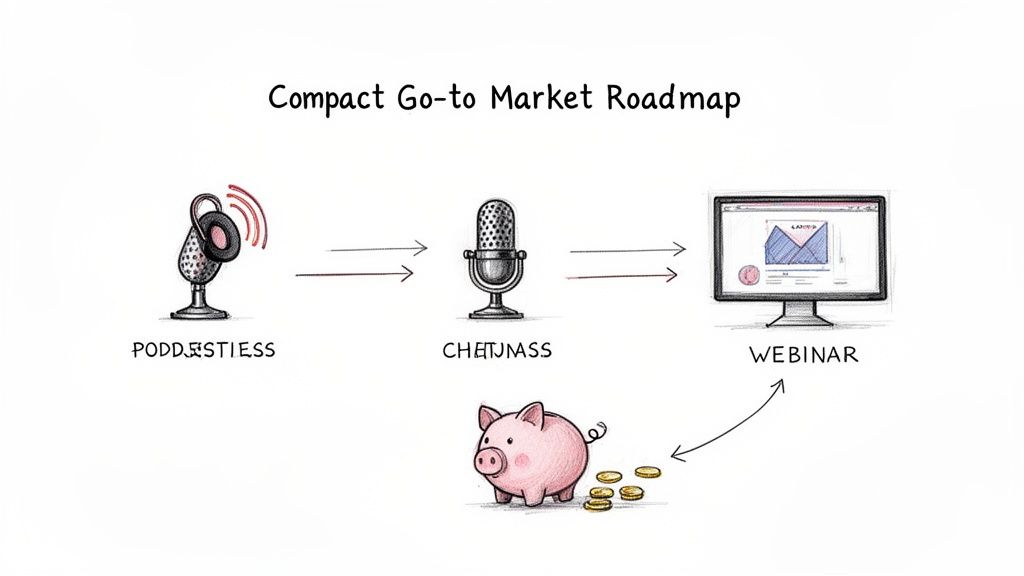
Using their new brand strategy, they made a brave choice. They paused almost all of their ad spend and went all-in on two activities:
A highly targeted weekly podcast with experts in their niche.
A deep-dive monthly webinar that solved a specific problem for their ideal customer.
The results were stunning. They cut their marketing spend by 60% and tripled their qualified leads within six months. By focusing their efforts, they went from shouting into the void to having meaningful conversations. If this resonates, you might be interested in our guide on fixing your go-to-market strategy.
Choosing Your Core Channels
So, how do you choose? Your brand strategy template will guide you, but it comes down to one question: "Where do our ideal customers go when they're looking for solutions?"
Don't just guess. Talk to your existing customers. Ask them:
What newsletters do you actually read?
What podcasts do you listen to?
What communities or industry groups are you a part of?
Who do you trust for advice in your field?
Their answers will give you a simple roadmap for where to focus your attention. You’ll likely find that just two or three channels are responsible for the vast majority of influence.
This kind of structured thinking is what drives real brand value. In 2023, the total brand value of Australia's top 100 brands surged by 15% to AU$194 billion. This growth wasn’t accidental; it was the result of deliberate strategies connecting strong positioning with consistent market presence.
One Confident Step to Bring It All Together
You've done the hard work. You’ve wrestled with the big questions, filled out the brand strategy template, and now you have a document that represents hard-won clarity.
So… what now?
The last, and most important, step is to make it real. This isn't about planning some huge launch that will paralyse your team. It's about taking one small, confident action that weaves this new clarity into the fabric of your business.
Overwhelm is the enemy of momentum. The best way to build confidence is to start with small, deliberate steps that create a ripple effect.
A Simple Activation Checklist to Get You Started
Forget the giant to-do list. Focus on this simple sequence. It turns a daunting task into a series of manageable actions.
Here’s where to begin:
This Week: Update the main headline on your homepage. Just that one thing. Make it perfectly reflect your new positioning.
Next Week: Tweak the first paragraph of your company’s LinkedIn page. Use the simple, human language you defined.
The Week After: Brief your sales team on the new one-sentence description of what you do. Give them the exact words and explain why this will make their conversations easier.
See the pattern? It’s all about small, visible changes. These simple wins build momentum without the stress of a big reveal. Each little step reinforces the new direction.
If this part of the process feels a bit messy, or if you're struggling to get the team to actually use the new language, that’s completely normal. You’re not falling behind. It’s usually a sign that you need a more structured, sprint-based approach to bridge the gap between strategy on a page and execution in the real world.
Most teams get stuck here because they’ve never had someone show them how to structure this exact part of the work—translating a document into daily behaviour. When we embed with a team, this is a core problem we solve.
Start small, be deliberate, and watch the clarity spread.
Still Have Questions About Brand Strategy?
Even with a solid template, it's normal for a few questions to pop up. Building a brand strategy is a big undertaking, and it’s easy to feel like you’re missing something. Let’s clear up a few of the most common things we hear.
The goal here is to give you the confidence to push forward.
How Often Should We Revisit Our Brand Strategy?
Your brand strategy isn't a "set it and forget it" document. For a growing company, a light quarterly check-in is a great rhythm. It’s a chance to ask: Is our positioning still sharp? Is our messaging still hitting the mark?
You'll want to do a deeper dive once a year, or whenever something big changes—a major new product, entering a new market, or a significant pivot. The point isn’t to constantly be changing things, but to make sure your strategy stays relevant.
What’s the Real Difference Between a Brand Strategy and a Marketing Plan?
This is the most common point of confusion we see. Getting this straight changes everything.
Here’s the simplest way to think about it:
Your brand strategy is your foundation. It’s the 'who', 'what', and 'why' of your business. It's the core thinking that defines your unique position in the market.
Your marketing plan is the 'how'. It’s the actions, channels, and campaigns you'll use to bring that brand to life. A marketing plan without a solid strategy is just a list of disconnected activities—which is why so much marketing feels like guesswork.
How Do We Get Our Whole Team on the Same Page?
Conflicting ideas about brand direction are incredibly common. It's usually a sign that you need a structured process to get everyone aligned.
Honestly, the template itself is one of the best tools for this.
Get your key people in a room and work through the sections together. Out loud. An external facilitator can be a game-changer here, as they can keep the conversation focused.
The trick is to anchor everyone's subjective opinions to the objective questions in the template. This shifts the conversation from "I think..." to "What's right for the business?" This is exactly how we start our sprints—by structuring the conversation and guiding the team to a clear, unified outcome.
If you're tired of guessing and ready to build a brand with structure, clarity, and confidence, Sensoriium can help. We embed with your team to fix what’s not working and give you a clear path forward. Let's talk.