
A Guide to Marketing Strategy Consultation
- Jan 23
- 11 min read
You're doing a lot of marketing—running ads, posting on socials, sending emails—but it all feels disconnected. There's a flurry of activity, but no real momentum. Sales are slow, the team seems confused, and you're not sure which levers to pull next.
If that sounds familiar, you’re not failing. It’s a common growing pain that happens when ad-hoc marketing just doesn’t cut it anymore. Feeling stuck is a normal part of scaling up.
The real problem isn't a lack of effort. It's the absence of a clear structure connecting all that hard work to actual business results. A marketing strategy consultation is designed to fix exactly that. It's not about adding more to your plate; it's about making sure every single thing you do has a purpose.
Why Your Marketing Feels Stuck
Let's start with a feeling most founders know. You're doing a lot of marketing—running ads, posting on social media, sending emails—but it all feels disconnected. It’s a flurry of activity, but there’s no clear ‘why’ behind it all.
This isn’t a sign you're failing. It’s actually a very common growing pain that happens when ad-hoc marketing just doesn't cut it anymore. Feeling stuck is a completely normal part of scaling up.
The Real Source of the Problem
You know your product is fantastic, but your team has a hard time explaining its value in a way that sticks. This confusion shows up as slow sales cycles and prospects who just don't 'get it'.
More often than not, this happens because businesses are chasing the wrong things. It's so easy to get caught up in metrics that look good on paper but don't actually move the needle, which is a big part of why vanity metrics are actually hindering your progress. Likes and traffic are great, but they don't pay the bills.
The issue isn't a lack of effort or ideas. It's the absence of a solid framework that connects all that hard work to real business results.
Founder Moment: An agtech client once told us, "We had three different ways of describing our product. In our first workshop, we realised none of them actually explained the problem we solve for farmers." That single realisation changed everything.
This is precisely where a fresh, outside perspective becomes invaluable. Most teams are too close to the problem to see the solution. They’ve never had someone come in, structure the conversation, and ask the tough, uncomfortable questions.
When we join a team, the very first thing we do is tackle this gap between frantic activity and meaningful outcomes. A marketing strategy consultation is built to diagnose this disconnect. It’s not about piling more work onto your plate; it’s about making sure every single thing you do has a purpose and moves you along a clear, confident path forward.
What a Consultation Actually Looks Like
Forget generic slideshows packed with textbook ‘best practices’. A proper marketing strategy consultation isn't a lecture; it's a hands-on diagnostic process. The goal is to get to the heart of what’s really going on in your business.
Think of it as a structured deep-dive. A consultant steps in to look at your business model, customer perspectives, competitive landscape, and how your internal teams are aligned. They’re there to ask the tough questions your own team is too close to the action to see clearly.
This disconnect often creates a domino effect. Disjointed ads lead to a confused team, which then causes sales to slow down.
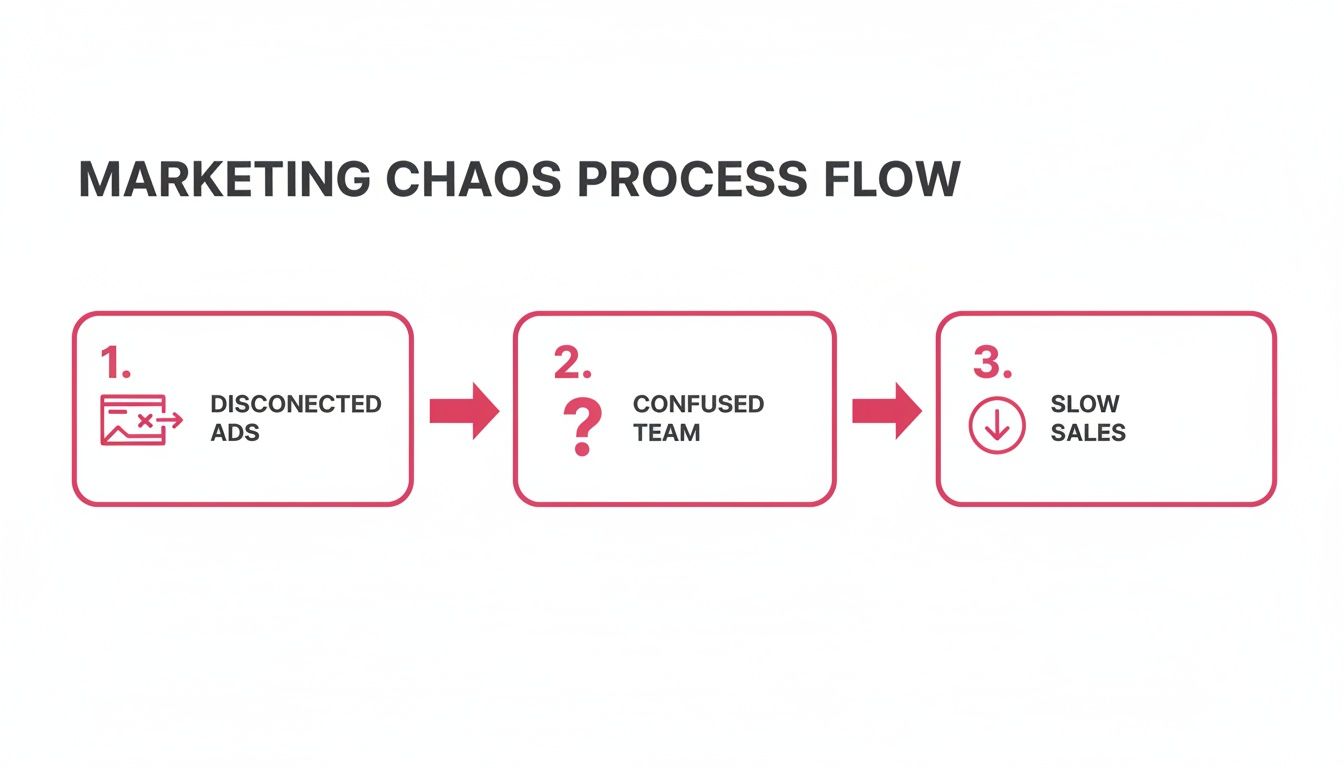
As you can see, symptoms like poor ad performance are rarely the real problem. They're just the most visible sign of a deeper strategic mess.
From Mess to Momentum
A quality consultation goes beyond surface-level issues to find the gaps in your foundation. It’s less about finding a magic bullet and more about building something solid that will actually last.
Here’s an analogy: if your car keeps pulling to one side, you don’t just keep yanking the steering wheel in the other direction. You get a wheel alignment. A consultation is the strategic equivalent of that alignment for your business.
For example, when we embed with a team, we facilitate workshops that force these foundational conversations out into the open. It’s a collaborative, focused process that builds genuine clarity and gets everyone pointing in the same direction.
Founder Moment: “We had three different ways of describing our product. In our first workshop, the consultant put them all on a whiteboard and asked, ‘Which one actually gets you a second meeting?’ That single question changed everything for us.”
This is the real work. It’s not about generating more ideas; it’s about structuring the thinking so the right ideas can emerge and stick.
Uncovering What Really Matters
The process is methodical, looking at the entire system instead of just isolated parts. A good consultant will dig into areas like:
Customer interviews: To hear directly from the people who buy (or don't buy) from you.
Team workshops: To get marketing, sales, and leadership on the same page.
Data analysis: To find the real story hiding in your numbers, looking at everything from website traffic and lead sources to sales conversion rates. A thorough technical review, like the process we outline in our guide to getting clarity with SEO audit services, often uncovers critical insights.
The end goal isn't a massive, complicated report that gathers dust. It’s to deliver a clear, actionable path forward that your team feels confident executing. You should walk away with structure and momentum, not just another document.
The Difference Between Advice and an Actionable Plan
We’ve all been there. You hire a consultant, and a few weeks later, a massive PDF lands in your inbox. It’s packed with recommendations that sound good but feel… generic. It might look impressive for a day, but then it gets filed away on a server, never to be seen again.
That experience is frustratingly common, and it’s why so many founders are wary of consultants. It makes sense. You weren't given a plan; you were given a document.
There’s a massive difference between getting advice and getting an actionable plan. The real value isn't in a hundred different ideas. It's in the structure, priorities, and clear steps that build momentum for your team.

From Theoretical to Tangible
A proper marketing strategy consultation should deliver a practical roadmap, not a theoretical paper. Think of it as a tool your team can use to guide decisions, assign ownership, and measure progress.
A consultant's output should reduce your workload, not add to it. If you’re left with a list of 50 things to do, they haven’t done their job. Their real job is to deliver clarity and focus, not just another to-do list.
This is at the core of how we see things. When we work with a team, our goal isn't just to leave them with a plan. It’s to give them the systems and clarity to execute it confidently long after we’re gone. The point is to build your team’s capability and confidence.
For that to happen, the plan has to connect the big-picture strategy to the day-to-day grind. It needs to answer questions like:
What are the three most important things we need to do this quarter? Not twenty things, but the vital few.
Who owns each initiative? This is about accountability and making sure things get done.
How will we measure success? This gets you out of the guessing game and into tangible results.
What do we stop doing? Often the most powerful part of a good strategy—getting permission to stop wasting energy.
This is what we focus on when building a marketing strategy that works, because a plan without a system is just another document.
The Difference in Deliverables
It's easy to see the gap between generic advice and a structured consultation when you compare what you walk away with. One gives you ideas, the other gives you a pathway.
Consulting Outcomes: Advice vs A Plan
Deliverable | Generic Advice-Based Consultation | Structure-Based Consultation |
|---|---|---|
Output | A long document of recommendations. | A clear, prioritised roadmap with timelines. |
Clarity | Often overwhelming, with dozens of "shoulds". | Focused on the 3-5 most critical initiatives. |
Ownership | Vague; leaves the team to figure out who does what. | Specific owners assigned to each action item. |
Measurement | Suggests general KPIs to track. | Defines specific, measurable goals for each initiative. |
Next Steps | Leaves you with a new project: "implement the report". | Provides the first 30-60-90 day steps to get started. |
Ultimately, a structured plan is designed for action. It’s built to be used, not just read.
An Example in Action
Let’s imagine a B2B SaaS company struggling to get enough leads.
Generic advice would sound like, "You should create more content." It’s not wrong, but it’s not helpful. It leaves the team wondering, "What content? On what platform? For who?"
An actionable plan is specific. A consultant might find that the highest-value leads come from a specific customer segment, say, logistics managers in mid-sized firms. The plan would then outline a three-month content calendar focused only on solving their unique problems. It would assign the blog posts to one person, the LinkedIn distribution to another, and set a clear goal for new demo requests from that specific content.
For a deeper dive into making this happen on social media, resources like Your Social Media Marketing Strategy Playbook can offer a great framework.
That’s the difference. One is a vague suggestion. The other is a clear, confident path forward.
How to Prepare for Your Consultation
The success of a marketing strategy consultation comes down to preparation. This isn't about having all the answers. It’s about being honest with yourself and the consultant about what’s not working.
You might be looking at a tangled mess of data and disconnected tactics. That’s completely normal. A good consultant isn't there to judge; they're there to help you make sense of the chaos. Your job is to bring all the pieces to the table so they can see the whole puzzle.
When a client comes prepared, the consultant can get to the heart of the matter and deliver clarity much faster.
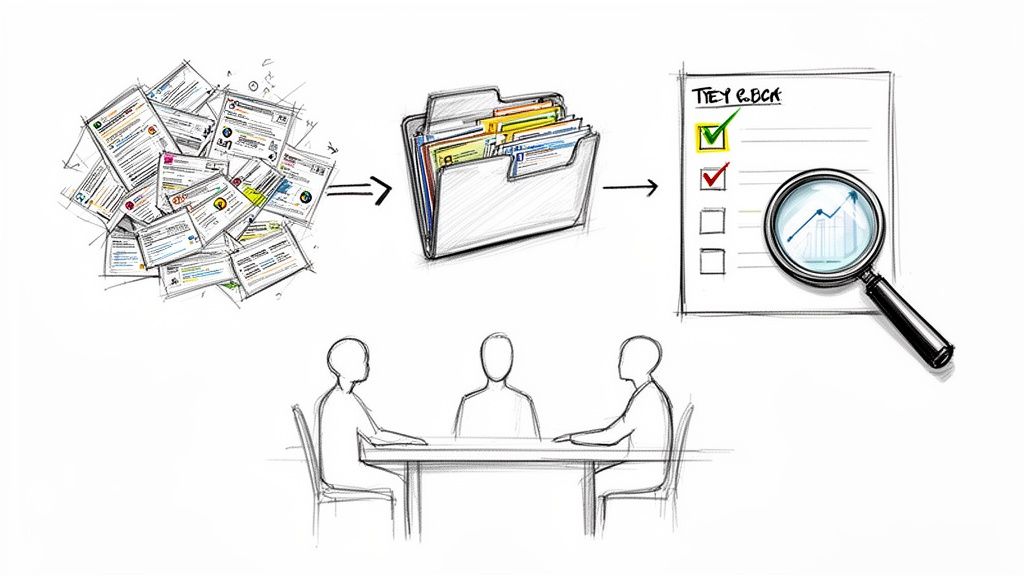
Think of this prep work as the first step in building momentum. It’s the same groundwork we establish when we embed with a new team.
Collect What You Already Have
Before the first meeting, start pulling together any data you have. Don’t worry if it feels messy or disorganised. The idea is to give the consultant a real starting point.
Marketing & Sales Data: Pull reports from your CRM, Google Analytics, ad platforms, and social media. Even a simple spreadsheet tracking leads and conversion rates is gold.
Previous Plans or Audits: Got any old strategy documents gathering dust? Dig them out. They offer context on what’s been tried before.
Customer Feedback: Gather any customer surveys, online reviews, or interview notes. Hearing things in your customers' own words is often the most insightful data you can share.
The best consultations start with a founder saying, "Here’s everything. It's a mess, but it's the truth." That honesty is the fastest path to clarity.
Define What a Win Looks Like
This might be the most important part of your preparation: getting clear on what a successful outcome looks like for your business. Be specific.
Don't just say, "We want more leads."
A much better goal would be: "We need to generate 20 qualified enterprise leads per month within the next six months to hit our revenue targets."
See the difference? That small shift changes the entire conversation. It moves you from fuzzy activities to tangible business results. It gives the consultation a sharp focus right from the start.
Understanding Consultation Pricing Models
Let's cut through the confusion around cost. When you're looking at a marketing strategy consultation, the price tag isn't just a number. It’s a reflection of how the consultant defines value.
You're not just buying hours; you're investing in clarity, structure, and momentum. The way you pay should line up with those goals.
This is becoming more important as the need for specialist skills grows. Australia's consulting market is expected to hit around AUD $29.78 billion by 2034, up from AUD $14.45 billion in 2025. This growth shows how vital it is to partner with someone focused on tangible results, not just billable hours. You can dig into the full research about Australia's consulting market expansion for the full picture.
Choosing Value Over Hours
Most consultants use one of three pricing models. Knowing the difference is key.
Hourly Rates: The old-school approach. The problem is, it rewards the consultant for taking longer, not for finding the fastest path to a solution. You end up watching the clock instead of focusing on the problem.
Monthly Retainers: These can be great for ongoing work, but for a one-off strategic deep-dive, they can get vague. You risk paying for access instead of action, and the initial urgency is lost.
Project-Based or Sprint Fees: This is where it gets good. A fixed fee for a specific, defined outcome—like a complete strategic roadmap—gets everyone on the same page. The investment is tied directly to a tangible result.
We exclusively use a sprint-based model because it forces focus. When we embed with a team, the fixed fee means our only incentive is to deliver clarity and a workable plan as efficiently as possible. It removes the tension of hourly billing.
Why a Fixed Fee Creates Confidence
A project-based fee changes the dynamic. It becomes a partnership. You know exactly what you’re investing and what you'll have at the end. No surprise invoices, no budget blowouts.
This transparency lets you see the consultation as an investment in your company's foundation, not just another expense. It gives you the confidence to tackle those messy, deep-seated problems because everyone is pulling towards the same clear goal.
Your First Step Toward Marketing Clarity
This isn't about a hard sell. The goal is to give you one calm, confident next step you can take right now—before you spend another dollar on marketing that isn't working.
Take a moment and think about your business. What's the single biggest point of friction? What's the one thing that just feels… messy?
Is your messaging all over the place?
Has your sales pipeline slowed to a halt?
Are you struggling to find qualified leads?
The most powerful thing you can do today is put a name to the main source of the chaos. If you can't pinpoint it, that's completely normal. You're not behind; you're just too close to the problem.
This is where a fresh perspective makes a huge difference. When your view is clouded by the day-to-day grind, a structured conversation can bring the real issue into focus, fast.
If this feels difficult, that’s a good sign. It means you’re on the right track. The messiest problems, once solved, create the most momentum and give you back your confidence.
If you're finding it tough to nail down that starting point, our complimentary 15-minute Clarity Call is designed for exactly this. It’s a simple, no-pressure chat to help you identify that one critical friction point and find your first step toward real structure.
Got Questions? Let's Get Them Answered
If you're a founder or marketing leader weighing up a strategy consultation, a few questions probably come to mind. Here are some of the most common ones we hear, with straight answers.
How Long Does a Consultation Take?
A high-impact consultation shouldn’t drag on. The point is to get you significant clarity and a real-world plan within a set timeframe.
A sprint-based approach often runs for a fixed period, say four to six weeks. That’s usually the sweet spot to diagnose the real problems, build a solid strategy, and get your team moving with some early wins.
This avoids the dreaded open-ended retainer where progress feels fuzzy. We get in, help you solve the big strategic puzzle pieces, and get you on a clear path. Fast.
What’s the Difference Between a Consultant and an Agency?
Think of a marketing strategy consultant as an architect. Their job is to find the root cause of what’s stalling your growth and then design the strategic framework—your positioning, messaging, and plan—to fix it.
An agency, on the other hand, is the builder. They’re the crew you hire to run your ads, manage your social media, or handle your SEO.
While some agencies offer strategy, a dedicated consultant brings an unbiased, senior-level perspective focused purely on getting the foundations right. They draw up the blueprint; an agency helps you build the house.
A consultant’s core deliverable is clarity and direction. An agency’s is day-to-day work. Most teams struggle because they hire for execution before they have a clear strategy, which is like starting construction without a blueprint.
Will a Consultant Work With My Existing Team?
Absolutely. They have to. A good consultant doesn’t replace your team; they make them better. The process has to be collaborative, pulling in key people from marketing, sales, and leadership.
The consultant’s role is to provide the structure and direction that might be missing internally. When we embed with a team, we act as a temporary leader to get everyone aligned and leave your team more capable and confident than when we started.
It's about building your internal muscle for the long haul, not creating dependency. By the end, your team should feel like they have a much firmer grip on the wheel.
If you're tired of guessing and ready for a clear, structured path forward, Sensoriium can help. We provide the senior marketing leadership and practical support to give your business the clarity and confidence it needs.