
SEO Audit Services: Getting Clarity in Your Marketing
- Jan 20
- 12 min read
Ever get that nagging feeling something’s just… off with your website?
You're creating content, tweaking pages, maybe even running ads. But the numbers are flat. Traffic is stuck, leads are sporadic, and you can’t quite put your finger on why.
It’s a frustration we see all the time. There's a sense you’re missing something fundamental, but you're just too close to it to see the problem clearly. You’re not imagining it. That feeling is real.

Why your hard work isn't translating to results
That stuck feeling usually comes from a dozen small, unaddressed technical and strategic issues that have piled up over time. They create a serious drag on your momentum.
A website can’t perform if the foundation is cracked. In fact, most professional services websites aren't winning clients precisely because of these hidden gaps.
This is where professional SEO audit services come in. It’s not about finding a magic keyword or chasing the latest algorithm. It’s about taking a clear-eyed look at the root cause of the stagnation.
An audit’s purpose is to move from guessing and hoping to having genuine clarity and confidence. It gives you a structured, practical plan to fix what's actually broken.
When we embed with a team, this diagnostic is the very first thing we do. It pinpoints the exact roadblocks, giving them the structure needed to make confident decisions instead of just trying more things.
The path from confusion to clarity
The whole point is to stop the cycle of random actions and build an intentional path forward. A solid SEO audit brings that clarity by answering critical questions:
Are there technical glitches making your site invisible to Google?
Does your content actually line up with what your customers are searching for?
Is your online presence strong enough to be seen as a credible authority?
Getting straight, honest answers is how you shift from feeling stuck to building real, sustainable momentum.
So, what is an SEO audit, really?
Let’s be honest. A lot of so-called "audits" are just long, intimidating lists of broken links and tech jargon. That’s not clarity; that’s just noise.
Think of it like getting a builder’s inspection before you renovate. You wouldn’t start knocking down walls without knowing if the foundation is solid or if the wiring is a fire hazard. A proper SEO audit does the same thing for your website—it’s an essential diagnostic.
Its purpose is to uncover the hidden roadblocks preventing your site from being found by search engines and, more importantly, by your ideal customers. It goes way beyond surface-level numbers to give you a clear, prioritised plan.
From vague problems to a clear roadmap
A great audit takes that nagging feeling of "why aren't we growing?" and turns it into a specific, actionable plan. It’s about finally getting answers to the big questions.
So, instead of just wondering, “Why isn’t our traffic growing?”, the audit gives you a concrete reason: “Your page load speed is two seconds slower than your main competitor, causing a high bounce rate on mobile.”
That shift from guesswork to a data-backed diagnosis is where the real value lies. It provides the confidence and structure to make smart decisions.
What a real audit uncovers
A thorough SEO audit service looks at your entire digital foundation, not just a few keywords. When we work with a team, our first sprint is always this deep diagnostic phase because it immediately tells us what to tackle first for the biggest impact.
Typically, it delivers:
A Technical Health Score: A clear snapshot of your site’s crawlability, indexability, speed, and mobile-friendliness. Can Google even find your pages?
A Content & Relevance Analysis: An honest look at whether your content actually matches what your audience is searching for.
An Authority & Trust Snapshot: A measure of your online reputation, including your backlink profile and how you stack up against competitors.
A Prioritised Action Plan: This is the most important part. Not a list of 100 problems, but a focused roadmap that says, "Here are the three biggest opportunities. Let's start here."
This structure is what turns a messy, overwhelming problem into a series of calm, manageable steps. It creates momentum.
A valuable audit doesn't just tell you what's broken. It shows you the precise order in which to fix things to get the best results with the least wasted effort.
For growing B2B teams, this kind of strategic direction is vital. In Australia, SEO audits can range from $2,000 to over $10,000 for a comprehensive project. That investment buys the clarity needed to sharpen your entire go-to-market approach. It makes sense when you consider that 93% of online experiences begin with a search engine, yet 75% of users never go past the first page.
As a practical example, one of our audits helped a business increase its indexed pages from just 6 to 378, completely changing their online visibility. You can get a better sense of Australian SEO pricing and value on studiohawk.com.au.
The three layers of a meaningful website audit
It's easy to feel like you're chasing your tail with SEO. You tweak some content, fix a few broken links, and then... nothing really changes. This frustrating loop often happens because teams are only looking at one piece of a much larger puzzle.
To get real clarity, you need to think of a website audit in three distinct layers. A weakness in one layer will always undermine the effort you put into the others. It’s why so many marketing efforts feel like they’re running on flat tyres.
Layer 1: The technical foundation
First is the Technical Audit. This is the non-negotiable foundation of your entire online presence. Think of it like the plumbing and wiring in your house—if it’s faulty, it doesn’t matter how nice the furniture is.
This layer answers one critical question: can search engines efficiently find, crawl, and understand your website?
It’s where we look for invisible roadblocks, such as:
Slow page speeds that send frustrated visitors away.
Mobile usability issues that alienate the majority of your audience.
Indexing errors that make your most important pages invisible to Google.
This is often where we find the biggest quick wins when we embed with a team. Fixing these foundational issues can unlock progress that was previously stuck, creating a stable base for all other work.
Layer 2: The content and on-page structure
Next, the On-Page Audit. This layer zooms in on the actual content on your website and how it’s structured. It’s about making sure your message is clear, relevant, and easy for both people and search engines to follow.
This isn’t about stuffing in keywords. It’s about asking deeper questions:
Are your pages actually targeting the topics your ideal customers are searching for?
Is your messaging clear, guiding visitors toward a specific next step?
Are you using headings and internal links to create a logical, intuitive flow?
A great website is a carefully structured experience. Our guide on what makes a good website dives deeper into how this structure builds clarity for you and confidence for your visitors.
Layer 3: The off-page authority
Finally, the Off-Page Audit. This layer looks at your website's authority and reputation across the wider internet. In simple terms: does the rest of the web see you as a credible, trustworthy source?
This is primarily about your backlink profile—who is linking to your site? A strong profile, with links from reputable websites, acts as a powerful vote of confidence for search engines. A weak or toxic profile can hold you back, no matter how good your content is.
A proper SEO audit connects all three layers. It gives you a single, unified picture, showing you precisely how technical health, content relevance, and online authority are working together—or against each other.
This diagram shows how a comprehensive diagnostic is built on these three pillars: technical health, content relevance, and online authority.
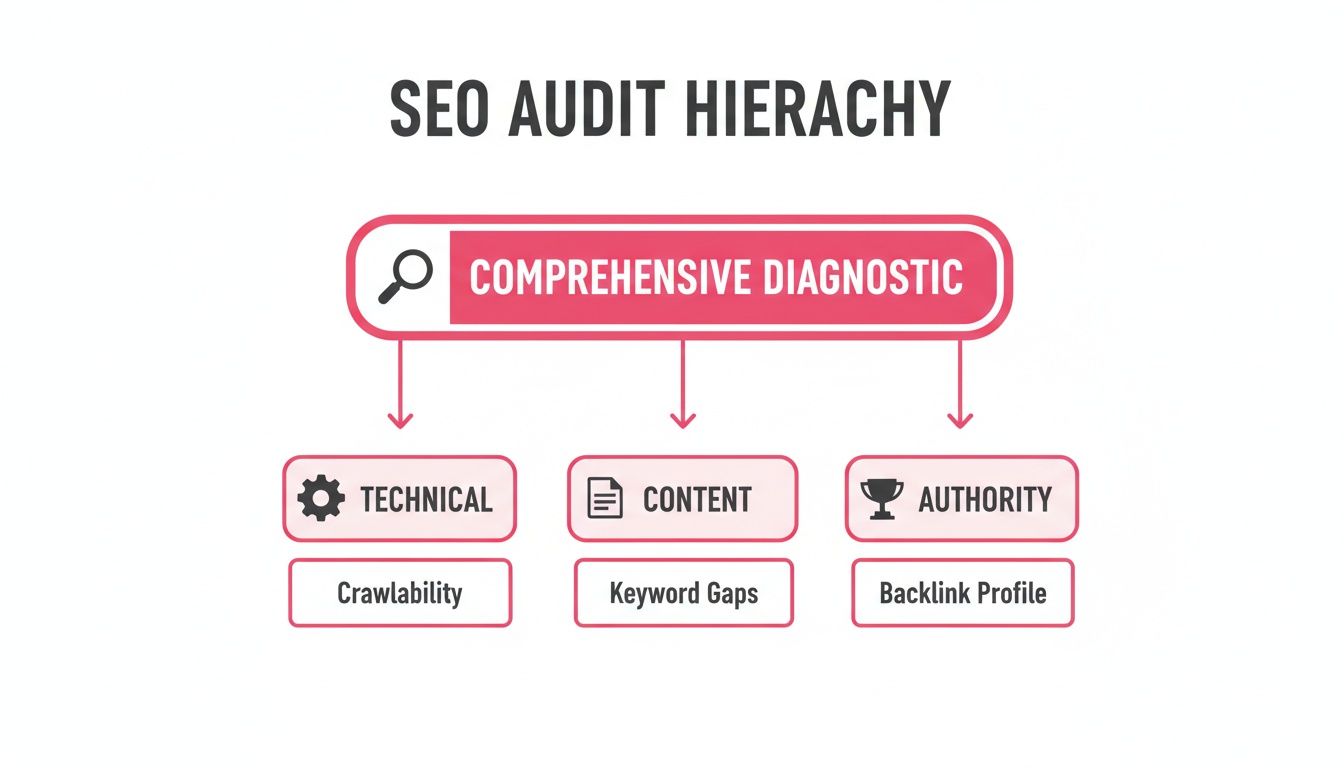
The key is that you need all three components working in harmony. For a more targeted example, look at mastering local SEO audits, which applies these same principles to a specific area. Only by addressing all three layers can you build sustainable, long-term momentum.
Turning audit findings into a simple plan
An audit that just lists a hundred problems isn't helpful. It's just more noise. You've probably seen those reports—a dense, jargon-filled PDF that lands in your inbox, leaving you more confused than when you started.
The real value of good SEO audit services is turning findings into a clear, prioritised roadmap. The goal isn't a massive list of every tiny flaw; it's a simple plan that says, ‘Here are the top three things holding you back. Let’s fix these first.’
For a founder-led business, that kind of clarity is gold. It stops the team from chasing shiny objects and focuses their energy on changes that will actually make a difference.
From a long list to focused sprints
This is where breaking the work into sprints is so effective. Most teams get paralysed by a long, open-ended project plan that just feels overwhelming. A better way is to slice the work into focused, manageable chunks.
Instead of a six-month slog, you tackle the most critical technical fixes in a single two-week sprint. Once that’s done and everyone sees progress, you move on to content improvements in the next sprint.
This approach does a few crucial things:
It creates momentum: You see tangible results fast, which builds confidence.
It reduces overwhelm: A giant to-do list is replaced by a clear focus on this sprint.
It forces prioritisation: You have to decide what truly matters now, not what might be nice to fix someday.
When we join a team, this is exactly how we get things moving. The first thing we fix is the gap between a messy audit document and a clear, sprint-by-sprint plan. It turns a scary list into a calm, step-by-step process.
Comparing audit approaches: ad-hoc fixes vs structured sprints
The difference between randomly fixing things and working in structured sprints is night and day. One path leads to chaos; the other builds clarity and real momentum.
Here's a quick breakdown.
Aspect | Ad-Hoc 'Fix-It' Approach | Structured Sprint Approach |
|---|---|---|
Focus | Reacts to the loudest problem or latest idea. | Focuses on the highest-impact tasks from the audit. |
Pacing | Unpredictable bursts of activity and long lulls. | Consistent, predictable progress in short cycles. |
Team Morale | Often feels like you're constantly behind. | Builds confidence with clear wins each sprint. |
Outcomes | Small, disconnected fixes with little overall impact. | Cumulative gains that build on each other. |
This shows why a structured approach is so much more powerful.
A great action plan isn't about doing more; it's about doing the right things in the right order. This structure is what turns an audit from just another document into a genuine catalyst for progress.
If you want to see what this looks like, looking at some actionable SEO audit report sample templates can provide a solid starting point for turning raw data into a clear direction.
The goal is to create a plan that feels manageable and empowering, not intimidating. The audit should be the start of a clear, confident path forward.
Why your business is invisible in the right places
Here’s a situation we see all the time, especially with Australian B2B companies. You’ve got a fantastic service and a great team. You’re getting some real traction in your local area. But when you zoom out, it feels like you’re shouting into the void everywhere else.
It’s incredibly common for a business to be perfectly optimised for its home turf—say, Melbourne—but fall completely flat for potential customers in Sydney, Brisbane, or Perth. Your ideal clients are scattered across the country, but your website is stuck talking to just one city.

Uncovering the untapped market on your doorstep
This geographic blind spot is a massive opportunity, and it’s something a thorough SEO audit is designed to uncover. By digging into your digital footprint and figuring out where your competitors are winning, an audit gives you a clear roadmap for building authority in new locations. It provides the structure you need to expand your reach on purpose.
This goes way beyond sprinkling a few city names on a webpage. It’s a deliberate strategy that involves:
Creating targeted content that speaks to the unique problems of customers in each new region.
Building local signals that prove to search engines you’re a relevant player in that specific market.
Earning relevant links from sources within those communities to signal credibility.
Most teams never get around to this because they’ve never had someone come in and structure the work. They're just too bogged down in the day-to-day to see the strategic win sitting right in front of them.
Founder moment: from local player to national presence
Let’s put this in context. Imagine you’re the founder of a consulting firm in regional Victoria. You’re the go-to expert locally, but you know your services could help businesses all across New South Wales and Queensland. The only problem? No one up there has ever heard of you.
An SEO audit service would analyse search behaviour in those specific regions, identify your strongest local competitors, and map out the exact content and authority gaps you need to close. Instead of guessing, you get a step-by-step plan to become a known, trusted name in those new markets.
This isn’t just a nice idea; the data is clear. A 12-month study of 36 Australian businesses revealed that those targeting multiple locations saw 557% more organic traffic. They averaged over 80,000 sessions compared to just over 12,000 for single-location sites. This was directly tied to building backlinks and producing consistent content. You can dig into the impact of local SEO for Australian businesses to see the full story.
For many businesses, expanding their geographic focus is the single biggest lever for finding new customers without reinventing their entire marketing strategy.
When we embed with a team, this is often one of the first gaps we look for. It’s a practical, high-impact way to generate momentum and build confidence quickly.
Your next step is getting the foundations right
If this feels messy or overwhelming, that’s normal. You’re not behind; you just need a clear path forward. The goal isn’t to become an SEO expert overnight. It’s to get an honest diagnosis of what’s really going on so you can start making confident decisions again.
Before you spend another dollar on new content, ads, or a website redesign, the smartest move is to first understand the foundation you're building on. This is what a proper audit gives you. It’s the calm, logical first step that stops the guesswork and provides the direction you need.
From hope to a clear plan
A good audit makes sure every marketing dollar and every hour your team spends is on work that actually makes a difference. It shifts your strategy from just hoping for the best to acting with clarity and confidence.
Our Foundations Audit is designed to create this exact shift. We deliver a practical roadmap, not just another long list of problems.
The stakes for visibility are getting higher. Australian brands are projected to spend $1.5 billion on SEO in 2025, a 12% jump from 2024. This spend is driven by a simple reality: the top result on Google gets a massive 29.5% click-through rate, while the second spot drops to just 12.8%.
With organic results driving up to 90% of all clicks and 75% of users never scrolling to page two, being invisible isn't an option. A structured audit is the tool that gives you a genuine shot at that top spot. You can discover more insights about Australian SEO statistics on redsearch.com.au.
Your one simple question
You don’t need all the answers right now. You just need to ask the right first question.
Start by asking this: "Do we have a clear, data-backed understanding of our website's performance, or are we just hoping things will improve?"
Answering that honestly will tell you exactly what you need to do next. It’s the starting point for moving from confusion to clear, structured progress.
Got questions about SEO audits?
It's normal to have questions. SEO can feel like a bit of a black box, so let's clear up some of the most common queries we hear.
The idea here is to give you straightforward, practical answers—no confusing jargon, just the info you need.
How long does an SEO audit take?
It depends, but a realistic ballpark for a small or medium-sized business website is between two and four weeks. That's enough time to go beyond a quick scan and really dig into the details.
For bigger, more complex sites—like e-commerce stores or large corporate sites—it could stretch to six weeks. A word of caution: if someone promises a comprehensive audit in a couple of days, they're likely just running an automated tool. The real value comes when an expert reviews that data and turns it into a smart, prioritised plan for your business.
What does a good SEO audit cost in Australia?
The price can swing wildly depending on the depth and experience. You’ll see cheap, automated reports for a few hundred dollars, but they rarely provide the clarity needed to make real business decisions.
For a professionally conducted, comprehensive audit in Australia, you should expect to invest anywhere from $2,000 to $10,000. For a small business, a solid audit often lands in the $2,000–$4,000 range. If you’re a larger company or in a fiercely competitive industry, the cost will be higher. The key is that this investment shouldn't just buy a list of problems; it should deliver a clear, actionable roadmap.
Is an SEO audit a one-time thing?
The initial deep-dive audit is usually a one-off project to get your foundations sorted. Think of it as the major diagnostic that provides that first wave of clarity and a solid plan. But SEO is not a "set it and forget it" game.
Your first big audit is like a full health check-up. Afterwards, you shift to regular, smaller check-ins to monitor progress and stay on track.
We find most businesses benefit from a full-scale audit every 12 to 18 months. In between, smaller quarterly health checks are perfect for catching issues early. This rhythm helps you stay on top of algorithm updates, market shifts, and your own website's evolution.
How do I know if I need an audit?
That nagging feeling of being stuck is often the biggest clue. If any of the following sound familiar, an audit is a smart move:
Your organic traffic has flatlined or is dropping: You feel like you're putting in work, but the numbers aren't moving up.
You're getting the wrong kind of leads: You have traffic, but it's from people who aren't your ideal customers.
You've recently redesigned your website: Big site changes are notorious for creating hidden technical SEO issues.
You can't explain your performance: If you don't have a clear, data-backed answer for why your SEO is working (or not), an audit will find it.
If you can't confidently answer the question, "What should we work on next to get the biggest impact?" then an audit is the most logical next step. It’s about swapping guesswork for a clear, structured plan.
If you’re tired of guessing and ready for your marketing to finally click, Sensoriium can help. We bring clarity and structure to build real momentum, starting with a clear-eyed diagnosis of what's holding you back. Learn more about how we work.