
Finding Effective Digital Marketing Services in Perth Can Be a Mess. Here’s How to Get Clarity.
- Jan 13
- 15 min read
You're spending decent money on digital marketing—SEO, some social media, maybe a few ads—but you can't quite connect the dots between all that activity and actual business growth. Sound familiar?
For many Perth business owners, this is a constant, low-grade frustration. Instead of a reliable way to find new customers, you get confusing reports and the nagging feeling that you’re just ticking boxes, not building a real asset for the business.
Feeling stuck like this is normal. It doesn’t mean your marketing is "bad" or your team isn't working hard. It usually means a single piece is missing: a clear, simple structure that connects everything together.

Why It Feels So Disconnected
The real problem isn’t a lack of effort. It’s that your marketing activities are probably running in their own lanes, disconnected from each other and from what the business actually needs. You might have someone doing great SEO work and another person running a clever social media campaign, but if they aren't working together to guide a potential customer from 'just looking' to 'let's talk', it’s just expensive noise.
The solution isn't to spend more money or add another marketing channel to the mix. It's about bringing focus and structure to what you’re already doing.
The core issue for most Perth businesses isn't a lack of marketing activity, but a lack of a clear, unified system that turns that activity into measurable results. Without structure, even the best tactics fail to deliver.
This shift from fragmented activity to a unified system is critical. Between 2019 and 2023, we saw a huge swing in Western Australia towards digital-first customer behaviour. We know from national data that businesses combining SEO and paid ads see 25% more clicks and 27% higher profits than those relying on just one. But here’s the kicker: with average website conversion rates sitting at a tiny 2.35%, most companies are letting potential customers slip right through their fingers.
To fix this, you need a disciplined, data-driven approach that gets everyone on the same page. Does your current marketing feel disconnected? This table might help clarify things.
The Difference Between Busy and Effective
Symptom of Fragmentation | Outcome of an Effective System |
|---|---|
Inconsistent lead quality and volume | A predictable pipeline of qualified leads |
Marketing and sales teams are misaligned | Sales and marketing work as a unified team |
Budget is spent with no clear ROI | Every dollar spent is tracked and justified |
Reports are confusing and lack insights | Reporting shows clear progress toward goals |
Activities feel random and reactive | A clear strategy guides all marketing efforts |
If the left column feels a bit too familiar, that's okay—it’s a fixable problem. The key is to stop treating marketing as a collection of separate tasks and start building an integrated system.
A Simple Scenario
Let’s take a Perth-based AgTech company. They have a decent website and they're running some ads on LinkedIn, but the leads are all over the place. The sales team complains the leads aren't the right fit, and the marketing team feels their hard work isn’t valued.
The issue here isn't the ads or the website. It's the lack of a single, shared picture of their ideal customer and the message that will actually connect with them. Their marketing is completely fragmented.
When we embed with a team in this situation, this is the very first thing we address. We don't start by launching a flashy new campaign. We begin by building structure, often kicking off with a Foundations Audit to map out what's working, what isn't, and where the true growth opportunities are hiding. This process gives everyone—from the CEO to the sales team—a clear, shared path forward.
The Three Pillars of Marketing That Actually Works
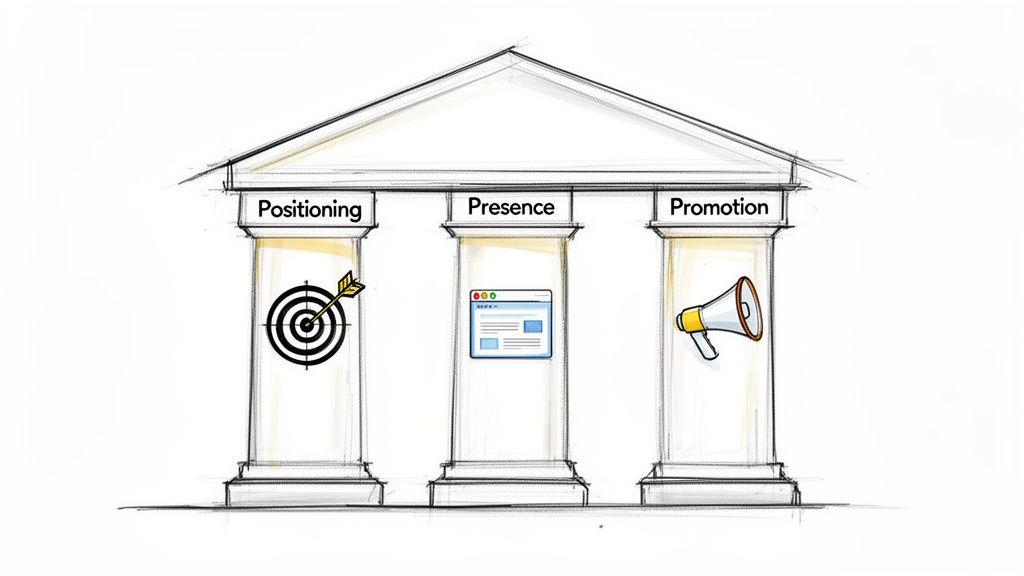
So, how do you go from doing a bit of this and a bit of that to running a digital marketing program that actually delivers? It's a lot simpler than you might think. It’s about getting three fundamental pillars right, and just as importantly, getting them in the right order.
Most marketing fails because people get this order backwards. Think of it like building a house. You wouldn't hang pictures on the walls before the foundations are poured. But businesses do this all the time—they jump straight into promotion without a solid base.
This simple mental model—foundations first, then walls, then decoration—is a powerful way to understand why past efforts might have felt so chaotic. You need structure before you can build any real momentum.
Pillar 1: Positioning
This is your foundation. Before you spend a dollar on ads or SEO, you have to be brutally clear about who you serve in the WA market and why you are the only logical choice for them. Positioning isn't a fluffy branding exercise; it's the core strategic decision that makes every other marketing choice a hundred times easier.
It forces you to answer the hard questions:
Who is our ideal customer? Not just a job title. What specific, painful problem do they have that we are uniquely equipped to solve?
What makes us different? In a sea of competitors, what is our sharp, defensible point of difference that genuinely matters to that customer?
What is our core message? How do we talk about what we do in a way our ideal customer instantly gets and values?
Get this wrong, and your marketing will always feel like you're pushing water uphill. You end up with generic messaging that tries to appeal to everyone and ends up resonating with no one. This is exactly where a short, focused sprint can bring incredible clarity. To go deeper on this, our guide on defining your market strategy is a great place to start.
Pillar 2: Presence
Once your positioning is locked in, the next step is building a presence that reflects that clarity. This is about making sure your digital shopfront—your website, social media profiles, and sales materials—is a true and compelling representation of the value you deliver.
Your online presence is where your positioning comes to life. It’s about getting your messaging, design, and content all singing from the same song sheet, so when your ideal customer finds you, they feel like you get them. They see themselves in the problems you describe and feel confident you have the solution.
Many businesses have a huge gap between the quality of their service and the quality of their online presence. Closing this gap is one of the fastest ways to build credibility and command a premium.
When we embed with a team, this is often the second thing we tackle. We take the clear thinking from the positioning work and use it to sharpen website copy, refine key sales assets, and create content that speaks directly to that target customer. It’s rarely about a massive rebrand; it’s about smart, strategic alignment.
Pillar 3: Promotion
And only when you have rock-solid positioning and a coherent presence should you turn your attention to promotion. This final pillar is about creating simple, repeatable systems to build trust and generate demand from your ideal customers right here in Perth.
This isn't about being on every channel. It’s about picking one or two channels where your customers actually hang out and executing them exceptionally well. Whether that’s highly targeted LinkedIn campaigns, valuable content that pulls in organic traffic, or a focused advertising strategy, the goal is always consistency and measurement.
This is where many companies get overwhelmed, but it doesn't need to be so complicated. A simple promotional system built on a strong foundation will always outperform a complex one built on sand. It gives you the structure you need for confident, sustainable growth.
What to Demand From Your Marketing Partner
When you’re looking for a digital marketing partner in Perth, it’s easy to get buried in presentations full of impressive-sounding numbers. Clicks, impressions, engagement rates—they all sound great, but if they don’t connect to what’s actually happening in your sales pipeline, they’re just noise. It’s no wonder you feel uncertain; you're being sold activity, not outcomes.
The shift from feeling stuck to feeling confident starts with knowing what to demand. This isn’t about being difficult; it’s about setting clear standards for a true partnership. You need someone whose job is not just running campaigns, but building a stronger business alongside you.
Demand a Focus on Pipeline, Not Just Clicks
The single biggest mistake businesses make is paying for marketing activities instead of business results. Your marketing partner's primary focus should be on one thing: creating a predictable, high-quality sales pipeline. Everything else is secondary.
This means their reporting can't just stop at website traffic. It needs to connect directly to your commercial goals:
How many qualified leads did marketing generate this month?
What was the cost to acquire each of those leads?
How many of those leads turned into sales conversations?
What is the total value of the pipeline that marketing influenced?
If a potential partner dodges these questions, they aren't the right fit. This is where a structured approach, like a sprint model, brings immediate clarity. Every activity is tied to a specific business outcome from day one.
Expect Them to Build Your Capability, Not Create Dependency
A great marketing partner works to make themselves redundant. Their goal should be to build systems, processes, and knowledge inside your business, leaving you stronger and more self-sufficient than when they started.
They should be completely transparent about their methods, explaining the ‘why’ behind their ‘what’. They should be actively training your team, documenting workflows, and creating assets that you own and understand. This is a massive departure from the old agency model, which often thrived on keeping clients in the dark.
The best partners don't just solve your immediate marketing problems; they build the structure and internal understanding to prevent those problems from happening again. They transfer knowledge, not just deliver tasks.
When we join a business, our first job is to get under the hood and understand the internal gaps—in skills, in process, in communication—and start fixing them from the inside out. This approach ensures the improvements stick long after our direct engagement ends. For a deeper look, you can explore the different ways a partnership can be structured in our breakdown of engagement models.
Look for Senior Leadership, Not Just Junior Execution
Many agencies sell you with their A-team but hand off the actual work to junior staff. You end up paying for strategy but getting basic task execution. Make sure you demand access to the senior people who can actually diagnose complex problems and architect the right solutions.
This is especially critical in Perth. The Australian digital marketing services sector is booming, with forecasts showing it growing from AUD 2.22 billion to AUD 6.25 billion by the early 2030s. As more of your competitors adopt sophisticated tools, the gap between "good enough" and "truly effective" widens. You need a partner with the experience to help you build a system that delivers real value.
Evaluating a Digital Marketing Partner
To cut through the noise, you need a simple framework. This checklist is designed to help you separate the genuine strategic partners from the task-doers.
Area to Evaluate | What to Look For (Green Flags) | What to Avoid (Red Flags) |
|---|---|---|
Focus & Metrics | They ask about your sales targets and pipeline value on the first call. | They lead with vanity metrics like impressions, clicks, or followers. |
Strategy & Process | They outline a clear, structured process (like sprints) with defined outcomes. | Their process is vague, promising "ongoing support" without clear milestones. |
Team & Expertise | You have direct access to senior strategists working on your account. | The senior team disappears after the sales pitch, leaving you with junior staff. |
Capability Building | They talk about training your team, documenting processes, and making you self-sufficient. | They use secret methods or proprietary tools, creating a lock-in effect. |
Commercial Acumen | They understand the Perth market and can talk confidently about your industry. | They offer a one-size-fits-all solution that ignores your business context. |
Choosing the right partner is a big decision, but asking these questions upfront will give you the clarity needed to pick someone who will be a genuine asset to your growth.
A 90-Day Marketing Sprint in Action
All this theory is great, but how does it work in the real world? It's easy to feel like these neat ideas don't apply to the messy reality of your own business.
So, let's make it tangible. Let’s look at how a structured approach can deliver actual results for a company that feels a bit stuck.
Imagine that same Perth-based AgTech company. They have a fantastic product, but their sales pipeline is slow and their message feels fuzzy. This is a classic scenario where a focused 90-day sprint can cut through the noise and build real momentum. It’s about replacing chaos with a clear plan.
This timeline shows how we break down the work into focused, manageable chunks, with each phase building on the last.
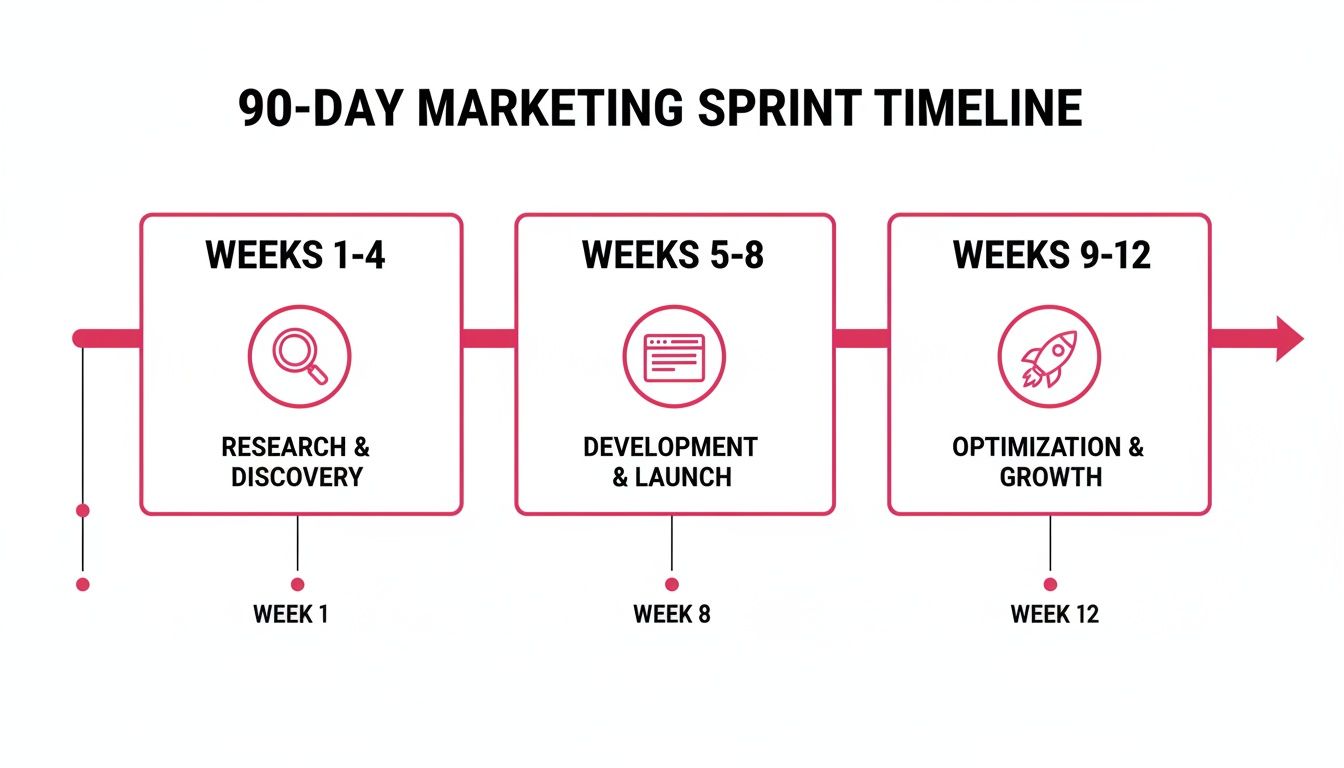
This roadmap lays out a clear path from initial research to a live campaign you can test, proving how structure creates progress in a short time.
Weeks 1-4: The Positioning Sprint
Before we touch the website or run a single ad, the first month is all about getting the foundation right. The goal is simple: define a sharp, defensible market position that makes your company the only logical choice for your ideal customer.
This isn’t about guessing in a boardroom. It’s a proper discovery process.
Interviewing their best customers: We need to hear—in their own words—what problem they had and why they chose this specific solution.
Analysing key competitors: We map out how other players in the WA market are talking about themselves, spotting their strengths, weaknesses, and any gaps we can own.
Defining the core message: Using that research, we craft a new, clear message that speaks directly to the customer’s pain points.
By the end of this sprint, the team has a clear, evidence-backed answer to the question: "Who do we serve, and why should they care?" This is the clarity most businesses are missing.
Weeks 5-8: The Presence Sprint
With that newfound clarity, the next four weeks are all about aligning the company’s digital presence with its new, sharper positioning. This is where we close the gap between how good the company is and how good it looks online.
The outputs from this sprint are tangible assets you can actually use:
Rewrite core website messaging: We update the homepage and key service pages to reflect the new positioning, making sure the language connects instantly.
Create a new sales deck: The sales team gets a powerful new tool that tells a consistent, compelling story.
Build one high-value case study: We develop a detailed customer story that proves the company’s value.
Notice this isn’t a full website rebuild. It’s a focused effort on the highest-impact assets that will start generating results quickly.
This sprint-based approach is intentionally designed to produce real, usable assets in a short timeframe. It replaces the slow, meandering pace of a traditional retainer with a sense of urgency and accomplishment.
Weeks 9-12: The Promotion Sprint
Finally, with a solid foundation and a clear presence, the last four weeks are about putting the new message to the test. This is where we start building a simple, repeatable system for generating demand.
We wouldn’t launch a huge, multi-channel campaign. Instead, we’d start small and smart. For our AgTech client, this would likely be a highly targeted LinkedIn campaign aimed at a very specific audience. The goal isn’t to reach everyone; it’s to see how the new messaging resonates with the right people.
This controlled approach lets us gather real-world data and learn fast, without burning through the budget. It's a practical application of what local Perth case studies have shown us: the most effective digital marketing services Perth has to offer are about doubling down on what works, not spreading yourself thin. To understand more about what’s currently working in the local market, you can explore detailed insights on the Perth digital marketing playbook.
By the end of 90 days, this company doesn’t just have a few new marketing bits and pieces. It has clarity, structure, and the beginnings of a predictable growth engine.
Setting Realistic Budgets and Timelines
One of the most common questions from Perth business owners is, "What should digital marketing actually cost?" It’s a point of serious confusion. You can get a dozen different quotes for what looks like the same service, with no clear reason for the massive price gap.
The heart of the problem is that most people are asking the wrong question. Asking, “How much does SEO cost?” is like walking up to a builder and asking, “How much for some bricks?” The question is disconnected from the outcome you want.
A much better question is, “What level of investment do we need to generate ten qualified sales demos a month?” This small shift changes the entire conversation. You stop talking about buying activities and start talking about investing in tangible business outcomes.
Linking Budgets to Business Outcomes
When you connect your budget to a specific goal, it suddenly becomes easier to justify and measure. You’re no longer just "spending money on marketing"; you’re funding a system designed to produce a predictable result. This is a fundamental change that brings real clarity and confidence to your financial planning.
This is exactly how we approach our work. We don’t just hand over a menu of services. We start by getting to the core of your commercial objectives and then build a plan to hit them.
Here’s a simple way to think about it:
Your Goal: Generate 15 qualified leads per month.
The Question: What mix of positioning, presence, and promotion is needed to make that happen?
The Budget: The investment required to resource that specific plan.
This approach gives you a clear line of sight between every dollar you spend and what you get in return.
Timelines: What to Realistically Expect
Just as budgets need to be anchored in reality, so do timelines. It’s impossible to fix years of fuzzy messaging in a single week. Foundational work, like sharpening your market positioning, takes focused effort.
But that doesn’t mean you have to wait a year to see things happen.
Meaningful momentum can be built within the first 90 days. A well-structured sprint can deliver tangible assets—like clearer website messaging or a targeted pilot campaign—that start producing results quickly.
The trick is to focus on progress, not perfection. A short, intensive sprint creates a sense of urgency and delivers usable outputs fast. This builds confidence and gives you immediate data to inform the next phase of work.
Measuring What Actually Matters
Finally, let’s talk about measurement. It’s incredibly easy to get distracted by vanity metrics—things like website traffic or social media likes. While these numbers might feel good, they don’t tell you if your marketing is actually working.
To get genuine clarity, you have to focus on the metrics that are directly tied to revenue. For most B2B businesses in Perth, here are the three KPIs that truly matter:
Cost Per Qualified Lead (CPL): How much you’re spending to get a lead that your sales team agrees is a genuine opportunity.
Sales Pipeline Generated from Marketing: The total value of the sales opportunities created by your marketing efforts.
Conversion Rate at Key Funnel Stages: How effectively you’re moving prospects from initial interest to a sales conversation.
Focusing on these core metrics cuts right through the noise. It provides a simple, powerful way to assess whether your digital marketing services in Perth are effective and ensures every dollar you spend is genuinely working to grow your business.
Your Next Step Toward Marketing Clarity
If all this feels a bit messy, you're not alone. That’s a normal feeling. It doesn't mean you're behind; it means your business has simply reached the point where random tactics won't cut it anymore. A more structured marketing approach is needed.
Real marketing effectiveness isn't about doing more things. It's about finding clarity. It’s about stripping away the noise and focusing on the handful of activities that will actually move the needle for your business. This is where so many teams get stuck, not because they lack talent, but because they’ve never had someone step in to structure the work and point them in the right direction.
Before you hire an agency or add another person to the team, take one simple step. Get your leadership team together for 30 minutes and answer just one question:
What is the single most important business problem we need marketing to solve in the next 90 days?
Is it getting more sales-ready leads? Is it fixing a leaky funnel? Is it that your core message just isn't landing with the right people?
Answering this question honestly is the first step toward building a marketing function that creates momentum, not just busywork. To really push forward with confidence, it's crucial to understand how to measure marketing effectiveness and maximize ROI from the very start.
This simple act of getting everyone on the same page gives you a clear starting point. It turns that feeling of chaos into a confident first step and gives you the focus you need to find the right help to solve the right problem.
Common Questions About Digital Marketing in Perth
Even with a solid plan, questions pop up. The world of digital marketing can feel overly complex, but the right answers can give you the confidence to move forward. Here are a few common questions from Perth business owners.
How Is Digital Marketing Different in Perth?
While the fundamentals of good marketing are the same everywhere, Perth’s market has its own flavour. It’s a relationship-driven economy, which means content that builds trust and clear, honest positioning are non-negotiable. An aggressive approach that might get results in a bigger city can easily fall flat here.
The audience is also smaller, demanding much sharper targeting. For businesses focused on Perth customers, knowing how to implement effective localized keyword research strategies is crucial. A winning Perth strategy is about doubling down on what truly resonates with a WA audience.
What’s a Realistic Starting Budget?
It’s always better to think in terms of outcomes. Instead of asking for a price list, a better question is, "What would it take to generate 10 qualified leads per month?" This changes the conversation from buying activities to investing in tangible results.
A focused program with a strategic partner—covering positioning, content, and promotion—often costs about the same as a mid-level marketing salary. The difference? You get senior-level expertise driving the strategy. Be wary of providers offering rock-bottom prices; they usually just cover basic tasks and lack the strategic thinking that actually grows a business.
Should I Hire an Agency, a Freelancer, or Go In-House?
The right answer depends on your biggest gap.
A freelancer is perfect for specific tasks like running an ad campaign, especially if you already have a clear strategy.
An in-house marketer makes sense when you need someone to manage ongoing tasks and become a subject matter expert on your business.
An embedded partner is often the best fit if your real problem is a lack of senior direction and structure—a common growing pain.
Most teams struggle not because they lack effort, but because they've never had someone step in to properly structure the work. An embedded model brings in that senior leadership to fix what's broken and build systems that last, without the long-term cost of a full-time executive. It's about getting the clarity and direction needed to build real momentum.
At Sensoriium, we provide the senior leadership and hands-on support to untangle the marketing mess and give your business the structure it needs to grow. If you’re ready for clarity, explore how we partner with businesses like yours at https://www.sensoriium.com.