
How to Build a Client Engagement Plan That Actually Creates Clarity
- Jan 16
- 12 min read
It’s that nagging feeling, isn’t it? A key client has gone quiet. Another project feels like it’s drifting. Your team is busy, but you’re not sure they’re busy on the things that actually prove your value. You’re putting out fires instead of leading the relationship.
You’re not imagining it. That sense of chaotic, ad-hoc client management is incredibly common, especially for growing B2B tech companies. What worked when you had five clients starts to crack with fifteen.
Without a deliberate client engagement plan, momentum fizzles out. The value you provide gets lost in the day-to-day noise, and renewals turn into a stressful sales effort instead of a smooth continuation. The problem isn't a lack of care; it's a lack of structure.
Why Good Intentions Aren't Enough
The real issue isn’t that your team isn't trying. They are. The problem is the absence of a shared system for managing client relationships.
When each team member does things a little differently, inconsistencies appear. One client gets weekly updates; another hears from you once a month. This creates an uneven experience that slowly erodes their confidence. It’s a structural gap, not a people problem.
To fix this, you don't need more meetings or another piece of software. You need a shift in thinking—from reacting to problems to proactively guiding the relationship. This is about creating predictable, positive interactions that build momentum and reinforce your value at every turn.
This is usually where a sprint approach creates clarity, fast. By focusing on a structured process, you replace guesswork with a predictable rhythm, which builds confidence for both your team and your client.
Exploring proven customer success best practices can give you a strong foundation, but the core idea is simple: create structure. Different projects need different levels of interaction, which is why understanding various engagement models for service businesses is a crucial first step.
The rest of this guide will give you a simple framework to build a plan that provides that much-needed clarity.
Ground Your Plan in Three Pillars of Clarity
Before you touch templates or schedules, we need to talk about the foundation. Without it, your plan is just organised chaos. I’ve seen countless engagement plans fail, not because the tools were wrong, but because they lacked a core philosophy. They became a glorified to-do list instead of a framework for partnership.
A plan that actually works is built on three simple pillars: Role Clarity, Communication Clarity, and Value Clarity. Get these right, and you create the structure to make every client interaction meaningful and sidestep that slow drift that kills so many business relationships.
Pillar 1: Role Clarity
What’s the fastest way to frustrate a client? Make them guess who to talk to about what. If they have a technical question, a billing query, and a strategic idea, and they have to fire all three at one overloaded account manager, you’re creating bottlenecks.
Internally, it’s just as bad. When your team isn't sure who owns the relationship or who escalates issues, things fall through the cracks.
Practical Example: We once worked with an agtech startup where three different team members contacted a key client in a single week, each giving slightly different updates. The client wasn’t unhappy with the work, but they lost confidence because the process felt disorganised. Clarity would have prevented this.
Getting this right is simple:
Define a Single Point of Contact: Your client needs one go-to person. This person doesn't need every answer, but they must know who to get them from. They become the single source of truth, bringing consistency and calm.
Map Internal Responsibilities: Create a clear map for your own team. Who is the strategic lead? Who handles the day-to-day? Who’s the technical expert? A simple chart outlining these roles creates clear accountability. Honestly, this is often the very first gap we fix when we embed with a team.
Pillar 2: Communication Clarity
Good communication isn't about more meetings. Clients don’t want more meetings. They crave a reliable rhythm they can count on so they never have to ask, "What's happening?"
This means creating a simple, sustainable communication cadence that feels reassuring, not smothering. It’s about setting expectations for how and when you’ll connect. This could be as simple as a weekly check-in email that follows the exact same format every time, paired with a strategic monthly review.
Consistency is everything. A predictable rhythm eliminates uncertainty, which is the root cause of most client anxiety. It gives both sides a shared sense of control and momentum.
Pillar 3: Value Clarity
This is the most important pillar. Your plan must constantly answer the client’s unspoken question: "Am I getting my money's worth?" If a client ever has to second-guess the ROI of your work, your relationship is on thin ice.
Value Clarity means tying your team's daily activities directly back to the client’s core business objectives. It's not enough to say you completed a list of tasks. You have to show how that work moved the needle on what they care about—whether that’s revenue, market share, or efficiency.
This is where a sprint-based approach can be a game-changer. It creates natural, regular checkpoints where you can connect the work you just finished to the goals you both agreed on. By making this a regular practice, the value of your partnership is always clear. Renewal conversations stop being a frantic scramble and become a simple formality.
Mapping the Client Journey From Onboarding to Renewal
A client engagement plan isn't a static document; it’s a living map of the entire client lifecycle. It’s the guide your team uses to create a consistent, confidence-building experience from the first conversation right through to renewal.
Where I see founders go wrong is they pour all their energy into the sale. The moment the contract is signed, the client gets tossed to the delivery team with little structure. That jarring gap kills momentum and makes the client second-guess their decision.
A well-mapped journey closes that gap. It creates a seamless flow where every stage builds on the last, reinforcing the value you provide. It makes renewals feel like a natural next step, not a tense negotiation. For a deeper dive, our guide on customer journey mapping offers a framework for marketing clarity.
Your Most Important Milestone: The Onboarding Process
The first 90 days are the most critical. This is your window to set the tone and prove they made the right choice. A rushed or disorganised onboarding is a massive red flag that screams chaos.
Remember, onboarding isn't just technical setup. It's about transferring the confidence and excitement from the sales process over to the delivery phase.
A structured onboarding should include:
The Kickoff Call: This isn't just a meet-and-greet. Its purpose is to align everyone on goals, process, and what success looks like.
The 30-Day Check-in: A dedicated moment to ask, "Are we on track? Is this what you expected?" It’s a simple way to catch misunderstandings early.
The First Small Win: Deliver a tangible piece of value within the first month. This builds immediate momentum and shows you can execute.
The Middle Journey: Quarterly Business Reviews
Once a client is settled in, the biggest risk is the relationship slipping into an unstructured routine. The work gets done, but the strategic connection fades. The Quarterly Business Review (QBR) is your most powerful tool to prevent this.
A QBR is not a project status update. It’s a strategic conversation to reconnect your work to their business goals.
The goal of a QBR is to zoom out. You're reminding them of the value you've delivered, recalibrating based on their changing priorities, and looking ahead. It’s your chance to lead, not just report.
A simple QBR agenda can be very effective:
Review of Previous Quarter: "Here were the goals we set, and here’s the progress."
Value Delivered: "This work resulted in X, which helps your business by Y."
Future Focus: "Based on what we've learned, here’s our recommendation for the next 90 days."
This visual timeline shows how the core pillars—Role Clarity, Communication, and Value Clarity—should be reinforced throughout the journey.
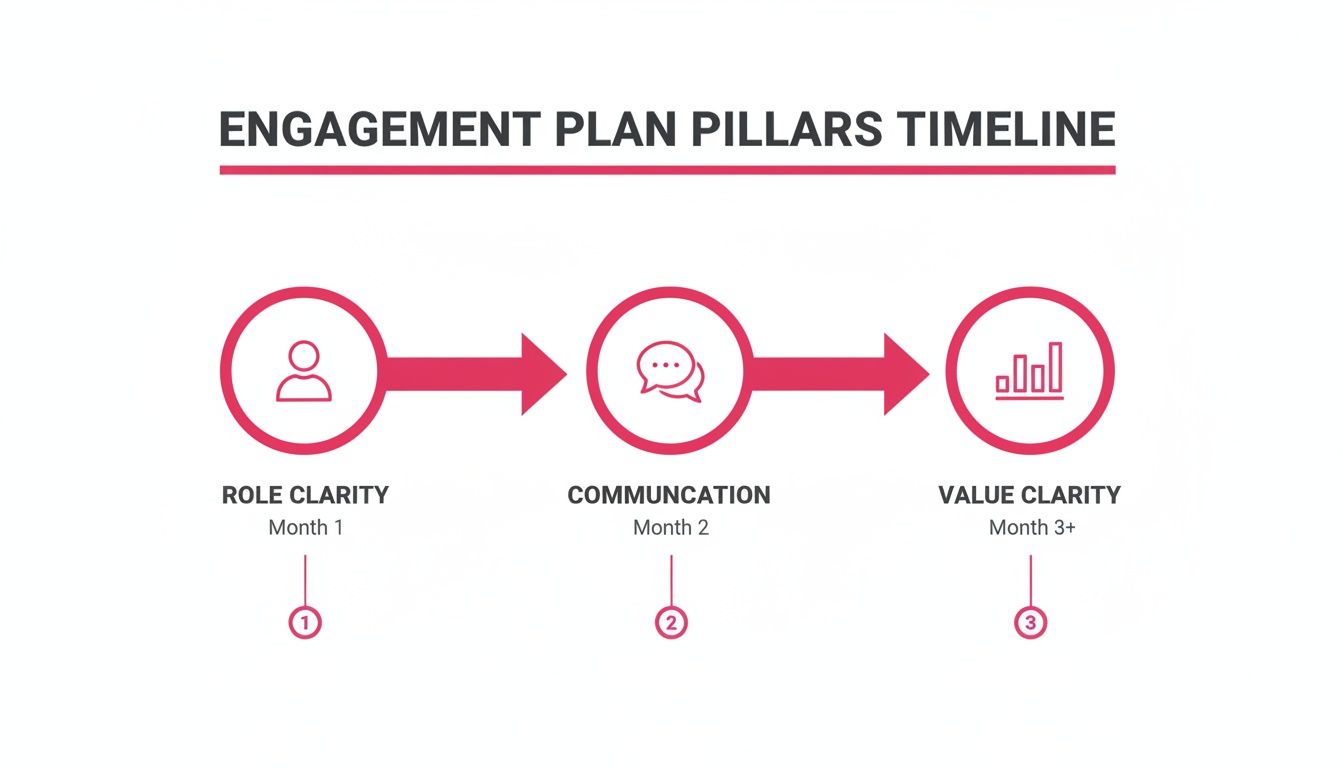
Maintaining clarity isn't a one-time setup; it’s an ongoing process you weave into every stage of your engagement plan.
The Graceful Exit: Why Offboarding Matters
No client relationship lasts forever. But how it ends has a lasting impact on your reputation. Most companies have no offboarding process. The project wraps up, the final invoice is paid, and then… silence. This is a huge missed opportunity.
A structured offboarding shows a level of professionalism that clients remember. It keeps the door open for future work or referrals.
Practical Example: A software development agency I know implemented a simple three-step offboarding. First, a final handover meeting to provide a clean finish. Second, a feedback request a week later. Third, a simple, non-salesy check-in email six months later. This thoughtful approach has directly led to repeat business by turning an ending into a potential new beginning.
Building Your Communication Cadence: A Simple Framework
This is where your plan becomes real. The goal isn't more meetings. It's to create a rhythm so predictable that your clients stop wondering what’s going on, because they always know what to expect.
Most founders I talk to either over-communicate with frantic, unstructured updates or under-communicate, creating an information vacuum. Both cause anxiety.
The solution is a deliberate communication cadence—a simple framework setting the purpose, format, and frequency of every touchpoint. This isn’t about being rigid; it’s about being reliable. When you establish a clear rhythm, you manage expectations and create openings for feedback before small issues become big problems.
Intentional Touchpoints, Not More Meetings
Let's kill the idea that engagement means constant meetings. It means making every interaction count. A big part of this is separating the tactical from the strategic. You need a place for quick updates and a separate, protected time for big-picture conversations.
This is a gap we often see when we embed with teams. They try to cram a major strategic discussion into a 15-minute check-in, leaving everyone feeling rushed.
A simple, effective communication cadence could look like this:
Daily Flow: For the quick, day-to-day stuff. A shared Slack channel is perfect. It keeps inboxes clean and gives the whole team visibility.
Weekly Pulse: A short, asynchronous update. Think a standardised email or a quick Loom video summarising progress, flagging roadblocks, and outlining the focus for the week ahead.
Monthly Strategy: A dedicated meeting to zoom out. It's your chance to connect the work back to business goals, review metrics, and plan the next push.
This structure creates an incredible amount of clarity. It gives your team and your client a sense of calm control because everyone knows how and when information will be shared.
A Practical Example of a Communication Cadence
To make this tangible, let’s map out a simple communication plan for a typical three-month project sprint. This model provides structure without being suffocating.
Interaction Type | Frequency | Channel | Purpose |
|---|---|---|---|
Project Kickoff | Once (Week 1) | Video Call | Align on goals, scope, and what "success" looks like. |
Daily Check-ins | As needed | Shared Slack Channel | Quick updates on progress and blockers. |
Weekly Pulse Report | Every Friday | Email or Loom Video | Summarise wins and track progress against goals. |
Monthly Strategic Review | Once a Month | Video Call | Review performance and connect work to business value. |
Sprint Retrospective | End of Project | Video Call | Discuss what worked, what didn't, and plan next steps. |
This isn't a one-size-fits-all solution, but it’s a solid starting point. The magic is in the consistency. When clients experience this rhythm, their trust deepens. They see you not just as a vendor, but as a structured partner who knows how to lead with confidence.
Today's clients carry high expectations. A PwC report on the Australian service industry found that 88% of customers are more loyal after great experiences. A structured, professional approach makes all the difference. You can learn more about these Australian service industry trends from PwC.
By implementing a simple communication framework, you turn your interactions from a source of chaos into a tool for building strong client partnerships.
Measuring What Matters to Signal Relationship Health
So, how do you know if your client engagement plan is working?
It’s a question that trips up many founders. The temptation is to look at activity metrics—hours logged, tasks completed. But that just tells you if your team is busy, not if they’re making an impact.
True relationship health is signalled by quieter, more meaningful indicators. You have to move past tracking inputs and start measuring the signals that show a genuine partnership is forming. This is about creating a simple feedback loop that gives you real insight.
Beyond the Obvious Metrics
Most teams get stuck here because they’ve never had someone show them how to structure this kind of measurement. But it doesn't have to be complex.
Start by tracking a few simple indicators that tell the real story:
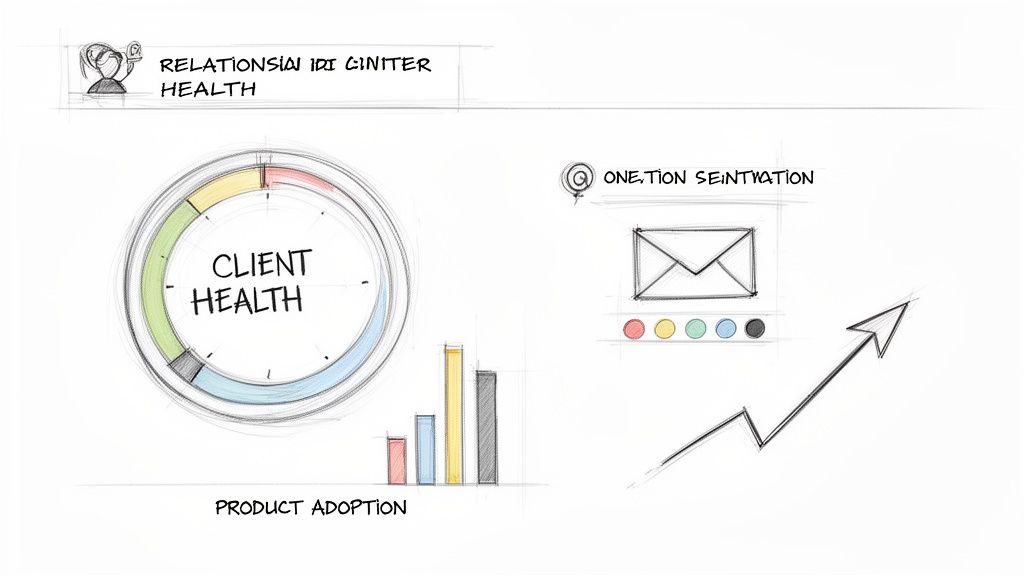
Client Health Score: This doesn't need a complex algorithm. Start with a simple Red/Amber/Green system. Are they using your product regularly? Are they responsive? Do they pay on time? It's a gut check with a bit of structure.
Product Adoption Rates: For any tech or SaaS business, this is gold. Are clients using the key features you built to solve their biggest problems? If not, they aren't seeing the full value and are a churn risk.
Proactive Client Feedback: This one is huge. Are they offering ideas without you asking? A client who passively receives a service is engaged, but one who actively contributes is invested.
The Power of the One-Question Email
You don’t need complicated surveys to get started. In fact, one of the most effective tools is beautifully simple.
Founder Moment: A founder I work with sends a one-question email to each of his key clients on the first Monday of every month: "On a scale of 1-10, how happy are you with our partnership right now?" It takes 10 seconds to answer.
Anything less than an 8 gets an immediate phone call to ask, "What can we do better?" This simple system once caught a brewing issue with a major account, letting him fix it weeks before it would have become a crisis.
A key goal of any plan is mastering customer retention. Simple, proactive checks like this are foundational to making that happen.
Creating Your Simple Feedback System
The goal is to build a simple dashboard—even a spreadsheet—to track these signals over time. This isn’t about creating admin work; it’s about making relationship health a visible part of how you manage your business. Knowing how to define success clearly for your team is the first step toward tracking it.
The CPM Australia State of Customer Experience Report shows that while 94% of Australian consumers have left a brand after a bad experience, only 2% said this happened recently, suggesting businesses are getting better at stable engagement.
With 70% of consumers saying service interactions are highly important, the risk of getting it wrong is massive. By focusing on these health indicators, you shift from guessing to knowing, gaining the confidence to lead your client relationships with clarity.
Your Next Step Is to Start Here, Not Everywhere
Reading this, you might feel the urge to overhaul everything at once. Resist that urge. That’s the fastest path back to overwhelm.
The real goal is to build momentum, not create more chaos. You don't need to fix everything today. You just need to fix the first thing.
Focus on the First Impression
Your single most impactful first step is to nail your client onboarding process.
A structured, welcoming, and clear onboarding sets the foundation for the entire relationship. It's your first and best chance to show you're a professional outfit and prove your client made the right choice. Get this wrong, and you're immediately trying to claw back trust. Get it right, and you build a powerful buffer of goodwill.
If your current onboarding feels messy, that’s normal. You're not behind; you just need structure. Most teams struggle here because no one has ever stepped back to properly map it out.
What to Do Next
Your immediate task is simple: map out the first 30 days of a new client's life with your business.
Forget the entire lifecycle for now. Just zoom in on that initial experience. Get your team together and ask some direct questions:
What does our client need to know in their first week? (Think access, key contacts, next steps).
Who do they need to meet? (Go beyond their main contact).
What is the first small, tangible win we can deliver? (This is critical for building confidence).
This exercise isn't about creating a huge document. It’s about building a simple, repeatable checklist. The goal is to ensure every new client has the same calm, confident, and clear starting experience.
Nailing your onboarding is the biggest lever you can pull to improve your entire client engagement plan. It calms client nerves, gives your team a clear process, and sets a professional tone that lasts.
Start there.
Got Questions About Your Client Engagement Plan?
If you're building out your first client engagement plan, a few questions always pop up. Here are the answers I usually give to B2B founders.
How often should we actually be talking to our clients?
There's no magic number. A solid starting point is a quick, informal update each week and a more structured, strategic check-in monthly or quarterly.
The secret isn’t frequency, it’s consistency and purpose.
The weekly update keeps the wheels turning. The monthly or quarterly meeting is where you zoom out. The goal is to establish a predictable rhythm so your client never has to wonder what's happening.
What's the single most important part of the plan?
The onboarding process. Hands down.
A smooth, reassuring onboarding sets the tone for the entire relationship. It’s your first chance to align expectations, build trust, and prove they made the right call. Nail this, and you'll sidestep a mountain of problems later. Most client friction can be traced back to a messy or unclear beginning.
What tools do we need to make this work?
You can probably get started with what you already have. The desire for shiny new software is often a way to put off doing the hard work: defining the process.
A shared document for the plan, a project management tool you already use like Asana or Trello, and your usual communication channels are enough to get going.
Focus on getting clear on the process and responsibilities first. Only bring in a new tool when you've hit a specific roadblock it can solve. Structure always comes before software.