
How to Write Website Content When You're Not a Writer
- Jan 15
- 13 min read
Writing content for your website should be simple. You know the business better than anyone. It’s just explaining what you do, right?
But when you sit down to do it, you’re met with a blinking cursor on a blank page. The stare-down begins. You write a sentence, delete it, and start guessing. What should the tone be? What do people actually need to hear? The whole thing feels messy, so you punt it to next week’s to-do list.
It makes sense that you feel stuck. This isn’t a writing problem. It’s a clarity problem.
First, stop trying to write

That paralysis you feel isn’t a personal failing. You’re not a bad writer. You’re a founder staring at a huge, undefined task called "write the website," and your brain is correctly identifying it as overwhelming.
The solution isn’t to become a world-class copywriter overnight. It’s to build a simple structure before you even think about sentences. This small shift changes everything. It turns a chaotic, creative task into a calm, logical process.
Why structure is the answer
Most teams struggle here because they’ve never had someone step in to structure the work. Without a clear plan, writing becomes a debate over personal preferences and vague marketing phrases. It’s why so much website copy ends up sounding generic.
The good news is that a simple structure brings immediate relief. It breaks the enormous job of "writing content for the website" into a series of small, manageable steps. This creates momentum and gives you the confidence that you’re on the right track.
The real issue is rarely a lack of writing skill. It's the absence of a clear, agreed-upon message. Once you fix the structure, the words tend to fall into place.
This shift in thinking is crucial. Australian businesses are increasingly moving away from guesswork, with the content marketing industry now valued at over $453.2 million. Yet, only 41% of Australian small businesses have a website, even though 75% of consumers prefer buying from those that do. A clear, structured approach is what separates a website that works from one that just sits there.
Of course, for those moments when the words just won’t come, knowing how to overcome writer's block is a handy skill. But remember, the block itself is often just a symptom of that missing clarity.
If this feels messy, that’s normal. You’re not behind. You just need a system. Let’s start with the most important piece.
Establish your positioning before you write a word
Most website content fails before a single sentence is typed. I’ve seen it countless times. Founders, keen to get something live, jump straight into writing pages without first getting brutally clear on their positioning.
This is the shaky foundation that makes so many websites feel vague. You end up talking about features and company history, but it never quite lands because you haven't answered the most fundamental questions first. The result is generic copy that forces customers to figure out if you’re even right for them.
This isn’t a creative problem; it’s a structural one. When we embed with a team, this is the very first thing we fix. We run a positioning sprint to nail the message with absolute clarity before anyone thinks about writing content for a website.
Three questions that bring clarity
You don’t need a 50-page brand document to start. You just need clear, simple answers to three questions. Getting these right is what separates a message that connects from one that gets ignored.
Who do you really serve? Be specific. "Small businesses" is too broad. "Second-generation, family-owned bakeries in Victoria" is a real audience you can talk to. Deciding who you serve also means deciding who you don’t serve, which brings incredible focus to your message.
What painful, specific problem do you solve? Don’t say you "optimise operations." That means nothing. Say you "cut invoice processing time for finance teams by 10 hours a month." A real problem has a real cost, and your content needs to talk about that pain directly.
How are you genuinely different? Your difference isn’t that you "care more" or offer "great service." Everyone says that. It has to be something tangible. Maybe it’s your process, your business model, or a specific piece of tech. What do you do that the alternatives (including doing nothing) don’t?
Answering these gives you the raw ingredients for a strong message. From there, you can look at positioning statement examples to give your brand clarity and lock in the one that fits.
A practical example
Imagine an agtech founder who says their product "improves farm efficiency." It’s a classic starting point, but it's completely forgettable.
We’d push them to get specific using the three questions:
Who? Not "farmers," but "large-scale grain farmers in Western Australia."
Problem? Not "inefficiency," but "skyrocketing diesel costs during harvest."
How are you different? "Our software optimises harvester routes in real-time without needing new hardware."
Suddenly, a vague claim becomes a powerful position: "We help WA grain farmers cut harvest-time fuel costs by 15% without buying new equipment."
That small shift changes everything. The website copy practically writes itself. The homepage headline is clear, the service page explains a real benefit, and blog posts can target specific pain points with total confidence.
This clarity is the foundation of good content. It provides structure and confidence, ending the guesswork that leads to weak copy. Once you have this, learning how to write SEO articles that consistently rank becomes the logical next step to make sure people find you.
If your message feels fuzzy, stop writing. Go back and sort out these three answers first. It’s the single most important thing you can do for your website.
Give every page one job to do
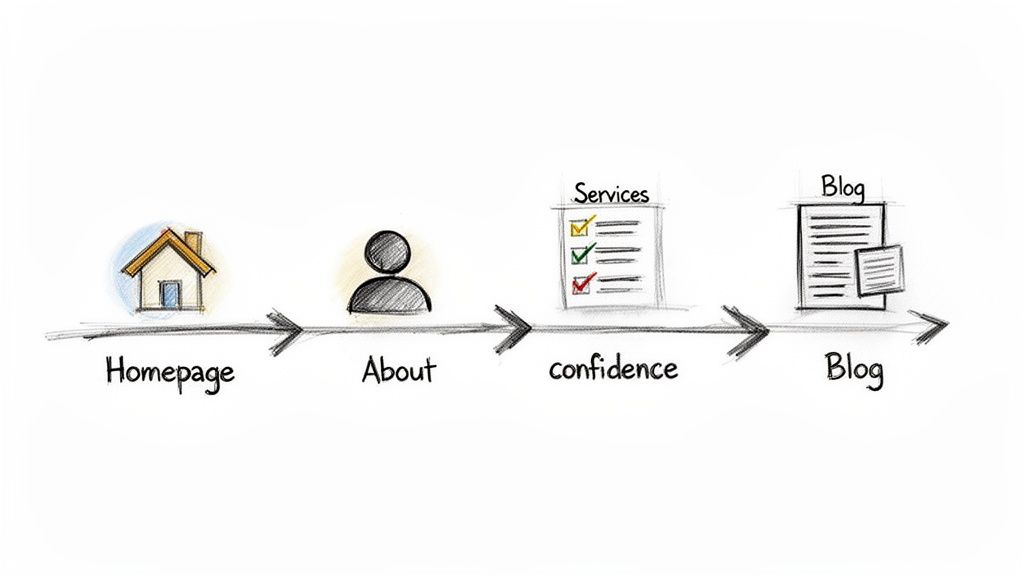
It’s easy to think of your website as one big thing. But a potential customer never sees it that way. They experience it one page at a time, moving from one question to the next.
This is where many websites fall apart. The pages feel disconnected, like random documents that happen to share the same logo. A homepage makes a promise, a services page gets lost in technical details, and the about page is a history lesson nobody asked for. Each page is doing its own thing, forcing the customer to piece the story together. It’s exhausting for them, and it kills momentum.
This isn’t a design flaw. It’s a structural one. When writing content for a website, the goal isn’t just to fill pages. It’s to create a clear path that guides someone from curiosity to confidence.
How to think about your core pages
The secret is to stop treating your site like a brochure and start treating it like a system. Each core page has one specific job to do. This is often where a sprint approach creates clarity quickly; we define the role of each page so the entire system works together to guide the user forward.
Think of it like this:
The Homepage: Its only job is to make an instant connection. It must answer three questions in five seconds: What is this? Who is it for? And why should I care? It’s a handshake, not a full pitch.
The Services/Product Page: This is where you provide the logical proof. After the homepage hooks them, this page gives them the concrete details they need to feel confident and understand the value.
The About Page: Its job is to build trust. People want to know who is behind the business. This isn’t about listing credentials; it’s about showing the human side and building a connection.
The Blog/Resources: This is where you prove your expertise. It answers customer questions, shows your authority, and gives them a reason to come back.
When each page has a clear purpose, the user's journey feels simple and effortless. They get the right information at the right time, building the confidence they need to take the next step. If you want to go deeper, our guide on what is customer journey mapping provides a practical framework.
Most website content feels messy because no one has asked a simple question: "What is this page's one job?" Define that, and the writing becomes ten times easier.
To make this clearer, here’s a breakdown of the job each core page plays in guiding a potential customer.
The role of your core website pages
Page Type | Primary Job | Key Message to Convey | Example Call to Action |
|---|---|---|---|
Homepage | Make an instant connection and orient the visitor. | "You're in the right place. We get your problem and have a solution." | "See Our Solutions" or "Learn How It Works" |
About Page | Build trust and humanise your brand. | "We're experts you can trust, and we share your values." | "Meet the Team" or "Read Our Story" |
Services/Product | Provide logical proof and detail the value. | "Here’s exactly how our solution solves your problem and what you get." | "Book a Demo" or "View Pricing" |
Blog/Resources | Demonstrate expertise and answer questions. | "We know this space inside-out and can help you succeed." | "Subscribe" or "Download the Guide" |
Thinking this way ensures your website isn't just a collection of pages, but a cohesive system designed to guide someone forward.
This structure creates momentum
Mapping your content this way has a powerful effect. It reduces the visitor's mental load because they aren't struggling to figure out what to do next. Each page answers a specific set of questions before calmly pointing them to the next logical step.
This structured approach is vital. Australian businesses are set to spend $1.5 billion on SEO services, a jump of 12%, so just having a website isn't enough. It has to perform. A well-structured site is the foundation for any good SEO effort. Adding things like customer reviews—which can increase conversions by 58%—fits perfectly into this journey, often on a services or case study page. You can find more Australian SEO and content marketing statistics on localdigital.com.au.
A clear content map turns a collection of pages into an asset that builds trust and momentum, guiding people naturally towards a conversation.
If your website feels like a jumble of disconnected ideas, that’s normal. You just need to give it a clearer structure. Start by taking your four core pages and writing down the single most important job for each one. That simple act alone will bring a huge amount of clarity.
Write like a human
You’ve done the strategic work. You know who you’re talking to and what job each page needs to do. Now it’s time to write the words, and this is where the pressure often builds.
It’s a common trap. Founders feel they need to become a ‘writer’, so they reach for corporate-speak and tired marketing clichés. Words like ‘synergy’, ‘leverage’, and ‘transformative’ creep in because they sound official.
But the result is almost always content that sounds robotic. It alienates the very people you’re trying to connect with. Your goal isn’t to sound like a faceless corporation; it’s to sound like an intelligent, trustworthy person who can help.
Ditch the jargon and just talk to them
The single biggest shift you can make when writing is to focus on benefits, not features. It’s an old saying, but it holds true: people don’t buy a drill because they want a drill; they buy it because they want a hole in the wall.
So, instead of describing what your product is, spend your time describing what it does for your customer. This simple change instantly moves your writing from being all about you to being all about them, which is the fastest way to build trust.
Getting this right is a core part of the clarity we build with our clients. We help them move away from jargon and toward simple messages that connect on a human level. A big piece of this is mastering your brand's voice, which we explore in our founder's guide to mastering tone in writing.
A quick before-and-after example
Let's look at a typical product description. You’ll see how a few small tweaks can make a world of difference.
Before:"Our synergistic platform leverages advanced AI algorithms for transformative business outcomes. We provide a full-funnel solution designed to drive awareness and unlock growth potential through optimised data analytics."
It’s packed with buzzwords and tells the reader almost nothing about what the product actually does for them. It’s vague, a bit intimidating, and easy to ignore.
After:"Our tool helps your sales team spend less time on admin and more time selling. It uses AI to automatically update your customer records, giving you clean data without the manual work."
See the difference? The second version is direct, simple, and speaks to a real pain point. It’s written in everyday language and is focused entirely on the user's benefit. This is how you build confidence and clarity.
The most powerful copy isn’t the cleverest; it’s the clearest. If a customer has to re-read a sentence to understand it, you’ve already lost them.
How to add keywords without sounding robotic
You need keywords for SEO, but stuffing them into your copy makes it unreadable. The trick is to always write for humans first. Once you've written a clear, helpful paragraph, go back and see where your target keyword might fit naturally.
Honestly, if your writing is focused on solving your customer's problem, the right keywords will often show up without you even trying. Good SEO is a byproduct of clear communication, not the other way around.
The data backs this up. A recent Australian study found that 74% of companies now have a documented content strategy, and they get 3.2 times higher return than those who don’t. AI-powered SEO tools are also cutting content production time by 31% while improving keyword rankings. This shows that a structured, strategic approach to writing delivers real results. You can find more insights in the state of SEO and marketing in Australia on searchscope.com.au.
If you’re struggling to write in a way that feels natural, that’s normal. The goal isn’t to be a perfect writer. It's to be a clear communicator. Start by writing down how you would explain your business to a friend over coffee. Then just tidy that up. It’s often the best place to start.
Create a system to get it done
You’ve got clarity, structure, and a human tone of voice. But now comes the part where it all tends to fall apart: the chaotic cycle of actually getting the content written, reviewed, and published.
This is where momentum dies. A simple page refresh bloats into a three-month project, bogged down by endless feedback loops. The final version? Often a vague, lifeless mess edited by a committee.
This isn’t a sign of a disorganised team; it's a symptom of a missing system.
Ditch the endless project and run a sprint
The biggest shift you can make is to stop treating content updates as long, drawn-out projects. Instead, break the work into small, focused ‘content sprints’.
A content sprint is a short, time-boxed effort to get a specific piece of work done—from idea to published page. This is the exact approach we use when we embed with teams because it forces clarity, creates momentum, and stops work from dragging on forever.
You’re not trying to fix the entire website at once. You’re just rewriting one service page, this week. That feels manageable.
The goal of a sprint isn't perfection; it's progress. It replaces the vague goal of "improving the website" with a concrete outcome: "get the new Services page live by Friday."
This approach changes the dynamic. It respects everyone’s time, forces decisions, and builds a sense of accomplishment that fuels the next piece of work. It’s how you turn the chaotic task of writing content for a website into a series of calm, predictable steps.
A simple one-week sprint
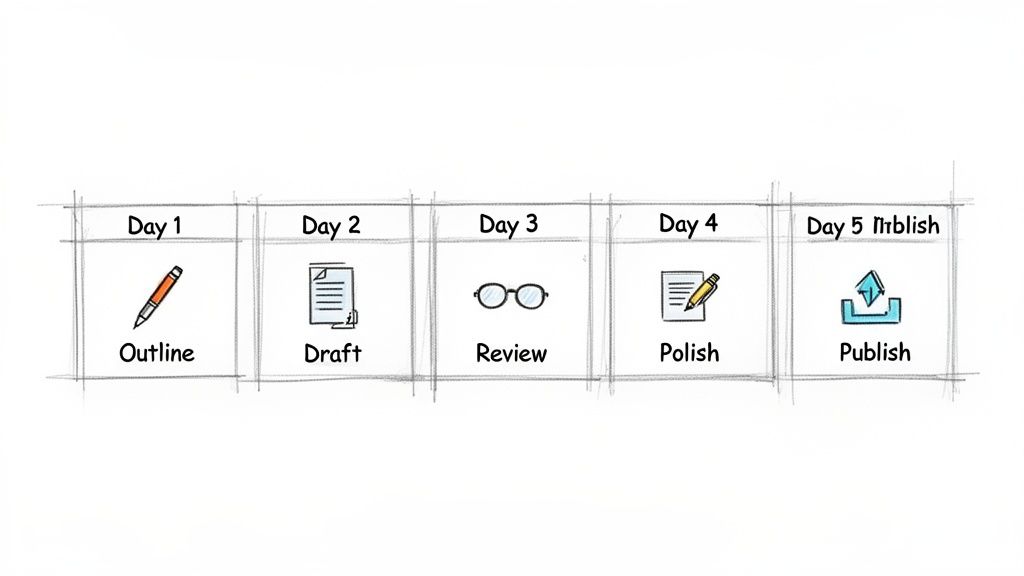
Imagine you need to rewrite a service page. Instead of letting it linger on your to-do list, you can frame it as a five-day sprint. This gives everyone a clear structure and a finish line.
Here’s what that could look like:
Day 1: Outline and Key Messages Agree on the structure before a single sentence is written. What’s the number one message? What are the three core benefits? Who is this page for? Nailing this upfront prevents huge rewrites later.
Day 2: Draft the Copy With a clear outline, the writer can now focus purely on the words. They aren’t guessing what needs to be said; they’re just bringing the agreed structure to life in a human tone.
Day 3: Internal Review The team reviews the draft, but their feedback is focused. The question isn't "Do you like it?" but "Does this draft achieve the goals from Day 1?" This keeps feedback constructive.
Day 4: Final Polish The writer incorporates feedback, tightens the language, and gets the page ready. This is for small tweaks, not major overhauls.
Day 5: Publish The new page goes live. The sprint is done. In one week, you’ve made a tangible improvement, replacing endless discussion with decisive action.
This sprint-based system is what we implement to give teams direction and control. It stops the cycle of second-guessing and builds the confidence that comes from seeing real progress. Most teams get stuck because they've never had someone step in to structure the work this way.
If managing your website feels overwhelming, you don’t need more hours; you need a better process. Start by picking one page that needs improving and commit to a one-week sprint. That small win will give you the momentum you need to tackle the next one.
Common questions about website content
Even with a plan, questions always pop up the moment you sit down to write. That’s normal. It’s a good sign—it means you're thinking through what will actually connect with your audience.
It's also where it's easy to get stuck. These are the exact questions we work through with founders every week. Let's break down some common ones with straightforward advice. The aim is clarity, not rigid rules.
How often should I update my website content?
Think in terms of relevance, not time. A strict schedule can become a chore, but thinking about relevance keeps your site sharp and useful.
For your core pages—Homepage, Services, About—review them every 6-12 months. Check that they still reflect your positioning and what you offer. But if you launch a new feature or find a better way of explaining things, that’s your trigger to update them immediately.
For your blog, consistency is more important than frequency. One high-quality, genuinely helpful article a month will do more for you than four rushed posts.
Treat your website like a living asset, not a static brochure. A simple calendar reminder for a quarterly check-in on your main pages is a fantastic habit to build.
Should I just get AI to write everything?
AI is an incredibly powerful assistant, but it should never be the final author. The second you hand over your core messaging to a machine, you lose the human connection that builds trust.
Where AI shines is in the prep work. Use it to:
Brainstorm blog post ideas.
Whip up a rough outline for a page.
Smash through that initial blank-page paralysis with a messy first draft.
Generate simple technical descriptions that you can then polish.
Your core message, your unique voice, and the stories that connect with your customers have to be human-led. AI can't fake the empathy that makes a customer feel like you truly get them. Never just copy and paste without a thorough human edit.
The best approach is a partnership. Let AI do the heavy lifting. Then, have a human come in to handle the final steps: refining, editing, and injecting the strategic clarity and personality only you can provide.
What's the biggest mistake people make?
This one’s easy. The most common mistake is writing about themselves instead of their customers. It's a surprisingly easy trap to fall into.
So many websites are a sea of "we do this," "our features include," and "our company was founded in..." Your potential customer doesn't care about your company history. They only care about their own problems. Your content has to be relentlessly focused on them: their challenges, their goals, and how you make their life better.
A Quick Founder Test
Pull up your homepage right now. How many times do you use the words "we," "us," or "our"? Now, count the number of times you use "you" and "your."
If the ‘we’ count is higher, it’s a red flag that your message is pointing the wrong way.
Shifting the focus from your business to your customer is the single most powerful change you can make. It’s a small shift in language that signals a huge shift in perspective, and it’s what turns a website from a brochure into something that actually works.
If your website content feels messy and getting it right is a constant struggle, that’s normal. It’s not a sign you’re behind; it’s a sign you need structure. At Sensoriium, we step in to provide that clarity and direction, turning guesswork into a confident path forward. Learn how we can help at https://www.sensoriium.com.