
What is demand generation? A guide to marketing that actually works
- Feb 7
- 14 min read
Let's be honest about why you're here. Your company is doing well, the product is solid, but your marketing feels like a messy collection of random activities. You run ads one month, push out blog posts the next, but none of it connects into a reliable system for bringing in customers.
It feels like you’re stuck on a hamster wheel, right? Always busy, but never really getting anywhere.
You hear terms like ‘demand generation’ and the explanations are vague. Most advice just adds another task to your already full to-do list without explaining how it all fits together.
If that feels frustrating, you’re not crazy. It makes sense that you feel stuck. It’s what happens when you focus on individual marketing tactics instead of building a connected system.
Why random marketing tactics don't work
The problem isn’t the tactics themselves. Ads can work. Content is important. The problem is the lack of a clear strategy that ties them together. Most teams struggle here because they’ve never had someone step in to structure the work. They have all the puzzle pieces but no box lid to show them what the final picture should look like.
Without a clear plan, you end up with common frustrations:
Uneven results: Some months are great, others are a ghost town, and you have no idea why.
Wasted money: You're spending on activities that don't connect to a larger goal, so it's impossible to know what’s working.
Team burnout: Your team is always scrambling, leading to exhaustion without the satisfaction of seeing steady growth.
The goal isn’t to just do more marketing. It’s to build a calm, structured engine that works for you. This shift in thinking is what turns marketing from a cost into a real business asset.
This guide will give you that clarity. We’re not giving you another "top 10 tips" list. Instead, we’ll show you how to think about growth differently. We'll explain what demand generation really is, why it matters for complex sales, and how to build a simple system that creates momentum.
You’re not behind; you just need a better map.
Demand Generation vs Lead Generation Explained
It’s easy to mix these two up. Most marketing advice uses them interchangeably, which is why so many strategies feel messy and don’t deliver results. If you feel confused about the difference, you’re not alone.
This confusion is where most marketing plans go wrong. But when you strip away the jargon, the difference is simple. It’s not about different tactics; it’s about a different mindset.
Getting this right is the first step towards building a marketing function that creates momentum instead of noise. When we embed with a team, the first thing we fix is this exact gap. It changes everything that comes after.
Creating Demand vs Capturing Demand
Here’s the simplest way to think about it: lead generation is about capturing existing demand, while demand generation is about creating new demand.
Lead generation targets people who are already aware they have a problem and are actively looking for a solution. They know what’s wrong and are shopping for a fix. Your job is to find them and get their contact details.
Think of it like fishing with a net in a well-known, crowded pond. You’ll catch some fish, but you’re competing with every other boat for the same prize.
Demand generation, on the other hand, is about educating your ideal customers about a problem they might not even have a name for yet. You’re not trying to grab their email address straight away; you’re trying to become their most trusted source of information. You’re building a reputation as the expert who understands their world better than anyone else.
This is like teaching an entire community where the best, undiscovered fishing spots are. You’re showing them the way, and when it’s time for them to get a boat, yours is the only one they’ll consider.
This shift from capturing to creating is what builds a long-term business asset, not just a list of names for your sales team to call this week.
A Practical Comparison
So, how do these two approaches look in the real world? One is about getting an immediate action, while the other is focused on building long-term trust. Understanding this difference will bring clarity to where you should put your time and budget.
To make this clear, here is a simple table that shows the key differences.
Demand Generation vs Lead Generation At a Glance
Aspect | Demand Generation | Lead Generation |
|---|---|---|
Main Goal | Educate the market, create awareness of a problem, and share your unique point of view on how to solve it. | Capture contact information from people who have shown direct interest in your solution. |
Core Activity | Sharing valuable insights freely through articles, podcasts, social content, and events—with no form-fill required. | Offering a gated resource (like an ebook or webinar) in exchange for an email address. |
Key Metric | Pipeline influence, sales cycle length, and prospects saying, "I've been following your work for a while." | Cost per lead (CPL), number of marketing qualified leads (MQLs), and form conversion rates. |
Timeframe | A long-term strategy that builds momentum over 6-12 months. | A short-term tactic designed to get results within a specific campaign period. |
As you can see, they serve very different purposes. Focusing only on lead generation is why so many B2B companies end up with a slow pipeline full of low-quality leads. For a deeper dive, our guide on effective B2B lead generation strategies can help you blend these approaches. If your efforts aren't adding up, you could also build out a robust webinar marketing strategy to generate leads to demonstrate clearer results.
A healthy marketing engine needs both. You create demand to build a loyal audience and establish trust, then you use smart lead generation to capture that demand when the timing is right. But it always starts with creating, not just capturing.
The Three Pillars of a Demand Generation Engine
Okay, so we’ve sorted the difference between creating demand and just capturing it. Now, let's get practical. A strong demand generation strategy isn’t a massive, complicated document. It’s a simple, repeatable system built on three core pillars.
This structure is what turns chaotic marketing into a calm, predictable engine for growth. Most teams we see are struggling because they're missing one of these pillars, which throws the whole system out of balance. This is usually where a sprint approach creates clarity quickly.
This visual shows how demand generation and lead generation fit into your overall marketing efforts, each playing a distinct but vital role.
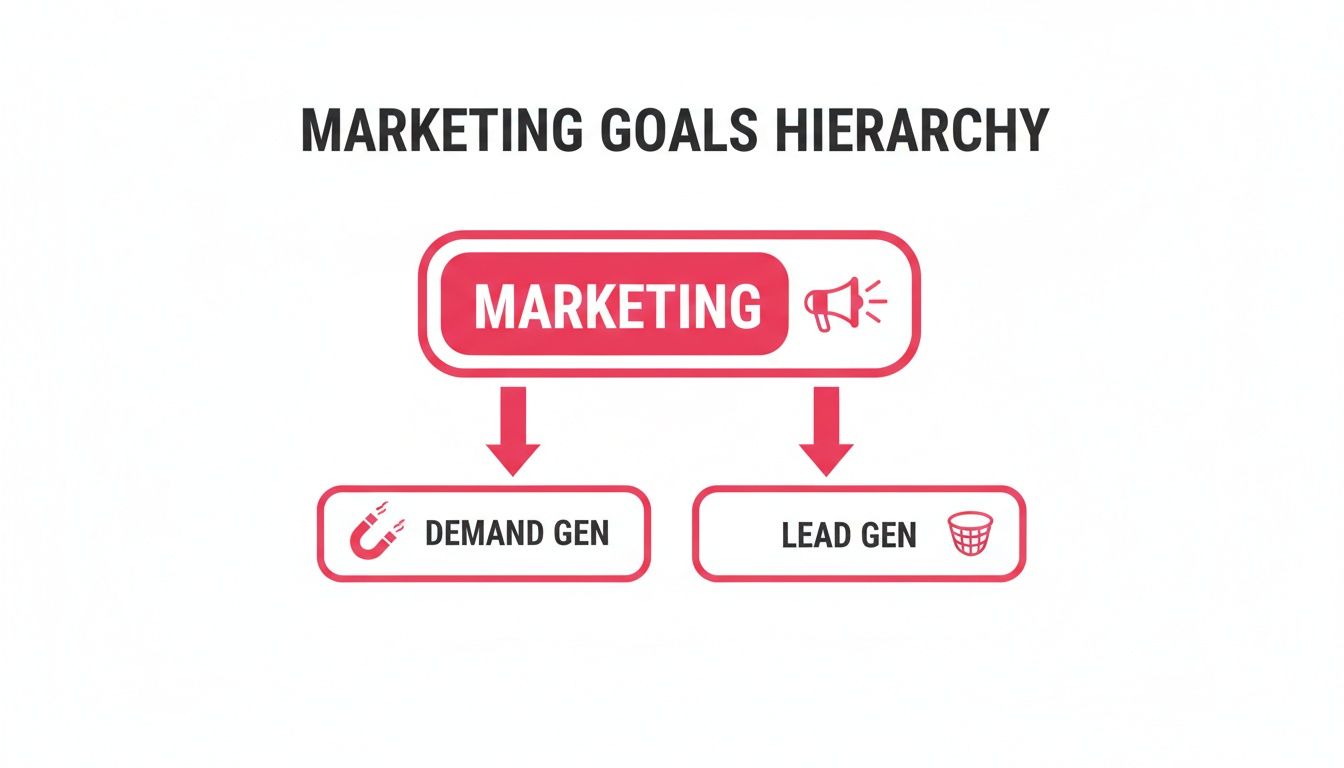
Think of demand generation as the magnet that attracts broad interest, while lead generation is the net used to capture it once it’s there.
Pillar 1: Get Clear on Your Positioning
This is the foundation. If you get this wrong, everything else you do will be ten times harder. Positioning is the tough work of getting brutally honest about three things:
Who you serve: Not a broad industry. The specific type of person or company that gets the most value from what you do.
The problem you solve: The sharp, painful problem they have that you are uniquely equipped to fix.
Why you are the best choice: Your distinct point of view on that problem and its solution. What makes your approach different?
Without this clarity, your content will be generic and your ads won’t work. Most marketing problems are actually positioning problems in disguise. It’s the essential first step.
Pillar 2: Build a Presence Through Education
Once you know who you’re talking to and what you want to say, the next pillar is building your presence. This isn't about being everywhere at once. It's about consistently showing up where your ideal customers are and educating them over time.
The key is to build trust without asking for anything in return. You’re not trying to capture an email address with every piece of content. You’re simply sharing your expertise freely to help people understand their problem in a new light.
This is where you build a real connection. Your goal is for your ideal customer to think, "Every time I see something from them, it's smart and helpful." This goodwill is the fuel for your entire demand engine.
This might be a series of in-depth articles, a podcast, or insightful posts on LinkedIn. The format doesn’t matter as much as the quality and consistency of the thinking behind it. If you need help visualising this, our guide on customer journey mapping provides a framework for marketing clarity.
Pillar 3: Promote for Engagement
The final pillar is promotion. Great content is useless if no one sees it. This pillar is about using targeted methods to get your educational content in front of the right people and start conversations. It’s about being helpful, at scale.
This isn’t about blasting your message to everyone. It’s about focused distribution.
Sharing valuable insights on the social platforms where your audience is already active.
Running small, targeted ad campaigns to amplify your best educational content, not just gated assets.
Engaging in relevant communities with helpful advice, not lazy sales pitches.
This structured approach—positioning, presence, and promotion—removes the guesswork. You build a brand that attracts your ideal customers, earns their trust, and makes your business the obvious choice when they’re finally ready to act.
A Practical Example: From Messy to Focused
Let’s lose the theory and make this real. It’s easy to look at frameworks like this and think they're only for big companies with massive budgets. But this way of thinking is most powerful for small teams.
It’s about making smarter choices, not just more of them.
Let’s walk through a founder moment. Imagine the founder of an AgTech SaaS company. Her product is brilliant—it helps farms monitor soil moisture to manage water usage more efficiently. But her marketing feels like a mess of random tactics that aren't adding up.

She decides to build a proper demand engine using the three pillars: Positioning, Presence, and Promotion. A focused sprint is often the best way to get this done and find clarity fast.
Step 1: Nailing the Positioning
First, she has to sort out her positioning. Her current message is broad: "We help all farms save water." It sounds fine, but it’s too generic to connect. It also forces her to compete with everyone.
She needs to get specific.
After looking at her data on her best customers, she realises they all have something in common. They’re all large-scale vineyards in dry, drought-prone regions of Australia.
That’s her lightbulb moment.
She narrows her focus from 'all farms' to 'large-scale vineyards in dry regions facing increasing water scarcity'. This one small shift changes everything. Now she has a clear enemy (drought) and a specific hero she can serve (the vineyard manager). All her marketing can be aimed at one person with one sharp problem.
Step 2: Building a Genuinely Helpful Presence
With her positioning sorted, she moves on to Presence. Before, her team was churning out generic blog posts like "5 Tips for Better Water Management." The content was okay, but it wasn’t attracting the right people.
Now, she knows exactly who she’s talking to. Instead of flimsy tips, her team pours their effort into a single, high-value piece of content: a definitive guide titled "The Vineyard Manager’s Playbook for Drought-Proofing Operations."
This guide isn't a sales pitch. It covers the whole picture: soil health, canopy management, government water allocations, and new irrigation techniques. She’s educating her audience on the entire problem, positioning her company as the go-to expert. This is how you build trust long before you ask for a sale.
This shift—from creating shallow content for everyone to creating deep, valuable resources for someone specific—is the core of an effective demand generation program. It's about becoming the go-to source of information for your ideal customer.
Step 3: Promoting to the Right People, in the Right Place
Finally, she tackles Promotion. In the past, she’d boost a post on Facebook and get a few likes, but it led nowhere. Now, her promotion is targeted and has a purpose.
She knows her ideal customer—the vineyard manager—spends their time on LinkedIn. So, her team focuses there. They don’t just run ads asking for a demo. Instead, they get smart:
Share snippets of the guide: They pull out key insights from the playbook and share them as valuable, standalone LinkedIn posts. No hard sell, just pure value.
Run a targeted webinar: They host an online event called "How Australia’s Top Vineyards Are Surviving the Drought" and use a small ad campaign to promote it to people with the job title "Vineyard Manager."
Join the conversation: They get active in industry groups and comment helpfully on other people's posts about water management.
This example turns the fuzzy idea of 'demand generation' into a tangible, step-by-step process. It shows how small shifts in thinking—from broad to specific, from selling to educating—create real momentum.
She’s no longer just chasing leads; she’s building a structured, repeatable system that attracts her perfect customers.
How To Measure What Actually Matters
One of the biggest anxieties for any founder is pouring money into marketing without knowing if it’s working. It’s a fair frustration. But when you shift from capturing leads to creating demand, the way you measure success has to change too.
This isn't about chasing empty numbers like likes or website visits. Those metrics don't tell you if you're building a real asset for your business. We need to look at indicators that show you're building a trusted presence and influencing the right customers.
This is where most teams get stuck. They try to apply old lead generation metrics to this new way of thinking, and it doesn't work. When we join a team, one of the first things we do is build a simple dashboard to bring clarity and confidence back.
Moving Beyond Vanity Metrics
The goal of demand generation isn't to get a click today; it's to win a customer in six months. That requires a different way of looking at measurement, one that focuses on genuine influence and the health of your pipeline.
Your new dashboard should connect your marketing activity to real business results.
Here are the core numbers to track:
Sales Cycle Length: How long does it take from a first touch to a signed deal? As you build more demand, this number should get shorter, because prospects show up already knowing and trusting you.
Customer Acquisition Cost (CAC): This should drop over time. Building a brand that pulls customers in is far more efficient than constantly paying to hunt them down.
Pipeline Velocity: How fast are deals moving from one stage to the next? A good demand engine produces better-fit prospects who move through your sales process with less friction.
Percentage of Inbound-Sourced Revenue: This one is huge. What slice of your new revenue comes from people who came to you? When this number climbs, it's the clearest sign that what you're doing is working.
The Softer Signals That Matter Most
Not everything valuable can be put in a spreadsheet. Some of the most powerful signs that you’re building a brand people trust are qualitative.
Founder Moment: The real win is when someone gets on a sales call and says, "I've been following your content for months. I feel like I already know you guys." That’s it. That’s the ultimate proof your strategy is working. You’ve won their trust before the sales process has even started.
These "dark social" signals are pure gold. It’s important to have a simple way for your sales team to capture this. A quick note in your CRM every time a prospect mentions your podcast or an article adds a powerful, human layer of data that spreadsheets will never give you.
This idea of tracking real demand isn’t unique to software. You can see it in other complex industries. For example, the State of the Energy Market 2025 report shows how evolving demand patterns are being tracked in Australia's energy sector. This data-driven view reveals how new technologies are disrupting old models. You can check out the full report from the Australian Energy Regulator. It's a great reminder of why you need clear indicators to navigate change.
Keep It Simple
You don't need a complex analytics setup to get this right. A simple dashboard with just these key metrics will give you a much clearer picture of your marketing’s impact. The goal is to build a calm, confident view of your progress, not drown yourself in data.
This shift in measurement gives you the structure to see what's actually working and the confidence to keep investing in the things that matter.
Your First 90-Day Sprint to Get Started
If this feels overwhelming, that’s normal. Staring at the gap between what you're doing now and a full demand engine can feel like you're at the bottom of a mountain. The secret is to ignore the mountain and just focus on the first few steps.
You don't need a huge project plan. You just need momentum. The best way to build it is with a simple, focused 90-day sprint. This is the exact approach we take with teams because it breaks a massive goal down into calm, manageable steps.
Month 1: Clarity
For the first 30 days, forget everything else. Your only job is to get crystal clear on your positioning. If you rush this part, everything you build on top of it will be wobbly.
Spend the month talking to your best customers. Not prospects, not lost deals—the people who already love what you do. Find out, in their words, what problem you solve and why they chose you. Use these conversations to nail down your ideal customer and sharpen your message.
This single month of focused work will give you more direction than a year of random tactics ever could.
Month 2: Presence
Now that you have clarity, it’s time to build one thing of genuine value. In month two, your focus is on creating a single, high-value piece of content based on your new positioning. Don't try to launch a blog, a podcast, and a newsletter all at once. That’s a recipe for burnout.
Pick one format and make it exceptional. Maybe it's a deep-dive guide that becomes the definitive resource on a topic. Or a practical webinar that teaches your audience something useful. The goal is to create one cornerstone asset that serves your ideal customer.
Month 3: Promotion
With your high-value asset in hand, month three is about getting it out there. Again, focus. Don’t try to be everywhere. Your only task is to get that one piece of content in front of the right people, on the channel where they spend their time.
This might mean sharing snippets on LinkedIn or running a small, targeted ad campaign. You’re not trying to reach everyone; you’re trying to reach the right ones. This focused effort ensures your valuable content gets seen.
If this three-month plan still feels messy, that’s normal. You’re not behind. You need structure. To see how this sprint fits into a larger framework, our guide on how to create a marketing plan that actually works can give you the bigger picture.
The most important thing to remember is this: start by fixing your positioning before you touch anything else. That clarity is the calm, confident first step forward.
Common Demand Generation Questions
Even with a clear framework, it's normal to have a few questions. If you're still piecing it all together, you're not alone.
Let's tackle a few of the most common questions we hear from founders.
How Long Does Demand Generation Take To Work?
This is the big one. The honest answer is that demand generation is a long game. It's not a quick fix to hit a quarterly target. While you can see promising early signs within 90 days—like better conversations with prospects or a shorter sales cycle—building a truly predictable pipeline usually takes 6-12 months.
The point isn't just to get a list of names for your sales team this month. You're building a lasting brand asset that pulls the right people towards you, creating momentum that builds over time.
Can a Small Team Actually Do This?
Absolutely. In fact, a small, focused team often has an advantage. You can move faster and stay aligned more easily than a big department.
The trick is to fight the urge to do everything at once. This is where a sprint approach shines. Start with one audience, one core problem, and one or two channels. A 90-day sprint lets you build momentum without burning everyone out. For a deeper look at the overall approach, you can explore a comprehensive modern B2B demand generation strategy that can help drive growth.
Is Demand Generation Only for B2B SaaS?
While it’s a natural fit for B2B SaaS, the principles work for any business selling something that requires a considered purchase. This could be high-value professional services, complex hardware, or specialised consulting.
If your customers need to learn and build trust before they're ready to buy, a demand generation mindset is essential. It gives you the roadmap to guide them from simply being aware of you to confidently taking action.
If your marketing feels stuck and you need a clear path forward, Sensoriium can help. We provide the structure, clarity, and momentum to build a marketing engine that actually works. Find out how we do it.