
What Is Product Positioning and How Do You Get It Right?
- Jan 4
- 16 min read
Product positioning is deciding who your product is for, what problem it solves for them, and why it’s the only logical choice to get the job done. It’s the foundational story that aligns every single part of your business, from marketing and sales to product development.
That vague feeling something isn't working
It’s a feeling many founders know all too well. The business is running, you’re making sales, and everyone is busy. But underneath it all, there's a disconnect. You can’t quite put your finger on it, but the signs are everywhere.
Maybe your sales team struggles to explain what makes you different. Your marketing campaigns might feel like shouting into a crowded room, hoping the right person happens to overhear. There's that nagging suspicion that your best customers don't really get the full value you deliver.
If this feels familiar, you’re not crazy. It’s a classic symptom of weak or unclear product positioning. You’re not stuck because you’re doing something wrong; you’re stuck because you lack a clear, guiding story.
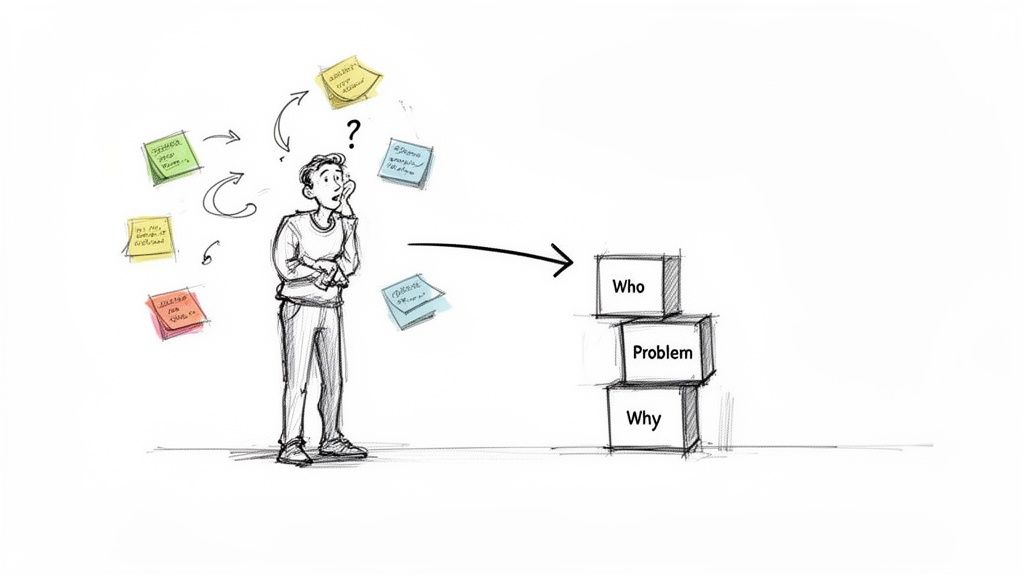
The problem isn't effort, it's clarity
When things feel messy, the default response is often to do more. More ads, more content, more sales calls. But throwing more activity at the problem without a clear direction just makes the chaos louder. The real issue isn't a lack of effort; it's the absence of a central, guiding idea.
This is exactly what product positioning fixes. It’s not just a fluffy marketing exercise or a tagline for your website. It’s a strategic choice that brings focus, confidence, and structure to your entire organisation.
When your positioning is clear, every decision gets simpler. You know which features to build next, which customers to focus on, and what your sales team should say on every call. It’s the difference between guessing and knowing.
To put it another way, think of building a house. Without a blueprint (your positioning), everyone is just nailing boards together, hoping it ends up looking like a home. With a blueprint, every action has a purpose, contributing to a solid, coherent structure.
This table contrasts the common symptoms of poor positioning with the clarity that strong positioning provides, helping you quickly diagnose your core challenge.
From chaos to clarity: a positioning snapshot
Symptom of Poor Positioning | Outcome of Clear Positioning |
|---|---|
Sales team struggles to explain your unique value. | Sales conversations are confident and compelling. |
Marketing messages feel generic and get ignored. | Marketing attracts high-quality, ideal-fit leads. |
Product roadmap is driven by random requests. | Product development is focused on what matters most. |
Constantly competing on price. | You can command premium pricing for your unique value. |
Low team morale and internal confusion. | The entire team is aligned and motivated by a shared story. |
When we embed with a team, this is almost always the first gap we fix. We help founders and their teams move from a vague sense of what they do to a sharp, shared understanding of their unique place in the market. This single shift creates immediate momentum, turning that quiet frustration into confident direction.
Why most positioning advice falls flat
Ever Googled "what is product positioning" and felt your eyes glaze over? You’re not alone. Most of the advice out there is a tangled mess of complex frameworks and corporate jargon that feels completely disconnected from the day-to-day reality of running a business.
You’re told to fill in the blanks on a "positioning statement" template, but it feels more like a creative writing assignment than a genuine business tool. The templates show you the finished product—a neat little sentence—but they don't teach you how to make the tough strategic decisions that actually matter. This is why that advice almost always misses the mark. It treats positioning like a copywriting task, not a strategic one.
The worksheet trap
Here’s the biggest problem with that generic advice: it pushes you to write a perfect, polished sentence that, in reality, nobody on your team ever uses. It gets ticked off a list, filed away in a Google Doc, and is promptly forgotten.
The real goal isn't to craft some flawless sentence for a marketing plan. It’s about creating a deep, shared understanding across your entire company—from sales and marketing right through to product and customer support—about the deliberate choices you’re making in the market.
Positioning isn’t about what you write down in a document. It’s about the clarity of the idea in your team’s heads. Can they all answer the same basic questions, the same way, without looking at a worksheet?
This is exactly where so many teams get stuck. Most teams struggle here because they’ve never had someone step in to structure the work. The whole process feels messy and hard, so they reach for a template, hoping for a quick fix.
Focusing on features instead of choices
Another common trap is the obsession with "features and benefits." So much advice tells you to just list everything your product does and then compare that list to your competitors. This almost always leads to weak positioning built on minor technical details that your ideal customer couldn't care less about.
Strong positioning isn't about being marginally better. It’s about being distinctly different. It requires making courageous, deliberate choices about who you serve and—just as critically—who you don’t.
Founder moment: a simple scenario
Let's imagine a company that sells project management software. Most of the advice they'd find would tell them to list their features—Gantt charts, time tracking, integrations—and then claim they're "the best" or "easiest to use." It’s totally forgettable.
Now, picture a founder who really gets positioning. She makes a choice. She decides their tool is built exclusively for creative agencies who despise spreadsheets. Instantly, everything snaps into focus. The website copy, the sales demos, the product roadmap—it all gets laser-focused. They are no longer just another project management tool; they are the only logical choice for that very specific audience.
That's the mental shift you need to make. It’s not about filling in a worksheet; it’s about having the clarity and courage to plant a flag and make a stand. This structured thinking is what transforms a generic product into a solution that feels indispensable.
The four pillars of powerful positioning
Forget all the dense academic theories for a moment. When you strip it all back, powerful product positioning really just comes down to four foundational pillars. If you get these right, you’ll have the clarity and structure you need to move forward with real confidence.
Think of effective positioning as a solid platform supported by four legs: Your Audience, Your Value, Your Difference, and Your Proof.
Whenever we start working with a new team, one of the first things we do is check the strength of each pillar. Nine times out of ten, any confusion in their marketing or sales process can be traced back to a crack in one of these four areas.
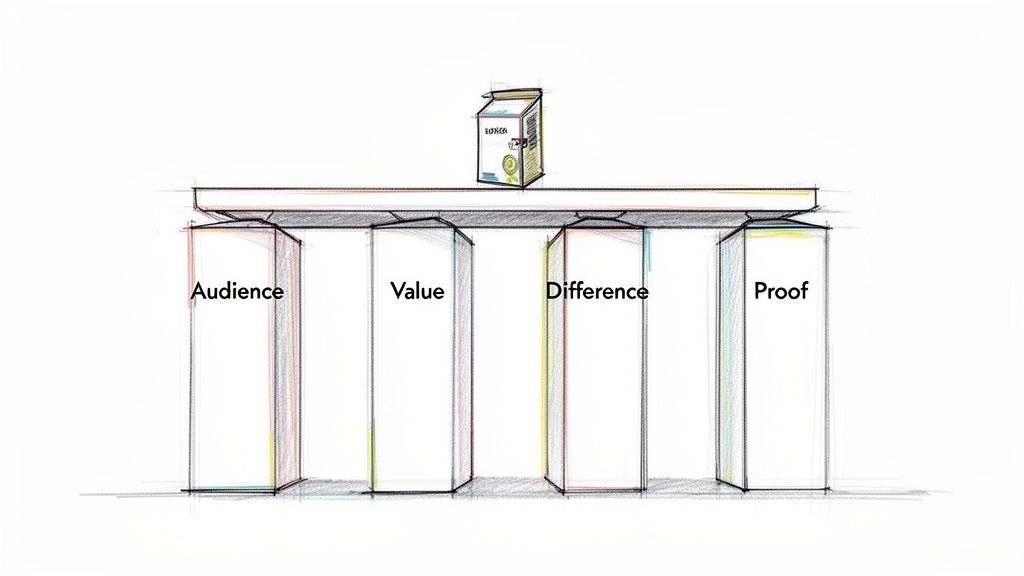
To make this even clearer, here’s a quick breakdown of what each pillar is all about.
The four pillars of positioning explained
Pillar | Key Question It Answers | Practical Example |
|---|---|---|
Audience | Who is this for, specifically? | Instead of "farmers," think "early-adopter wheat farmers in Western Australia running family operations of 2,000-5,000 hectares." |
Value | What tangible outcome do they get? | Not "real-time data," but "cut your water and fertiliser costs by 15% in the first season." |
Difference | Why should they choose us over anyone else? | We're the only solution built by agronomists that offers on-the-ground support, not just a dashboard. |
Proof | How do we make our claims believable? | A detailed case study showing how "Smith Farms" in Geraldton achieved a 15% cost reduction. |
These pillars build on each other, creating a logical and compelling story for your product. Now, let’s look at each one a bit more closely.
Pillar 1: Your audience
This is the single most important decision you’ll make. It’s not about finding the biggest market you can possibly sell to; it's about pinpointing the exact group of people you can serve better than anyone else.
So many founders fight this. Niching down feels like you’re leaving money on the table, but the opposite is true.
When you try to be everything to everyone, you end up being nothing special to anyone. A sharp focus on a specific audience gives your entire business a filter, making every decision—from product development to marketing copy—radically simpler.
The question isn't "Who could buy our product?" The real question is, "Who feels the pain we solve most acutely, and who will get the most value from our specific solution?"
Answering this honestly is the first step to creating a product that feels indispensable, not just like another option on a long list. It’s the difference between shouting into a crowd and having a meaningful, one-on-one conversation.
Pillar 2: Your value
Once you know exactly who you’re talking to, you have to frame your value in a way that actually resonates with them. This is where most companies stumble, falling into the classic trap of listing features instead of selling outcomes.
Let’s be clear: your customers don’t buy your software, your sensor, or your service. They buy what it does for them. They’re paying for a result, a transformation, a better version of their reality.
To nail this, you have to translate every feature into a tangible benefit.
Feature: "Our software integrates with Xero."
Value: "Slash your bookkeeping time by five hours a week."
Feature: "This sensor provides real-time soil data."
Value: "Know exactly when to irrigate to maximise crop yield and cut water costs."
Getting this right is how you stop competing on price. This is especially true in price-conscious markets. As of 2025, Australian consumers are notoriously price-sensitive, with 81% pointing to lower prices as their top reason for choosing store brands. But quality is the second-biggest factor at 43%, showing that Aussies will happily pay more if they can see genuine value.
Pillar 3: Your difference
In a crowded market, being different is far more important than being slightly better. If your only claim is that you’re a marginally improved version of a competitor, you’re forcing your customers to do a direct comparison—which almost always defaults back to who’s cheaper.
Real differentiation isn't about having a longer feature list. It’s about being the only one who does what you do in the way you do it. This is where you plant your flag.
Your difference could come from anywhere:
Your business model: A SaaS company offering radically simple pricing in an industry known for complexity.
Your service approach: A consultancy that embeds its team with yours instead of just dropping off a report.
Your unique perspective: A software tool built by industry veterans who understand the workflow inside and out.
To figure this out, you need to dig deep into the market using solid competitor analysis frameworks to find the gaps your competition has left wide open. Those gaps are where your business can become the only logical choice. While this is different to brand-level strategy, it's a vital piece of the puzzle. You can learn more in our guide on what brand positioning is and how to find yours.
Pillar 4: Your proof
Okay, so you’ve defined your audience, your value, and what makes you different. The final step is to make it all believable. Without proof, every claim you make is just noise.
Proof isn't a few cherry-picked testimonials on your homepage. It’s a compelling portfolio of evidence that shows you can actually deliver on your promises.
Powerful proof removes risk from the buyer's mind. It makes choosing you feel like a safe, intelligent decision rather than a gamble.
Some of the most effective forms of proof include:
Case Studies: Real stories that show how a specific customer achieved a measurable result.
Data and Statistics: Hard numbers that quantify your impact (e.g., "Our customers see a 30% reduction in waste").
Customer Reviews: Honest, verifiable feedback on third-party sites that builds social trust.
Demonstrations: A clean, compelling product demo that shows your value in action, rather than just talking about it.
These four pillars aren’t a one-time checklist. They're a way of thinking—a solid foundation that brings clarity, confidence, and direction to everything you do next.
Putting it all into practice: a simple scenario
All the theory in the world doesn’t mean much if you can't see how it actually works in a real business. It's easy to get tangled up in abstract ideas about value and differentiation. So what does good positioning look like when you're in the trenches?
Let’s walk through a founder moment to make it real.
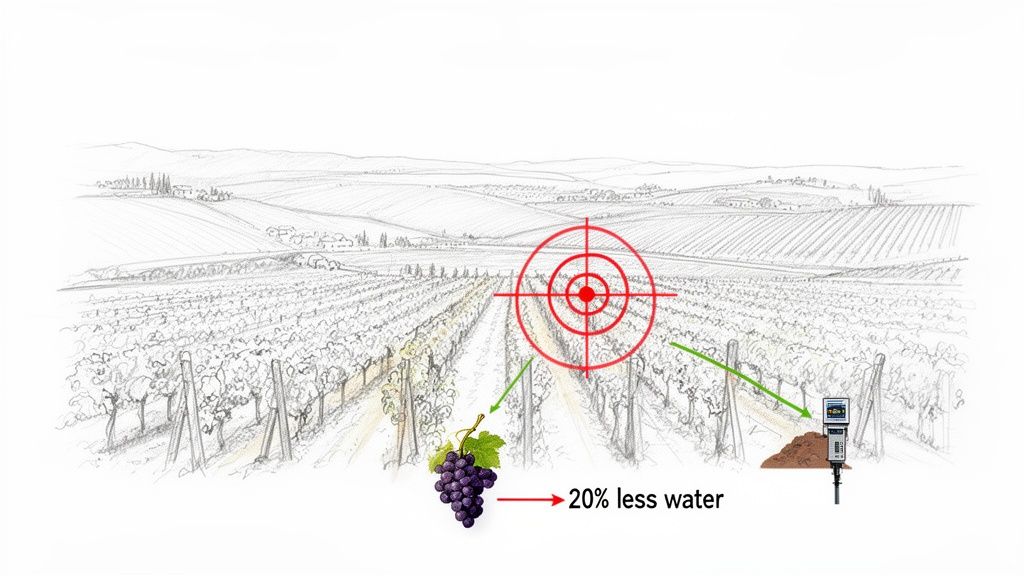
Imagine an Aussie agtech company has just built a brilliant new soil moisture sensor. The tech is solid, it's accurate, and it's reliable. The founders, hungry for growth, decide to sell it to every farmer in the country. This is such a common mistake, and it's almost always a costly one. It leads to vague messaging, a confused sales team, and a marketing budget stretched so thin it makes zero impact.
This is the exact point where most teams get stuck. They have a great product but no clear story to tell or direction to follow. This is usually where a sprint approach creates clarity quickly.
The power of a single, deliberate choice
Instead of trying to be everything to everyone, the founders take a step back. They do the hard work of thinking through the four pillars: Audience, Value, Difference, and Proof. They realise their sensor is a bit pricier but offers exceptional accuracy in tracking water use at very specific soil depths.
Now, who feels the pain of water management most acutely? It’s probably not the broadacre wheat farmer with thousands of hectares. It’s the premium winemaker.
So, they make a deliberate choice. They decide to focus exclusively on large-scale vineyards in South Australia’s Barossa Valley that are struggling with strict water scarcity regulations.
This single decision is the moment the chaos stops and clarity kicks in. Suddenly, everything else snaps into focus.
How one choice changes everything
That sharp focus cascades through the entire business, giving them immediate structure and momentum.
Their messaging transforms. It shifts from generic tech-speak like “accurate moisture readings” to a compelling, audience-specific promise: “Meet water compliance targets and increase grape yield with 20% less water.” The second version speaks directly to a winemaker’s biggest headaches and hopes.
Their website copy gets sharp. The homepage no longer talks about farming in general. It’s now filled with images of vineyards, testimonials from vintners, and case studies about improved grape quality.
The sales process becomes efficient. The sales team can stop wasting time chasing unqualified leads. They can build a targeted list of Barossa wineries and walk into every conversation already understanding their prospect’s world.
Product development gains direction. Instead of adding features at random, the roadmap is now guided by a clear question: “What will help our winemakers get an even better result?” Maybe that’s an integration with vineyard management software or a predictive algorithm for frost alerts.
This is what product positioning actually does. It turns a good product into the only relevant solution for a specific group of people. It’s not about limiting your potential; it’s about concentrating your energy where you can actually win.
A great way to visually map this out and really grasp your product's place in the market is by using a marketing positioning matrix. It's an invaluable tool for seeing where you stand and figuring out the strategic moves you need to make next.
This agtech company didn’t change its product. It just changed its mind. By making a single, courageous choice, they gave their entire business the focus it needed to stop guessing and start growing with real confidence. You can see how this clarity translates into a powerful message in our guide with 8 positioning statement examples to give your brand clarity.
Common positioning traps and how to avoid them
Even when you know the rules, it's surprisingly easy to get product positioning wrong. The path is littered with subtle traps that can quietly steer your strategy off course, leaving you right back where you started: confused and struggling to stand out.
Recognising these pitfalls is half the battle. They aren’t usually big, dramatic failures. More often, they’re common-sense assumptions that creep in when a team is too close to their own product and lacks an outside perspective to challenge them.

Let’s walk through the most frequent traps we see founders fall into, and more importantly, how you can sidestep them.
Trap 1: The danger of being for everyone
This is the most common and seductive trap of all. The logic feels sound: if we appeal to a broader market, we’ll have more chances to make a sale. But in reality, trying to be the perfect solution for everyone makes you the perfect solution for no one.
Your messaging gets watered down, your marketing budget is stretched thin across too many channels, and your product roadmap becomes a chaotic wish list of competing features. You end up as just another generic option in the market, forced to compete on price because you don’t stand for anything specific.
How to avoid it: Be brave and make a choice. Have the tough conversation to define your absolute best customer—the one who gets the most value from your work and is the most profitable for you to serve. Plant your flag with that audience and go all-in. It feels risky, but it’s the only path to becoming truly relevant.
Trap 2: Competing on features alone
It’s so easy to get fixated on what your product does. You’re proud of the tech, so of course you want to talk about it. The trap here is believing that a longer feature list automatically makes you the better choice.
Newsflash: your competitors can (and will) copy your features. If your only point of difference is a technical capability, you’re stuck in a never-ending arms race that exhausts your team and just confuses your customers.
How to avoid it: Shift your focus from what your product does to the outcome it delivers. Your customers aren't buying a list of features; they're buying a better version of themselves or their business. Frame your value around that transformation, not your tech specs. Understanding where your rivals play is critical here; our guide on how to conduct competitor analysis can give you the structure you need.
Trap 3: Thinking positioning is a one-time task
So many teams treat positioning like a project with a neat start and end date. They run a workshop, write a positioning statement, and file it away in a shared drive, thinking the job is done. But markets don't stand still. Competitors evolve and customer needs change.
Positioning isn't a static document you frame on the wall. It’s a living, breathing part of your business strategy that needs regular attention.
A positioning statement that’s gathering dust in a shared drive is useless. The real test is whether it actively informs your decisions about marketing, sales, and product every single day.
How to avoid it: Schedule a positioning check-in every 6 to 12 months. Ask the hard questions: Is this still true? Have our customers’ priorities shifted? Has a new competitor changed the game? This simple habit keeps your strategy sharp and relevant.
Trap 4: The internal reality vs. market perception gap
This one is subtle but deadly. Your team lives and breathes your product every single day, developing a shared, internal shorthand for its value. The mistake is assuming the outside world sees you the same way. What you believe is your killer differentiator might be completely lost on potential customers.
You absolutely have to test your assumptions. For B2B tech companies, Australia has become a fantastic test market thanks to its diverse, tech-savvy business environment. It’s a great place to see how your positioning lands before you take on the world.
How to avoid it: Get out of the building and talk to your customers. Even better, talk to the prospects who didn’t choose you. Ask them how they describe what you do and what ultimately swayed their decision. This dose of external reality is the fastest way to close the gap between how you see yourself and how the market actually sees you.
Your next step towards gaining clarity
If you’re feeling a bit overwhelmed right now, that’s completely normal. The point of all this isn't to nail your entire product positioning strategy in one sitting. It's about figuring out where to start.
Trying to fix everything at once is a recipe for chaos. Before you even think about rewriting website copy, redesigning your sales deck, or launching a new ad campaign, you need to get your foundation right.
This is where a focused, structured conversation can make all the difference. Most teams get stuck here because they've never had an outsider facilitate the discussion, so their attempts end up feeling messy and unproductive.
One task to create alignment
Start by fixing this one thing before you touch anything else. Get your leadership team in a room for 90 minutes with a single, clear goal: to get a shared, honest understanding of your four pillars.
Forget about polished marketing slogans for a moment. Aim for brutal honesty and genuine alignment.
Who is our absolute best customer? Not just the biggest or loudest, but the one we serve better than anyone else.
What is the single biggest result we help them achieve? Get past the features and focus on the tangible outcome.
Why are we genuinely different? No clichés. What’s the real reason a customer should choose us over everyone else?
What is our most compelling proof? Where’s the undeniable evidence that we deliver on our promise?
If this exercise feels messy, you’re not behind. It’s a sign that you’ve found the exact point of friction that needs attention. You don’t need more activity; you need structure.
Getting aligned on these points is the first, most critical step. It’s the single action that builds a stable platform for making smarter, faster decisions on everything else. Get this right, and the path forward will become a whole lot clearer.
A few final questions about product positioning
Even with a clear roadmap, it’s completely normal to have some questions floating around. Getting your product positioning right isn't about finding a single magic answer; it's about building the confidence to make smart, deliberate choices for your business.
Here are some quick, practical answers to the questions we hear most often from founders and their teams.
How is product positioning different from brand positioning?
This is a classic point of confusion, and it’s a great question because the two are tightly linked but solve different problems.
Think of it this way: Product positioning is tactical. It’s all about winning a specific sale. You're defining your product's value for a specific audience, showing how it stacks up against a specific set of competitors. It answers the question, “Why should I choose this product over the others, right now?”
Brand positioning, on the other hand, is much broader. It’s the long-term emotional connection and reputation you build in the market over years. It’s strategic. It answers the question, “What does this company stand for in the world?”
Your product positioning should always support your brand positioning, but they operate at different altitudes.
How often should we revisit our positioning?
Positioning isn’t a “set it and forget it” exercise. Markets change, competitors launch new features, and what your customers need today might be different tomorrow.
As a rule of thumb, it’s smart to formally review your positioning every 12 to 18 months.
But you should also be informally pressure-testing it all the time. If your sales team starts hearing new objections on their calls, or a new competitor suddenly seems to be everywhere, those are clear signals that it’s time for a check-in. The goal isn’t to constantly reinvent yourself, but to make sure your message stays sharp and relevant.
Does every product need its own positioning?
Yes, absolutely. If you have a portfolio of products, each one needs its own distinct positioning that spells out its unique audience, value, and competitive edge.
Trying to use one generic, company-level message for multiple products almost always ends in confusion. A single agtech company, for instance, might sell one product positioned for large-scale corporate farms and another designed for independent family operations. Each product needs its own story to connect with its unique audience.
Modern marketing demands this kind of focus. The core idea of getting the right product in front of the right person at the right time isn't new. In fact, way back in 2011, Australia’s product placement market hit $243 million as brands looked for smarter ways to reach audiences. You can learn more about how brands have evolved their positioning strategies in this MarketingMag article.
If this feels messy, that’s normal. You’re not behind. You need structure. Sensoriium provides the senior leadership and practical support to untangle that mess, giving you the clarity and confidence to grow.