
8 Practical Examples of Positioning Statements That Actually Create Clarity
- Jan 17
- 19 min read
Trying to write a positioning statement can feel like a trap. You know it’s important, but every attempt sounds either too generic or completely unbelievable. You’ve read the same advice a dozen times, seen the same tired examples, and you’re still stuck.
It makes sense that you feel frustrated. You’re not trying to come up with a clever slogan; you’re trying to find the simple, honest words that explain why your business actually matters to a specific group of people. The good news is, you’re not crazy and you’re not behind. You just need a better way to think about the problem, moving from abstract theory to practical structure.
This isn't about finding a magic formula. It’s about finding a framework that gives you the clarity to move forward with confidence. Most teams struggle here because they’ve never had someone step in to organise the work, connecting what the business does with what the market truly values. The gap isn't a lack of effort; it's a lack of structure.
This article provides that structure. We’re going to walk through eight distinct types of positioning statements, complete with real-world examples from B2B tech, SaaS, and service-driven businesses. For each one, we’ll break down precisely why it works, what to avoid, and provide a simple template you can adapt. You’ll get a clear, practical look at examples of positioning statements that cut through complexity and give you the direction you need to align your sales and marketing efforts.
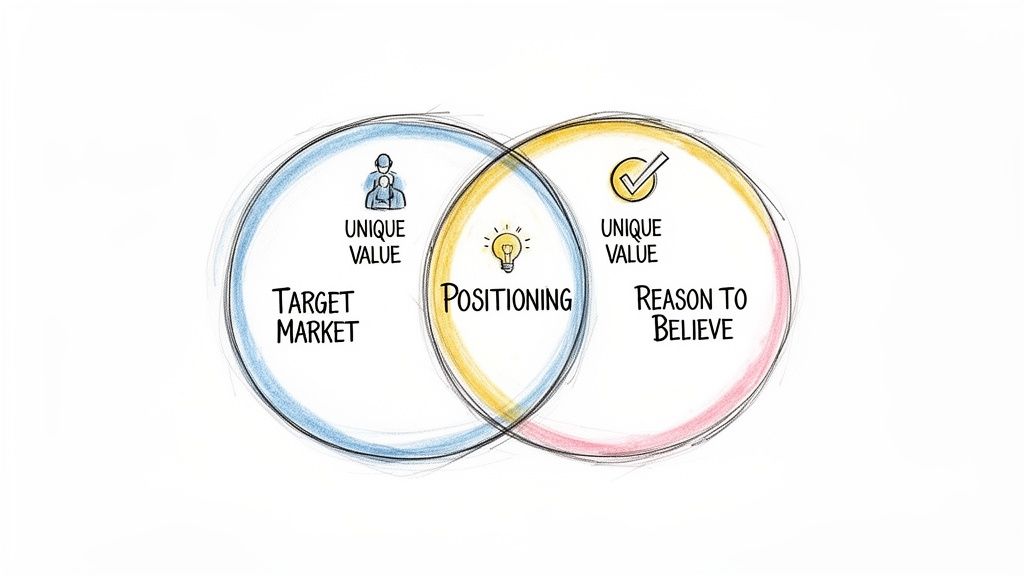
1. The Target Market + Unique Value + Reason to Believe Framework
If your messaging feels vague or disconnected from what your customers actually care about, it’s often because the foundational logic is missing. You might be describing features instead of articulating value. This framework forces you to stop talking about yourself and start with who you serve, what they need, and why you’re the credible choice. It’s the starting point for almost all the positioning work we do at Sensoriium because it replaces guesswork with structure.
The format is straightforward: For [target customer] who [problem/need], [brand] is [category] that [unique benefit]. Unlike [alternative], we [key differentiator]. This simple sentence structure is deceptive; getting it right requires intense clarity on your business.
Why This Framework Works
This is one of the most effective examples of positioning statements because it systematically dismantles vague marketing language. It demands specificity at every step.
Slack: "For distributed teams overwhelmed by communication chaos, Slack is a unified communication platform that replaces scattered email, chat and file sharing. Unlike email, we keep conversations searchable and organised." * Target: Distributed teams. * Problem: Communication chaos. * Unique Benefit: Unified, searchable, and organised conversations. * Differentiator: Superior to email’s scattered nature.
HubSpot: "For growing businesses tired of disconnected sales and marketing, HubSpot is an all-in-one CRM platform that unifies customer data. Unlike point solutions, we eliminate data silos." * Target: Growing businesses. * Problem: Disconnected tools and data. * Unique Benefit: Unified customer data. * Differentiator: An all-in-one platform, not separate tools.
This structure provides a clear, defensible statement that aligns your marketing, sales, and product teams. It becomes the internal compass for every decision. Once you've defined your unique value and reason to believe, you can leverage it for strategies like establishing a strong market presence through Thought Leadership Marketing.
How to Apply It
Define Your Target Customer: Be ruthlessly specific. "Small businesses" is too broad. "AgTech founders in Australia losing margin to supply chain opacity" is precise and actionable.
State Their Problem: Articulate the pain point they feel, not the solution you offer. Use their language.
Articulate Your Unique Benefit: Connect your solution directly to their problem. This is the "so what?" that makes them care.
Name Your Differentiator: This is your "reason to believe." It must be a tangible, provable advantage over a specific alternative. Avoid superlatives like "best" and focus on what makes you different.
If you are struggling to get this right, it’s a strong signal that you need to deepen your understanding of your customers and competitive landscape. It's a foundational step we cover when helping businesses find their brand positioning.
2. The Value-Based Positioning Statement
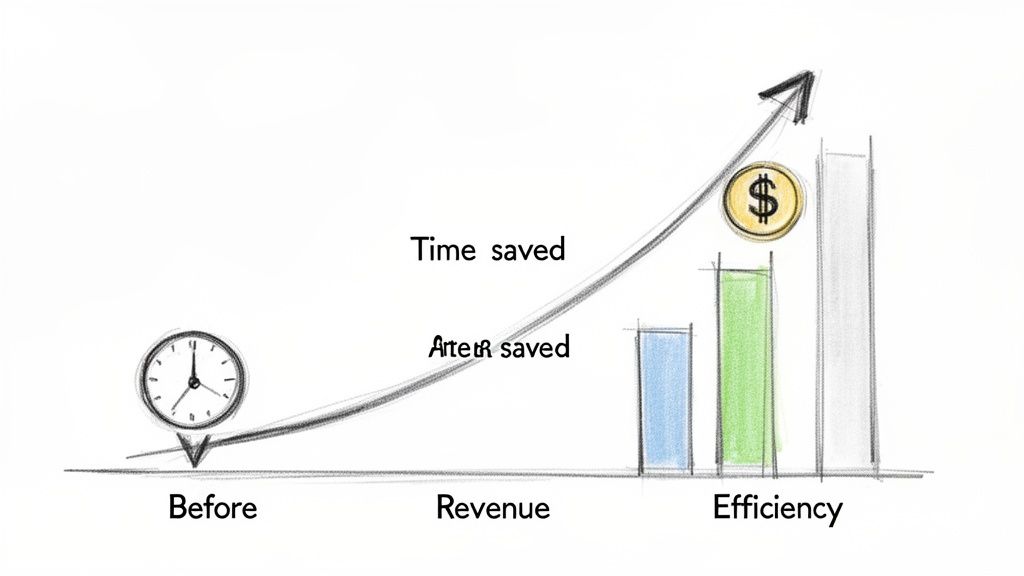
If you find yourself constantly talking about features or technology, you’re likely losing your audience. Customers don’t buy a CRM; they buy shorter sales cycles and more productive teams. The value-based approach shifts the conversation from ‘what we do’ to ‘what measurable outcome you get’. It focuses on the transformation your customer experiences, making your product an investment, not an expense.
This is powerful because it directly addresses the buyer's core business objectives. Instead of selling software, you’re selling a quantifiable improvement to their bottom line, like reduced churn or faster time-to-market. It moves the conversation away from technical specs and toward strategic impact.
Why This Framework Works
This is one of the most effective examples of positioning statements for B2B tech because it aligns your solution with the KPIs your buyer cares about. It forces you to prove your worth with numbers, not just promises.
Salesforce: "End user productivity increases and sales cycles shorten." * Value: This isn’t about a "cloud-based CRM." It's about tangible business outcomes. * Transformation: From slow, manual processes to efficient, accelerated sales. * Audience: Directly appeals to sales leaders measured on revenue and team performance.
Atlassian: "Teams ship faster and collaborate across silos." * Value: They don't lead with "issue tracking software." They lead with speed and collaboration. * Transformation: From disconnected, slow development to unified, rapid deployment. * Audience: Speaks directly to the pain points of engineering and product managers.
This framework is the foundation for moving upmarket and justifying a premium price. When we help clients define this, it often clarifies not just their marketing but their entire pricing strategy. You can learn more about how value informs what you charge in our guide on how to price your product without guessing.
How to Apply It
Ground Claims in Customer Data: You can’t guess the value. Interview 5-10 of your best customers and ask for their "before and after" metrics.
Use Specific Metrics: "Faster implementation" is weak. "Reduce onboarding time by 60%" is a defensible, compelling claim.
Align to Buyer KPIs: A COO cares about operational efficiency. A sales leader cares about pipeline velocity. Tailor your value statement to their specific goals.
Update It Regularly: The value your customers get will evolve. Revisit your claims quarterly to ensure they reflect what your product actually delivers today.
If you can't articulate a specific, measurable outcome, it’s a sign you need to get closer to your customers. This is often the first gap we close when embedding with a team, as it’s the key to building a marketing engine that generates real demand.
3. The Competitive Positioning Statement (Head-to-Head)
If you operate in a crowded market, your prospects are already making comparisons. Ignoring your competitors is not a strategy; it’s a denial of reality. This framework leans into that comparison, using a well-known alternative as an anchor to highlight what makes you different and better. It’s a direct approach designed to educate buyers on how to choose, framing the decision criteria in your favour.
The format is elegantly simple: Unlike [competitor or category], [brand] offers [key differentiator that solves a specific pain point]. It moves the conversation from a vague feature list to a sharp, value-based contrast. This clarity is crucial when buyers feel overwhelmed by similar-sounding options.
Why This Framework Works
This is one of the most powerful examples of positioning statements because it hijacks an existing mental model. Your customer already knows the competitor, so you don't need to educate them on the category. Instead, you can focus all your energy on explaining your distinct advantage.
Notion vs. Asana: "Unlike project management tools that force rigid workflows, Notion gives you the flexibility to build custom workspaces." * Alternative: Rigid project management tools (like Asana). * Pain Point: Being forced into a single way of working. * Key Differentiator: Flexibility and customisation. * Result: Positions Notion as the creative, adaptable choice.
HubSpot vs. Salesforce: "Unlike legacy CRMs built for IT, HubSpot is built for business users-no implementation team, no IT requirements." * Alternative: Legacy CRMs (like Salesforce). * Pain Point: Complexity, long implementations, reliance on IT. * Key Differentiator: Simplicity and user-friendliness for business teams. * Result: Positions HubSpot as the accessible, faster-to-value option.
This structure arms your sales and marketing teams with a clear, repeatable message that directly addresses the question every prospect is asking: "Why should I choose you over them?" To develop a truly impactful competitive positioning statement, leveraging a comprehensive guide to competitive intelligence for SEO can provide invaluable insights into your rivals' strategies.
How to Apply It
Identify the Right Alternative: Don't pick a fight with the market leader if you’re not ready. Often, it's better to position against a category of solution (e.g., "manual spreadsheets," "legacy ERPs") rather than a specific brand.
Focus on Buyer Priorities: Your differentiator must matter to the customer. A faster processing speed is a feature; getting critical insights in 30 days instead of 18 months is a value-based differentiator that resonates.
Be Specific and Provable: Avoid vague claims like "better" or "easier." Your differentiator must be a tangible point of difference you can demonstrate. For example, "we get you insights in 30 days."
Validate Your Claim: Test your statement with prospects who have evaluated both you and the alternative. Does it ring true? Does it simplify their decision? This is a crucial step that many teams skip. Learning how to conduct proper analysis is the first step; we provide a framework for how to start competitor analysis when you have no idea where to begin.
4. The Category Design Positioning Statement
If your product feels revolutionary but you keep getting lumped in with competitors who only solve part of the problem, you might be trying to win in a category that doesn’t fit. Category design isn't about competing; it's about creating a new game where you are the default leader. It reframes the customer's problem so they see your solution not just as the best choice, but as the only logical one.
This approach positions your company as the pioneer and authority of a new category, using specific language to educate the market on a different way of thinking. It's a high-risk, high-reward strategy best suited for well-funded companies with a clear, long-term vision.
Why This Framework Works
This is one of the boldest examples of positioning statements because it doesn't just find a niche; it creates one. It shifts the entire market conversation from "who is better?" to "what is this new thing and why do I need it?" It demands you evangelise the problem, not just your product.
Figma: "Figma is a collaborative design tool for teams to create, test, and ship better designs from start to finish." * Old Category: Design tools (like Sketch, Adobe XD). * New Category Created: Collaborative Design. * Problem Reframed: Design isn't a solo activity; it's a team sport that happens in real-time. * Result: Figma became the standard for teams, making static, single-player tools seem outdated.
Notion: "Notion is the all-in-one workspace for your notes, tasks, wikis, and databases." * Old Category: Note-taking apps, project management tools, wikis. * New Category Created: All-in-one Workspace. * Problem Reframed: Your work is scattered across a dozen disconnected apps. * Result: Notion defined a new expectation for what a productivity tool could be: a single, unified environment.
This structure allows you to own a market by defining it. It’s a powerful move that, when successful, creates a lasting competitive moat.
How to Apply It
Identify the "Missing" Category: Articulate what existing categories fail to describe about your solution. What is the fundamental shift you represent? "Logistics software" becomes "predictive supply chain intelligence."
Name and Frame the New Category: Give it a simple, intuitive name. Use research, industry analysis, and thought leadership to define the category's importance. This is less about marketing and more about market education.
Evangelise the Problem, Not the Product: Your content should focus on why the old way is broken. Help customers see the problem through your new lens before you even introduce your solution.
Recruit Your Customers as Co-Creators: Your early adopters are proof the category is real. Document and share their success stories as evidence of this new way of operating.
This is a long-term play. If you don't have a funding runway of at least three years and significant customer validation, focus on positioning within an existing category first. This is the kind of strategic decision we help founders make when their ambition is big but their path to market leadership is unclear.
5. The Niche/Vertical Positioning Statement
If your growth has stalled and you feel like you're shouting into a void, you might be trying to be everything to everyone. A horizontal approach feels safe because it keeps your options open, but it often leads to generic messaging that resonates with no one. This is where vertical positioning provides a powerful solution. Instead of being a generalist, you become the definitive expert for a specific industry, company size, or buyer.
The core idea is to tailor your entire go-to-market strategy to a single, well-defined niche. This focus creates intense relevance, allowing you to build momentum and market leadership much faster than if you were competing on a broad, noisy field. It’s a strategy we often use to help clients find traction when they feel stuck between multiple, equally viable markets.
Why This Framework Works
This is one of the most effective examples of positioning statements because it trades breadth for depth, creating a powerful competitive advantage. By concentrating your resources, you can outmanoeuvre larger, less focused competitors within your chosen vertical.
Toast: "For restaurants of all sizes, Toast is the all-in-one point of sale and restaurant management system that helps you improve operations, increase sales and create a better guest experience. Unlike generic POS systems, we are built from the ground up specifically for the restaurant industry." * Target: Restaurants (not hospitality, not retail). * Problem: Juggling multiple, disconnected systems for ordering, payments, and management. * Unique Benefit: A single, integrated platform designed for restaurant workflows. * Differentiator: Built exclusively for restaurants, not adapted from other industries.
Veeva Systems: "For life sciences companies navigating complex regulatory environments, Veeva is the cloud-based CRM and content management platform that ensures compliance and speeds up time to market. Unlike horizontal CRMs like Salesforce, our platform is pre-validated for GxP compliance." * Target: Life sciences companies. * Problem: Regulatory compliance and industry-specific data requirements. * Unique Benefit: Streamlined compliance and accelerated product lifecycle. * Differentiator: Built-in validation for industry regulations, a feature absent in generalist CRMs.
This approach creates a domino effect. Your messaging becomes sharper, your product development more focused, and your sales cycles shorter because you are speaking the exact language of your customer and solving their unique, high-stakes problems.
How to Apply It
Choose a Niche with an Unfair Advantage: Don't pick a vertical at random. Look for where you have existing credibility. Did the founder come from that industry? Do you already have a handful of happy customers there? Start where you have a head start.
Validate the Niche Size: A niche needs to be small enough to own but large enough to support your revenue goals. Is the total addressable market big enough to be worthwhile? Aim for a market that can realistically deliver significant revenue before you need to expand.
Go Deep, Not Wide: Learn the vertical's terminology, pain points, regulations, and buying cycles. Your goal is to be seen as an insider, not a vendor. This is where most companies fail; they adopt the label of a vertical but don’t do the work to understand it.
Build Concentrated Proof: Before expanding, secure three to five flagship customers in your chosen vertical. These case studies become your most powerful sales and marketing assets, proving your expertise and de-risking the purchase for new prospects. Create vertical-specific webinars, content, and case studies that speak directly to their world.
6. The Problem-First Positioning Statement
If your prospects’ eyes glaze over when you explain what you do, you’re likely leading with your solution, not their pain. Customers don’t buy features; they buy solutions to problems they feel acutely. This framework flips the script by starting with a vivid, specific problem the target customer immediately recognises. It builds instant resonance by showing you understand their world deeply, positioning your brand as the logical, necessary answer.
The format is less of a rigid template and more of a narrative flow: [Vivid problem description]. [Brand] solves that. This approach is powerful because it mirrors how people actually make decisions. They become aware of a pain point long before they start shopping for a solution. Meeting them at the point of pain makes your message feel less like marketing and more like help.
Why This Framework Works
This is one of the most direct examples of positioning statements because it bypasses jargon and speaks to a tangible reality. It creates an immediate "yes, that's me" moment for the right customer. It’s a foundational step we use at Sensoriium to cut through internal noise and focus on what truly matters to the market.
Figma: "Design teams are fragmented. Remote designers can't collaborate. Version control is a nightmare. Figma solves that." * Problem: The chaotic, disconnected reality of modern design work. * Logic: It lists three distinct, painful scenarios that any design leader instantly recognises. * The Turn: The solution is presented as the clear, simple antidote to that complexity.
Intercom: "Most businesses lose customers because they don't understand what's happening in the product experience. We change that." * Problem: The high-stakes issue of customer churn linked to a specific blind spot. * Logic: It connects a painful outcome (lost customers) to a root cause (lack of understanding). * The Turn: The solution is framed as a fundamental transformation, not just a tool.
This structure forces you to stop talking about your technology and start talking about the customer’s world. It builds empathy and authority simultaneously.
How to Apply It
Isolate the Core Problem: Talk to your customers. Your goal is to find the single most frustrating, recurring, and costly problem they face that you can solve. Don’t guess.
Use Their Language: Describe the problem using the exact words and phrases your customers use. Ditch marketing jargon for real-world descriptions.
Agitate the Pain (Gently): List a few specific symptoms of the problem. Show you understand the day-to-day friction it causes. This isn't about fear-mongering; it's about demonstrating empathy.
Present the Simple Solution: After detailing the problem, introduce your brand as the clear, confident fix. The contrast between the detailed problem and the simple solution is what creates impact.
If you struggle to articulate the problem clearly, it’s a sign you need to spend more time listening to your market. When we embed with teams, this is often the first gap we fix to bring clarity and structure to their messaging.
7. The Benefit-Led Positioning Statement
If your messaging focuses heavily on what your product is or what it does, you might be leaving the most important question unanswered for your customer: "So what?" Features are easy to list, but they don’t create an emotional connection or a sense of urgency. A benefit-led approach flips the script, starting with the tangible outcome the customer gains, which is far more compelling.
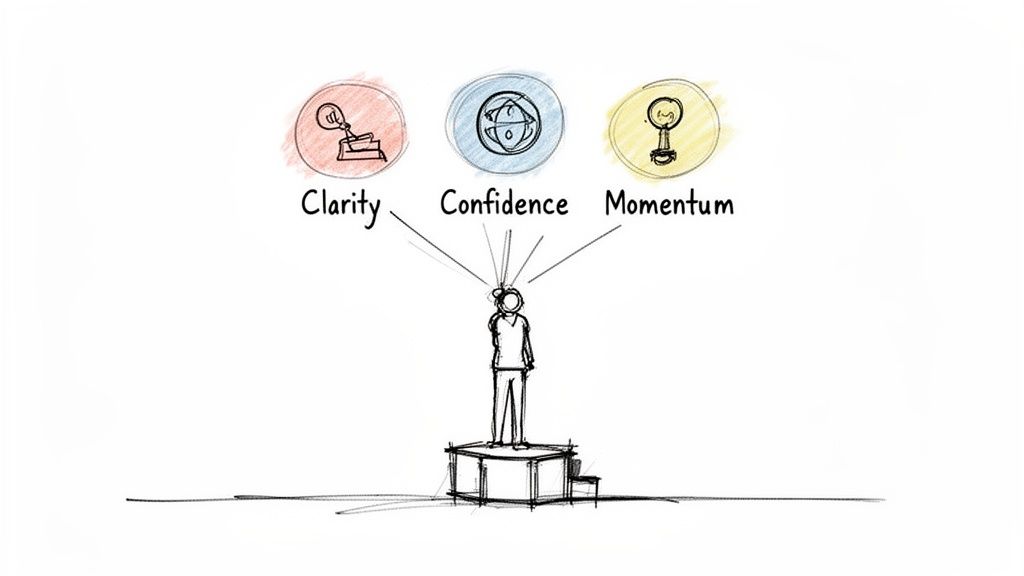
This method centres on the transformation or capability your customer unlocks. It shifts the conversation from your solution's technical details to your customer's future success. The format is simple but powerful: With [our solution], you can [achieve this benefit] so that [higher-order outcome]. This is especially effective for service-based businesses, as it sells a result, not just a process.
Why This Framework Works
Benefit-led positioning is one of the most direct examples of positioning statements because it speaks to a customer's core desires: to gain something, avoid a loss, or feel a certain way. It bypasses technical jargon and connects directly to the motivations that drive purchase decisions. It's not about what you sell, it's about what they get.
Peloton: "Workouts that fit your schedule so you actually stick with them." * Benefit: Fits your schedule. * Higher-Order Outcome: Consistency and the confidence that comes with it. * Positioning: They aren't selling a bike; they're selling the feeling of accomplishment from a fitness routine that finally works.
Sensoriium: "Get senior marketing leadership and structure so your team can scale confidently without guessing." * Benefit: Senior leadership and structure. * Higher-Order Outcome: Confident scaling without wasted effort. * Positioning: This isn't about marketing services; it's about giving founders and their teams the clarity and momentum to grow.
This framework is the antidote to feature-focused marketing that fails to resonate. It becomes the internal guide for creating case studies, writing website copy, and structuring sales conversations around customer value, not product specs.
How to Apply It
Lead with the Primary Benefit: What is the single most important outcome a customer gets? Don't bury it. Start with the "get."
Connect to a Higher-Order Outcome: The primary benefit should enable something bigger. "Save time" is a benefit; "so you can focus on strategic growth" is the higher-order outcome that makes it matter.
Use Customer Language: How do your customers describe their desired state? Do they say "increase ROI" or "stop wasting money on ads that don't work"? Use their words.
Create Proof: This positioning demands proof. Back up your benefit claims with case studies, testimonials, and data that show customers achieving the promised outcomes. This is where most teams fall short; they state a benefit without providing the reason to believe it.
8. The Outcome-Guarantee Positioning Statement
If you’ve ever felt buyer hesitation stall a deal, it’s often because the customer is weighing an unknown outcome against a known cost. They are scared of the risk. The outcome-guarantee statement flips this dynamic by absorbing that risk for them. It’s a high-confidence move that replaces vague promises with a concrete, measurable pledge. This approach stops you from selling features and forces you to sell a specific, guaranteed result.
The format is built on a direct promise: For [target customer] facing [specific challenge], we guarantee [measurable outcome] in [timeframe], or [consequence for the business]. This structure isn't for everyone; it demands absolute confidence in your ability to deliver, turning your positioning into a contractual promise.
Why This Framework Works
This is one of the most powerful examples of positioning statements because it immediately dismantles risk and demonstrates supreme confidence in your solution. It forces you to be brutally honest about the results you can consistently generate.
A B2B Marketing Agency: "For SaaS companies struggling with lead quality, we guarantee 30 qualified sales meetings in your first 90 days, or our next sprint is free." * Target: SaaS companies. * Challenge: Poor lead quality. * Measurable Outcome: 30 qualified sales meetings in 90 days. * Consequence: A free sprint of work.
Basecamp: "For teams new to our platform, we guarantee you'll master Basecamp in 30 minutes. If not, we'll teach you for free." * Target: New users. * Challenge: Learning a new tool. * Measurable Outcome: Mastery in 30 minutes. * Consequence: Free, personalised training.
This structure acts as a powerful filter. It attracts serious customers who are ready for the promised outcome and repels those who aren't a good fit, saving everyone time. It becomes a core part of your brand identity: you're not just a provider, you're a partner with skin in the game.
How to Apply It
Isolate a Quantifiable Outcome: Identify a specific, measurable result that your ideal customer desperately wants. "Increased efficiency" is vague; "Reduce invoice processing time by 50%" is a guarantee.
Define the Conditions: Clearly state what the customer must do to be eligible for the guarantee. This ensures shared responsibility for success.
Set a Realistic Timeframe: The promise must be achievable within a specific period. This creates urgency and a clear finish line.
Choose a Meaningful Consequence: The "or else" part must be significant enough to make the guarantee feel real. A full refund, free service, or a cash payment are common options.
If creating a guarantee feels impossible, it’s a sign that your process lacks the structure and predictability needed to deliver consistent results. This is often where we find teams need to tighten their operations before they can confidently make such a bold market promise.
8-Point Positioning Statement Comparison
Positioning Framework | Implementation Complexity 🔄 | Resource Requirements 💡 | Expected Outcomes 📊 | Ideal Use Cases ⚡ | Key Advantages ⭐ |
|---|---|---|---|---|---|
The Target Market + Unique Value + Reason to Believe Framework | 🔄 Moderate — structured template; needs iteration | 💡 Customer research (5–10 prospect tests); cross‑team alignment | 📊 Clear, testable positioning; consistent messaging across channels | ⚡ Early-stage → growth B2B/SaaS refining core positioning | ⭐ Aligns org; prevents feature‑focus; easily repurposed |
Value-Based Positioning Statement | 🔄 Moderate — analytical framing | 💡 Outcome data, case studies, analytics to quantify ROI | 📊 Strong C‑suite resonance; justifies premium pricing; faster deals | ⚡ Mid‑market & enterprise buyers focused on impact | ⭐ Differentiates on measurable business outcomes |
Competitive Positioning Statement (Head‑to‑Head) | 🔄 Low–Moderate — competitor research heavy | 💡 Competitive analysis, sales enablement assets, testing | 📊 Clear decision criteria; improved win rates in comparisons | ⚡ Mature/crowded categories where buyers compare options | ⭐ Sharp sales talking points; clarifies trade‑offs vs alternatives |
Category Design Positioning Statement | 🔄 High — requires narrative & category work | 💡 Significant marketing, PR, research, funding, thought leadership | 📊 Potential to own category; premium pricing and durable moat | ⚡ VC‑backed or well‑funded pioneers creating new markets | ⭐ First‑mover advantage; long‑term brand equity if adopted |
Niche/Vertical Positioning Statement | 🔄 Low–Moderate — focused adaptation | 💡 Vertical expertise, tailored case studies, niche GTM channels | 📊 Faster traction; lower CAC; stronger niche brand equity | ⚡ Companies targeting specific industry/role/use‑case first | ⭐ Easier to be best‑in‑class; defendable vs horizontal rivals |
Problem‑First Positioning Statement | 🔄 Moderate — requires deep empathy & validation | 💡 Qualitative interviews, customer language, pain quantification | 📊 Immediate resonance; better lead qualification; urgency | ⚡ Early‑stage markets where problem is vividly felt | ⭐ Strong emotional connection; positions solution as logical fix |
Benefit‑Led Positioning Statement | 🔄 Low–Moderate — benefits articulation | 💡 Proof points, testimonials, service design to deliver benefits | 📊 Easy to visualize outcomes; supports premium/specialist offers | ⚡ Service firms, agencies, premium product offers | ⭐ Creates emotional + rational appeal; tangible transformation |
Outcome‑Guarantee Positioning Statement | 🔄 High — operational discipline and risk control | 💡 Robust delivery systems, strict customer qualification, tracking | 📊 Removes buyer risk; higher conversions but operational exposure | ⚡ Sprint‑based services or predictable outcome offers | ⭐ Strong differentiation; builds trust when reliably delivered |
So, What’s the Next Step?
It's easy to look at the eight different examples of positioning statements we've walked through and feel a fresh wave of overwhelm. You see the logic in the Problem-First framework, the ambition in the Category Design model, and the clarity of the Niche/Vertical approach, and now you’re stuck wondering which one is the one.
If you’re feeling that paralysis, it’s a sign you’re thinking about this in the wrong order. This isn’t about picking the perfect sentence structure out of a lineup. It’s about having the right foundational ingredients to fill in the blanks, no matter which framework you choose. The common thread woven through every strong example, from a global SaaS giant to a specialised agtech firm, is an almost obsessive clarity about who they serve.
The Real First Step: Nail Your Ideal Customer
Before you can articulate your unique value, you must know for whom it is uniquely valuable. A vague customer definition is the single biggest reason positioning statements end up feeling generic and lifeless. They become marketing-speak because they aren't anchored to a real, specific human with a real, specific problem.
Your next move isn’t to workshop a statement. It’s to get brutally honest about your best customer. Not the biggest logo you landed, not the market you wish you were in, but the customer you serve better than anyone else. The one who ‘gets it’ fastest, uses your product most deeply, and sees the most tangible results.
Think about that specific customer profile.
What is their role? What pressures are they under?
What specific problem of theirs do you solve? Use their words, not yours.
What do they secretly fear if they fail to solve it?
What does a 'win' look like for them, and how do you help them get there?
Once you have this razor-sharp clarity, the right positioning framework often chooses itself. If your best customer is in a crowded market and needs to see differentiation, a Competitive Positioning Statement becomes the obvious choice. If they are an underserved vertical struggling with generic tools, a Niche Positioning Statement is the clear path forward.
From Messy to Methodical
Most founder-led businesses and scaling tech teams we work with are grappling with this exact challenge. They have a great product but their messaging feels disconnected because it’s trying to speak to everyone at once. This is usually where a structured sprint approach creates clarity fast. When we embed with a team, the very first thing we fix is this gap between their product’s potential and their market’s understanding of it.
Your goal isn’t to find a clever tagline. It’s to build a clear, confident and structured answer to the question: “Why should our ideal customer choose us over any other option?” By focusing on that one customer first, you’re not limiting your market; you’re building a solid foundation from which to scale. That clarity gives you momentum, and it makes every subsequent marketing and sales decision simpler and more effective. You’re not just writing a statement; you’re building the central logic for your entire go-to-market engine.
When you’re too close to the business, getting this clarity can feel impossible. At Sensoriium, we embed senior marketing leadership directly into tech and agtech teams to provide the structure, clarity and strategic direction needed to scale. If you need a clear path forward, visit Sensoriium to see how we help build marketing functions that deliver.