
A Branding Strategy Template That Actually Builds Clarity
- Feb 10
- 11 min read
Trying to fill out a branding strategy template can feel like being asked to solve a giant puzzle without the picture on the box. You stare at the empty sections for 'Mission', 'Vision', and 'Values', a wave of overwhelm washes over you, and you quietly close the tab and get back to the million other things that feel more urgent.
If this sounds familiar, you’re not going crazy. It makes sense that you feel stuck.
The problem isn't you. It's that most templates are just collections of empty boxes. They ask huge, abstract questions but don't give you a process for finding the answers. They’re designed as documents to be completed, not as tools to create genuine clarity. It's a common frustration, and we've dived into why strategic branding often feels so messy in another guide.
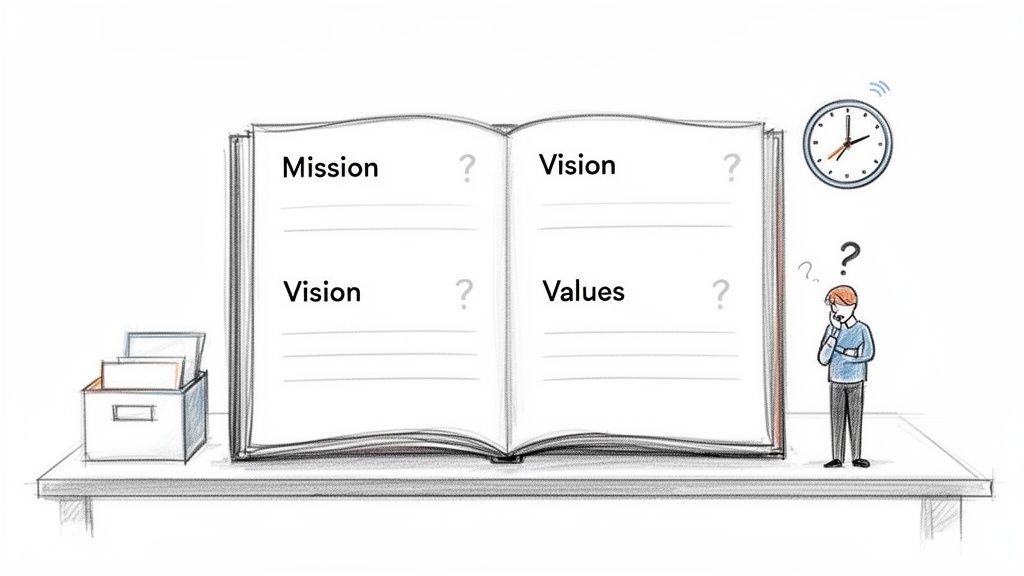
They skip the thinking work
Most templates fail because they jump straight to the outputs (like a mission statement) without guiding you through the thinking required to get there. They miss the foundational work of figuring out who you serve, what they really need, and why your business is the only logical choice to help them.
This is where most teams get stuck, simply because they’ve never had someone come in and structure the work. Without that foundational clarity, you’re essentially just trying to decorate a house that has no foundations.
The real goal of a brand strategy isn't to create a perfect document. It's to build a framework for making better decisions, faster. It should reduce debate and give your team a shared language for what matters.
A framework for decisions, not a document for the drawer
Instead of another empty template, this guide offers a different way to think about the process. It's about building a practical framework that will guide every decision you make, from your website copy to your sales pitches. It’s a tool that gives you structure and confidence, so you know exactly what to do next.
This is a branding strategy template built to create momentum, not another document to gather dust in a folder.
The Three Pillars That Actually Matter in Your Brand Strategy
Founders often get tangled up in logos, taglines, and website button colours. But before any of that, you need to get three foundational pieces right. This is where people get stuck. It’s not because the ideas are complex, but because they don't have a simple way to connect what their company believes with what it actually does.
Without a clear mental model, you end up with a random assortment of marketing tasks that don't add up to anything. A blog post here, a social media campaign there. It's chaos. Let's simplify things. Forget the jargon for a minute. It all boils down to three pillars.
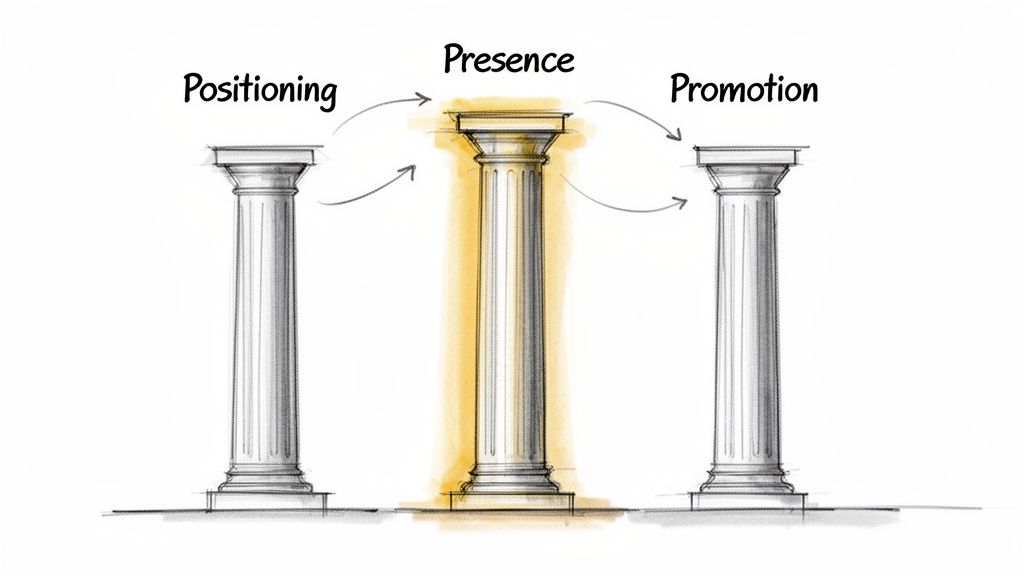
Pillar 1: Positioning
This is about being crystal clear on who you serve and why you’re the only real choice for them. Think of it as the foundation that makes every other decision—from product features to marketing campaigns—so much easier.
When you nail your positioning, you stop chasing every shiny object and trying to be everything to everyone. You gain the confidence to say "no" to the wrong opportunities and "yes" to the right ones. It's about owning a specific piece of real estate in your customer's mind. The same principles apply whether you're building a company or learning how to create a personal brand that opens doors.
Pillar 2: Presence
Once you know where you stand, it's time to build the tangible things that prove it. Your presence is how your positioning shows up in the real world. This includes your website, your sales deck, your team’s LinkedIn profiles—anything your customer can see, touch, or interact with.
A strong presence does more than look professional; it shows your audience you get them. It’s the difference between a website that just lists features and one that tells a story that resonates. To dig deeper into this, we've got a detailed guide on what is brand positioning and how to find yours.
Pillar 3: Promotion
Now we can talk about promotion. With your positioning locked in and your presence established, you can think about getting the word out. This isn’t about shouting and hoping someone hears you. It's about creating simple, repeatable systems to earn the attention and trust of the right people.
Founder Moment: I once worked with an AgTech company that had incredible technology, but their sales deck and website were packed with impenetrable jargon. Their 'Presence' was weak. We helped them reshape their story to focus on how their tech gives farmers more control—a message that hit home. Their sales conversations changed almost overnight because their 'Positioning' was finally clear in their materials.
This is how a good branding strategy template helps you connect the dots. By understanding how these three pillars work together, you can move from feeling overwhelmed to having a clear, actionable plan.
To make this even more concrete, here's how these pillars translate from big ideas into actual work.
From Abstract Concepts to Actionable Tasks
Pillar | What It Solves | Practical Example for a SaaS Company |
|---|---|---|
Positioning | "Who are we and why should they care?" | Defining your ideal customer as a mid-sized e-commerce brand struggling with cart abandonment, not "all online businesses." |
Presence | "How do we show up and prove our value?" | Creating a case study and a one-page PDF that specifically shows how you helped a similar e-commerce brand recover 20% more revenue. |
Promotion | "How do we get in front of the right people?" | Running a targeted LinkedIn ad campaign directed at 'Heads of E-commerce' that links to that exact case study. |
See how it flows? Each pillar builds on the last, creating a coherent strategy instead of just a list of things to do.
How to Fill Out Your Branding Strategy Template, Section by Section
A blank template can feel as intimidating as a blank page. You have the structure, but the real work—the thinking that creates clarity—is figuring out what to put in the boxes. This is where most templates let you down.
Let’s fix that. We're not just handing you a document; we're walking you through the process. Below is a breakdown of each section. We’ll cover the 'why' behind each part and what you need to do to fill it with something genuinely useful.
Forget about finding perfect, poetic answers. This is about making clear, confident decisions that give your team a roadmap.
Purpose and Vision
This is your foundation. It’s not a fluffy mission statement destined for a handbook. It’s a simple answer to two questions: "Why do we exist?" and "What future are we helping our customers create?"
Getting this right is your filter for making tough decisions. Most teams get stuck here because they try to write a slogan for a billboard. Don't. Write it for your team, using plain language that feels true.
A quick story: An AgTech startup we worked with initially said their purpose was “To revolutionise global farming with AI.” It sounded big, but it was vague. After a focused workshop, they landed on something far more powerful: “To give family farms the same data-driven tools as corporate agriculture, so they can stay independent and profitable for generations to come.” One is a slogan; the other is a compass.
Ideal Customer Profile
You can’t build a strong brand if you don’t know who you’re building it for. This section forces you to get specific about the one type of person you help better than anyone else. Go beyond basic demographics and dig into their real-world frustrations, goals, and worries.
When you have this clarity, marketing stops feeling like shouting into a void and starts feeling like a direct conversation.
Ask yourself:
What keeps them up at night? (e.g., "Wasting thousands on ads that don't bring in qualified leads.")
What does a big win look like for them? (e.g., "Hitting their sales quota without having to work weekends.")
What do they get wrong about their problem? (e.g., "They think they need more website traffic, but what they really need is clearer messaging.")
Market Positioning
Put simply, positioning is about owning a specific idea in your customer's mind. It’s about finding a gap your competitors aren't filling and planting your flag there. You can't be the best at everything for everyone, so what’s your thing?
This is where a short, sharp sprint can bring incredible clarity. Don't guess—map it out. Look at what your top three competitors are saying. Are they all fighting to be the "cheapest," the "fastest," or the "most advanced"? Your opportunity is probably in the space they’ve ignored.
For instance, if everyone else is yelling about technical features, your position could be built on incredible customer support or being the easiest tool for non-technical teams to use. This is how you stop competing on price.
Messaging Pillars
Once you’ve locked in your positioning, your messaging pillars are the three or four core themes you’ll talk about, over and over again. They are the repeatable stories that prove your positioning claim is true. These pillars give your content structure and ensure your team is telling a consistent story everywhere.
When we embed with a team, this is often the first thing we fix. Without defined pillars, content ends up feeling random and disconnected.
Example Messaging Pillars (for a SaaS company positioned around "simplicity"):
Effortless Onboarding: Our software is built to be set up in minutes, not days.
Clarity Over Complexity: We design dashboards that show you what matters and hide the noise.
Human Support: You’ll always get a real person, ready to help, in under five minutes.
Every blog post, sales email, and social media update should tie back to one of these core ideas. That’s how you build a brand people remember.
Common Mistakes That Make Brand Strategies Fail
You’ve done the work. You filled out the branding strategy template and got the team on the same page. A few weeks later, it’s like those meetings never happened. The strategy document is buried in a shared drive, collecting digital dust.
Sound familiar? The real challenge isn’t creating the strategy; it’s closing the gap between a great plan on paper and the day-to-day reality of running a business. This is where most brands stumble. It's not a failure, just a sign that a critical piece of the puzzle is missing.
The Strategy-Execution Gap
The problem usually isn’t the strategy itself. It’s the absence of a structured way to bring it to life. A recent national survey of Australian CEOs captured this perfectly. While 81% agree branding is a major competitive advantage, only 16% plan to invest more in it. It's the classic knowing-versus-doing gap. You can read more about these findings on Australian business priorities if you're curious.
This gap opens up when we treat brand work as a one-off project. It needs to be a living part of the business. Your brand has to be woven into every decision, from the script for a sales call to the interface of a product update.
Most teams struggle here because they’ve never had someone step in to structure the work. The intention is there, but the operational framework to turn that intention into consistent action is missing.
This is why having a process is so important. The flow below shows how a solid branding template moves from abstract ideas to concrete visual outputs.
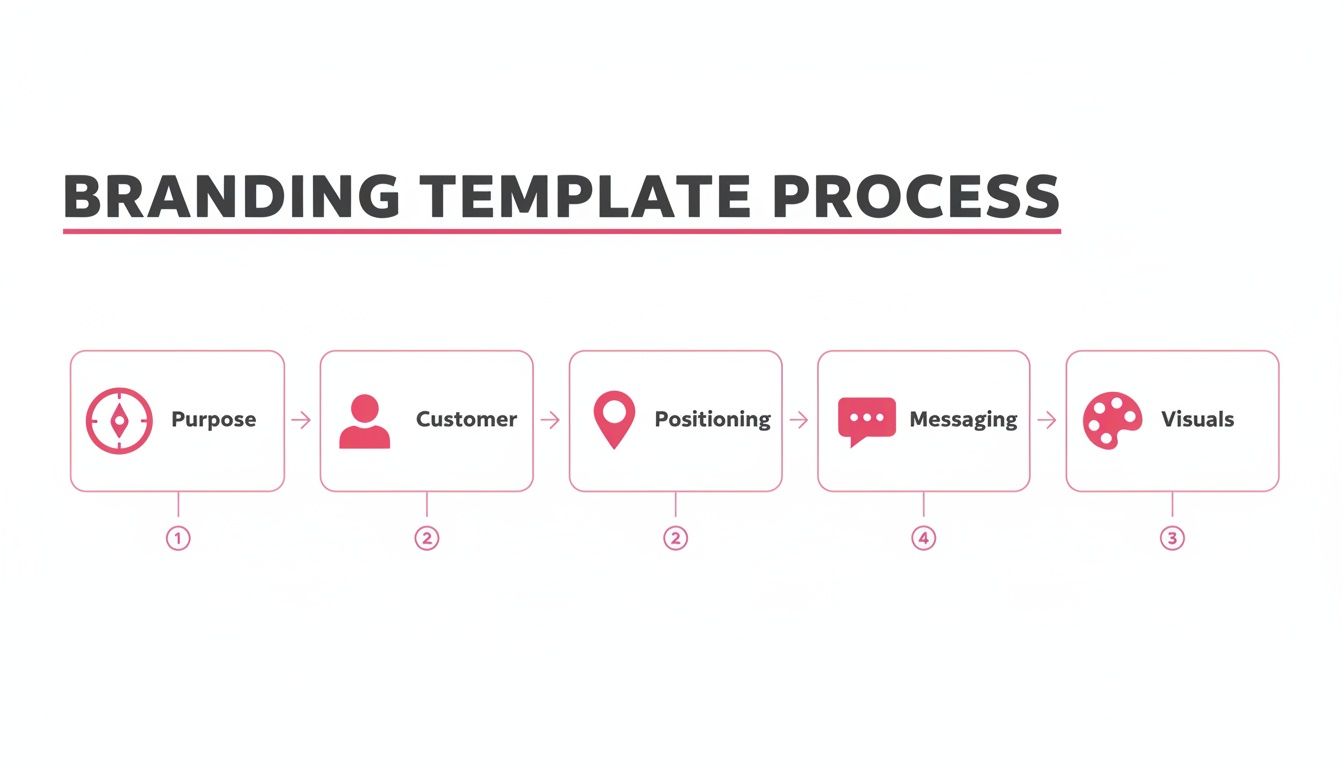
Each step logically builds on the one before it. This creates a clear path that stops the strategy from becoming fragmented when you start putting it into action.
Are you falling into these traps?
How do you spot if your business is making these classic mistakes? The signs are often subtle at first.
Inconsistent Messaging: Does your sales team say one thing, your website another, and your social media feel like it belongs to a different company?
Chasing Every Opportunity: Are you jumping on every potential customer that comes along? Without a clear brand filter, your team gets pulled in a dozen different directions.
Debating the Basics: Do you have the same conversations again and again about who you are and what you do? That’s a sure sign nothing was ever truly decided.
Seeing these issues is the first step. The way forward isn’t about trying harder—it’s about building a better system to turn your strategy into daily habits.
Putting Your Brand Strategy to Work
So, you’ve filled out the branding strategy template. It’s sitting there, looking smart. But then comes that sinking feeling… what now? How do you stop this document from becoming just another PDF lost in a server folder?
This is the exact moment where most brand strategies fizzle out. A brilliant plan without a clear execution path is just a well-organised wish list. The secret isn't a massive, overwhelming "brand launch." It's about breaking the work into smaller, focused chunks.
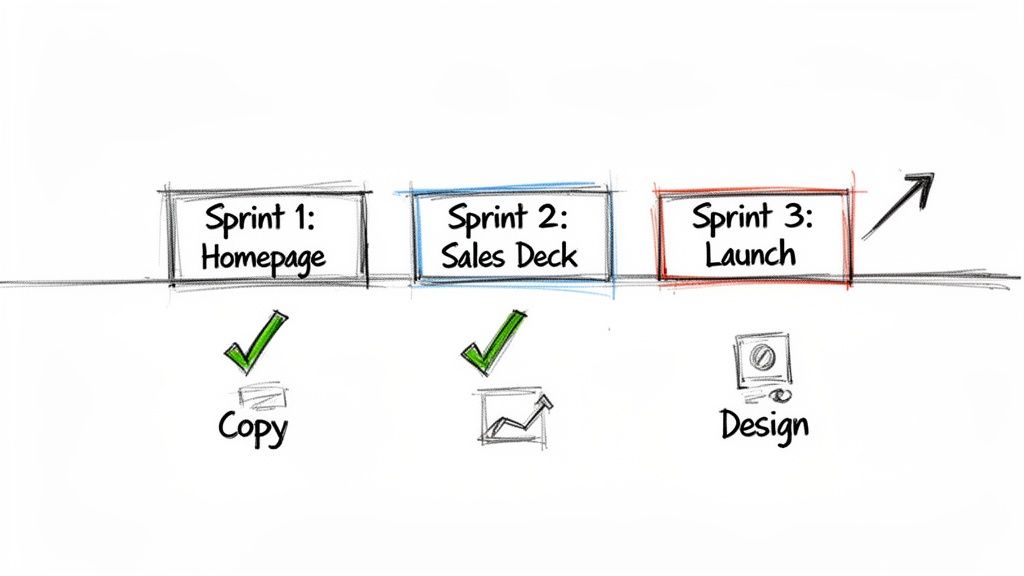
From a document to doing the work
Instead of a huge overhaul, think in marketing sprints. These are short, dedicated pushes where you tackle one specific part of your brand at a time. This approach builds momentum and gets you tangible results, fast. This is usually where a sprint approach creates clarity quickly.
A sprint provides structure, turning a big, intimidating project into a series of manageable wins.
Founder Moment: I remember a SaaS client who had a new brand strategy they were thrilled with, but they were completely paralysed by the amount of work it would take to implement. Their first sprint was simple: just rewrite the top half of their website's homepage using the new messaging pillars. It took one week. Seeing that immediate, visible improvement gave them the confidence and momentum to dive into the next piece.
Your First 90-Day Roadmap
You don’t need a complex project plan. You need a simple sequence of sprints to get the ball rolling. This is how you bring your brand to life in a calm, controlled way.
Here’s a practical example of what that could look like:
Sprint 1 (Weeks 1-2): Homepage & LinkedIn Profiles. These are your two most visible assets. Focus on updating the core messaging on your homepage and then get every team member’s LinkedIn profile telling the same, consistent story.
Sprint 2 (Weeks 3-4): Your Core Sales Deck. Take your new positioning and messaging pillars and bake them right into the sales presentation your team uses every single day.
Sprint 3 (Weeks 5-6): One High-Value Case Study. Create a powerful story that proves your new brand promise, using a real customer. This is a crucial trust-building asset.
This focused approach is more important than ever. Aussie B2B buyers have shifted dramatically online, with 72% now starting their research digitally. A clear online presence isn't a nice-to-have anymore; it's non-negotiable for building trust.
By breaking the work down, you activate your brand piece by piece. To see how this flows into specific campaigns, check out our practical guide to brand activation in marketing. It’s all about building momentum, not aiming for an overnight miracle.
Start by fixing one thing
If looking at your completed template still feels messy, that’s normal. You’re not behind. You need structure.
That feeling of being overwhelmed is just a sign that you care about getting this right. The problem isn't your commitment; it's the lack of a clear path to channel that energy.
Don't try to overhaul your entire brand in one go. The point of using a branding strategy template isn't to achieve overnight perfection. It’s about finding one small piece of clarity you can run with.
Pick one thing and fix it. Just one. It doesn’t have to be the biggest problem. The goal here is to score a small win that builds confidence and creates momentum.
This could be as simple as:
Nailing that one-sentence description of who you help.
Rewriting the main headline on your homepage to reflect your new positioning.
Updating your LinkedIn bio to align with your messaging pillars.
The most effective brands are built with small, deliberate steps taken with confidence, one after another. This is how you build a brand that works.
When we embed with a team, the first thing we fix is this exact gap. We look for the smallest, most powerful lever to pull first. This creates clarity fast because it proves that progress is possible.
This small, focused action is your starting point. It's how you turn a document into a decision-making tool and swap overwhelm for control.
Forget about climbing the entire mountain. Just focus on that first, simple step. Start there.
Ready to move from a messy process to a clear, structured path forward? At Sensoriium, we embed with your team to provide the senior marketing leadership and hands-on support you need to build a brand that works. We untangle the chaos, tighten the gaps, and give your business the confidence and momentum it needs to grow.
Find out how we can bring clarity to your brand at https://www.sensoriium.com.