
What Is Strategic Branding? (And Why Does It Feel So Messy?)
- Jan 25
- 14 min read
You're spending money on ads, you've launched a new website, and you’re creating content, but nothing is quite landing. It feels like you're pushing a huge boulder uphill—all that effort, and the results are still patchy and chaotic.
It's a frustrating place to be. But you're not doing a bad job. You're just experiencing a classic symptom of a missing foundation.
Why Your Marketing Feels Disconnected and Chaotic
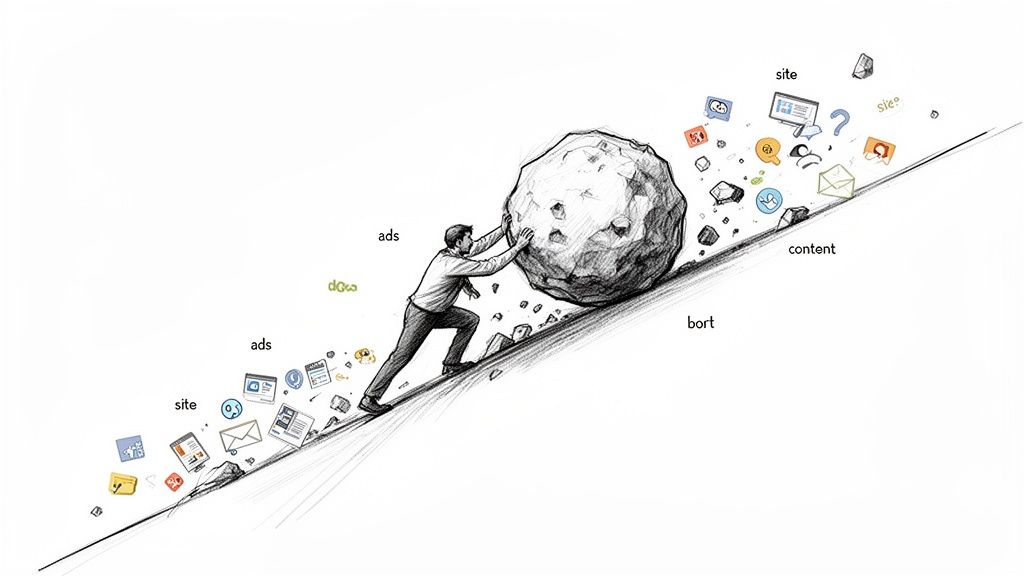
If your marketing feels all over the place, you're in good company. Most growing businesses hit a point where their efforts feel like a jumble of tactics, not a cohesive plan. This is what expensive guesswork looks like.
You might have a freelancer running social media, an agency on Google Ads, and someone in-house writing blog posts. On paper, everyone’s busy. In reality, they're working in silos, each with their own idea of who the customer is and what they care about.
The result? A messy customer experience that confuses people, erodes trust, and costs you money. This chaos isn't a sign of failure; it's just what happens when there's a lot of activity without a central plan to guide it.
The Real Cost of Guesswork
Without a clear, guiding strategy, your business bleeds resources in ways that aren't obvious at first. You might think you have a channel problem—that your ads aren't working or your content is weak—but the root cause is much deeper.
Wasted Ad Spend: You pour money into campaigns that target the wrong people with a message that doesn't connect. All you get are low-quality leads and a high cost to acquire them.
Inconsistent Messaging: Your sales team says one thing, your website says another, and your social media has a completely different vibe. It confuses potential customers and makes your brand seem flaky.
Team Friction: When there’s no shared understanding of the brand's direction, marketing and sales often pull in opposite directions. This leads to frustration and missed opportunities.
This is the exact spot where most teams get stuck. Most teams struggle here because they’ve never had someone step in to structure the work. The good news is, the fix isn't about adding more to your plate. It's about creating the underlying clarity that makes every dollar and every hour you spend work smarter.
If this is hitting home, our guide on why your marketing feels disconnected dives deeper into this very problem.
You don't have a marketing problem; you have a strategy problem. That feeling of being stuck is completely normal when the foundational work of strategic branding hasn't been done.
This isn’t about working harder. It’s about making smart, deliberate choices before you execute. It’s about building the confidence that comes from knowing every piece of your marketing is anchored to a clear, unified direction.
In the next sections, we'll unpack what strategic branding actually is and how it gives you the solid framework your business needs to move forward with purpose.
So, What Exactly Is Strategic Branding?
Let's skip the jargon. When people talk about "branding," they often mean logos, fonts, and colour schemes. But that’s just the paint on the walls, not the foundation of the house.
Think of strategic branding as the architectural blueprint for your business. It's the disciplined, upfront thinking you do to decide exactly how you want your ideal customers to see you. It means making deliberate choices so that every single thing your business says and does reinforces that specific perception.
This isn't a fluffy creative exercise. It's a series of structured, commercial decisions.
Strategic branding is the intentional act of shaping perception. It shifts your business from being just another option to becoming the only viable choice for a specific group of people solving a specific problem.
It’s less about looking pretty and more about building a coherent, reliable structure that customers instantly recognise and connect with.
Going From Vague Ideas to a Solid Framework
Many founders skip the blueprint stage. They get excited and jump straight to building the house—launching a website, running ads, hiring a sales team—all without a clear plan. It's no wonder things feel chaotic.
Strategic branding provides that missing framework. When we embed with a team, the first thing we fix is this exact gap. It all comes down to clarifying four core components that must work in sync:
Positioning: Nailing down exactly who you serve and what makes you the best possible solution for them.
Messaging: Crafting the core story and the exact words that communicate your value, simply and consistently.
Identity: Designing the visual and verbal elements (logo, colours, tone of voice) that genuinely reflect your strategy.
Experience: Making sure every single touchpoint—from your website to sales calls to customer support—delivers on the promise you're making.
These pillars provide the structure you need to make smart, aligned decisions across the entire business. You can dive deeper into how these elements fit together in our founder’s guide to clear branding and messaging.
The Big Difference: Tactical vs. Strategic Branding
Without this strategic layer, "branding" just becomes a checklist of random activities. You post on social media, you tweak your logo, you write a blog post. It's the difference between having a map and just wandering around, hoping you'll stumble upon your destination.
This table shows the difference in a nutshell:
Aspect | Tactical Branding (The Common Approach) | Strategic Branding (The Effective Approach) |
|---|---|---|
Focus | Short-term campaigns, visuals, and immediate outputs. | Long-term business goals, market perception, and customer loyalty. |
Process | Reactive and often disconnected. "We need a new logo." | Proactive and integrated. "How does this decision shape our reputation?" |
Outcome | A collection of assets (logo, website, ads). | A coherent brand reputation that helps the business grow. |
Example | Running a social media campaign with a new visual theme. | Defining a unique market position and ensuring all marketing, sales, and product actions reinforce it. |
Getting this right is where most businesses miss the mark, but the payoff is huge. A recent study of 164 Australian business leaders found that while a massive 81% see branding as a key competitive advantage, only 55% felt their brand was actually being used effectively to fuel growth. This gap is where strategic branding lives—it turns your brand from a simple visual asset into the core engine driving your commercial success. To see how others are bridging this gap, consulting an essential social media branding guide can offer practical steps for defining your identity across platforms.
Ultimately, what strategic branding gives you is clarity. It’s that calm, confident foundation that allows your marketing, sales, and product teams to pull in the same direction, with purpose.
The Four Pillars of a Powerful Brand Strategy
If strategic branding is the blueprint for your business, then these four pillars are the load-bearing walls. Get them right, and you’ve built a solid structure. Get them wrong, and everything feels wobbly.
Most teams stumble here because they mix these pillars up, treating them like a random checklist instead of a logical sequence. But the order matters. You have to nail the strategy before you can think about execution.
This diagram shows how it all flows together, with the big-picture strategy cascading down into four distinct parts.
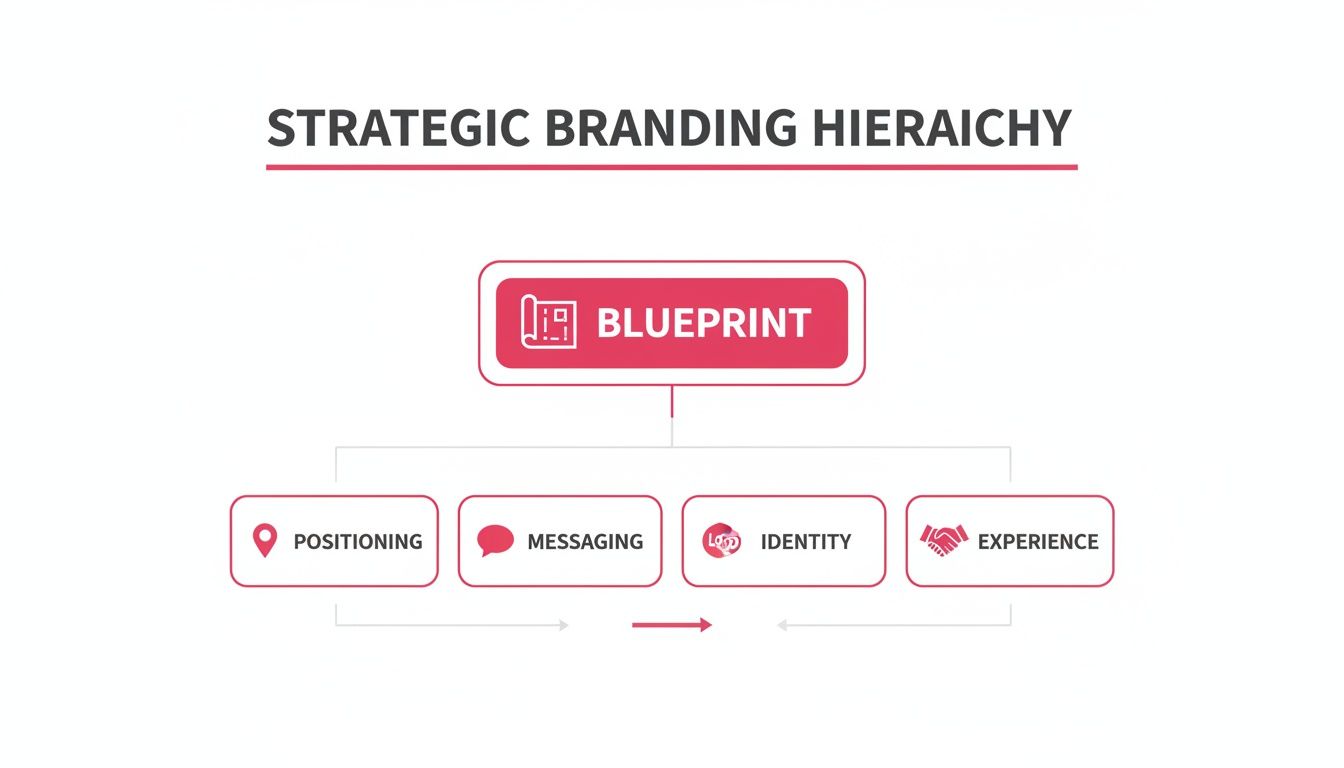
As you can see, everything starts at the top. The choices you make in one pillar directly shape what’s possible in the next. It creates a system where every part reinforces the others.
Pillar 1: Positioning
What it is: Think of positioning as deliberately choosing your battlefield. It’s where you get crystal clear on your specific niche, your ideal customer, and the unique space you own in their mind. It answers the question: "Out of everyone else, why should they choose us?"
Why it matters: Without sharp positioning, you’re just another generic option. You end up trying to be everything to everyone, which means you’re nothing special to anyone. Strong positioning makes you the only logical choice for the right customer, letting you sidestep the competition.
Founder Moment: We once worked with a SaaS founder who described his market as “all large-scale farms in Australia.” That lack of focus made his marketing vague and left his sales team struggling to explain what they actually did.A positioning sprint helped him narrow it down to “macadamia and almond growers in Northern NSW and Queensland struggling with water management.” Suddenly, every marketing and sales decision became dead simple. They weren't just another farm tool; they were the solution for a specific, high-value problem.
Pillar 2: Messaging
What it is: Once you know where you stand (your positioning), messaging is how you talk about it. It’s the core story you tell and the consistent language you use. This covers your main value points, your one-liner, and the simple, repeatable phrases your teams use every day.
Why it matters: Inconsistent messaging kills trust. If a customer hears one thing from an ad, reads something different on your website, and gets another story from a salesperson, their confidence vanishes. A unified messaging framework ensures that no matter where someone interacts with you, they get the same clear, compelling story.
This is often where we see the biggest and fastest wins. Just fixing the messaging creates an immediate ripple effect of clarity across the whole business.
Pillar 3: Identity
What it is: Your identity is the sensory part of your brand—what people see, hear, and feel. This is where your logo, colour palette, typography, and tone of voice come in. It’s not just about looking good; it's about making sure your look and feel is a direct, authentic reflection of your strategy.
Why it matters: Your visual and verbal identity is a cognitive shortcut. It helps people recognise you instantly. When your identity is out of sync with your strategy—like a serious fintech firm using playful, cartoonish branding—it creates a jarring disconnect that hurts credibility.
Your brand identity should feel like an honest expression of your strategy, not a decorative afterthought.
Pillar 4: Experience
What it is: The brand experience is the sum of every interaction a customer has with your company. It covers their first click on your website, the sales process, onboarding, and customer support. It’s the living, breathing proof of the promises your messaging makes.
Why it matters: A great brand promise with a poor experience is a recipe for disaster. You can have the best positioning and the slickest identity, but if your product is clunky or your support is slow, that’s what people will remember. Your brand isn't what you say it is; it's what your customers experience it to be.
Making sure every touchpoint reinforces your brand promise is what separates good brands from great ones. It’s the final, and most crucial, pillar in building a reputation that not only attracts customers but keeps them.
How Strategic Branding Builds Credibility and Trust
For any business selling something complex—be it agtech, SaaS, or specialised services—trust is everything.
If potential customers are confused or hesitant, your sales cycle will stretch into eternity. This isn't a sales problem; it's a credibility gap, and it’s almost always caused by a brand that’s all over the place.
When your brand feels consistent and stable, customers can relax. They get the sense they're in safe hands because every touchpoint tells the same clear, confident story. This consistency is what trust is built on.
Strategic branding provides the framework for this consistency. It gets rid of the random activities that make a business seem flaky, replacing them with a unified direction that signals competence to a cautious market.
From Confusion to Confidence
Think about the last time you were looking to make a big purchase for your own business. You probably checked the company’s website and their LinkedIn. If the message was different everywhere, it would have given you pause, right? That tiny flicker of doubt is where deals go to die.
A solid brand strategy makes sure this never happens. It becomes the single source of truth for your organisation.
For Your Customers: It simplifies their decision. They see a clear, consistent message and feel confident they know what you do and who you do it for. This clarity removes friction.
For Your Team: It eliminates the guesswork. Your sales team knows what story to tell, and the marketing team creates content that lines up perfectly. This internal alignment is felt on the outside as a seamless, professional experience.
When we embed with a team, the first thing we do is close these internal gaps. Creating a shared understanding of the brand is the fastest route to building external credibility. It ensures everyone is on the same page, which projects an image of a well-run, dependable business.
In a market full of noise, clarity is the ultimate signal of competence. A brand that communicates with confidence and consistency doesn’t need to shout; its credibility speaks for itself.
Credibility Is the New Differentiator
In a crowded market, a great product isn’t enough. Your credibility becomes a tangible asset—something your sales team can use to build momentum. This isn't a theory; it’s a commercial advantage.
The IMAA Future Trends and Insights Report, which draws from Australian media partners, points to credibility as the ultimate brand differentiator. In a fragmented market where 37% of Australians now value their time more than their money, the brands that win are the ones that offer emotional clarity and cut through the complexity. You can dive deeper into how consumers are seeking brand clarity in the full media trends report.
This means your brand’s main job is to make your customer’s decision feel simple, safe, and obvious. Strategic branding achieves this by systematically building trust at every stage of their journey, turning your reputation into your most powerful sales tool. It provides the structure needed to turn your brand from just another name into a signal of reliability.
A Practical Sprint to Build Your Brand Foundation
All this talk about pillars and blueprints can feel a bit abstract. What does it actually look like to put strategic branding into practice without boiling the ocean? You don’t need a year-long project; you just need to get moving.
This is where a sprint-based approach creates clarity, fast. Instead of getting bogged down in endless meetings, we break the work into a short, focused process. It’s about getting you tangible results and a clear direction in weeks, not months.
Think of it as turning a messy napkin sketch into a clean architectural drawing. It gives you the structure you need to move forward with confidence.
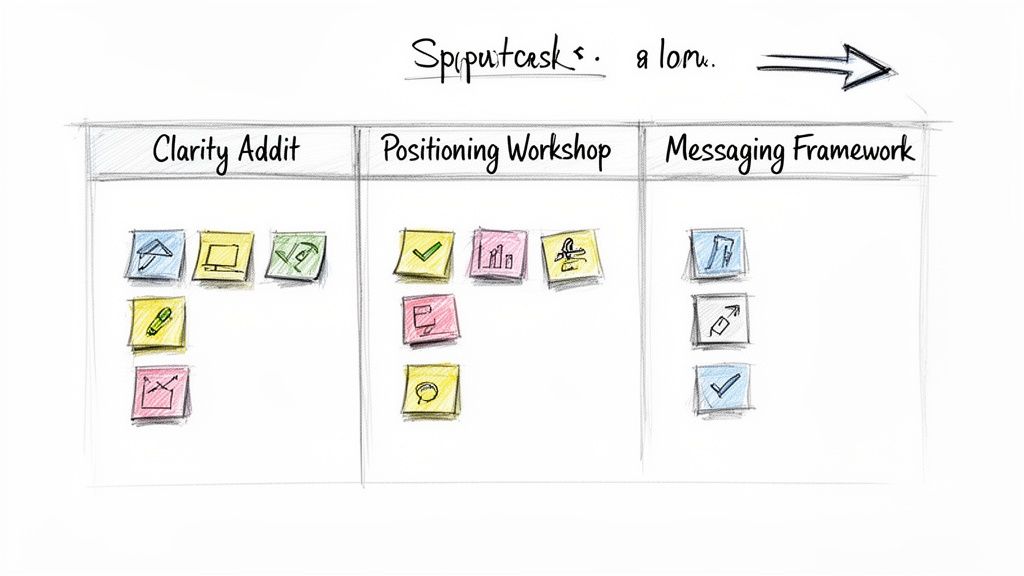
Here's a simple, three-step sprint that gets the job done.
Step 1: The Clarity Audit
First, you don’t start by creating anything new. You start by taking an honest look at what you already have. It’s surprising how many teams run on assumptions that have never been tested.
A Clarity Audit is a structured review of where you stand today. You pull together your marketing materials, sales decks, and website copy. Then, you ask a few simple questions:
Consistency: Does all this stuff look and sound like it came from the same company?
Clarity: Can a potential customer figure out what you do and for whom in 10 seconds?
Differentiation: Is it obvious why someone should choose you over the competition?
This exercise isn’t about pointing fingers; it’s about finding the gaps. It quickly shows you where a lack of structure is creating confusion and gives you a clear starting point.
Step 2: The Positioning Workshop
Once you know where the cracks are, it's time to build the strategic core of your brand. A positioning workshop is a focused session to get your leadership team aligned on the big questions.
This isn't a vague brainstorming session. It’s a structured process to lock in three critical elements:
Ideal Customer: Getting laser-focused on the single type of customer you are built to serve best.
Market Category: Defining the space you compete in so customers instantly know what you are.
Point of Difference: Nailing down the one thing you do better than anyone else for that customer.
The goal is to leave the room with a single, clear positioning statement. This becomes the North Star for every decision from here on out. To see how this works in the real world, check out our guide on practical examples of positioning statements.
A great positioning statement isn't just a marketing slogan. It’s a business tool that forces clarity and focus across your entire organisation.
When we run these workshops, this is often the moment everyone in the room breathes a sigh of relief. For the first time, the whole team is on the same page about who the business is and where it’s going.
Step 3: The Messaging Framework
With your positioning locked in, the final piece is to translate that strategy into actual words. A Messaging Framework is a simple, one-page guide that outlines your core story.
This isn’t some dense document. It’s a practical tool for your sales and marketing teams to make sure everyone is telling the same story. It usually includes:
Your One-Liner: A short sentence that explains what you do.
Your Core Narrative: A small paragraph that tells your story in a compelling way.
Key Messages: Three or four key points that back up your main promise.
Tone of Voice: A few simple words describing how your brand should sound (e.g., confident, direct, reassuring).
This simple framework can eliminate inconsistent messaging overnight. It provides the calm, confident structure needed to ensure every ad, email, and sales call reinforces your brand and builds trust.
Measuring What Matters for Real Business Impact
How do you know if all this branding work is making a difference? Most founders get stuck here. They end up staring at fuzzy metrics like ‘brand awareness’ or social media followers, which feels like measuring effort, not impact.
But strategic branding isn’t a ‘soft’ expense. It’s a direct investment in your company’s commercial engine, and its impact is measurable. You just need to know where to look.
When your brand is clear and consistent, it makes your entire business run more efficiently. It has a direct, tangible effect on the numbers that data-driven founders care about.
Shifting from Vanity Metrics to Business KPIs
Instead of getting lost in likes and shares, a strong brand strategy shows up in real-world business outcomes. It’s the framework that makes everything from sales to marketing just work better.
Here are the kinds of numbers that prove your brand is creating real value:
Lead Quality: Are you attracting more customers who are a perfect fit? Clear messaging repels the tyre-kickers and pulls in the exact clients you’re built to serve.
Sales Cycle Length: Is your sales team closing deals faster? When a prospect already gets what you do before the first call, the conversation changes. A strong brand does the heavy lifting of building trust early.
Share of Search: Are more people searching for your company by name? This is a huge indicator that your brand is becoming a destination, not just another option. It’s solid proof your reputation is growing.
These aren’t fluffy marketing metrics; they are core business KPIs. They prove that strategic branding is about building a more effective, more profitable commercial engine.
Connecting Brand Clarity to Commercial Results
It’s easy to see why most teams struggle to connect these dots. They’ve likely never had someone step in and build a unified way to measure how marketing links to reputation and, ultimately, sales. But making that connection is everything.
Recent analysis from Kantar points out that the brands thriving today use technology to spark creativity and demand unified measurement. The study revealed that a net 38% of global marketers, including here in Australia, plan to increase spending on channels that offer clearer results. Why? Because clarity drives nearly 3x the purchase intent compared to just adding more noise. You can explore the Kantar marketing trends report to get the full picture.
Your brand isn’t just an asset; it’s a performance driver. Measuring its impact isn’t about justifying a marketing budget—it’s about understanding how your company’s reputation is directly fuelling its growth.
By focusing on these bottom-line numbers, you can see exactly how a disciplined approach to your brand delivers a clear return. And that gives you the confidence to keep investing in what works.
So, What's the Next Step?
If you’ve made it this far, something here has probably resonated. Maybe your marketing feels chaotic, fragmented, and not delivering the results you know you’re capable of. You’re working hard, but it’s not adding up.
That feeling is normal. The issue isn’t a lack of effort. It’s the absence of a solid, strategic core to guide all that hard work. The answer isn't to layer on more marketing complexity.
It's to find clarity.
That feeling of chaos is a classic growing pain. It's a sign that your ambition has outpaced your structure. The solution isn’t to work harder—it’s to work smarter by giving every action a clear purpose.
This is precisely where we help. When we partner with a team, our first job is to build that structure, turning scattered tactics into a powerful, unified force.
Before you spend another dollar on ads, try this simple exercise.
Get five people from different parts of your business—sales, marketing, leadership—and ask them to write down one sentence that answers this question:
“What do we do, and who do we do it for?”
If you get five different answers, you’ve just found the root of the problem. That gap in understanding is where your budget, energy, and confidence are draining away.
Fixing that gap is your next step.
At Sensoriium, we provide the clarity and structure needed to close that gap for good. We help growing businesses build the strategic foundation that makes marketing effective. Learn how we bring direction to your brand.