
A Clear Guide to SEO & SEM Services for Australian Businesses
- Feb 14
- 13 min read
You’ve been told you need to be on page one of Google. You’ve probably spent money on ads that didn’t seem to lead anywhere, or on blog posts that felt like they were shouting into an empty room.
For most founders, search marketing feels like a chaotic, expensive mess. You know your customers are looking for you on Google, but bridging that gap feels confusing and wasteful. It’s a frustrating cycle that makes it feel like you’re just guessing.
If this feels familiar, it’s not because you’re doing something wrong. It’s because the whole approach is missing a clear, structured system.
So, what's really going on here?
The problem isn't a lack of effort. It’s a lack of structure. Most teams struggle here because they’ve never had someone step in to structure the work from the ground up. Without that solid foundation, every dollar you spend feels like a gamble.
If you feel like you're wasting money, especially with paid search campaigns, it’s often because of a poor grasp of analytics in advertising. This blind spot leads to campaigns that aren’t properly optimised and that feeling of just burning through cash.
The real issue isn’t choosing SEO over SEM. It’s about building a single, coherent system where every marketing activity has a clear purpose tied directly to a business outcome.
A common founder moment
Picture this: a SaaS founder has just spent $20,000 on Google Ads over three months. The reports show plenty of clicks and website traffic. But when they talk to the sales team, the feedback is brutal—the leads are poor quality. The ad agency sends over reports filled with metrics like impressions and click-through rates, but the founder is left scratching their head, unable to connect any of it to actual revenue.
This is a classic symptom of motion without progress.
This is usually where a sprint approach creates clarity quickly. It forces everyone to pause and connect marketing actions to real business goals before another dollar is spent. The shift is simple but powerful: stop asking, "What are we doing wrong?" and start asking, "How do we build the right foundation?" This is how you find a calmer, more effective path forward.
The Real Difference Between SEO and SEM
Let's look at this practically, without the usual jargon. Think of it as the difference between owning a house and renting a billboard.
Search Engine Optimisation (SEO) is like building a house. It’s the deep, foundational work—the architecture, the wiring, the plumbing. It takes time and a clear plan. You won't see the finished product overnight. But once it’s built correctly, you own a valuable, stable asset that serves you for years, generating value long after the initial effort is over. It’s yours.
Search Engine Marketing (SEM), particularly the paid ads side, is more like renting a billboard on a busy highway. You get immediate, unmissable visibility right when people are looking. But the billboard only stays up for as long as you pay the rent. The moment you stop paying, it comes down, and the visibility vanishes.
This isn’t about one being "better." It’s about understanding their distinct roles and making them work together.
Owning Versus Renting Your Traffic
The core difference comes down to owning versus renting. With SEO, you are building an asset. Your website, your content, and your online authority become more valuable over time, creating a sustainable source of leads that doesn’t depend on a daily ad budget.
Paid ads are a direct transaction: you pay for a result today. This is powerful for specific goals—like launching a new product or reaching a niche audience quickly—but it's not a long-term foundation for growth. When we embed with a team, one of the first things we often fix is an over-reliance on rented traffic without a plan to build an owned asset.
This is a classic recipe for a wasted budget. Without a clear strategy, businesses get caught in a reactive cycle of pressure and spending that delivers poor results.
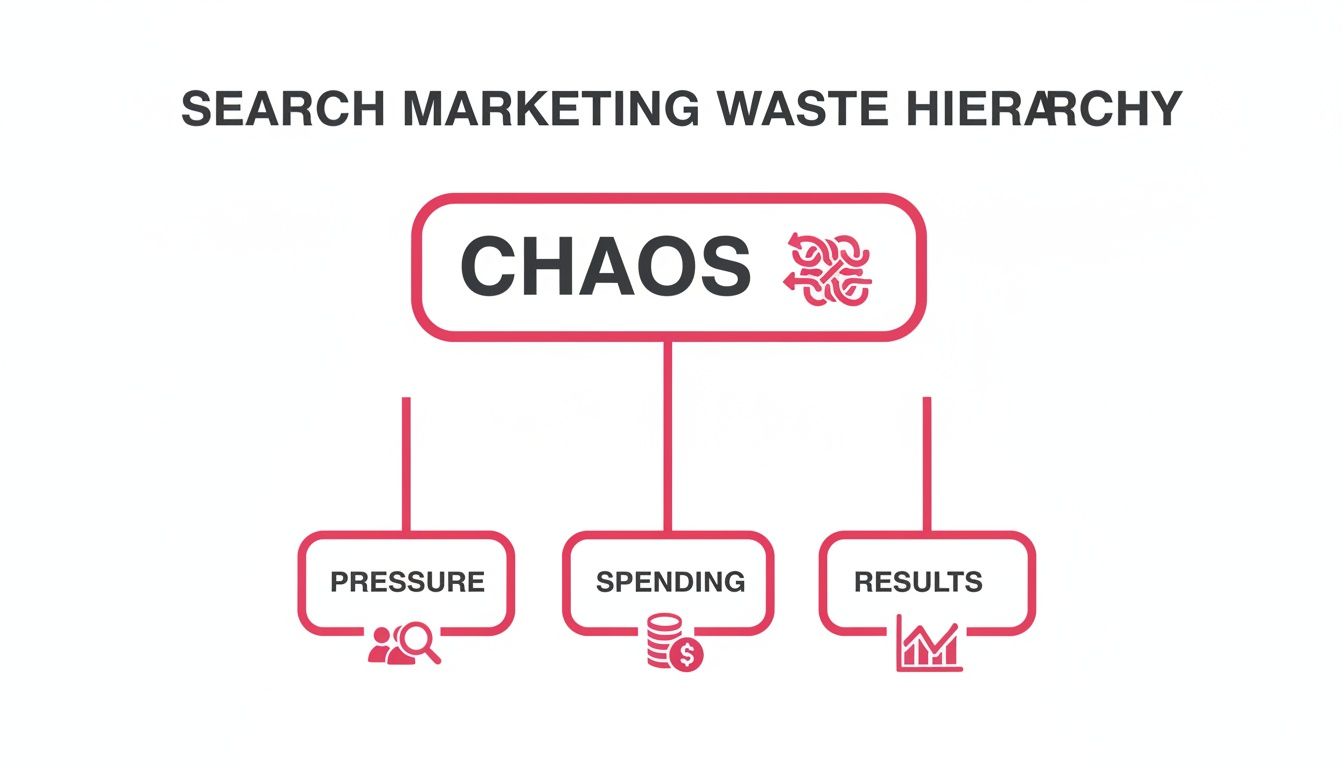
This diagram shows the trap perfectly: chaos leads to pressure, which forces wasteful spending and ultimately leads to disappointing outcomes.
SEO vs SEM At a Glance
To make the comparison even clearer, here's a simple table breaking down the two approaches using our "house vs. billboard" analogy.
Aspect | SEO (Building the House) | SEM (Renting the Billboard) |
|---|---|---|
Time to Results | Slower (months to see significant impact) | Immediate (traffic starts when ads go live) |
Cost Model | Upfront and ongoing investment in expertise & resources | Pay-per-click (PPC) or per-impression (CPM) |
Longevity | Results are cumulative and can last for years | Results stop the moment you stop paying |
Targeting | Broader; targets user intent through content | Highly specific; targets demographics, keywords, location |
Core Goal | Build long-term authority and organic traffic | Drive immediate traffic, leads, or sales |
This shows that SEO is about building a permanent, valuable asset, while SEM is a tool for capturing immediate attention.
A practical example: The agtech founder's decision
Let's make this real. Imagine a new Australian agtech company that helps farms manage their water usage. They need leads, and they need them now.
Their SEM Play (Renting the Billboard): They run a highly targeted Google Ads campaign focusing on keywords like "smart water management for farms" and "irrigation monitoring software NSW". This gets their name right in front of farmers actively searching for a solution, generating initial demo requests and valuable market feedback. It’s a fast, direct way to start conversations.
Their SEO Play (Building the House): At the same time, they start building. They publish genuinely helpful articles answering the real questions their customers have, like "How to calculate water usage for lucerne crops" or "Best irrigation practices for the Riverina region". This doesn't bring a flood of leads overnight. But over 6 to 12 months, it establishes them as a credible authority.
Soon enough, their articles start ranking on page one, bringing in a steady stream of traffic from farmers who might not be ready to buy today but are researching for the future. This builds a pipeline that costs them nothing per click. Their house is built, and it’s now attracting the right people all on its own.
That’s the synergy most businesses miss. For a deeper dive, you can explore the strategic differences between SEM and SEO in our founder's guide.
A smart strategy doesn’t choose one over the other; it uses both with intention. It uses paid SEM services for immediate traction and data, while patiently building the long-term, cost-effective engine of SEO. This structured approach is what provides clarity and real momentum.
So, what does the work actually look like?
You've signed on for SEO and SEM services. Now what? It’s a fair question. Too many business owners are sold a "black box" of optimisation, leaving them disconnected from the work and wondering where their money is going.
Let's pull back the curtain and look at what the day-to-day work involves and, more importantly, the purpose behind it all.
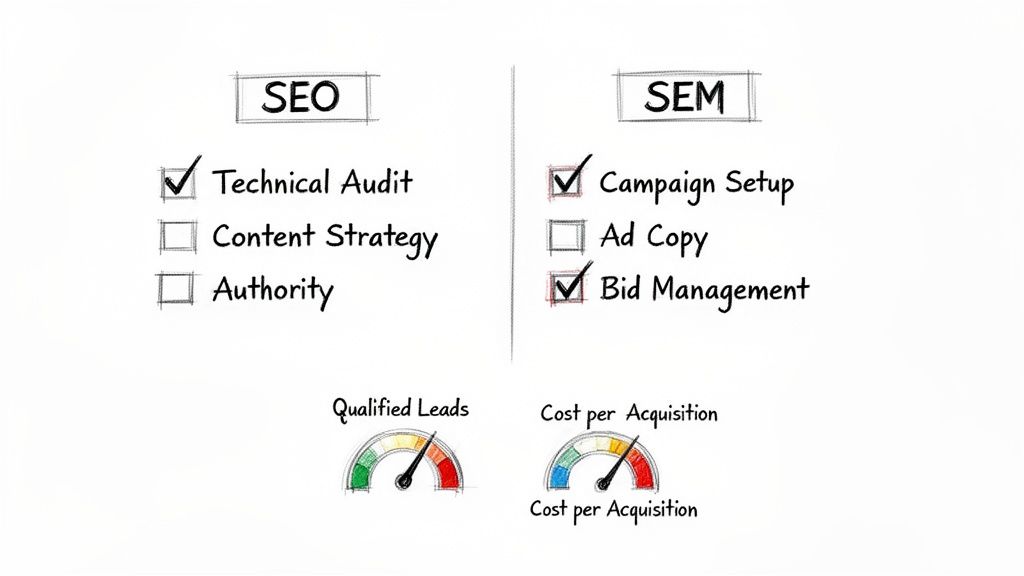
Core SEO Activities: Building Your Digital Foundation
Think of SEO as laying the groundwork. It’s methodical, structural improvement that builds real, lasting value.
Technical Audit & Fixes: This is like a building inspection; it finds the cracks in the foundation that stop Google from understanding what your website is all about. We always start here, because no amount of great content can fix a site that search engines can't even crawl or index properly.
Content Strategy & Creation: This is much more than “blogging.” It’s about mapping out the exact problems your ideal customers are searching for and then creating the most helpful, authoritative answers on the internet. You're building assets that attract genuine buyers.
Authority Building (Link Building): This is the most misunderstood part of SEO. It’s not about buying spammy links. True authority building is about earning genuine mentions from reputable websites in your industry. These act as votes of confidence, signalling to Google that you're a credible source.
These activities work together to build a sustainable asset—one that keeps generating traffic and leads for years.
Core SEM Activities: Getting Immediate Traction
If SEO is the long-term build, SEM is about immediate action. It's how you get your message in front of the right people at the right moment.
Campaign Setup & Structure: This is the architecture of your paid search plan. A solid structure ensures your budget is spent efficiently on the most relevant searches—a poor one is the number one reason ad spend gets wasted.
Ad Copywriting & Testing: Writing a great ad is part art, part science. It has to grab attention, speak directly to a user's problem, and convince them to click. A good SEM process involves constantly testing different messages to see what resonates.
Bid Management & Optimisation: This is the daily work of managing your budget effectively. It involves adjusting bids for keywords based on their performance, making sure you aren’t overpaying for clicks that don't lead to valuable actions. For a deeper dive, checking out Search Engine Marketing best practices can set you up with a strong foundational strategy.
The goal of any good engagement isn't to deliver a long list of tasks. It's to deliver clarity and results. You should always understand why something is being done and how it connects to your business goals.
The Metrics That Actually Matter
Finally, let’s talk about reporting. A monthly report filled with vanity metrics like "impressions" or raw "traffic" is just noise. It doesn't help you make better decisions.
For a B2B business, the only metrics that really move the needle are the ones tied to revenue. Your reports should be laser-focused on:
Qualified Lead Volume: How many real, potential customers did our search efforts actually generate?
Cost Per Acquisition (CPA): How much did it cost us, on average, to get each of those new customers?
Pipeline Contribution: How much potential revenue did our search campaigns add to the sales pipeline?
When we start working with a new team, this is one of the first things we fix. We strip away the confusing jargon and get everyone focused on the numbers that signal real business growth. It creates the transparency you need to feel confident your investment is paying off.
Why Do So Many Search Strategies Flop for Australian B2B Companies?
If you feel like your search marketing is just spinning its wheels, you’re not alone. The problem usually isn't about budget or effort—it's that the work has become disconnected from actual business goals.
It's an easy mistake to make. The pressure to "get on page one" often leads to a chase for keywords that bring in plenty of noise, but no real business. Before you know it, you're celebrating traffic spikes that never turn into conversations with potential customers.
Fishing in the wrong pond
One of the most common pitfalls is targeting broad, generic keywords instead of zeroing in on the specific, high-intent phrases that signal a buyer is ready to talk. Getting this small detail right changes everything.
Let's take an Australian agtech company as an example. It might seem logical to target a high-volume keyword like ‘farm technology’. But who is actually typing that into Google? Mostly students, researchers, and journalists. The company gets a flood of website visitors, but the sales team is left wondering where the leads are.
Now, picture a different approach.
What if they instead focused their efforts on a term like ‘livestock management software for NSW’? The search volume is a fraction of the broader term, but the intent behind it is perfectly clear. The person searching for this isn't writing a university paper; they're running a farm in New South Wales and have an urgent problem to solve. This subtle shift is the difference between attracting curious researchers and attracting qualified buyers.
Ignoring how Australians actually search
Another critical error is using a strategy that doesn’t account for the local market. In Australia, the search engine landscape is a monopoly. It's all about Google, which absolutely dominates the market with 93% of all search engine usage.
This means your strategy has to be Google-first. What's more, with 46% of all Google searches having local intent, optimising for specific Australian states and cities isn’t just a nice-to-have; it's essential. You can discover more key Australian marketing statistics here to understand these dynamics. If you don't build your plan around this reality, you’re fighting an uphill battle.
Your entire search strategy has to be built on a deep understanding of who your customer is, where they are, and the exact words they use when they’re ready to solve a problem. Anything less is just guesswork.
Using outdated content plays
The game has changed. Google’s algorithms are now incredibly good at spotting generic, low-effort content. They heavily prioritise content that shows genuine expertise, authority, and trustworthiness (E-E-A-T).
Just publishing another blog post won't cut it anymore. Your content now has to be the single most helpful, insightful, and credible resource out there. This demands deeper strategic thinking before a single word is written. You need to be crystal clear on your market position and your unique point of view.
When we join a team, this is often the first thing we tackle. We help them define what they're truly experts in and build a content strategy that proves it. It's about moving away from churning out generic articles and toward creating genuine assets that build lasting authority.
How to Structure Your Investment in Search Marketing
Figuring out how much to spend and what kind of engagement makes sense can be a real headache. It’s tough to tell which option will actually move the needle and which one will just keep an agency busy. This is where budgets get torched and frustration kicks in.
The goal isn't just to hire a vendor. It's to find a partnership model that works for a growing business—one that demands flexibility, clear accountability, and results you can actually see.
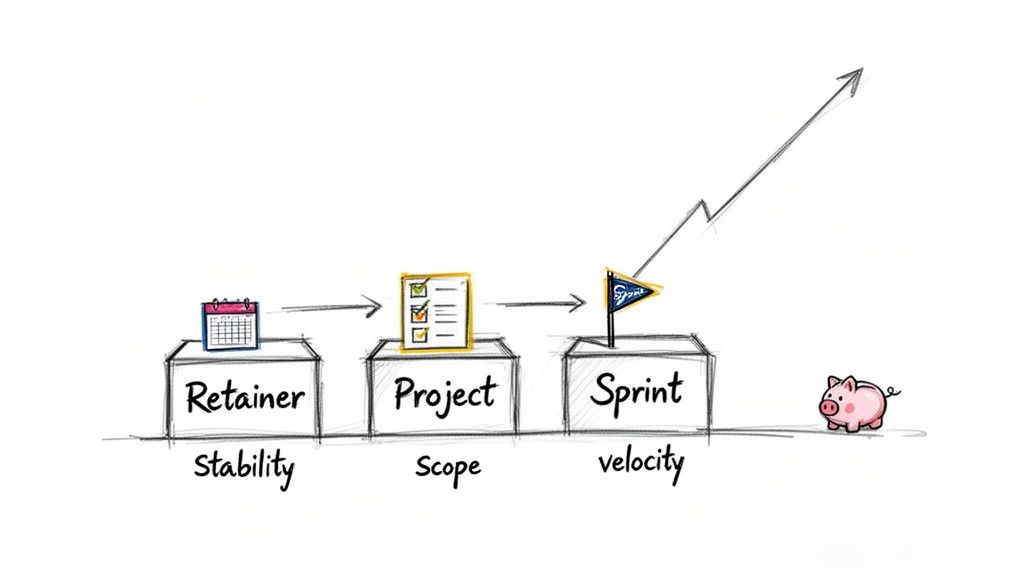
Common Engagement Models
Most agencies have a few standard ways of working. Knowing the trade-offs is crucial for picking a path that builds real momentum, not just generates reports.
The Monthly Retainer: This is the old-school approach. You pay a fixed fee every month for a list of ongoing tasks. While it offers predictable billing, its biggest pitfall is complacency. Without sharp, time-bound goals, retainers can easily become a cycle of busywork with no clear endgame.
The Fixed-Fee Project: This works perfectly for a specific, one-off goal, like a website migration or a deep-dive technical SEO audit. You get a clear deliverable for a set price. The downside? It's rigid. If priorities change halfway through, there’s not much wiggle room.
The Sprint-Based Approach: This model is all about focus and speed. Work gets broken down into tight, 2-4 week “sprints,” each with one clear objective. This forces everyone to prioritise what really matters and ensures you see tangible progress, fast.
The right model isn't just about cost; it's about creating a structure that forces clarity and direction. A long-term retainer can hide a lack of progress, whereas a fixed-fee sprint demands it.
Finding the right fit for your business
The industry is moving towards more structured, tool-driven strategies. Australia's SEO software market is forecast to hit USD 5.2 billion by 2030, with small and medium-sized businesses leading the charge. This tells us that more companies are looking for disciplined, data-backed ways to win online. You can dig deeper into this trend in this comprehensive market research report.
For a growing business, the sprint model usually strikes the perfect balance. It dodges the "set and forget" trap of retainers while giving you the adaptability that fixed projects lack.
When we join a team, our first sprint is always dedicated to fixing the single biggest foundational problem we find. This creates an immediate win, builds momentum, and gives everyone confidence that the investment is already paying off. It transforms a vague ambition into a series of achievable, short-term victories—and that clarity is everything.
Your First Step to Getting Search Marketing Right
If you've made it this far and your head is spinning a little, that's a completely normal reaction. The world of SEO & SEM services can feel like a tangled mess, and it’s easy to think you're miles behind.
You’re not. You just need a solid starting point.
The single most important thing you can do right now is not to hire an agency or launch a new ad campaign. It’s to get absolute, unshakeable clarity on one simple question.
What specific problem do we solve and for whom?
Everything in your search strategy hinges on this one answer. Before you even think about keywords or ad budgets, you need razor-sharp positioning. It’s the concrete foundation you build everything on. Without it, you’re just building on sand.
This is exactly why the very first sprint we run with any team is almost always dedicated to this foundational work. It’s the non-negotiable first step for any strategy that’s meant to build real momentum.
A practical moment of clarity
Try this. Get five key people from your team in a room and ask them that one question. If you get five different answers, you don’t have a marketing problem—you have a clarity problem. That's the real issue you need to fix first.
Instead of rushing into another campaign, pull your team together. Hash out your answer until it’s so clear and simple that everyone can repeat it. To see how we approach this, you can learn more about how clarity is the first step in our SEO audit services.
That single, focused answer is the most powerful asset you have. It will inform every keyword you target, every ad you write, and every piece of content you create. It’s what turns guesswork into confident action.
Common Questions about SEO and SEM
Even with a solid plan, it’s normal to have some lingering questions. Let's clear up a few of the most common ones.
How long does it really take to see SEO results?
The honest answer? Think in months, not weeks.
SEO is like planting a tree. You have to lay a solid foundation (technical SEO), nurture it with great content, and then give it time to grow. Be wary of anyone promising page-one rankings overnight.
Realistically, you can expect to see the first signs of progress—like better rankings and more organic traffic—within 3 to 6 months. But for the kind of results that truly move the needle, like a reliable stream of qualified leads, you're usually looking at a 6 to 12-month timeline. A structured plan helps you see tangible progress along the way, giving you the confidence to stick with it.
Can't we just do paid ads and skip SEO?
You can, but it’s like renting a house instead of buying one. Relying only on paid ads means you're renting your traffic. The second you stop paying, your visibility vanishes. It's a fantastic tool for immediate goals, like launching a new product or quickly testing a marketing message.
A strong SEO foundation, on the other hand, is an asset you own. Over time, it builds organic credibility that generates traffic without you having to pay for every click.
The smartest approach almost always uses both. Run paid ads for quick wins and to gather data, all while you patiently invest in SEO to build a more sustainable and cost-effective way to grow.
For B2B, what's more important: content or technical fixes?
This is a chicken-or-egg question, but one is useless without the other. It's like having a brilliantly designed race car (your content) with a broken engine (your technical SEO).
You could create the most insightful, expert-driven content on the planet, but if search engines can't crawl or understand your site because of technical glitches, it's invisible.
Conversely, a technically flawless website with shallow, irrelevant content offers no real value to anyone and will never rank for the keywords that matter. When we embed with a team, our first job is always to fix the technical gaps. We secure the foundation first, then build on it with high-quality content that proves your authority.
If you're tired of the guesswork and need a clear, structured path to making your search marketing work, Sensoriium can help. We provide the senior leadership and hands-on execution to build the foundations, create momentum, and give you confidence in your marketing.