
Search Engine Marketing vs SEO: A Founder's Guide to Clarity
- Feb 3
- 12 min read
You know you need to show up on Google. But the path forward is a fog of acronyms, conflicting advice, and the nagging feeling you're about to waste a lot of money. You've heard "SEM" and "SEO" thrown around, often in the same sentence, but no one's given you a straight answer on which one matters more right now.
If you feel stuck, that’s normal. It’s not because you’re missing something obvious. It’s because the marketing world is great at making simple things feel complicated. The pressure to just do something is immense, but a wrong turn can be expensive when every dollar and hour counts.
This guide is designed to cut through that noise. We’ll break down what Search Engine Marketing (SEM) and Search Engine Optimisation (SEO) actually are, how to think about them, and how to make a smart call for your business. The goal isn’t more theory; it's to give you the clarity and confidence to move forward.
What's the Real Difference? A Quick Look

Let's start with a simple, practical way to think about this.
SEM is paying for ads to appear at the top of Google. SEO is earning your spot there without paying for the click.
One is like renting a billboard on a busy highway for immediate attention. The other is like building your own permanent, trusted storefront on that same highway.
Here's a quick comparison to make the distinction clear.
Core Differences at a Glance
Aspect | Search Engine Marketing (SEM) | Search Engine Optimisation (SEO) |
|---|---|---|
Primary Method | Paid advertising (Pay-Per-Click) | Organic content & technical improvements |
Cost Structure | Pay for each click or impression | Investment in time, content, & expertise |
Speed to Results | Immediate (traffic starts when ads launch) | Gradual (takes 3-12 months to see real momentum) |
Visibility | Temporary (vanishes when you stop paying) | Lasting (builds a long-term, compounding asset) |
Best For | Testing offers, promotions, immediate leads | Building trust, authority, & sustainable traffic |
Analogy | Renting a billboard on a busy highway | Building your own storefront on that highway |
How SEM and SEO Actually Work

Most of the confusion around search engine marketing vs SEO comes from not having a practical grip on how each one operates day-to-day. Let's make it plain.
Search Engine Marketing (SEM) is about paying for visibility. You use a platform like Google to place your ad at the top of the search results for specific keywords your customers are using. You're in a direct commercial relationship: you bid against competitors for attention. For the fundamentals, check out this guide to paid search marketing.
Search Engine Optimisation (SEO), on the other hand, is about earning that visibility. It’s the foundational work of structuring your site, creating genuinely helpful content, and building authority so that Google trusts you enough to show your pages without you paying for the click. Here, you're trying to build a relationship with Google's algorithm by proving you're the most helpful answer.
The Real-World Impact: Paid vs Earned
Why does this difference matter so much? Because it changes how customers see you. One is an ad, and the other feels like an endorsement from the most trusted information source on the planet.
This difference in perception has a huge impact. Research consistently shows that organic SEO is 5.66 times more effective in Australia than paid search, mainly because users trust earned results far more than sponsored ads. With click-through rates for the top organic positions hitting 39.8% compared to just 1.6% for paid spots, it’s clear where people prefer to click.
This isn’t just theory. It has a direct effect on how many people find you and whether they trust you when they do.
A Simple Scenario
Let’s say you’re an agtech founder with new soil-testing software.
Your SEM approach: You run a Google Ads campaign targeting the keyword "best soil testing software". Your ad appears instantly at the top. You pay every time a farmer clicks on it. This is a brilliant way to get your first ten customers this month.
Your SEO approach: You write a detailed, practical guide called "A Farmer's Guide to Improving Crop Yield with Soil Data". It might take a couple of months for this article to start ranking on Google. But over the next two years, it attracts thousands of farmers to your site, building trust and generating a steady stream of qualified leads without you paying for a single click.
One is a tactic to capture immediate demand; the other is a strategy to build a long-term business asset. Most teams get stuck because they chase quick results without ever building the foundation for sustainable growth.
How Each Affects Your Timeline and Cashflow
One of the biggest disconnects for founders is understanding what SEM versus SEO actually means for the bank account and the calendar. You’ve heard one is fast and the other is slow, but what does that really mean over the next twelve months? This is where expectations and reality often collide.
You need to balance the urgent need for leads today with the strategic necessity of building a reliable pipeline for tomorrow.
SEM: A Predictable Operating Expense
Think of Search Engine Marketing like paying rent. It's a predictable, controllable expense that gets you immediate foot traffic.
You can launch a campaign today and have potential customers on your site by tomorrow. The budget is entirely in your hands—if you decide to spend $50 a day, that's what you spend. That control feels incredibly reassuring when everything else feels uncertain.
The catch? The moment you stop paying the rent, the doors close. The traffic vanishes. It’s a tap that runs dry the second you turn it off. The money you spent last month has zero impact on the leads you get this month.
SEO: A Long-Term Capital Investment
Search Engine Optimisation is different. It’s not an expense; it’s an investment in a core business asset. It's the difference between renting that storefront and buying the whole building.
The first few months require a lot of work with very little to show for it. You're pouring the foundations—fixing your site's technical health and creating genuinely useful content. For the first three to six months, you might see nothing more than a trickle of traffic. Frankly, this is where most founders lose their nerve.
But after that initial effort, something powerful begins to shift. The results slowly build, then become noticeable, and then start to compound. An article you published a year ago can keep attracting qualified leads for the next five years, all without you paying another cent. You’re building an asset that appreciates over time.
This is why a structured, sprint-based approach creates clarity so quickly. When we embed with a team, one of the first things we do is lay out a clear roadmap for this foundational work. It provides the confidence to stick with the process because the connection between today's effort and a future commercial outcome is made obvious.
A Practical Founder Moment
Let’s picture an agtech company with a new farm management platform.
SEM Cashflow: They budget $3,000 per month for Google Ads. In month one, they get 300 clicks and 5 trial sign-ups. In month twelve, they spend another $3,000 and get a similar result. The cost is constant, the return is linear.
SEO Cashflow: They invest $3,000 per month into creating foundational content. For the first four months, they get next to nothing. By month eight, their articles start to rank, bringing in 10 organic trial sign-ups per month. By month twelve, that number is up to 30, and it keeps growing even if they scale back their investment.
The crucial mental shift is from "marketing spend" to "asset creation." SEM buys you attention, while SEO builds you an asset that earns attention.
Choosing the Right Tool for the Right Job
So, how do you decide? The honest answer is that the endless debate of search engine marketing vs SEO is mostly a distraction. The real question is: what problem are we trying to solve this quarter?
Clarity comes when you match the tool to the job. Are you trying to test a new product, get immediate leads, or build a long-term, repeatable pipeline?
When to Use SEM for Immediate Momentum
Search Engine Marketing is your go-to when speed is the priority. It’s the perfect tool for situations where you need to validate an idea or get quick feedback from the market.
Think of it as a tactical move. It’s perfect for:
Product Launches: You’ve just shipped a new feature. SEM lets you get it in front of a targeted audience instantly to generate that first wave of users and feedback.
Testing Your Messaging: Not sure which headline hits the mark? Run multiple ad variations to see what language actually convinces people to click. We have more on this in our guide on how to get real creativity in ads.
Targeting High-Intent Buyers: When someone searches for "best accounting software for builders," they aren't just browsing. SEM puts your brand directly in their path at that exact moment.
When to Use SEO for Sustainable Growth
Search Engine Optimisation is your foundation for long-term, profitable growth. It's the right choice when your goal is to build a lasting asset that generates trust, authority, and a consistent flow of quality leads.
This more strategic approach is best for:
Building a Repeatable Pipeline: For complex B2B services with long sales cycles, trust is everything. SEO builds that trust by consistently showing up with genuinely helpful, expert content.
Becoming a Category Leader: If you want to own your niche, you need to be the go-to source for information. SEO is how you build that authority.
Reducing Customer Acquisition Costs: While SEO requires an upfront investment, its compounding returns dramatically lower your cost per lead over time.
In Australia, with Google’s massive 93.95% market share, it’s really the only game in town. SEM can deliver immediate visibility, but organic SEO delivers far greater value over the long haul. Top-ranking organic pages earn a 39.8% click-through rate compared to just 1.6% for the first paid position—proving that Aussies simply place more trust in earned rankings.
This flowchart offers a simple way to visualise the financial impact and timeline.
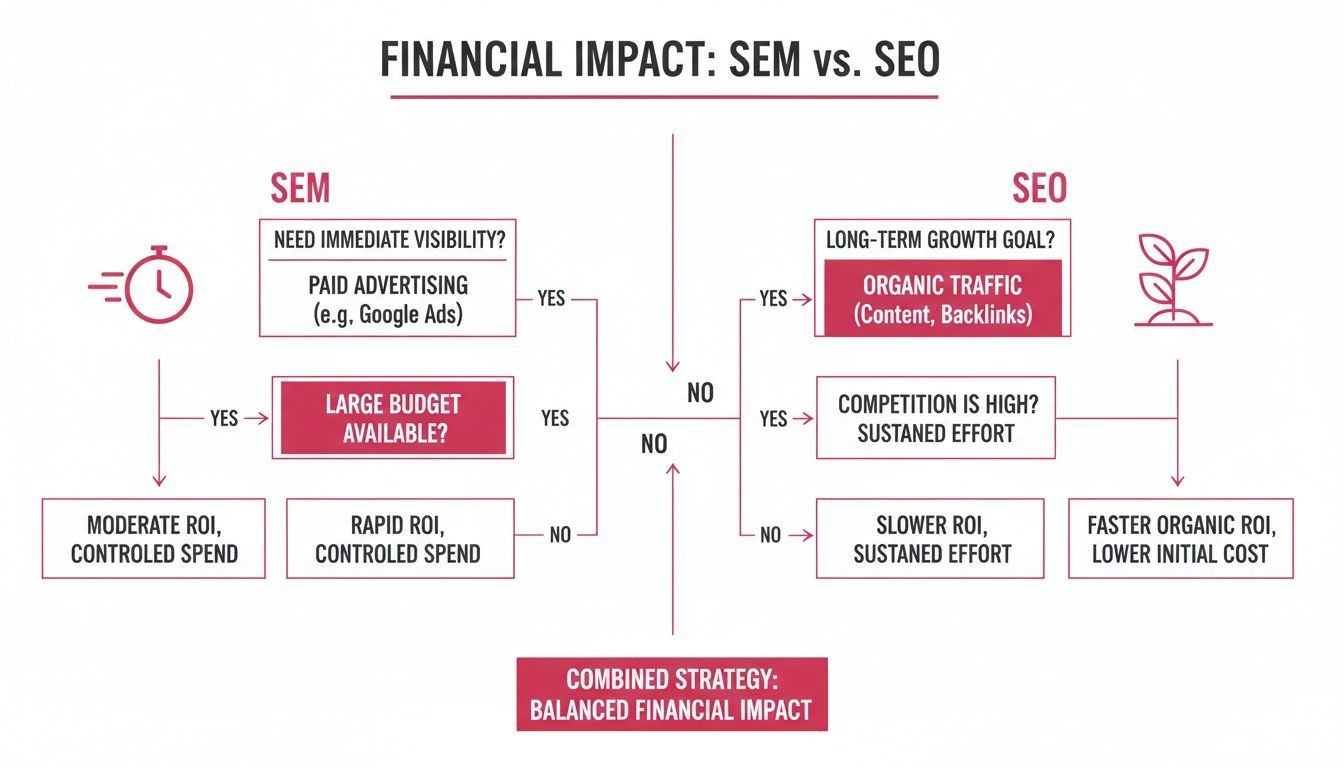
The key insight here is that SEM acts like a short-term expense for immediate results, whereas SEO is a capital investment that builds a compounding digital asset. The right structure makes the choice obvious. Most teams struggle here because they’ve never had someone step in to structure the work and align it with clear business goals.
And as you evaluate tools, it's worth exploring how technology can help. The right platform can give you the data needed to make smarter decisions, and many now incorporate AI search tracker tools to provide deeper insights.
Ultimately, the choice becomes much simpler when you stop thinking about tactics and start thinking about outcomes.
Building a Hybrid Approach That Actually Works

Smart founders don't get trapped in the "search engine marketing vs SEO" debate. They quickly realise it’s not an either/or decision. Instead, they treat them as a single system where each channel makes the other one stronger. The real frustration comes from running them as disconnected campaigns, which always feels chaotic.
Building a hybrid approach isn't about more work. It’s about creating a simple feedback loop where your short-term ad spend directly informs your long-term organic asset.
Using SEM to Inform SEO
One of the most effective ways to integrate these channels is using paid search data to sharpen your organic strategy. An SEM campaign gives you immediate, real-world data on what your customers are actually searching for, not just what keyword tools suggest.
This is a shortcut to finding the precise language that resonates. Instead of spending six months creating SEO content based on guesswork, you can use a small SEM budget to validate keywords in just a few weeks.
The process is straightforward:
Run a targeted Google Ads campaign.
Dive into the search terms report. This is the goldmine; it shows you the exact queries people typed before clicking your ad.
Look for unexpected phrases, specific questions, and problem-focused language.
Prioritise these proven, high-intent keywords for your next round of SEO content.
This small shift changes everything. You’re no longer guessing what content to create. You’re using real market data to build an SEO strategy that’s practically guaranteed to attract the right people.
Using SEO to Power SEM Retargeting
The other side of this is using your foundational SEO content to fuel a more efficient SEM strategy. SEO is brilliant for building trust with helpful articles and guides.
Someone might not be ready to buy your software today, but they might find and read your detailed guide on "how to improve soil health." That article establishes your credibility without a hard sell.
Once they've visited your site, you can then use SEM retargeting to bring them back. A simple, low-cost ad can follow them online, reminding them of your solution when they are ready to make a decision.
A Practical Application for a Service Business
Let's walk through a real-world example. Imagine you run a B2B consultancy helping tech companies in Australia with compliance.
Build the SEO Asset: First, you write a comprehensive guide on your website called "The Founder's Guide to ISO 27001 Compliance in Australia." It’s a genuinely valuable piece of content that builds authority over several months. For tips, see our guide on what makes a good website.
Run a Tactical SEM Campaign: While that guide gains traction, you run a targeted SEM campaign for "ISO 27001 consultants." This captures immediate demand. The data from this campaign reveals people are also searching for an "ISO 27001 audit checklist," giving you the perfect idea for your next SEO article.
Connect Them with Retargeting: Finally, you set up a retargeting audience for everyone who has read your big SEO guide. Now, you can show them a simple ad that says, "Ready for your ISO 27001 audit? We can help."
This isn't a complex framework. It’s a simple, structured system where each part supports the other. When we embed with a team, this is one of the first gaps we fix: creating a unified strategy that stops the disjointed campaigns and starts building real momentum.
Getting Clarity on Your Next Step
You should now have a much clearer picture of the difference between search engine marketing and SEO. The goal isn't to become an expert overnight, but to feel confident enough to make your next move. The biggest mistake is trying to do everything at once.
Don’t fall into that trap. Instead, ask one simple question.
What Does My Business Need Most Right Now?
Is it immediate traffic and leads this quarter, or is it building a sustainable asset for the next five years? Your answer points you in the right direction.
If you need immediate results: To test a product, validate an offer, or hit this quarter's targets, start with a small, focused SEM campaign. It's a direct tool for a direct problem.
If you need a sustainable future: To build a reliable source of demand that doesn't rely on your ad budget, the right move is to start fixing your SEO foundations.
If this all still feels a bit messy, that’s completely normal. You're not behind; you just need a bit of structure. The most common failure point we see is when teams jump straight into tactics without first diagnosing the core business problem they’re trying to solve. When we embed with a team, this is the very first gap we fix. We bring structure to the problem, which instantly cuts through the chaos.
Start by Fixing This One Thing
Before you spend a single cent on Google Ads or an hour writing content, your first real step is to get an unbiased view of where you actually stand. For most businesses building for the long term, this means understanding the health of their biggest digital asset: their website.
Getting a clear picture of your site’s technical health and content gaps is the most powerful starting point you can have. You can learn more about how a proper diagnosis provides structure in our guide on what to expect from SEO audit services.
Get clear on the outcome you need, and the right path forward will become obvious.
Common Questions About SEM and SEO
Even after laying it all out, some questions can linger. Let's clear up the most common ones we hear from founders.
Can I Do SEO Myself, or Should I Hire Someone?
You can definitely get started yourself. Things like tweaking page titles, writing helpful content, and setting up a Google Business Profile are fantastic first steps.
But the deeper, technical side of SEO—site speed, schema markup, and earning real authority—is where specialised expertise comes in. For a founder, the biggest cost isn't an agency fee; it's your own time and focus being diverted from what you do best. Often, the smartest move is bringing in a specialist. When we work with a company, our aim is to build the right foundation fast, giving you momentum without the steep learning curve.
How Long Until I See Results From SEO?
Honestly? Think in months, not weeks. It realistically takes 6 to 12 months of consistent effort to see significant results. I know that timeline can feel painfully slow for a founder.
The first three months are about laying the groundwork: fixing technical glitches, tidying up your website’s structure, and publishing those first foundational pieces of content. The growth is slow at first, but it compounds, eventually building a powerful, long-term asset.
Is SEM Just Google Ads?
For the most part, yes. While the term SEM technically covers any paid advertising on a search engine, including platforms like Microsoft Advertising, the reality in Australia is different.
Google has over 93% market share here. So, for an Australian business, an SEM strategy is almost exclusively a Google Ads strategy. That's simply where your customers are.
What’s Better for a B2B SaaS Company?
For the vast majority of B2B SaaS businesses, SEO is the long-term hero. Your customers are usually in a long consideration process, searching for expert, credible information to solve a real business problem. That’s precisely what a solid SEO strategy delivers.
SEM still has its place. It can be powerful for targeting hyper-specific, purchase-intent keywords (think "best accounting software for builders") or for giving a new feature a quick boost. But it’s SEO that builds the deep-seated trust and authority you need for sustainable growth.
If you’re tired of guessing and need your marketing to finally make sense, Sensoriium can help. We provide the clarity, structure, and momentum your business needs to grow. Learn more at https://www.sensoriium.com.