
A Founder's Guide to Digital Marketing for Technology
- Feb 1
- 15 min read
Ever feel like your tech company’s marketing is just a cycle of throwing things at the wall to see what sticks? You run some ads, publish a few blog posts, maybe dabble in social media, but there’s no clear, repeatable path to getting customers.
If this sounds familiar, it’s not because you’re doing it wrong. It makes sense that you feel stuck. Most marketing advice isn’t built for the complexity of a technology product.
This guide will give you a different way to think about it. It’s about building a solid foundation before you even think about the tools.
Why Digital Marketing for Tech Companies Feels So Chaotic
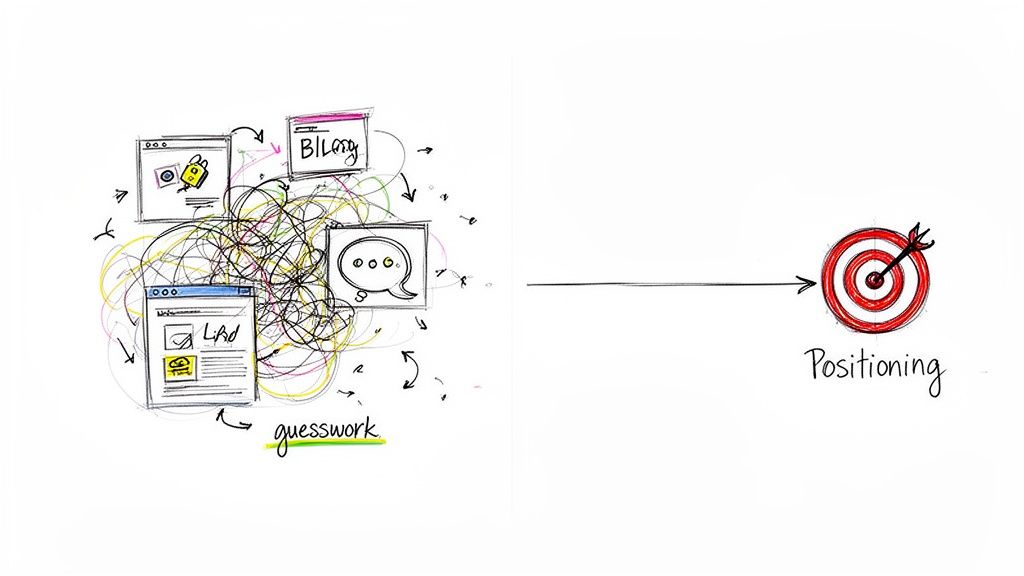
That feeling of just guessing with marketing is incredibly common among tech founders. You’re not crazy. You’re busy running a complex business, and most of the advice out there feels generic—it’s built for simple B2C products, not for sophisticated B2B tech with a long sales cycle.
This fundamental mismatch is where the chaos comes from. You hear vague advice like "be everywhere" or "create more content," but it ignores the reality of selling a technical product to a very specific, discerning buyer.
The Problem with “Random Acts of Marketing”
The real issue isn't a lack of effort. It's the scattered approach that happens when there’s no clear, structured plan. Most teams struggle here because they’ve never had someone step in to structure the work from the ground up.
This leads to a classic pattern of disconnected activities that don't add up to anything meaningful:
Running paid ads with fuzzy messaging that burns cash without bringing in qualified leads.
Publishing blog posts that aren’t tied to a bigger strategy, so they attract the wrong audience (or worse, no one at all).
Posting on social media because it feels like you should, but with no real purpose or way to know if it's even working.
Each of these actions feels productive in isolation, but they don't build on each other. Without a strong foundation, you’re just patching holes instead of building a proper system. This is exactly why your B2B tech marketing feels disconnected and why gaining real momentum feels impossible.
The only way out is to shift from doing random tactics to building a system.
The Founder Moment That Changes Everything
For most founders, there’s a distinct moment when they realise the guesswork has to stop. It might be after staring at the numbers from a failed ad campaign, or hearing from the sales team, yet again, that the leads just aren't good enough.
This is the turning point. It's where clarity becomes far more important than just being busy. Instead of asking, "What should we do next?" the question finally becomes, "Who are we for, and what are we actually trying to achieve?"
That feeling of chaos isn't a sign you're failing. It’s a sign you’ve outgrown your initial, ad-hoc approach. You're ready for structure. You just need a system designed for the unique challenges of marketing a technology product.
The fix starts by putting the tactics aside and focusing completely on your foundational clarity. Before you spend another dollar on ads or write another line of code, you have to get brutally honest about who you serve and why you are the only logical choice for them. When we embed with a team, the first thing we fix is this exact gap. It’s the small shift that changes everything that follows.
The Three Pillars That Actually Matter
Let's cut through the marketing noise. If you feel like digital marketing for your tech company is an endless to-do list, it’s because you’re being sold a complex and confusing bill of goods. The truth is much simpler.
Forget the thousand different tactics you could be doing. Real progress comes from nailing just three things. This isn't a complicated framework; it's a way of thinking that brings instant clarity and calms the chaos.
Pillar 1: Positioning
This is the bedrock. Before you write a single line of your website or spend a dollar on ads, you have to be absolutely clear on who you are and why a specific group of people should care. If this part is fuzzy, every marketing effort that follows will be a waste of money.
Positioning isn't a snappy tagline. It's the concrete answer to three non-negotiable questions:
Who is your ideal customer? Not a vague persona. A sharp, specific definition of the person who gets the most value from what you do.
What painful problem do you solve for them? It has to be a problem they're actively trying to fix right now.
Why are you the only logical choice? This is your unique value – what makes you different in a way that your ideal customer genuinely cares about.
Accurately understanding how to find your target audience is the foundation of any successful digital marketing strategy for a tech company. Get this right, and every other decision becomes simpler.
Pillar 2: Presence
Once you know who you are (Positioning), you need to decide how you’ll show up. Presence is about building the core assets that communicate your value clearly and consistently. It's where you turn your strategy into something tangible that customers can see and interact with.
This doesn't mean you need to be on every social media channel. It means building a strong, credible home base.
Founder Moment: A client once told us, "Our website is just an online brochure that we're embarrassed to send people to." That’s a classic presence problem. Your website shouldn't be a digital business card; it should be your hardest-working salesperson.
Your core presence boils down to a high-value website and crystal-clear messaging. It’s about creating a digital experience that makes a visitor instantly feel like you "get them" and that they’ve come to the right place. Most teams get stuck here because they’ve never had someone properly structure the work needed to build these assets from the ground up.
Pillar 3: Promotion
Only after you’ve sorted your Positioning and Presence should you even think about Promotion. This pillar is about how you intelligently connect with the right people. This isn't about blasting your message everywhere; it’s about choosing a small number of channels and executing them exceptionally well.
Promotion is where tactics like SEO, paid ads, and content marketing finally enter the picture. But they only work when they’re built on the first two pillars. Without clear positioning, your ads won't connect. Without a strong presence, the traffic you generate will have nowhere meaningful to go.
This is usually where a sprint approach creates clarity quickly. Instead of trying to launch five channels at once, the focus is on building one repeatable system for generating leads. This builds momentum and confidence, proving that your digital marketing for technology can be a structured, predictable engine, not a source of constant guesswork.
How to Choose the Right Channels (Without Lighting Your Budget on Fire)
"So... where should we actually spend our time and money?"
It’s the question every tech founder asks. You see competitors on LinkedIn, hear people talking about SEO, and your inbox is full of emails promising magic results from paid search. It feels like you should be doing everything at once.
Trying to be everywhere is a guaranteed way to end up nowhere, just with a much lighter bank account.
This feeling of being pulled in a dozen different directions is normal. It comes from a common myth: that more activity equals more results. The breakthrough happens when you stop chasing every new channel and start making deliberate choices based on where your customers actually are.
This simple flowchart shows how to structure your thinking. Notice how promotion is the last step, not the first.
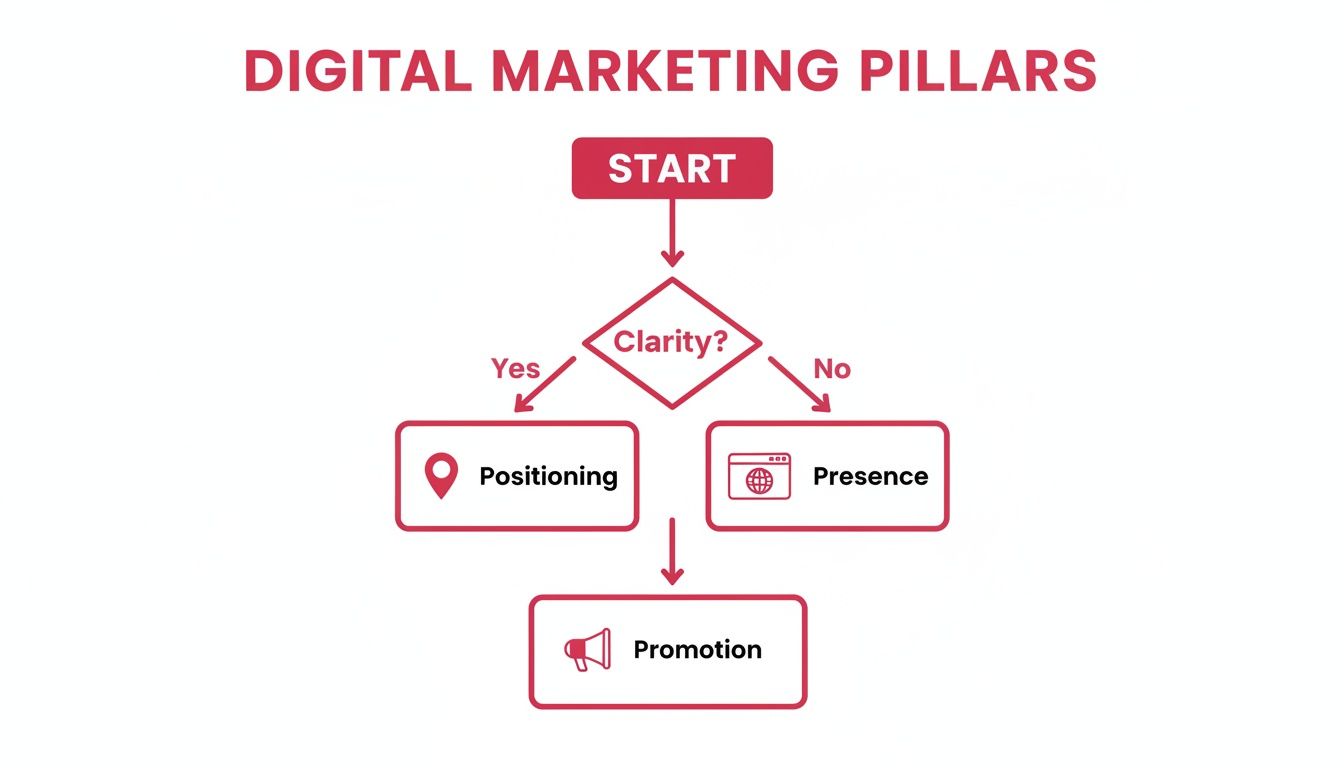
Without clarity on your positioning and a solid online presence, any money you spend on promotion is just a gamble.
From 'What' to 'Where'
Stop asking, "What channels should we use?"
Instead, ask: "Where do our ideal customers go to solve the problem we fix?"
This simple reframe changes everything. It moves you from a tactical mindset (doing things) to a strategic one (achieving an outcome). Most teams jump straight to tactics. It feels like progress, but it’s often just motion without momentum.
To make a smarter choice, filter your options through a few key questions:
How long is our sales cycle? A long, complex sale needs channels that build trust over time. Think content marketing and targeted LinkedIn campaigns, not channels built for a quick impulse buy.
What is our customer's intent? Are people actively searching for a solution like yours right now? If so, paid search can capture that demand. If they don’t know a solution exists, you’ll need to create awareness with educational content first.
What are our real-world resources? Be honest. It’s far better to master one or two channels than to be mediocre at five. If you have a small team, pick channels that play to your existing strengths.
A Practical Example
Imagine you're a SaaS company selling farm management software to broadacre farmers in regional Australia. The generic advice would be to start a blog, run some Google Ads, and post on Instagram.
Now, let's think it through with more structure.
Your ideal customer—a 55-year-old farm owner—isn't spending their evenings scrolling through tech blogs. They are, however, active in private Facebook groups for farmers and listen to industry podcasts during long hours in the tractor.
Instead of a scattered approach, a focused strategy would be to build relationships in those Facebook groups (by helping, not selling) and sponsor a popular agtech podcast. This is targeted, cost-effective, and meets the customer exactly where they are. It’s how a small, focused budget can achieve more than a large, scattered one.
This highlights just how critical deep audience understanding is when putting together your B2B lead generation strategies.
A Simple Channel Selection Framework
To help you map this out, here’s a quick-glance table comparing common channels for tech companies. It’s not about finding the "best" one, but the best one for you, right now.
Channel | Primary Goal | Best For | Typical Effort |
|---|---|---|---|
Content & SEO | Building authority, capturing organic search demand | Companies with a long sales cycle or complex products | High upfront, medium ongoing |
Paid Search (SEM) | Capturing high-intent leads who are actively searching | Products with a clear search keyword or short sales cycles | Medium upfront, high ongoing |
Paid Social | Creating awareness, targeting specific personas | Reaching niche audiences and promoting content | Medium upfront, medium ongoing |
Partnerships | Tapping into an existing, trusted audience | New market entry or building credibility quickly | Low-to-medium financial cost, high relationship-building effort |
Account-Based Marketing | Deeply penetrating a small list of high-value accounts | Enterprise sales or targeting specific large companies | High effort, highly personalised |
This framework isn't exhaustive, but it provides a starting point for making strategic decisions instead of just following the crowd.
It’s also worth keeping an eye on broader market trends. For instance, with social media advertising in Australia projected to hit AU$7.5 billion in 2025, and with 94% of small businesses planning to increase their marketing spend, knowing where to focus your own budget is more important than ever. The key is to turn these trends into momentum, not just noise.
Ultimately, choosing the right channels isn't about finding a secret formula. It's about having the clarity and confidence to say "no" to the channels that don't serve your specific goals, so you can go all-in on the ones that do.
Building a Marketing Engine That Actually Works
Does your marketing feel like a series of disconnected, short-term campaigns? One month you’re all-in on a webinar, and the next you’re scrambling to publish blog posts. It’s exhausting, and it rarely adds up to anything predictable.
This is a classic sign that your business is running on tactics, not a system. The real goal of digital marketing for technology isn't just to launch campaigns; it’s to build a structured, repeatable engine that works for you, even when you’re not actively pushing a button.
Think of it this way: great marketing should be an asset that grows in value over time, not a constant sprint on a treadmill. It’s all about moving from ad-hoc efforts to a system that consistently builds trust.
From Random Acts to Repeatable Systems
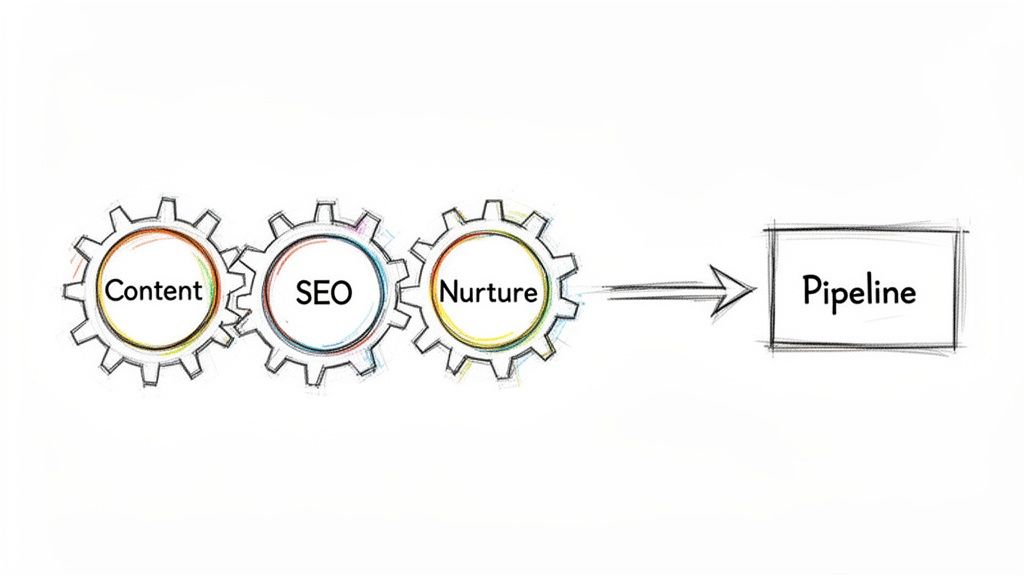
An engine has distinct, interconnected parts that work together to create momentum. A marketing engine is no different. Instead of a jumble of random activities, it needs three core components that feed into one another.
This is often where we see the biggest transformation when we embed with a team. We stop the random acts of marketing and start building the systems that were missing, leaving them with a clear structure and a path forward.
The foundational parts are simple but non-negotiable:
A Clear Content Strategy: This isn’t just ‘making content’. It’s about systematically answering your customers’ real, urgent questions. Each piece you create should be a building block, not a standalone item.
A Simple SEO Approach: Forget the complex jargon. For a tech company, good SEO is about being hyper-relevant for the specific problems you solve. It makes sure your valuable content is found by the people who need it.
A Thoughtful Nurturing Process: What happens after someone finds your content? A good nurturing process guides them with helpful information over time rather than hitting them with a hard sales pitch.
These three parts work together. Helpful content gets found via SEO, which attracts the right people, who are then nurtured into qualified leads for your sales team. This is the difference between hunting for leads and attracting them systematically.
Practical Application: A 90-Day Sprint
Let’s imagine you’re the founder of a B2B SaaS company that helps businesses manage compliance. You’ve been doing random marketing for a year with mixed results. Here’s how you could map out a 90-day sprint to build the first version of your engine.
Month 1 (Clarity and Content): Focus entirely on mapping out the top 10 questions your ideal customers ask before buying. Then, create 10 high-quality articles that answer each one in detail. No promotion, just building the assets.
Month 2 (SEO and Presence): Now, optimise and publish those 10 articles on your website. The goal is to make your site the definitive resource for solving the specific compliance problems you target.
Month 3 (Nurture and Distribution): Create a simple email sequence that offers more in-depth advice to anyone who downloads a checklist from one of your articles. You'd also start sharing this content on LinkedIn, driving relevant traffic back to your new assets.
In just 90 days, you’ve gone from random tactics to a functional engine. You’ve created long-term assets that will attract leads for years, not just a campaign that dies after a month. You've built a foundation for predictable progress.
This structured approach is vital in a crowded market. In early 2025, Australia had 26.1 million internet users, representing over 91% of the population. For tech firms, this huge online presence means focused sprints can deliver a significant return by capturing even a small slice of that attention.
Building an engine brings clarity and confidence because it gives you a framework for every marketing decision. You finally know how to create a marketing plan that actually works instead of just guessing what to do next.
Using AI and Automation the Right Way
Let's be honest, the hype around AI can be overwhelming. It feels like there's a new "game-changing" tool every week, and the pressure to adopt everything at once is intense. If you're feeling a bit behind, you're not alone.
Most of the noise is about chasing shiny new toys, not solving actual business problems. This creates more confusion than clarity.
The reality? You don't need a grand, complicated AI strategy. You just need a few clever automations to give your team back their time and help you connect with customers better. It's about using technology to create simple, effective systems, not more chaos.
Start Small with High-Impact Tasks
Forget trying to automate your entire marketing operation overnight. The smartest way to start is to pick off the small, repetitive tasks that AI can do faster and better than a human can.
This isn't about replacing people. It’s about freeing them up from the grunt work so they can focus on what they do best: thinking strategically and building relationships.
Here are a few practical places to begin:
Customer Research: Get AI tools to sift through customer feedback and support tickets. They can spot patterns in how people talk about their problems, giving you pure gold for your messaging.
Content Ideation: Stuck staring at a blank page? Use AI to brainstorm blog topics or social posts based on your customers’ biggest frustrations. It’s a great way to kickstart the creative process.
Lead Qualification: Set up simple rules in your CRM to automatically score leads based on what they do, like visiting your pricing page or downloading a guide. This helps your sales team focus their energy on the prospects ready to talk.
These small wins add up quickly. A sprint-based approach works wonders here—just focus on implementing one simple automation at a time.
A Practical Example: An Agtech Follow-Up System
Let's go back to that agtech company from earlier. You’ve just wrapped up a big trade show and have a list of 100 new leads from people who scanned a QR code at your booth.
The old-school method? Manually sending a generic "nice to meet you" email a week later and hoping for the best.
Here’s a better approach using simple automation:
Immediate Tagging: As soon as someone scans that QR code, they’re automatically added to your CRM and tagged with the event name, say, "Field Day Expo 2025".
Automated Welcome Email: Within an hour, a personalised email lands in their inbox. "Great to meet you at Field Day, [First Name]. Here’s that case study on water efficiency we discussed."
Nurture Sequence: Over the next two weeks, they automatically get a couple more emails. One might share a video testimonial from a farm just like theirs, and another could invite them to a short webinar.
This isn't complex AI. It’s thoughtful automation that builds trust systematically. You’ve created a structured, helpful experience that feels personal, freeing up your team to handle the warm conversations that result.
The goal is to use technology to strengthen human connection, not replace it. For B2B tech companies, learning to use AI chatbots effectively also means understanding the nuances of how to rank in ChatGPT, making sure your brand shows up when it matters most.
AI is already making big waves in tech marketing, with 91% of Australian marketing firms now using it to power their strategies. And it's working—a huge 77% of Aussie marketers say AI-driven personalisation gets them better engagement than older methods. By using automation tools in focused sprints, your team can build smarter systems.
Your First Step Toward Marketing Clarity
If you've made it this far and are feeling a little overwhelmed, that's completely normal. It doesn't mean you're behind; it means you're ready to get organised. The sheer number of things you could be doing in marketing creates a unique kind of paralysis for tech founders.
You don't have to boil the ocean to see progress.
Forget the endless list of tactics for a moment. Forget channels, content, and campaigns. Before you spend another dollar on ads or another hour writing a blog post, there is only one thing you need to fix.
Your positioning.
This is the single most important piece of the puzzle. If your positioning is fuzzy, everything you build on top of it will be unstable. Your ads won't connect, your sales team will struggle, and your content will miss the mark. But when it's sharp, every other marketing decision becomes radically simpler.
Start a Different Kind of Conversation
Getting this right doesn't require a massive branding project. It’s about having a brutally honest conversation with your team. This is the exact gap we fix first when we embed with a team, because it’s the one shift that makes everything else fall into place.
You can kick off that process today by asking these three questions:
Who feels the most pain when they don’t have our solution? Get specific. Not just "agribusinesses," but "vineyard managers in South Australia who are losing money due to inconsistent irrigation."
What is the real cost of them not solving this problem? Think beyond features. Does it cost them time? Money? Reputation? Are they at risk of falling behind their competitors?
If we disappeared tomorrow, what would they genuinely miss? This forces you to get real about your unique value. If the honest answer is "they'd just use a competitor," your positioning isn't strong enough yet.
Founder Moment: A client once realised their positioning was "we have more features." But their customers didn't care about features; they cared about reducing compliance risk. Shifting their messaging from "what it is" to "what it prevents" changed their entire sales conversation overnight.
Answering these questions gives you the raw material for a position that actually means something. It provides the clarity and confidence you need to build a marketing system that creates real momentum.
If this part feels messy or the answers are unclear, that’s normal. You haven’t done anything wrong; you've just identified the foundational piece that needs structure. Start here, before you touch anything else.
Frequently Asked Questions
Even with a solid game plan, it's normal to have questions about putting it into practice. That feeling of confusion usually comes from a lack of structure, not a lack of effort.
Let's tackle a few of the most common questions I hear from tech founders.
How Much Should We Really Budget for Marketing?
Look, there’s no magic number here. For a growing B2B tech company, a good rule of thumb is to set aside 7-12% of your revenue for marketing. If you're an early-stage company trying to get established, you might need to invest a bit more heavily at first.
The real secret isn't the exact amount, but where you point it. Don’t spread your budget thinly across a dozen different channels. Instead, focus your resources on solving one core problem at a time. That could be nailing your positioning, or building out one predictable channel that brings in leads. A sprint-based approach is perfect for this, as it keeps costs in check and ties every dollar you spend to a clear result.
When Should I Hire a Marketer Versus an Agency?
This comes down to whether you need strategy or execution. If you already have a proven strategy and just need more hands on deck to get things done, a junior or mid-level marketer could be a great fit.
But if you don't have that senior-level direction in-house, hiring a junior person is often a recipe for frustration. They end up guessing what to do, and you end up without the results you need. This is where an embedded partner or fractional team can be a game-changer. They provide the senior strategic thinking and the team to execute on it, giving you the benefits of a full marketing department without the long-term commitment.
What are the Most Important Marketing Metrics for a SaaS Business?
It’s easy to get lost in a sea of data. The trick is to tune out the vanity metrics—things like 'likes' and 'impressions'—and focus on the numbers that actually move your business forward.
For a SaaS business, there are really only a few metrics that matter:
Customer Acquisition Cost (CAC): How much does it cost you to get a new customer?
Customer Lifetime Value (LTV): How much revenue will one customer bring in over their entire time with you?
Lead-to-Customer Conversion Rate: What percentage of your leads turn into paying customers?
Pipeline Velocity: How fast are leads moving from first contact to closed deal?
Don’t try to track everything at once. Pick one or two metrics that align with your biggest priority right now. This brings focus and stops you from drowning in spreadsheets. When we embed with a team, the very first thing we do is simplify their reporting to track only what truly moves the needle.