
Content Marketing Services That Actually Create Momentum
- Jan 22
- 14 min read
You know that quiet frustration? The one where your marketing team is constantly busy, but nothing seems to be moving your business forward? You’re putting in the work, you’re spending the money, but you’re not seeing the results. It makes you feel stuck.
You’re not crazy. This is a common feeling.
When Your Marketing Is All Motion, No Momentum

This is a story I hear all the time from founders. You’re doing all the things you’re told you should do. The blog is updated. Social media is active. A newsletter goes out. There’s plenty of activity, but no real traction.
Your pipeline is slow, the leads aren't quite right, and you can’t shake the suspicion that you’re just shouting into a void. That’s when the second-guessing starts. Should we launch a podcast? Do we need to be on TikTok? Is our website copy missing the mark?
If this sounds familiar, you’re not failing. It’s a classic symptom of a simple problem: your marketing efforts lack a clear, foundational structure.
From Random Actions to a Cohesive System
Most marketing stalls not from a lack of effort, but because the team is working from a list of disconnected tasks instead of a unified plan. It’s why so many find their marketing feels disconnected; there’s no central strategy connecting everything.
Without that core structure, every marketing action is a guess.
Blog posts are written based on a gut feeling, not on what your ideal customers are actually trying to figure out.
Social media becomes a content treadmill, churning out posts without a clear purpose.
Sales materials are created on the fly, separate from the core message you're using everywhere else.
This is the exact kind of chaos that good content marketing services are designed to fix. It’s not about just creating more things. It’s about injecting clarity, direction, and a repeatable system into the work you’re already trying to do.
Most teams struggle here because they’ve never had someone step in to structure the work. When we embed with a team, the first thing we fix is this exact gap. We build the framework that connects those random acts of marketing to measurable business growth.
The goal is to move from guessing to knowing. It's about building a calm, confident marketing engine that creates momentum, not just motion.
This shift changes everything. That feeling of being overwhelmed is replaced by a sense of control. You can finally see how each piece of work contributes to a bigger goal, giving you a solid basis for making decisions. You can invest your time and budget with confidence, and that feeling of being busy finally transforms into the feeling of making real progress.
What Are Content Marketing Services, Really?
Let’s be direct. When people say "content marketing services," it’s easy to think of it as a takeaway service for blog posts. You place an order, get some words back, and tick a box.
But that’s not really it. In fact, that kind of thinking is why so much marketing feels like busywork that goes nowhere.
At its heart, using a proper content marketing service isn’t about hiring writers. It’s about bringing in a specialist team to build a system—an engine—for how your business consistently communicates its value to the world.
It’s a Capability, Not a Commodity
Imagine building a house. You wouldn't just hire a random crew of tradies and hope a house appears. You need an architect for the blueprint (your strategy), builders for the frame (content creation), an agent to get people through the door (distribution), and an inspector to make sure it’s all solid (measurement).
Viewing these services as just another expense is a common mistake. It’s much closer to installing a core business capability: the ability to translate your company's deep expertise into something that your ideal customers need to solve their problems.
When we start working with a client, the first thing we do is shift this mindset. We're not there to be an order-taker for content. We're there to install the operating system that makes all your marketing smarter and more effective.
This system is what gives your marketing purpose. It’s the difference between publishing random articles and methodically building a library of assets your sales team can use to close deals. It’s the shift from hoping for traffic to knowing exactly who you want to attract and why.
For anyone tired of the guessing game, we cover some foundational principles in our guide on how to write website content when you’re not a writer.
A System Connects Effort to Outcomes
The real value of proper content marketing services lies in the structure they bring. This structure forces you to answer the big questions: Who are we really for? What specific problem do we solve better than anyone else? What do our customers need to believe to feel confident enough to buy from us?
This strategic, system-led approach is no longer a "nice-to-have." In fact, the Australian content marketing industry is now valued at $453.2 million, which points to a major shift away from disconnected tasks and towards professional, structured guidance.
Here’s what that shift feels like in practice.
From Random Acts to a Structured System
Without a System (Random) | With a System (Structured Services) |
|---|---|
Content ideas come from guesswork or copying what competitors do. | Content is built around real customer problems and your business goals. |
Each blog post or social update is a standalone effort. | Every piece of content is an interconnected asset that builds value over time. |
Success is measured by vague metrics like "views" or "likes". | Success is tied directly to qualified leads and helping sales. |
The team feels reactive, always chasing the next urgent task. | The team feels proactive, confident, and clear on their priorities. |
This structure is what turns marketing from a cost centre into a predictable way to find new customers. It gives you the confidence that every dollar and hour is being invested in work that actually moves the business forward.
To get a feel for the full range of what these services can cover, you can dig into this ultimate guide to content marketing for professional services.
The Four Core Jobs of a Content Marketing Service
Most founders feel swamped by content marketing. They see it as one huge, messy task—run a blog, start a podcast, do a newsletter, and somehow master five social media platforms all at once.
This is a fast track to burnout, not momentum.
The reality is much simpler. A proper content marketing service isn’t one giant job; it’s a sequence of four distinct, manageable jobs. Thinking about it this way cuts through the chaos and gives you a clear path forward.
This flow shows how these four jobs—Architect, Build, Distribute, and Measure—work together as a system.
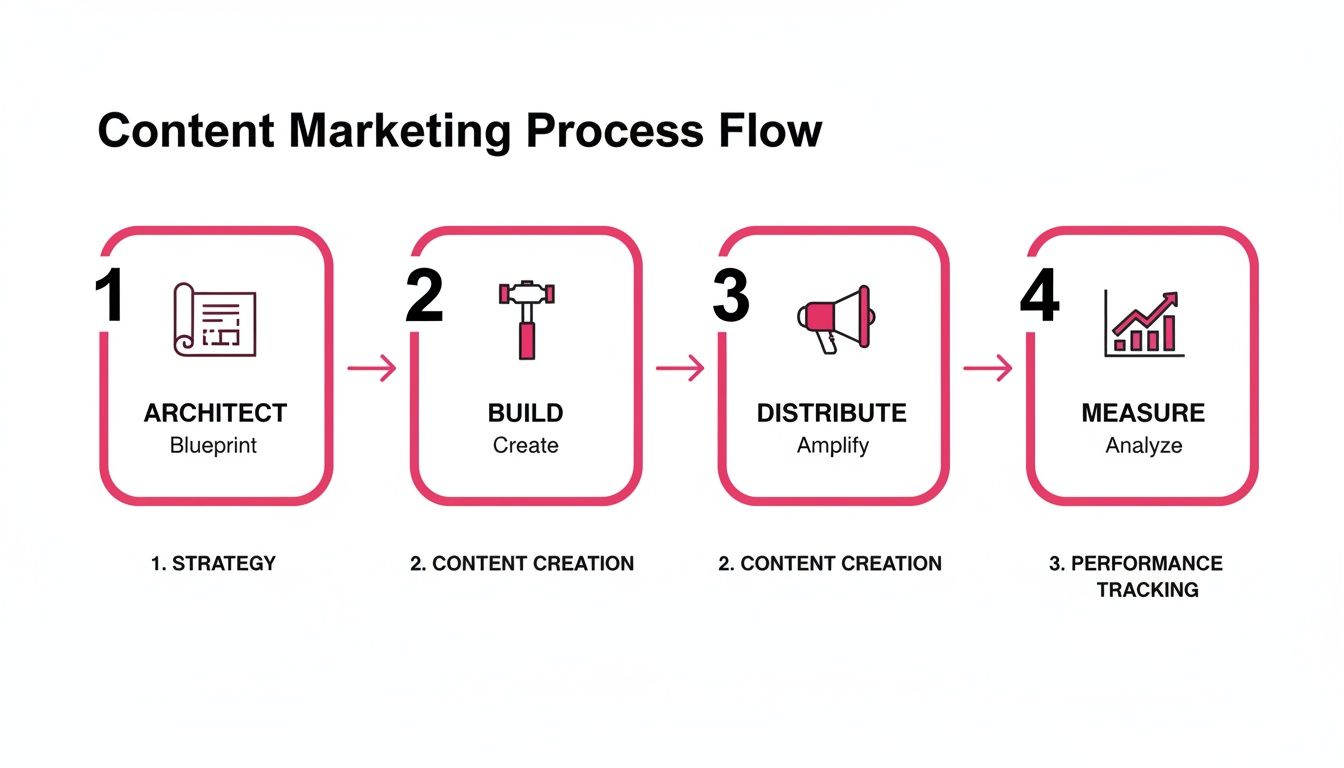
Each step builds on the last, turning random marketing acts into a predictable engine.
Job 1: Architect a Solid Strategy
This is the blueprint for everything that follows. Before a single word is written, you have to get clear on the fundamentals. Who are you for? What urgent, expensive problem do you solve for them? And why are you the best choice?
Without solid answers, everything else is guesswork. You end up creating content for everyone, which means it connects with no one.
This is usually where a sprint approach creates clarity quickly. Instead of endless meetings, we focus on getting this foundation right first. It’s the single most important step to bring structure and confidence to your marketing.
A Practical ExampleA B2B software company was writing generic articles about "productivity tips" for their project management tool. They got a bit of traffic, but no one signed up.During a strategy sprint, they realised their best customers weren't just any project managers—they were engineering leads in construction firms. This small shift changed everything. Suddenly, they had a specific audience with very specific problems they could help solve.
Job 2: Build the Right Content
Once the strategy is clear, you can start building the actual assets. And no, this isn't just about blog posts. It’s about creating the specific things your ideal customer needs at each stage of their journey to making a purchase.
For that construction software company, this could mean:
Helpful articles that tackle real-world problems, like "How to Accurately Forecast Timber Costs for a Multi-Unit Development."
Detailed case studies showing how a similar construction firm used their software to finish a project 15% under budget.
Clear website copy that speaks their language, acknowledges their pains, and feels like it was written just for them.
This stage is about turning strategic clarity into tangible assets that build trust and prove your expertise. Understanding what customer journey mapping is provides the perfect framework for planning these assets.
Job 3: Distribute and Promote It
Creating great content is only half the job. The best article in the world is useless if the right people never see it. This is the distribution job—making sure your valuable content gets in front of your ideal customers.
This doesn't mean spamming links everywhere. It means being deliberate.
For our construction software company, this would look like:
Sharing that powerful case study in the targeted LinkedIn groups where construction leaders hang out.
Turning key insights from the cost-forecasting article into a short, punchy video for social media.
Partnering with an industry publication to get their insights featured in a newsletter for builders and developers.
It’s about finding the specific channels where your audience already spends their time, then showing up with something genuinely useful.
Job 4: Measure What Matters
Finally, you have to know what’s working. Measurement isn’t about chasing metrics like 'likes' or 'page views'. It’s about connecting your content to real business outcomes.
You need a simple way to answer questions like:
Which articles are generating the most qualified leads for our sales team?
Did that case study help shorten the sales cycle?
Is our new website copy leading to more demo requests?
When we embed with a team, one of the first things we fix is this feedback loop. We build a simple dashboard that gives founders the clarity they need to see what’s truly moving things forward.
It’s not about getting lost in spreadsheets. It’s about having the confidence to know where to double down on your efforts and where to stop wasting time.
How to Choose a Partner, Not Just a Vendor
The market for content marketing services is noisy. Every agency website promises amazing results. It’s easy to fall into the trap of comparing hourly rates and deliverable lists, trying to get the most blog posts for your budget.
But that’s the wrong way to think about it. You’re not buying words by the kilo. You're looking for a partner who can bring clarity and structure to a critical part of your business.
Choosing the right team has little to do with their price list and everything to do with the quality of their thinking. You need someone who will push back, ask the tough questions, and focus on solving the root problem.
Look for Strategy Before Deliverables
A vendor sells you content. A partner helps you figure out what content you should create in the first place, and why. The difference is massive. A vendor will happily take your order for ten blog posts. A partner will press pause and ask, "Are we sure blog posts are the right move right now?"
This is a crucial distinction. Any competent writer can produce an article. But a strategic partner makes sure that article is the right asset, for the right audience, at exactly the right time.
When we embed with a team, the first thing we do isn't writing. It's asking questions. We have to understand the business from the inside out before we can hope to represent it properly on the outside.
This strategy-first approach is what separates effective content marketing services from the kind that just adds more noise to the internet.
The Questions That Reveal a True Partner
When you’re talking to potential agencies, steer the conversation away from "what do we get?" and towards "how do you think?". Their answers will tell you everything.
Here are the kinds of questions that cut through the sales pitch:
How do you help us get clear on our positioning before you start creating anything?
What's your process for making sure your work helps our sales team?
Can you walk me through how you’d help us if our current messaging isn't landing?
If we disagree on a strategic direction, how do you handle that?
A vendor will give you vague answers. A partner will have a clear, structured process. They’ll sound less like a supplier and more like a senior member of your own team.
A Quick Founder Moment
Picture this: you run a software company and you tell your marketing provider, "We need a case study on our new feature."
The Vendor Response: "Great. We can have a draft by next Friday. Who should we interview?" They take the order and execute it. The problem? The new feature isn’t selling because your customers don't understand the problem it solves. The case study, while well-written, falls flat.
The Partner Response: "Happy to. But first, can we look at the data? Demo requests for this feature are low. I think we have a messaging problem, not a proof problem. Before we write a case study, let's run a two-week sprint to nail the positioning on the website. Once people understand why they need it, the case study will actually land."
See the difference? The vendor did the job they were asked to do. The partner identified the real job that needed to be done to get the outcome you wanted.
This is precisely why a sprint-based, embedded model works so well. It’s built to find and fix these exact gaps quickly, creating clarity and alignment instead of just producing more assets. It builds confidence not just in your marketing, but in your entire business strategy.
Using AI in Your Content Marketing
The buzz around AI in marketing is impossible to ignore. New tools pop up every day promising to automate everything, which can leave you wondering if you're being left behind.
It’s tempting to jump in, but it’s also easy to get burned by churning out generic, soulless content that damages your brand. If you’re a little hesitant, that’s a good thing. It shows you know that genuine connection can’t be automated.
This isn't about replacing human insight; it's about using smart tools to make your team more effective. The best way to view AI is as a very capable assistant. It’s a tool for efficiency, not a substitute for strategy or understanding your customers. Let it handle the repetitive tasks that slow your people down, so they can focus on the high-impact work that only they can do.
Gaining Clarity and Confidence with AI
The real value of AI in content marketing isn’t about hitting a button and getting a finished blog post. It’s about sifting through mountains of information to give you a clearer starting point.
For example, this might mean:
Analysing sales call transcripts to pinpoint the exact words your customers use to describe their biggest challenges.
Scanning competitor content to find strategic gaps your business is perfectly positioned to fill.
Personalising email campaigns at scale, making every message feel more relevant and human.
This approach is already paying off. A recent report found that 77% of marketers in Australia saw better engagement from AI-powered personalisation. And while budgets for things like video (32%) and SEO (26%) are still higher, the growing spend on AI tools (7%) shows businesses are adding this capability deliberately. You can dive deeper into these figures in this detailed report on Australian digital marketing strategies.
This is about using AI to sharpen your thinking, not replace it. The goal is to get to a smarter, more informed starting line, faster. It brings structure and confidence to the entire creative process.
A Practical Application
Let’s imagine you run a B2B software company with a small marketing team. They spend days each month just trying to figure out what to write about.
Now, picture this: they use an AI tool to analyse the top 20 articles from their three biggest competitors. In minutes, that tool could produce a report showing:
The core themes competitors are focused on.
The crucial customer questions they aren't answering well.
Specific keyword opportunities they’ve completely missed.
Suddenly, your team isn't staring at a blank screen. They have a data-backed roadmap showing exactly where to focus their creativity. The AI did the grunt work, freeing up your team to do the strategic thinking. For those looking to see what tools are out there, a great place to start is a comprehensive directory of LinkedIn AI tools.
This is how you get your best people working on the problems that matter.
Your First Step Toward Marketing Clarity

If you’ve read this far, you might be nodding along... but also feeling a little overwhelmed. It’s easy to see the gaps in your own marketing, but the thought of trying to fix everything at once can feel paralysing.
That’s normal. You’re not behind. Your marketing isn’t broken. You just need a clear place to start.
So, for a moment, let’s forget about blog schedules and AI tools. Before you spend another dollar or another hour on any marketing activity, there’s only one thing you need to sort out first: your positioning.
Everything flows from this. Getting your positioning right is the foundation that brings order to the chaos. It's what gives you the confidence to move forward, and it's the single most important thing you can do to make every other marketing effort work.
The Three Questions That Create Clarity
Most marketing gets stuck because the team has never been given the space to step back and nail the fundamentals. This is always where we start. We pause the busywork and focus entirely on answering three simple questions.
Before you touch anything else, grab your team and see if you can get a straight, consistent answer to each of these:
Who is our ideal customer? Not a vague demographic. Get specific. What kind of person or business are they? What is their mindset?
What urgent, expensive problem do we solve for them? Get to the heart of the pain you take away or the opportunity you create.
Why are we the only logical choice to solve it? This is about what makes you different in a way your ideal customer actually cares about.
Getting these answers straight isn’t just a marketing exercise; it’s a business clarity exercise. It gives your entire team—from sales to product to support—a shared language and a clear direction.
Answering these questions honestly can be tough. It often reveals a lack of alignment that’s been holding the business back. But the process of getting it right is what builds real momentum.
This is the work that turns your marketing from a series of hopeful guesses into a structured system. It’s the difference between adding to the noise and building a message that connects with the right people.
If this feels messy, that’s normal. You don’t need more tactics. You need structure. Start here, with these three questions, and the path forward will become much clearer.
Frequently Asked Questions
Here are a few questions that often come up when founders are weighing up their content marketing options.
How Long Does It Take to See Results?
This is the million-dollar question. The honest answer is that content marketing is a long game. It’s about building trust and authority, and that takes time.
You’ll feel the foundational pieces click into place quickly—things like having a clear message and a solid plan. That usually happens within the first month. From there, you'll see early signs of life, like better engagement on your website or more on-topic conversations with leads, typically within three to six months.
But the real impact on your pipeline? That’s something that builds over six to twelve months as your content starts to compound and your search presence grows.
What Is the Difference Between a Freelancer, an Agency, and an Embedded Partner?
It comes down to the kind of problem you're trying to solve.
A freelancer is perfect when you have a specific, well-defined task. Need a batch of blog posts written? A freelancer is a great fit.
A traditional agency typically manages campaigns for you. They work as an external supplier, handling the tactical execution.
An embedded partner is different. We work from inside your business to tackle deeper, more strategic problems in focused sprints.
When we embed with a team, our job isn't just to tick off tasks. We’re there to help build your internal systems, get your teams aligned, and fix the underlying gaps in your strategy.
Can't Our Internal Team Just Handle This?
It's a fair question. Often, internal teams are great at getting things done, but they can lack the senior strategic direction to know they’re working on the right things. It's easy to be busy, but are you making progress?
Bringing in outside help isn't about replacing your people. It's about giving them the clarity, structure, and leadership they need to be effective. It fills that critical gap between a junior marketer and a full-time (and very expensive) Chief Marketing Officer, giving everyone the confidence to move forward on a clear path.
If your marketing feels like it’s spinning its wheels — lots of activity but no real momentum — it’s usually a sign that you need structure, not just more stuff to do. Sensoriium embeds with your team to bring clarity, direction, and a practical plan to your marketing. Find out how we can help at https://www.sensoriium.com.