
Voice & Tone: The Founder's Guide to Sounding Like You Actually Mean It
- Feb 4
- 14 min read
Trying to define your brand’s voice and tone can feel like wrestling with smoke. You know exactly what your business stands for, but when you sit down to write, the words come out sounding generic, stiff, or just… not quite right.
You end up with a document full of safe adjectives like ‘friendly’, ‘professional’, and ‘authentic’. Everyone nods, but nothing changes. Your website copy still feels like it was written by a different company to your sales emails, and your social media has a personality of its own.
If this feels frustratingly familiar, you’re not crazy. It makes complete sense that you feel stuck.
This is a classic hurdle for founders. It’s not a sign of a weak vision; it’s a symptom of being too close to it. The brand’s true voice is locked inside your head, and translating that gut feeling into a practical, usable guide for your team is a completely different skill.
Most teams struggle here because they’ve never had someone step in to structure the work of pulling that instinct out and making it something everyone can see, understand, and use.
Why Your Voice and Tone Are All Over the Place
That feeling of disconnect isn’t a sign you’re failing. It’s a symptom of a few common gaps that need to be plugged. When you feel like your marketing is disconnected, it's almost always a direct result of one of these underlying issues.
You’re likely dealing with:
Too many cooks, no recipe: Your marketer, a sales rep, and an engineer are all writing copy. Without a single playbook, they’re all just using their own individual styles. The result is a confusing experience for your customers.
Copycat syndrome: It’s tempting to look at your competitors and just follow their lead. But this is a shortcut to sounding generic. It skips the crucial work of figuring out what makes you unique, causing you to blend in.
The curse of knowledge: You know your product so well you’ve forgotten what it’s like to see it for the first time. This leads to copy filled with jargon and assumptions that leave potential customers feeling confused.
Fixing your voice and tone isn’t about finding a few clever words. It’s about building a clear, shared understanding of who your brand is and how you help people. That solid foundation gives your team the clarity and confidence to communicate with one powerful, consistent voice.
The One Small Shift That Changes Everything: Voice vs. Tone
Alright, let’s clear this up. If you’ve ever used ‘voice’ and ‘tone’ to mean the same thing, you’re not alone. But getting this distinction right is one of those small shifts that brings immediate clarity. It changes how your whole team communicates.
Think of it like this: your voice is your brand's core personality. It’s who you are, and it doesn’t change day-to-day. If your brand is inherently candid and practical, that’s your voice.
Your tone, on the other hand, is the mood or emotional inflection you apply to that voice. You wouldn't use the same tone to announce a massive win as you would to handle a customer's bug report. Tone is how you adapt your steady personality to the situation.
Voice Is Fixed, Tone Is Flexible
This is the very first concept we establish when embedding with a team. Without it, every piece of communication becomes a guess. To build a strong brand, you need a consistent voice for trust and a flexible tone for human connection.
Your voice is what you are: The stable, underlying character of your brand.
Your tone is how you express it: The specific emotional flavour you add for a particular audience or moment.
Let's make this practical. Imagine a founder known for being direct, insightful, and a bit witty. That's her voice. It's her default setting.
When she’s pitching investors, her tone will likely be confident and forward-thinking. But when she’s writing to her team after a setback, her tone will shift to be empathetic and reassuring. Her core voice—direct and insightful—is still there, but the emotional delivery has changed.
A consistent voice makes you recognisable. A thoughtful tone makes you relatable. You need both to build a brand people trust.
This simple structure gives your team the confidence to write without second-guessing themselves. They know the core personality they need to reflect (voice) and have the freedom to adjust their emotional expression (tone) to fit the moment.
To make this crystal clear, here’s a simple table breaking down the key differences.
Voice vs Tone: A Simple Breakdown
Attribute | Voice (Your Personality) | Tone (Your Emotion) | Founder Moment Example |
|---|---|---|---|
Consistency | Fixed and stable across all communication. | Varies depending on the context. | The founder is always direct, whether celebrating or troubleshooting. |
Purpose | To build brand recognition and trust over time. | To create an appropriate connection in a specific moment. | Announcing a new feature with an enthusiastic tone vs. an apology with a sincere tone. |
Example | Our voice is practical and candid. | Cheerful, serious, helpful, formal, playful. | Using a practical voice to explain a complex problem, but with an empathetic tone. |
Analogy | It’s who you are as a person. | It’s the mood you’re in today. | Your personality doesn’t change, but your mood does when you get good vs. bad news. |
Getting this right isn’t just about sounding good; it’s about building a predictable and trustworthy brand identity that still feels human and responsive.
How to Define Your Brand Voice Without the Fluff
Have you ever been in one of those brainstorming sessions? The one that ends with a list of generic adjectives like ‘innovative’ or ‘friendly’ on a whiteboard. Everyone nods, but a week later, nothing has changed. Your website still sounds disconnected from your social media.
The problem is that this approach starts in the wrong place. You’re trying to pick a personality instead of digging up the one your brand already has. The real work isn't about brainstorming adjectives; it's about answering three fundamental questions with brutal honesty.
This is exactly why a focused sprint approach creates clarity quickly. Instead of getting bogged down in endless meetings, we structure the work to get the answers that actually matter.
Start with Three Core Pillars
To define a brand voice with substance, you have to anchor it to the reality of your business. This means focusing on what's true, not just what sounds good on a slide.
Here are the only three pillars you need:
What you do (Your practical value): How do you actually help people? Be specific. Don’t say you “provide solutions”; say you “untangle messy sales data so finance teams can close the books faster.”
How you see the world (Your unique perspective): What do you believe that your competitors don’t? This is your point of view. Maybe you believe that B2B software doesn't have to be so damn boring. This is where your authentic voice comes from.
Who you are for (Your audience’s reality): Who is the one person you are built to serve? Get specific about their daily frustrations and what they secretly wish they had. Your voice should sound like a welcome relief to this person.
When we embed with a team, the first thing we fix is this exact gap. These three pillars close it for good, giving you a solid foundation for a confident voice.
The flowchart below shows how this journey works, moving from your core voice to applying a flexible tone for impact.
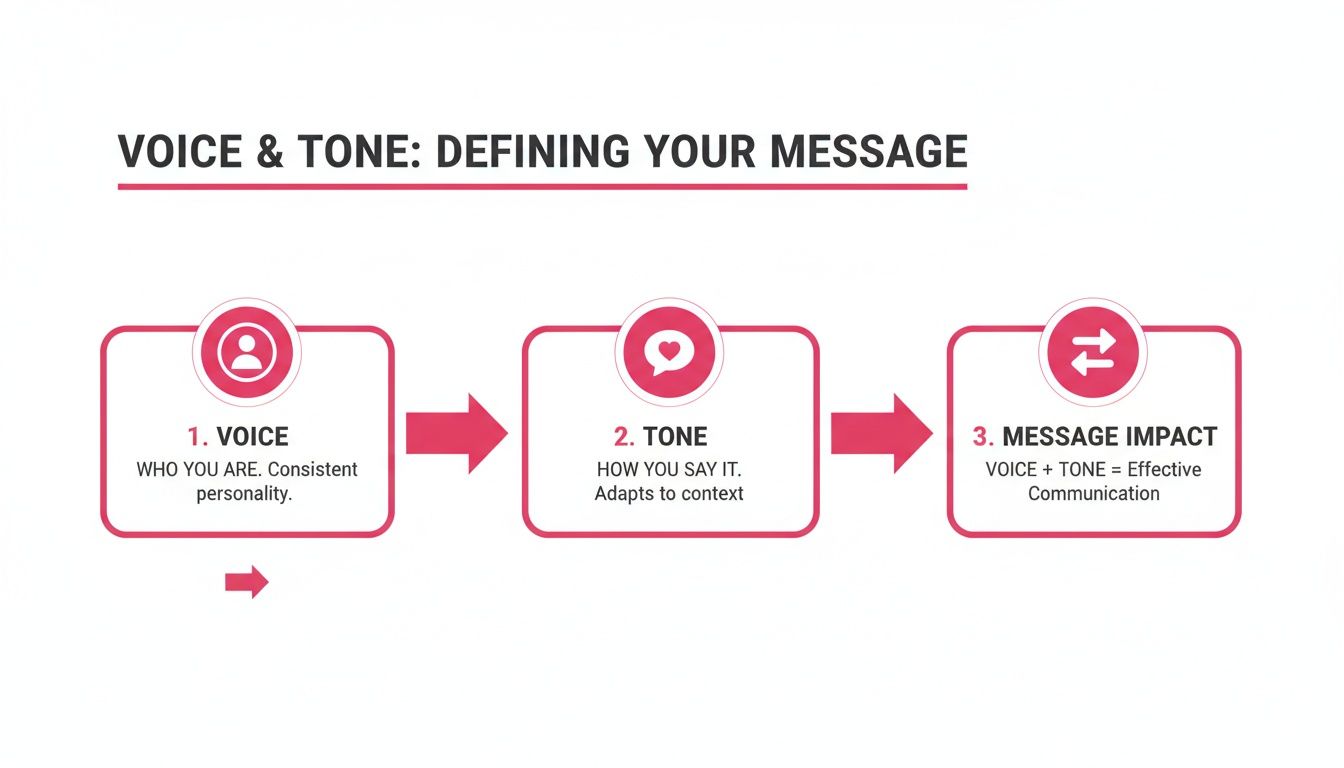
As you can see, a strong, consistent voice is the foundation. Tone is the adaptive layer that makes your communication feel relevant and human.
From Pillars to Principles
Once you have clear answers to those three questions, the next step is to translate them into practical voice principles. This is the secret to creating a usable tool, not just another document. A principle isn’t just an adjective; it’s an instruction.
Let’s walk through a founder moment to see this in action.
Imagine a SaaS founder in the agtech space. Her company’s software helps farmers manage water usage.
What she does: Her software gives farmers precise, real-time data to reduce water waste and increase crop yield.
How she sees the world: She believes powerful technology should be simple and rugged enough for real-world farm use.
Who she’s for: A third-generation farmer who is pragmatic, sceptical of tech hype, and short on time.
From these pillars, we can create concrete principles:
Be Practical, Not Pretentious: Always use simple, direct language. Focus on tangible outcomes like “save 2 megalitres a week” instead of “optimise irrigation cycles.” Show, Don’t Just Tell: Back up every claim with data or a real-world example. Our audience is sceptical, so proof is more powerful than promises. Respect Their Time: Get to the point. Quickly. Use short sentences and clear headlines.
See the difference? ‘Practical’ is a vague idea. ‘Be Practical, Not Pretentious’ is a clear instruction anyone on the team can follow. It gives them the structure they need to write with confidence. To ensure everyone stays aligned, it helps to develop detailed brand voice guidelines the whole team can reference.
This shift is crucial as communication evolves. For instance, 34% of Australians now own a voice-activated smart speaker, catching up to the US market. This surge highlights the need for a clear, conversational voice and tone. People expect natural, human-like interactions, and a practical, candid voice is no longer optional; it’s the standard for building trust. You can explore more on these trends by reading the full research on voice search statistics.
By focusing on these pillars and turning them into actionable principles, you create a framework that empowers your team. If you want to dive deeper, you can also check out our guide on clear branding and messaging for more practical steps. This is how you build momentum.
Putting Your Voice and Tone into Practice
Okay, so you’ve done the hard work. You’ve defined your voice and the principles are written down. But now you’re staring at a blinking cursor, wondering how to turn a word like ‘Practical’ into an actual email.
This is where most brand guides fall flat—they remain abstract ideas instead of becoming practical tools. The goal isn't just to create a document; it's to build a bridge from your core voice to all the different types of writing your team does every day.
This is where a bit of structure makes all the difference. Let’s make this real.
Turning Principles into Real-World Copy
To show you how this works, let's imagine a B2B SaaS company. We'll call them ‘FieldFlow’.
FieldFlow creates inventory management software for agricultural suppliers. Their voice principles are simple and direct:
Be Practical, Not Pretentious: Stick to simple, direct language. No jargon. Focus on real-world results.
Show, Don’t Just Tell: Back up every claim with tangible proof. Build trust through clear evidence.
Respect Their Time: Get to the point. Fast. Make everything clear and scannable.
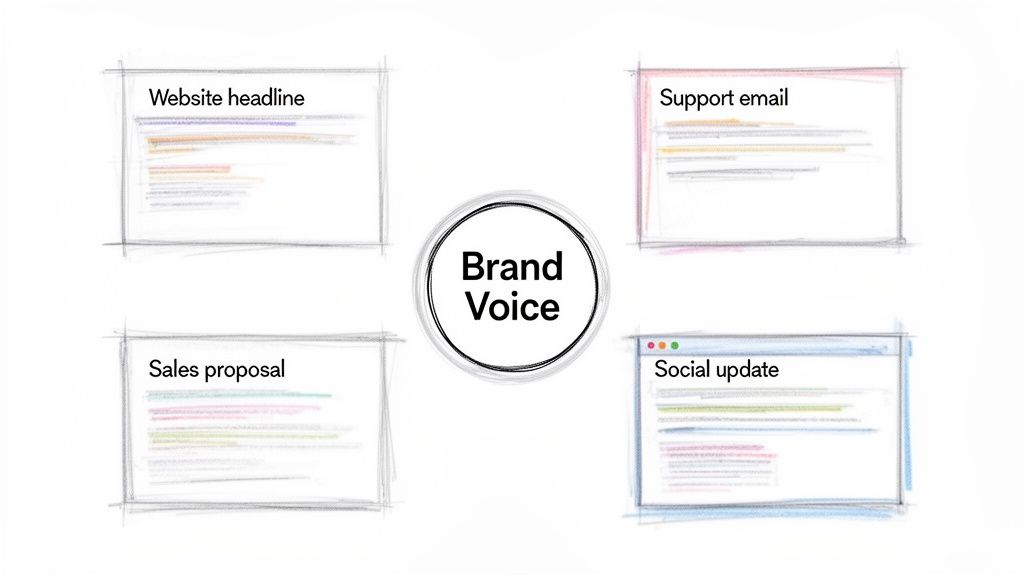
Now, let's see how these principles play out in four common scenarios. The point isn't to give you templates, but to show the thinking behind the final words.
Scenario 1: The Website Headline
A potential customer has just landed on your homepage. You have three seconds to show them they’re in the right place.
Generic Version: Revolutionary Inventory Management Solutions for the Modern Agricultural Sector.
FieldFlow Version: Stop guessing where your stock is. FieldFlow gives you a live look at your inventory, from warehouse to delivery.
Why it works: The FieldFlow version brings the voice principles to life. It’s practical ("stop guessing"), respects their time (by getting straight to the problem), and shows the outcome ("live look"). It connects with a real, everyday frustration.
Scenario 2: The Email to a Frustrated Customer
A customer is upset because a software update caused a reporting glitch.
Generic Version: We apologise for any inconvenience this may have caused. Our engineering team is looking into the issue and we will provide an update in due course.
FieldFlow Version: Hi Sarah, I’m really sorry about the reporting glitch—that’s incredibly frustrating. We’ve found the bug and the team is pushing a fix now. Your reports should be back to normal within the hour. I’ll email you personally the moment it’s done.
Why it works: This version is candid and direct. It acknowledges the customer's frustration instead of hiding behind corporate-speak. It’s practical by giving a specific timeline ("within the hour") and respects her time by being clear.
Scenario 3: The Social Media Update
You’re announcing a new feature: the ability to scan barcodes with a phone camera.
Generic Version: Exciting news! FieldFlow is proud to announce the launch of our new mobile scanning functionality, designed to enhance your workflow.
FieldFlow Version: Counting stock with a clipboard is officially over. You can now use your phone’s camera to scan barcodes directly into FieldFlow. Less typing, fewer errors.
This is what turns a brand guide from a PDF into a powerful tool. When the principles are clear, anyone on the team—from marketing to support—can communicate with confidence and consistency.
Why it works: It leads with the benefit, making it instantly practical. It respects their time by being short and sharp. And it shows the value by highlighting "less typing, fewer errors."
Scenario 4: The Sales Proposal Snippet
You need to outline the onboarding process for a new client.
Generic Version: Our comprehensive onboarding program leverages a synergistic approach to ensure a seamless transition and value actualisation.
FieldFlow Version: We’ll get your team up and running in two weeks. Our process is simple: we’ll import your existing stock data, then run a 90-minute training session so everyone feels confident from day one.
Why it works: It ditches vague promises for a clear, practical plan. It shows them exactly what will happen and respects their time by keeping everything straightforward.
Once you've defined your brand voice, it's worth exploring tools for tone matching to help maintain consistency. When we embed with a team, this is the exact kind of structured thinking we use to get everyone aligned and moving with momentum.
This consistency is vital everywhere, but especially in audio. Australia's digital audio advertising market surged to $313 million in 2024—an 18% jump—with podcast ad spend alone rocketing up by over 24%. Audiences are craving quality voice experiences. For any B2B team, mastering a practical voice and tone in audio builds trust far faster than inconsistent efforts ever could.
How to Get Your Team to Actually Use This
So, you’ve done it. You’ve created a brilliant voice and tone guide. It feels like a huge win.
But a week goes by, and the sales team is still sending the same old emails. That sinking feeling? It’s normal. You’re not going crazy. Getting a team to actually use a new guide is the hardest part.
The problem isn’t that your team doesn’t care. They’re just busy. A 10-page PDF feels like another chore. The secret isn't a grand launch; it's making it incredibly easy for them to do the right thing.
Most teams stumble here because no one has shown them how to put the plan into action. This is your chance to provide structure and build momentum.
Run a Short Workshop, Not a Long Meeting
Nobody wants another presentation. To get buy-in, you need to make the new guide feel like a helpful tool, not a rulebook. The best way is with a short, hands-on workshop.
Keep it simple:
Book 60 minutes. No more.
Explain the ‘why’ in one sentence. "This guide is here to make it faster for all of us to write with confidence."
Spend 10 minutes on the core concepts. Quickly walk them through voice vs. tone and your three principles.
Use the rest of the time for hands-on practice.
This is where the magic happens. Break everyone into small groups and give them a real piece of content to work on, like rewriting a jargon-filled paragraph from your website. Give them 20 minutes, then have each group share what they came up with.
This collaborative exercise proves to them that they can do it, and it reframes the guide as a shared asset.
Create a Simple Checklist, Not a 20-Page Rulebook
Your team won’t memorise the entire guide. To help them build good habits, give them a mental shortcut. Turn your voice principles into a simple, five-point checklist.
For our example company, FieldFlow, it might look like this:
The FieldFlow 2-Minute Review: 1. Is it Practical? Does it use simple language and focus on a real-world outcome? 2. Does it Show, Not Tell? Is there a tangible example or data to back up our claims? 3. Does it Respect Their Time? Is it direct, scannable, and easy to understand? 4. Does it Sound Like Us? Read it aloud. Does it sound like something a real person from our team would say? 5. Is the Tone Right? Does the emotion of the writing match the situation?
A checklist like this turns abstract ideas into a concrete action. When we work with teams, creating simple tools like this is one of the first things we do. It bridges the gap between strategy and day-to-day work.
Keep It Alive and Evolving
Finally, a brand voice guide isn't a one-and-done project. It’s a living document that needs to grow with your business.
Assign one person to be the "voice guardian." Their job is to own the document, collect feedback, and propose updates once or twice a year. As your company evolves, your perspective will naturally shift.
This simple process ensures your voice and tone evolve with you, giving your team lasting confidence and clarity.
Your Calm, Confident Next Step
Feeling a bit overwhelmed by all this? That’s normal. It's easy to look at the big picture and feel like you need to fix everything at once.
You don’t.
Forget about writing a massive brand book that’ll end up collecting digital dust. Instead, start by fixing this one thing before you touch anything else.
Let’s fix your homepage.
Why Your Homepage Is the Best Place to Start
Your homepage is your digital front door. It’s where most people form their first impression, deciding in seconds whether you’re right for them. If your message is confusing here, everything else you do will be harder.
Treating this one page as a testing ground is the fastest way to put this theory into practice. It’s about giving yourself a manageable, high-impact place to begin.
This process often feels messy at first. You’re not behind. That feeling is a sign you’re starting to move from guesswork to a proper system.
Your Simple Homepage Voice Audit
Grab your current homepage and run through this quick checklist. It’s a straightforward way to spot the gaps.
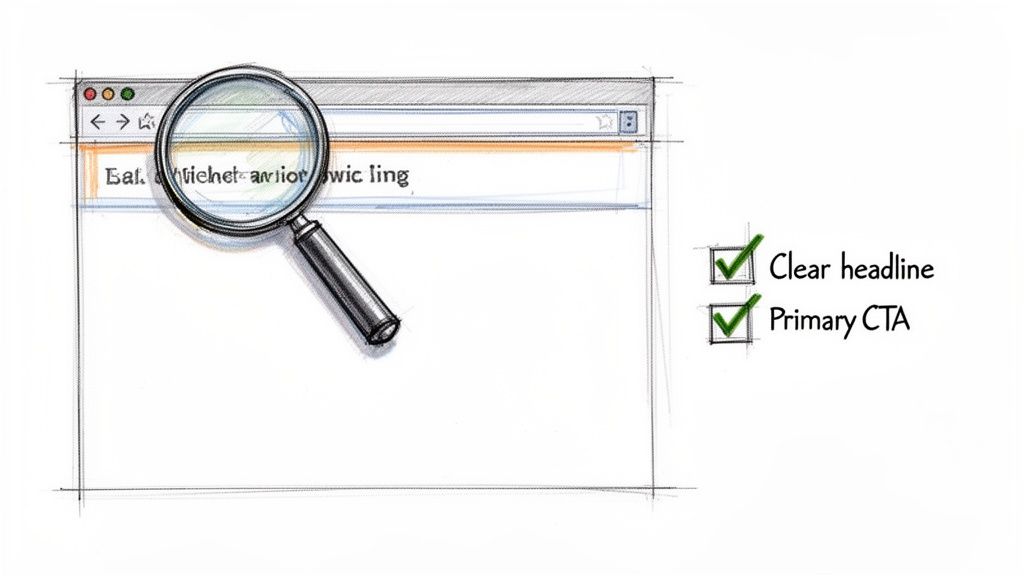
Headline Clarity: Does your main headline clearly state a benefit or solve a problem in plain English? Or is it loaded with industry jargon?
Audience Focus: Is the copy truly for your ideal customer, using their language? Or does it just talk about your company?
Voice Consistency: Read the headlines, subheadings, and button text out loud. Do they sound like they came from the same person?
Tone Check: Does the page feel confident and helpful? Or does it come across as timid or generic?
This simple exercise will give you a powerful sense of direction. It’s the first step toward building a framework your whole team can use to communicate with confidence and consistency.
Common Questions About Voice and Tone
Even with the best guidelines, you’ll hit situations that feel like a grey area. That’s not a sign your process is broken. Here are quick answers to the questions we hear most often.
How Do I Handle Negative Feedback and Still Sound On-Brand?
This is a classic. It’s easy to get defensive or slip into sterile, corporate-speak. The trick is to lean into your defined voice, not away from it.
Let's say your brand voice is practical and candid. Your response should be exactly that. Acknowledge their frustration head-on, give a genuine apology without the fluff, and tell them precisely what you're doing to fix it. Your voice (candid, helpful) stays the same, but your tone shifts to be serious and reassuring. Building trust this way is more powerful than having a perfect record.
How Do I Adapt My Tone for Different Social Platforms?
Think of it like being at a party. You’re the same person in every room (voice), but you’d chat differently in the quiet study than you would on the dance floor.
LinkedIn: Your tone should be more insightful, focused on sharing genuine expertise that reflects your brand’s point of view.
Twitter/X: Your tone needs to be direct, punchy, and conversational. It’s the spot for quick takes and witty comments.
Instagram: Your captions can adopt a more personal, storytelling tone, offering a behind-the-scenes look.
The goal is to match your emotional delivery (tone) to the environment without losing your core personality (voice). This is one of the first things we help structure to get consistency without sounding like a robot.
How Do I Know if This Is Working?
Measuring voice and tone can feel abstract, but you can track it by looking for the right signals.
Qualitatively, just listen. Are customers starting to use your own language when they talk to your support team? When you hear your message reflected back at you, that’s a massive win.
Quantitatively, check your engagement metrics. A clear, consistent voice often leads to higher email open rates, more meaningful social media engagement, and lower bounce rates on key web pages. It's about seeing a pattern of indicators that show your message is finally hitting home.
If this feels messy, that’s normal. You’re not behind. You need structure. When you're ready for clarity, direction, and momentum, Sensoriium can help. Find out more at https://www.sensoriium.com.