
What is a Fractional CMO and How Does It Actually Fix Your Marketing?
- Feb 5
- 11 min read
It's a familiar feeling for founders. You're trying to grow, but your marketing feels like a messy room full of random, disconnected activities. A few social media posts here, a blog post there. You’re stretched thin, second-guessing every move, and nothing seems to truly connect or move the needle.
You know there’s potential, but it’s buried under a pile of disjointed tactics. This isn't a sign you’ve failed; it’s a completely normal growing pain. You've hit a point where sheer effort isn't enough anymore. You need structure.

The Shift from Doing to Directing
That feeling of chaos is an important signal. It’s the tipping point where scattered tactics stop delivering results and start costing you momentum. The real problem isn't a lack of effort; it's a lack of senior, strategic leadership to connect all the dots into a cohesive plan.
Most teams struggle here because they’ve never had someone step in to structure the work. They're good at executing tasks, but they don't have a clear map to guide them. This is precisely where the concept of a fractional CMO becomes so powerful.
Founder Moment: You’re staring at your marketing reports, seeing a dozen different activities, but you can’t draw a straight line from any of them to actual revenue. It all feels disjointed and, frankly, a bit frustrating.
This gap between day-to-day marketing tasks and a high-level business strategy is where clarity gets lost. The answer isn't another tactic. It’s about bringing in structure and a clear path forward. If this sounds familiar, you might want to read our thoughts on how to fix it when your marketing feels disconnected.
So, What Exactly is a Fractional CMO?
Think of a fractional CMO as a specialist surgeon. You wouldn't hire a heart surgeon to be on your hospital's payroll full-time, just in case. You bring them in for their specific, high-stakes expertise when you need a confident, experienced hand to solve a critical problem.
A fractional CMO is a seasoned marketing executive who joins your company for a ‘fraction’ of the time and cost of a full-time hire. They don’t just offer advice from the sidelines like a consultant. They embed themselves in your leadership team and take ownership of your marketing function.
This model is built for delivering real impact, not just a deck of ideas. They are responsible for crafting the strategy, leading your team, and being accountable for the results.
More Than Just a Part-Time Leader
Crucially, a fractional CMO provides leadership, not just extra hands. You don't measure their value by the hours they clock in, but by the clarity, structure, and momentum they create.
A fractional CMO fills the leadership gap by focusing on three key areas:
Direction: They build the roadmap. They define what success looks like and lay out the practical steps to get there.
Structure: They put the right systems and processes in place to run marketing like a well-oiled machine.
Confidence: They mentor your team, make the tough calls, and give you the assurance that your marketing is actually working.
Demand for fractional CMOs in Australia's B2B space is showing 15% annual growth, especially among founder-led businesses that need senior direction without the heavy overhead. You can read more about this growing trend for Australian businesses here.
A Practical Example of What They Do
Picture a scaling agtech company. They have a fantastic product and two junior marketers who are busy writing content and managing social media. The problem? There's no clear plan, and the lead flow is unpredictable.
A fractional CMO won't just walk in and say, "you need more blog posts."
Their first job is to diagnose the real problem. They'll dive into the data, talk to the sales team, and interview customers. They might find the issue isn't a lack of content, but a muddled message that doesn’t connect with the right audience.
When we embed with a team, the first thing we fix is this exact gap. The fractional CMO would then lead a focused sprint to sharpen the company's messaging, align the sales and marketing teams, and build a simple system for generating the right kind of leads.
They provide the strategy and oversee the execution, turning chaos into a calm, predictable engine for your business.
How a Fractional CMO Is Different from an Agency or Consultant
If you’re a founder, you've probably stared at this exact crossroad. Do you hire a consultant, sign with an agency, or start the long search for a full-time executive? It’s a tough decision, and it’s normal to be unsure which path is right.
The confusion usually comes from not knowing what you actually need — is it ideas, more hands to do the work, or genuine leadership? Choosing the wrong one can mean wasted money and months of spinning your wheels.
Let's break down how a Fractional CMO stacks up against the other options.
Comparing Your Marketing Leadership Options
This table gives a quick overview of the key differences between bringing on a Fractional CMO, hiring a full-time executive, partnering with an agency, or engaging a consultant.
Attribute | Fractional CMO | Full-Time CMO | Marketing Agency | Consultant |
|---|---|---|---|---|
Primary Role | Leadership & Strategy | Executive Leadership | Task Execution | Strategic Advice |
Cost | Part-time executive cost | Full-time executive salary | Monthly retainer/project fee | Project or hourly fee |
Commitment | 6-12 months, part-time | Long-term, full-time | 3-6 month contracts | Short-term, project-based |
Integration | Embedded in leadership | Fully integrated | External vendor | External advisor |
Accountability | Accountable for results | Accountable for department | Accountable for tasks | Accountable for plan delivery |
Scope | Strategy, execution, team | Full department oversight | Specific marketing channels | Audit, analysis, recommendations |
Each model has its place. The best fit depends on your company's stage and immediate needs.
The Consultant Leaves a Map but No Driver
A marketing consultant is brilliant at providing a strategic plan. They’ll analyse your business and hand you a comprehensive document outlining what you should do.
But here’s the gap: they rarely stick around to help you do it. This leaves you and your team with a complex roadmap but no experienced driver. The responsibility for executing the plan still falls on your shoulders. For more on this, we've covered the role of a marketing consultancy in detail here.
The Agency Provides the Engine but No Architect
A marketing agency is built for execution. They are a team of specialists you hire to do things—run your ads, manage your social media, or handle SEO.
The challenge is that agencies often operate as external vendors. They work from a brief but aren't deeply embedded in your business's core strategy or internal team dynamics. This can create a disconnect where marketing activities don't quite align with sales or overall business goals.
The most common frustration we see is when a founder hires an agency to "get more leads" but hasn't fixed their underlying positioning. It's like putting a bigger engine in a car with no steering wheel—you just go faster in the wrong direction.
The Fractional CMO Is the Architect and the Builder
This is where the Fractional CMO role shines. They bridge the gap between high-level strategy and the hands-on work needed to bring it to life.
A fractional CMO isn't just an advisor or a vendor; they become an integrated part of your leadership team.
They set the strategy. Like a consultant, they diagnose the problems and build the plan.
They lead the execution. Unlike a consultant, they direct your team (or agency) to implement that plan.
They take ownership. Like a full-time executive, they are accountable for the results.
This diagram shows how a Fractional CMO plugs into the business, connecting high-level executive functions with day-to-day strategy and team leadership.
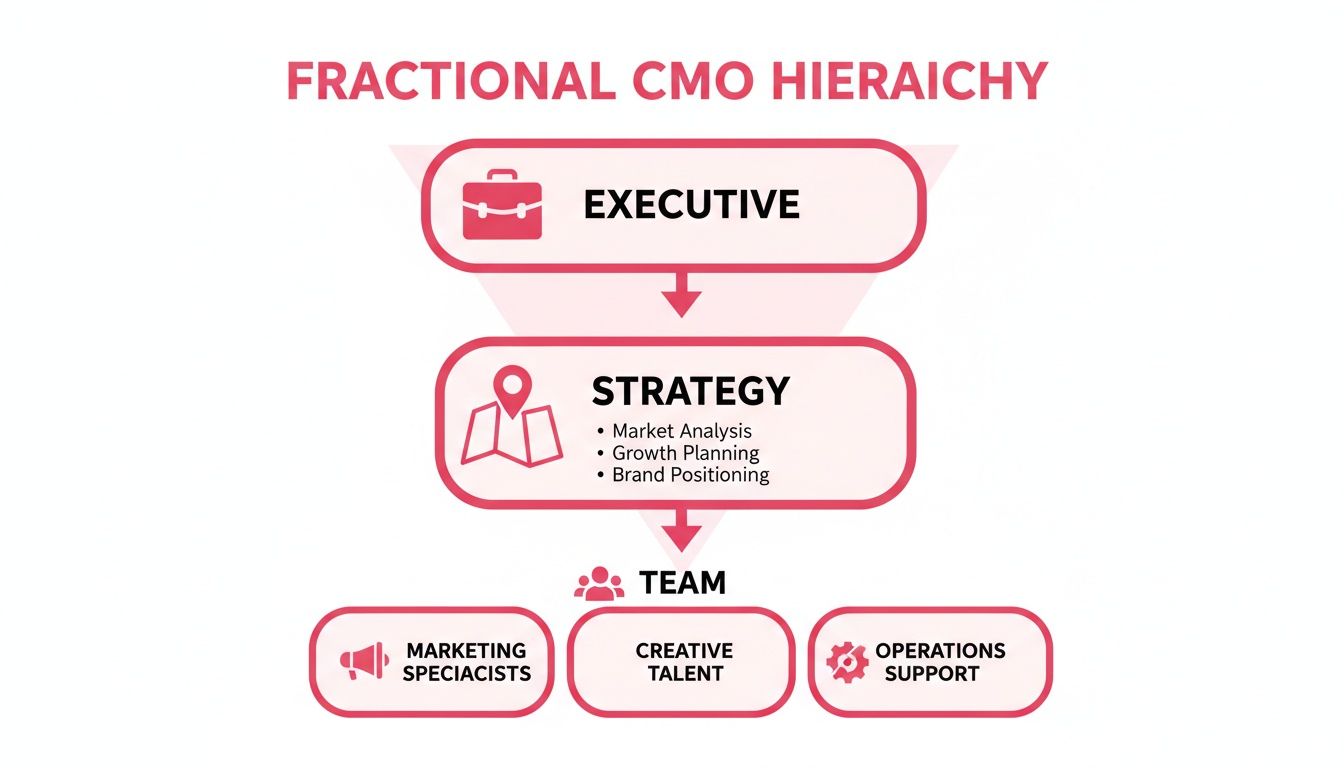
The key insight is that this model provides both the architect who designs the blueprint and the project manager who ensures it gets built correctly.
A Fractional CMO also plays a vital role in getting your sales and marketing teams on the same page, focusing on things like implementing essential sales and marketing alignment best practices. This deep integration is what sets them apart. It ensures marketing is actively fuelling the entire business's growth.
A Practical Look at a Fractional CMO Engagement
It’s easy to talk about strategy and leadership, but what does working with a fractional CMO actually look like week to week?
Many founders are wary. They’ve been burned before by consultants who drop off a hefty strategy document that just gathers digital dust. The real frustration isn't a lack of ideas—it's the gap between having a plan and actually getting it done. This is where a hands-on, structured engagement changes everything.
A Founder Moment in Action
Picture this: a B2B SaaS company has a brilliant product and some early traction. But behind the scenes, their sales and marketing efforts are out of sync. The sales team complains about getting poor-quality leads, while the marketing team feels their hard work is ignored. Sound familiar?
This is a classic scenario where a fractional CMO steps in—not to write another report, but to diagnose the root cause.
The first step isn't to launch a flashy new campaign. It’s to get both teams in the same room and figure out where the disconnect is. A good fractional CMO facilitates this, quickly uncovering that the real issue is a mismatch in messaging and a total lack of shared goals.
This initial diagnostic work is critical. It’s where most teams get stuck because they’ve never had an independent leader come in to structure the conversation. The goal here is to bring clarity to the chaos, not add another layer of management.
The 90-Day Sprint Model
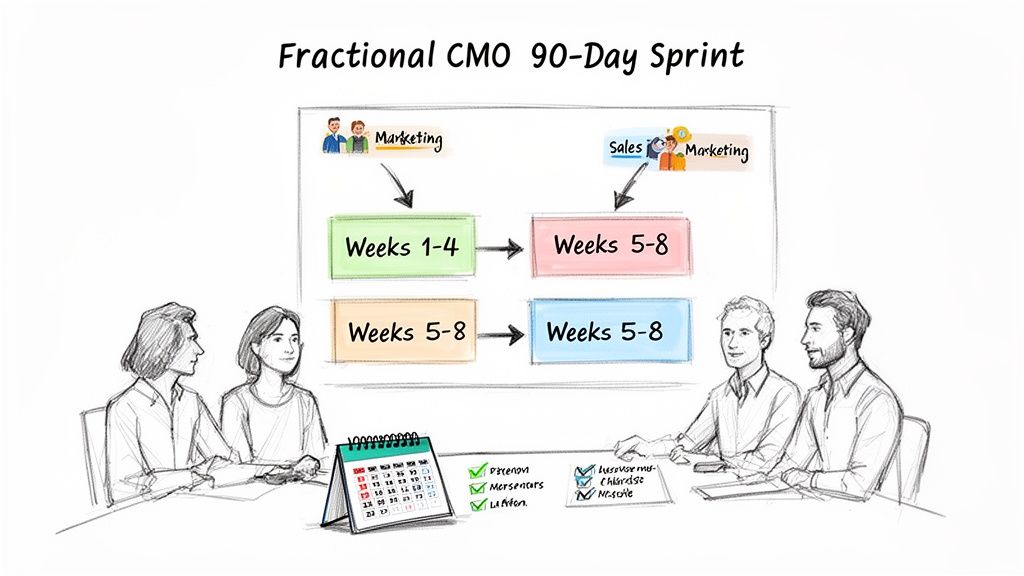
Instead of an open-ended project, effective fractional CMOs often work in focused sprints. For our SaaS company, a clear 90-day plan would be built to solve that specific sales and marketing alignment headache.
This is usually where a sprint approach creates clarity quickly. It's not a vague promise of "better leads" but a structured plan with clear milestones.
Months 1-2 Focus on Foundations: The priority is to get the teams on the same page. This means running workshops to nail down the ideal customer profile, sharpen the core messaging, and agree on a unified definition of a "qualified lead." The fractional CMO leads these sessions, ensuring everyone buys in.
Months 2-3 Focus on Systems: With a clear message, the next step is building a predictable process. The fractional CMO directs the team to implement a simple lead scoring system, create content that speaks to customer pain points, and set up a shared dashboard everyone can see. If you want a deeper look at this process, check out our guide on how to create a marketing plan that actually works.
Ongoing Focus on Momentum: Throughout the sprint, the fractional CMO runs the weekly marketing meetings, mentors junior team members, and gives the founder clear updates. They become the single point of accountability, ensuring the plan builds momentum.
The result after 90 days isn't just a few extra leads. It's a calmer, more confident team that finally has a shared language and a clear path forward. That’s the difference between getting advice and having true, embedded leadership.
Understanding the Financial Sense of the Model
Talking about marketing investment can feel tense, especially when cash flow is tight. The big question is always, “Is this actually worth it?” It’s about moving away from random marketing expenses and towards strategic, calculated investments.
Let’s get straight to the numbers, because the value of a fractional CMO isn't just about saving money on a salary. It's about what that smarter investment unlocks. You’re reallocating capital from a fixed overhead into active growth initiatives that directly build momentum.

The True Cost of a Full-Time Hire
Hiring a senior marketing executive is a huge financial commitment. It’s never just the base salary; it's the whole package of associated costs that quickly adds up.
In Australia, the average salary for a full-time Chief Marketing Officer is between $188,049 and $225,000. On top of that, you have to factor in superannuation, bonuses, benefits, and recruiter fees that can easily add another 15-20%.
Suddenly, you're looking at an annual commitment well over $250,000. For a business that needs to stay nimble, that’s a heavy weight to carry.
The Fractional CMO Alternative: A Smarter Allocation
A fractional CMO engagement is structured differently. Instead of that hefty salary package, you pay a predictable, fixed fee. A typical retainer for one or two days a week might be around $8,000 per month, or $96,000 annually.
When you do the maths, that's almost 65% cheaper than a full-time hire.
But here’s the most important part: the difference isn’t just savings. It’s capital you can now deploy into the marketing activities that will actually grow your business.
That $150,000+ difference is your new budget for running sprints, testing new channels, or creating the sales tools your team has been asking for. It’s the fuel for your growth engine, now directed by an experienced leader who knows how to spend it wisely.
This shift gives you two critical things:
Financial Control: You get predictable, fixed costs without the long-term burden of an executive salary.
Strategic Confidence: You have senior oversight ensuring your newly freed-up budget is spent effectively.
When thinking about the finances, it helps to look at the broader comparison of in-house vs. outsourcing SEO and other functions. The core principle is the same: you’re paying for the outcome and the expertise, not just for someone to fill a seat.
Your Next Step Is Gaining Clarity, Not Hiring Anyone
If you’ve read this far and found yourself nodding along, it’s likely because you recognise that feeling of being swamped. Your marketing feels messy, the options are confusing, and the pressure to make the right call is huge. It’s a normal place to be.
The classic mistake founders make at this point is to rush out and hire someone—an agency, a consultant, or the first fractional CMO they speak to—hoping a new face will magically fix everything. But hiring without clarity is just adding another expense to the chaos.
The smartest move you can make right now isn't signing a contract. It's to pause and find your single biggest gap.
Find Your Core Problem First
Before you can think about who you need, you have to get clear on what needs fixing most urgently. Most marketing problems fall into one of three buckets. Your job is to figure out which one is causing you the most pain today.
Is it a Positioning problem? Do you struggle to explain what you do in a way that connects? Is your message fuzzy or inconsistent?
Is it a Presence problem? Does your website truly reflect the quality of your business? Are your sales materials and brand assets professional and cohesive?
Is it a Promotion problem? Do you have a reliable system for generating leads and building trust with potential clients?
Gaining this simple clarity is the single most powerful thing you can do. It shifts your focus from feeling overwhelmed by a dozen issues to having one clear, manageable problem to solve.
When we start working with a team, this is the exact diagnostic process we use. By bringing structure to the chaos first, you put yourself in a position to make a smart, confident decision about what you need next. You move from confusion to calm, ready to take a deliberate step forward.
Got Questions About Fractional CMOs?
Even with a clear picture of what a fractional CMO does, it's normal to have a few questions. The idea of bringing in a senior leader part-time is still new for many founders.
Let's clear up some of the common questions we hear.
How Much of Their Time Do I Actually Get?
This is less about watching the clock and more about driving results. Most fractional CMOs dedicate about one to two days per week to your business. The value isn't in the hours logged—it's in the strategic direction and leadership they provide.
That time is focused on shaping your strategy, guiding your team, and making sure everything is moving in the right direction. It's about active leadership, not just showing up for meetings.
Are They an Employee or a Contractor?
A fractional CMO is a contractor, not an employee. This is a huge part of the appeal.
It means you get access to C-suite talent without the heavy financial load of a full-time salary, superannuation, and other overheads. You’re tapping into a high-level brain without the long-term strings attached.
Key Insight: The contractor model means you're paying for outcomes and leadership, not just to fill a seat. It turns marketing from a cost centre into a direct investment in your growth.
What's the Difference Between a Fractional CMO and a Marketing Coach?
This is an important one. A marketing coach is your guide from the sidelines. They're a brilliant sounding board, helping you or your team find answers and build skills.
A fractional CMO, on the other hand, gets on the field and plays. They don't just give advice; they embed in your business, make the strategic calls, direct the team's work, and hold themselves accountable for the results. They're a leader inside your team, not just an external voice. When we join a team, we're there to fill that leadership gap and get the work done.
How Long Does an Engagement Usually Last?
Every business has unique needs, but a great starting point is a focused 90-day sprint. This initial phase is all about making a quick impact—diagnosing the real problems, scoring some early wins, and getting the team energised and aligned.
After that initial burst, many businesses continue on a monthly or quarterly basis. This gives the fractional CMO the runway to oversee the long-term strategy and adapt as you grow. It’s the perfect mix of immediate results and sustained momentum.
If you’re tired of guessing and need to bring clarity, structure, and momentum to your marketing, Sensoriium can help. We provide embedded marketing leadership to help you untangle the mess and build a clear path forward. Find out how we work.