
What Is a Marketing Consultant and Do You Need One?
- Jan 24
- 13 min read
Think of a marketing consultant as an expert partner who brings a clear head and a steady hand to your business's growth. They're the ones who step in to diagnose the real problems holding you back, create a straightforward roadmap, and then help your team actually follow it. It's about shifting from random guesswork to a plan that just makes sense.
Why Is Marketing So Hard to Get Right?
Let's start with a feeling most founders know all too well: overwhelm.
One week, you're convinced you need to throw all your money into SEO. The next, a different expert swears the secret is mastering TikTok ads. This constant whiplash, chasing the latest shiny object, can leave you feeling like you're just gambling with your budget, hoping something finally pays off.
If you feel like you're spinning your wheels, you’re not going crazy. It's a completely normal growing pain.
This sense of chaos isn't a personal failure; it's a classic sign of a business that's grown faster than its strategy. Your team is likely very busy, but are they actually being effective? This is the core issue that leads to wasted money, scattered efforts, and that frustrating feeling of being stuck in neutral.

The Gap Between Doing and Winning
The problem is rarely a lack of effort. It’s almost always a lack of structure. Most teams get stuck here because they've never had someone dedicated to organising all the marketing work around a single, clear strategy. So instead, "marketing" becomes a jumbled collection of disconnected activities.
When your marketing feels disconnected, a few things inevitably happen:
Wasted Spend: Money gets poured into tactics that sound good on paper but don't actually connect back to any real business goal.
Team Burnout: Good people get exhausted from working hard on tasks that don't produce clear results or seem to contradict each other.
Stalled Growth: The business hits a ceiling because its marketing engine isn't built to scale—it’s just running on fumes.
The solution isn’t more activity. It’s clarity. It’s about pausing the frantic “doing” just long enough to build a simple, solid plan that everyone on your team understands and can get behind.
When we join a team, this is the very first gap we close. We help you move from a random list of tactics to a structured system designed for growth. If your marketing feels disconnected, here’s the fix. You don't need another channel to manage; you need a clear path forward.
So What Is a Marketing Consultant, Really?
A marketing consultant isn't just another marketer you add to the payroll. Think of them as a temporary, strategic partner who comes in to figure out what’s really holding your growth back and then builds a clear, logical plan to fix it.
I like to use the analogy of an architect. Before you can add a second storey to a house, an architect needs to inspect the foundations to make sure they can even handle the extra weight. A consultant does the same thing for your marketing. They look at your core foundations—your market positioning, your internal workflows, your team's skills—before recommending you go out and spend money on new campaigns.
Their real job is to bring a fresh, objective perspective to spot the gaps you're just too close to see. They don't just execute tasks; they install clarity and a sense of direction from the inside out.
From Doing Tasks to Building Systems
The biggest shift a good consultant brings is moving your marketing from a reactive list of fragmented tasks to a proactive, structured system. Most teams I've worked with are struggling simply because no one has ever taken a step back to organise the chaos. Marketing just becomes an endless to-do list instead of an actual growth engine.
This is where a consultant's true value lies—in building these repeatable systems:
Diagnosis First: They always start by figuring out why things aren't working, not just by launching another campaign and hoping for the best.
Strategic Planning: They create a straightforward plan that ties every single marketing activity back to a core business goal. No more random acts of marketing.
Capability Building: They work right alongside your team, fixing those foundational gaps and, crucially, leaving your people more confident and capable than when they started.
A good consultant doesn’t just give you a fish; they teach your team how to fish. They build the systems and structure that allow your team to operate with confidence long after the engagement is over.
A core skill here is developing and refining effective customer segmentation strategies, because without knowing exactly who you're talking to, your marketing will always fall flat. This strategic work is what makes sure you're reaching the right people with the right message.
This hands-on, strategic approach is really gaining momentum. In Australia, management consulting—which is the broader category marketing experts fall into—has become a powerhouse, with 94,910 businesses operating nationwide. This growth shows just how many companies are turning to specialised consultants for that senior-level thinking, but without the hefty price tag of a full-time hire. You can get a better sense of the industry's growth in the latest market research.
Ultimately, a marketing consultant delivers the clarity, confidence, and structure you need to finally turn marketing from a cost centre into a predictable driver of growth.
Consultant vs Agency vs In-House CMO: Which One Is Right For You?
Trying to figure out who to bring on board for marketing help can feel overwhelming. Do you need a consultant, an agency, or is it time to hire a full-time executive? It's a classic conundrum, and making the wrong call can be a costly mistake.
But the difference is actually pretty straightforward once you break it down.
Let's use a home-building analogy. A marketing consultant is your architect. They’re the expert you bring in to create the master blueprint. Their job is to make sure the design is solid, the structure makes sense, and everything is set up for success before a single nail is hammered. They focus on strategy and planning.
A marketing agency is more like your team of specialist contractors—the electricians, plumbers, and roofers. They have deep, hands-on expertise in one specific area, like running your Google Ads or managing your social media, and they execute that part of the plan with precision.
Finally, your in-house Chief Marketing Officer (CMO) is the full-time site manager. They're on the ground every single day, overseeing all the different contractors, managing the budget, and making sure the entire project stays on track for the long haul.
Making The Right Choice For Your Business
So, which one do you need? The right answer depends entirely on where your business is at right now. Are you missing a clear plan, specialised skills, or day-to-day leadership?
Go for a consultant when: You feel stuck, your efforts feel scattered, and you don’t have a clear strategic direction. You need the blueprint before you start building.
Go for an agency when: You have a solid plan but lack the specific in-house team to execute a piece of it, like technical SEO or performance marketing.
Go for a CMO when: You have a proven marketing engine and you're ready for a senior leader to manage and scale it full-time.
To help you decide, we've put together a quick comparison table.
Choosing Your Marketing Support Model
Factor | Marketing Consultant | Marketing Agency | In-House CMO |
|---|---|---|---|
Primary Role | Strategic Planning & Problem-Solving | Tactical Execution & Specialisation | Leadership, Team Management & Scaling |
Best For | Fixing foundational issues, gaining clarity, or launching new initiatives. | Outsourcing specific tasks like ads, SEO, or content creation. | Building and leading an internal team for long-term growth. |
Commitment | Short-term, project-based engagement. | Typically medium-term retainers (6-12+ months). | Long-term, full-time employment. |
Cost | Flexible; project fees or retainers. Less than a full-time hire. | Varies widely based on scope and services. | Highest cost; full-time salary plus benefits. |
This table shows there’s no single "best" option—just the right fit for your current stage and specific challenges.
This simple decision aid can also help you figure things out. If your marketing feels constantly reactive and chaotic, that’s a huge sign you need a consultant to bring some structure to the table.
As the flowchart suggests, if your efforts feel unplanned, a consultant’s roadmap is the logical first step toward getting back in control.
The Hybrid Option: An Embedded Consultant
There’s also a powerful hybrid approach that can give you the best of both worlds. An "embedded," sprint-based consultant provides the high-level strategy of an architect but also sticks around to work alongside your team to implement it, almost like a temporary site manager.
This model delivers senior-level strategic thinking and structured execution without the long-term cost and commitment of hiring a full-time CMO. When we embed with a team, our first job is to fix that exact gap between a great strategy and getting it done.
A key part of this is developing practical client acquisition strategies, like figuring out how to generate leads on LinkedIn in a way that actually works for your business. This blend of high-level planning and hands-on execution gives you both clarity and momentum.
You can check out different consulting engagement models to see how a flexible structure like this might fit your needs.
Four Signs It’s Time to Bring in a Marketing Consultant
So, when do you actually need an expert? It’s rarely about a single bad month or a campaign that flopped. More often, it’s a nagging feeling that the old playbook isn't working anymore, and you can’t quite put your finger on why.
Feeling stuck is a totally normal part of growing a business. But staying stuck is a choice. Here are four common scenarios that signal it might be time for a fresh perspective—one that builds a solid system for growth, not just piles on more activity.
1. Your Marketing and Sales Teams Are Disconnected
This one’s a classic. Your sales crew complains the leads from marketing are junk. Meanwhile, your marketing team feels completely unappreciated, certain that sales is dropping the ball on the gold they’re sending over.
Everyone’s working hard, but they're pulling in opposite directions. This isn't just an internal squabble; it's a direct drag on your revenue.
A consultant acts as a neutral third party to find the real source of the problem. Spoiler alert: it's rarely the people. It's usually a broken process or a simple failure to agree on what a "good lead" actually looks like. Getting these two teams aligned is one of the fastest ways to build serious momentum.
2. You’ve Hit a Revenue Plateau
The go-to tactics that took you from zero to your first million in revenue probably won't get you to ten million. What once felt like a reliable growth engine is now sputtering, and even though your team is busy, the numbers are flat.
Hitting a plateau like this is incredibly common. It’s what happens when your business outgrows its initial, scrappy marketing efforts. You've pushed hustle as far as it can go, and now you need a more deliberate, scalable system. This is the perfect spot for an embedded consultant to help you build that next-level growth engine.
It’s no surprise the demand for this kind of strategic help is booming. The Australian management consulting market, which includes marketing specialists, recently hit USD 5.6 billion and is expected to nearly double by 2033. This surge is driven by businesses needing a clear path forward, as you can discover in more detail from this market report.
3. You’re Launching Something New
Launching a new product, a new service, or breaking into a new market is a high-stakes game. You really can't afford to guess. The pressure is on to nail your positioning, messaging, and go-to-market plan right from the start.
Trying to do this with only an internal perspective is a huge risk. A seasoned consultant brings an objective viewpoint, having navigated these waters with other companies before. They provide the framework and process to move forward with real confidence, making sure you’ve covered all the bases before you start spending big on promotion.
4. Your Team Lacks a Clear Direction
Look at what your marketing team is doing this week. Are all their activities tied to a single, clear goal? Or does it look more like a random assortment of tasks—a blog post here, some social media updates there, an ad campaign over there?
If your team is busy but not effective, you don’t have a people problem; you have a structure problem. Without a clear plan, even the most talented people will spin their wheels.
This is often the most important gap a consultant fills. They don’t just hand you a strategy document that gathers dust. They work alongside your team to turn that strategy into a prioritised action plan that everyone understands. It’s all about creating clarity and turning chaos into focused, productive work.
What a Good Consulting Engagement Looks Like
Let’s be honest, many founders get a little nervous at the thought of hiring a consultant. They picture someone delivering vague advice, sending endless invoices, and leaving them with very little to show for it. It's a fair concern, and it often comes from a consulting model that's simply outdated.
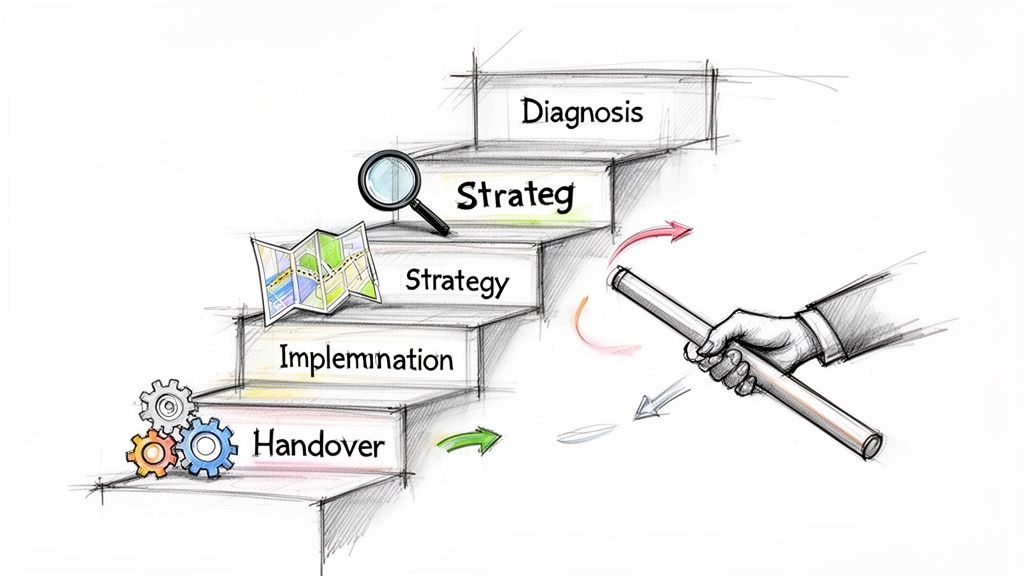
A healthy engagement isn't some open-ended retainer that drags on forever. It’s a structured process with a clear beginning, middle, and end. The whole point is to solve a specific problem and leave your business stronger and more capable than it was before.
This shift towards defined, outcome-focused work is fast becoming the new standard. In fact, Australia's consulting services market is projected to more than double from USD 9.1 billion to USD 18.8 billion by 2034. This growth isn't just about more consultants; it's about a move towards specialised projects that deliver tangible results, steering clear of those older, fuzzier models. You can read more about these consulting market trends.
The Four Key Phases of a Healthy Engagement
A productive consulting process almost always follows a clear, logical path. When we embed with a team, our work is organised into distinct phases so you always know where you are, what’s happening next, and why it matters.
It usually unfolds like this:
Diagnosis: First things first, we have to find the real problem, not just chase the symptoms. A good consultant will do a deep dive into your business—interviewing your team, analysing your data, and understanding your customers—to get to the root of what’s holding you back.
Strategy and Planning: With the core problem identified, the next step is to map out a practical, actionable plan together. This isn't some 100-page document that gathers dust on a shelf; it's a straightforward roadmap that outlines the priorities, milestones, and exactly what needs to get done.
Structured Implementation: This is where the rubber hits the road. A great consultant doesn't just hand you a plan and disappear. They work alongside your team to build the missing systems, fix foundational gaps, and generate real momentum. It’s all about building capability, not dependency.
Handover: The finish line for any successful engagement is a clean handover. The goal is to leave you with the tools, processes, and confidence to keep the momentum going on your own. You should feel equipped and in control, not locked into a never-ending contract.
This structured approach takes the mystery out of the whole process. It provides the clarity and direction that founders are looking for, turning a potentially intimidating investment into a calm, controlled, and valuable partnership.
This process transforms marketing from a constant source of stress into a predictable, structured part of your business. You can learn more about how we work using this sprint-based model to deliver clarity and momentum without the long-term retainers.
What's Your Next Move?
If you’ve been nodding along, recognising your own business in the challenges we've discussed, take a breath. It’s a completely normal part of the journey. You’re not falling behind; you just need a better way to organise the chaos.
The trap most founders fall into is trying to fix every single problem at once, which just creates more frantic energy and burnout. The real solution isn't more activity, but a deliberate pause. The most valuable thing you can do right now is get clear on the one bottleneck that's truly holding you back.
Start With One Simple Question
Before you even think about hiring someone or kicking off another campaign, get your team in a room and ask this question: “What is the one thing that, if we fixed it, would make everything else easier?”
Is your biggest hurdle…
A muddled message? Does your team find it hard to explain what you do in a way that gets people excited?
A disconnected sales process? Are marketing and sales blaming each other while potential customers lose interest?
No real priorities? Is everyone incredibly busy, but nobody is quite sure what they should be focused on to actually move the needle?
The goal isn’t to add more to your to-do list. It’s to find the right domino to push over first. Getting that initial clarity is how you start building real, sustainable momentum.
Once you’ve put a name to that core problem, the path forward suddenly becomes much simpler. It's not about making things more complicated. It’s about creating a straightforward plan you can execute with confidence, building the foundations you need to scale.
A Few Final Questions
Even after getting a clearer picture of what a marketing consultant does, most founders still have a few practical questions. It makes sense. It's a big decision. Here are the straight answers to the questions we get asked most often.
What's This Actually Going to Cost?
The price tag for a marketing consultant can vary wildly, but in Australia, most experienced pros structure their fees in one of three ways: by the project, on a monthly retainer, or by the hour.
A one-off project with a clear deliverable, like building out a complete marketing strategy from scratch, could run anywhere from $8,000 to $25,000+. If you’re looking for ongoing advice and direction, a retainer is more common, typically landing between $3,000 and $10,000 per month. Hourly rates are also an option, usually from $150 to over $400.
The most important thing isn't the model itself, but ensuring the cost is tied to a tangible business outcome, not just paying for someone's time.
How Do I Know if I'm Getting a Return on My Investment?
This is a great question, because measuring the ROI on strategic work isn't as clean-cut as looking at your ad spend reports. At first, the biggest return often comes from cost avoidance. A good consultant stops you from pouring money down the drain on the wrong channels or making a disastrously expensive hire.
As things progress, the results get more direct and measurable. You'll see the ROI in things like:
Better Quality Leads: The sales team is suddenly getting leads they can actually close because marketing is finally on the same page.
A More Effective Team: Your people are working with more purpose and less wasted motion. Things just get done.
Real, Trackable Metrics: You can finally have a confident conversation about your customer acquisition cost or conversion rates because the systems to track them are actually in place.
Ultimately, the real return is that feeling of moving from chaotic, reactive marketing to having a predictable engine for growth.
How Long Does This Take?
An engagement should last exactly as long as it takes to solve the problem you hired them for—and not a day longer. For a specific, focused project like developing a go-to-market plan, that might look like a 6 to 12-week sprint.
Be wary of open-ended retainers that seem designed to create dependency. A great consultant wants to solve the problem, build the system, and empower your team to run it without them. There should always be a clear finish line in sight right from the start.
If you’re ready to stop guessing and start building with a clear, confident plan, Sensoriium can help. We bring the structure and senior marketing leadership you need to get things on track, one focused sprint at a time. Find your clarity.