
A Guide to Marketing Strategy Consulting for Tech Companies
- Feb 9
- 13 min read
You have a great product and a smart team, but your marketing just isn’t working. Nothing feels connected. Every dollar you spend feels like a gamble, and the frustration is mounting. This is usually the moment leaders start searching for marketing strategy consulting—not for more tactics, but for a clear plan that connects their effort to actual results.
Why Your Marketing Feels Stuck (and Why It’s Not Your Fault)
It’s a familiar story for founders in tech and agtech. You’re funding marketing, your team is working hard, and you know the product is solid. Yet, the results are flat.
Campaigns feel random. Messaging doesn’t quite land. The sales pipeline is unpredictable. It feels like you’re just spinning your wheels, adding more tasks to a list that never seems to deliver any real momentum.
If this sounds familiar, you’re not going crazy. This feeling of being stuck almost always comes down to one thing: a missing strategic foundation.

The Real Problem Is a Lack of Structure
Most marketing teams are great at the doing—running ads, writing content, sending emails. But without a solid plan guiding those actions, it’s just activity without direction. It’s like trying to build a house without a blueprint; you have all the materials, but no clear idea of how they fit together.
The friction you feel isn't a sign of a bad product or a lazy team. It's a symptom of a structural problem. Often, the core pieces of a strong marketing system are either missing or misaligned:
Unclear Positioning: Your team isn’t fully aligned on who your ideal customer is and why your solution is the only one that makes sense for them.
Inconsistent Messaging: Different people describe the product in different ways, which confuses your audience.
Disconnected Systems: Marketing and sales operate in separate worlds, letting potential customers fall through the cracks.
No Clear Way to Measure Success: Everyone is busy, but no one can say for sure which activities are actually helping the business grow.
This is the exact reason companies bring in a marketing strategy consultant. It’s not about adding more work or chasing trends. It’s about stepping back, finding what’s broken, and building a simple, repeatable system that gives your team a clear and confident path forward. It’s about creating order from the chaos.
Learning how to measure marketing effectiveness is often the first step towards fixing this. It shifts the goal from just being busy to being genuinely effective.
"The most common reason marketing fails isn’t a lack of effort; it’s a lack of a coherent plan. Teams are executing tactics without a clear, shared understanding of the bigger picture."
When we embed with a team, the first thing we fix is this exact gap. We provide the structure that allows their hard work to finally pay off.
What Marketing Strategy Consulting Actually Does
Let’s be honest, the term “marketing strategy consulting” can sound a bit vague. It often brings to mind images of a thick, jargon-filled report that gets presented once, then sits on a server gathering digital dust.
Good consulting isn’t about delivering a document; it’s about embedding expertise into your business to achieve three specific things: diagnose what’s broken, build a repeatable system to fix it, and empower your team to run it long after the consultant is gone.
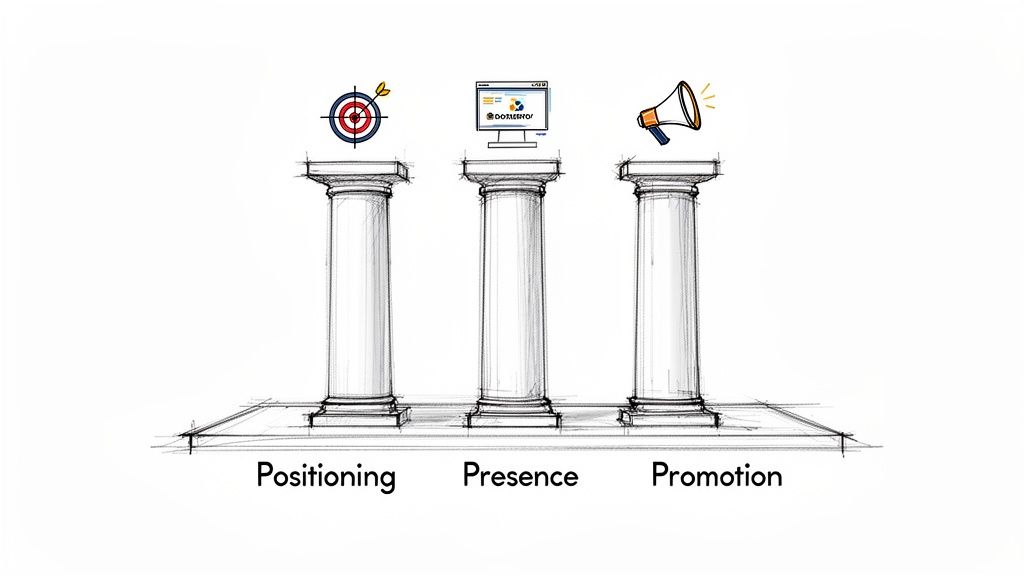
The real job is to bring structure to the chaos. Most teams we see aren't struggling from a lack of effort—they're drowning in tasks. Our work centres on building a solid foundation across three core pillars.
The Three Pillars of a Solid Marketing Foundation
A structured approach gives you clarity by directing energy where it matters most. Instead of chasing a dozen different ideas, everything comes back to strengthening these three areas:
Positioning: This is about getting crystal clear on who you serve and why you’re the only logical choice for them. It answers the fundamental questions that guide every other marketing decision. Most of the friction in a business comes from a lack of clarity right here.
Presence: This covers your brand, your core messaging, and your website. It’s how you show up in the world. Your presence must be a direct reflection of your positioning—consistent, clear, and built to earn trust with your ideal customers from the very first click.
Promotion: This is the system you use to attract the right people. This isn’t about random acts of marketing. It’s about building a simple, repeatable process that finds your ideal customers and helps them understand why they need you.
This systematic approach is designed to create real momentum. For tech companies, a strong strategy starts with understanding the core ideas of digital marketing. This founder's guide to digital marketing for startups is a great place to start building that foundational knowledge a consultant can then help you put into action.
An Example: Fixing a "Lead Quality" Problem
A founder recently told me, "Our sales team complains about lead quality, but marketing says they're hitting their targets." This is a classic symptom of a positioning problem, not a lead problem.
The marketing team was attracting people interested in a specific feature, but the sales team knew the real value was in the complete solution for a different kind of buyer. The teams weren't aligned on who the actual customer was.
Instead of creating more ads, we paused everything and ran a two-week sprint to clarify their ideal customer profile and messaging. Once both teams agreed on who they were talking to and what problem they solved, the "lead quality" issue vanished almost overnight. This is what fixing the foundation looks like in practice.
The old model of open-ended consulting often leads to slow progress. This is usually where a sprint approach creates clarity quickly. To see how this applies to technology companies, check out A Founder's Guide to Digital Marketing for Technology. It transforms consulting from a vague expense into a targeted investment in clarity and confidence for your team.
When to Hire a Marketing Strategy Consultant
Knowing when to bring in outside help is tough. It’s easy to wonder if your problems are serious enough or if you should just push your current team harder. That hesitation is normal.
Marketing strategy consulting isn’t for early-stage startups throwing things at the wall to see what sticks. It’s for businesses that have moved past that and now need a repeatable, structured way to grow.
It’s rarely about a single crisis. It’s about recognising that friction has become the new normal.
The Common Trigger Points
Most leaders don't just wake up one morning and decide to hire a consultant. It's usually a slow burn—a nagging feeling that things aren't working as they should. The reasons to call for senior strategic help tend to fall into a few familiar buckets.
Here are the most common situations where this kind of help makes sense:
You're ready to scale: You've found product-market fit, but the founder-led sales hustle is hitting its limit. You need a marketing engine that doesn’t depend entirely on one person's effort.
Sales and marketing are misaligned: Your sales team complains about lead quality, while marketing feels their work isn’t valued. This is a classic sign of a broken system where each team is using a different playbook.
Your team is talented but lacks direction: You've hired good marketers, but they don't have the senior leadership to connect their daily work to the company's goals. They’re busy, but are they effective?
You're entering a new market: You need a clear plan to introduce your brand into a new region or industry and get some early wins.
Most teams struggle here because they’ve never had someone step in to structure the work. The goal isn't to take over, but to provide that missing layer of senior guidance—to bring structure, confidence, and a clear path forward for the team already in place.
A Growing Need for Clarity
The demand for this kind of focused support is growing. The Australian consulting services market reached USD 9.1 billion in 2024 and is expected to more than double by 2034, driven by the need for digitalisation. This shows that tech and agtech companies with small teams and scattered marketing are feeling the pressure. If you're curious, you can read more about the growth of the consulting sector in Australia.
The right time to hire a consultant is when you realise you don’t have a tactics problem; you have a systems problem. It’s the moment you stop asking, "What should we do next?" and start asking, "How should we decide what to do next?"
This mental shift is everything. It’s the point where you move from chasing fleeting wins to building a genuine asset: a clear, confident, and effective marketing function.
The Consulting Process: From Diagnosis to Handover
If you're thinking about hiring a marketing strategy consultant, you’re probably wondering, "What does this actually look like?" It can feel abstract, like starting a journey without a map.
But a modern consulting project isn't an endless stream of meetings. It’s a structured, sprint-based process designed to deliver clarity and results, fast. Think of it less like a vague retainer and more like a focused project with a clear beginning, middle, and end.
This approach turns a tangled problem into a logical, manageable journey. The infographic below shows the simple path from feeling that initial friction to getting an expert on board.
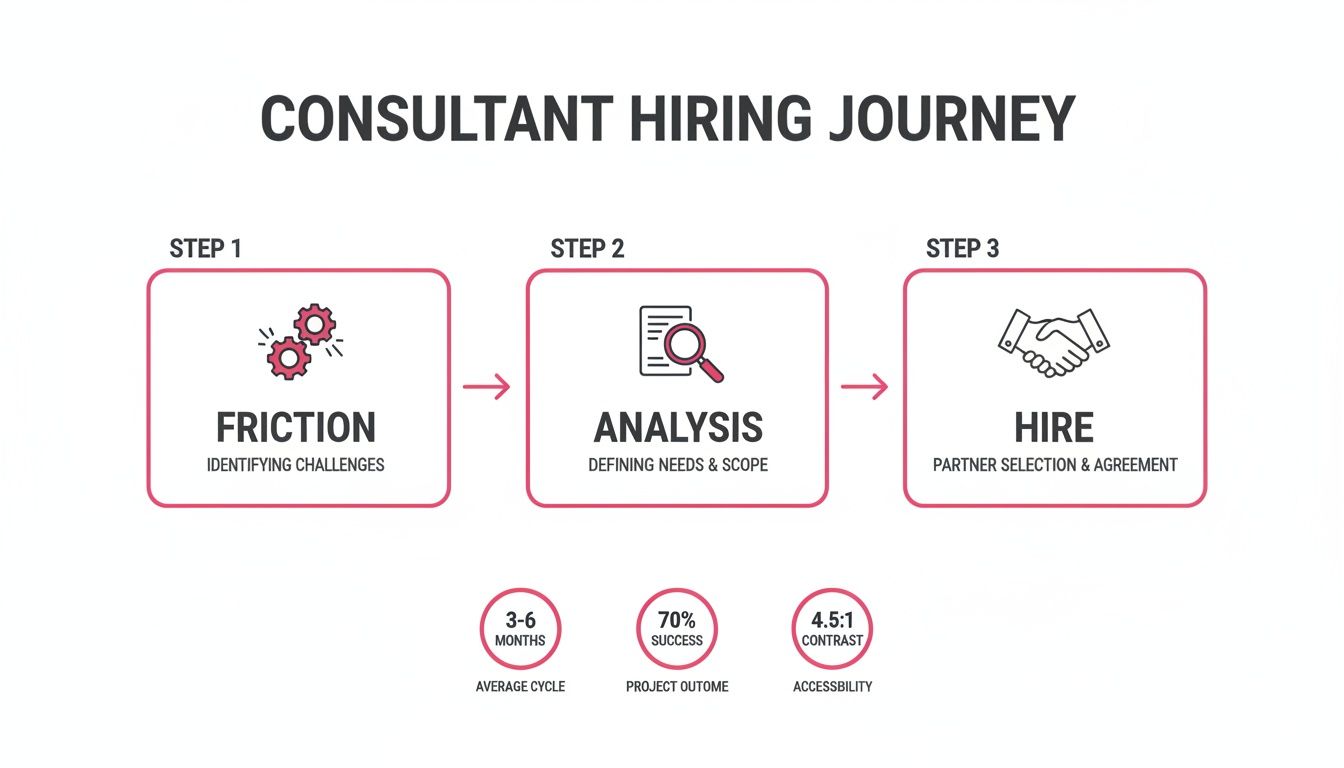
It really is that straightforward: you recognise a problem, find a partner, and get the structure you need.
So, how does it work? We move through four distinct phases, each designed to leave your team stronger than when we started.
The Four Phases of a Marketing Strategy Sprint
Phase | What Happens | What You Get |
|---|---|---|
1. Diagnosis | We embed with your team to find the real root cause of the friction. This involves a deep dive into customer interviews, internal workflows, and team dynamics. | A clear, documented report pinpointing the one core problem that, if fixed, will create the biggest positive impact. |
2. Fix | We focus all our energy on solving that one core problem first. For most tech companies, this is almost always a gap in their positioning or messaging. | A crystal-clear positioning statement, defined key messages, and a unified story that both marketing and sales can confidently use. |
3. Build | With a solid foundation, we start building the practical assets and systems your team needs. This is about simple, usable tools, not complex machinery. | Tangible assets like sales materials, a high-converting landing page, or a simple content marketing system. |
4. Handover | We transfer all knowledge and ownership back to your team. The goal is empowerment, not dependency. This includes training, playbooks, and establishing new rhythms. | A fully equipped team with a clear plan, the skills to run it, and the confidence to own it long-term. |
Let's look at each phase.
Phase 1: Diagnosis
The first step is always to find the root cause. We embed with your team to get a real, on-the-ground understanding of what’s happening. This isn’t about surface-level symptoms; it’s a deep dive into your positioning, processes, and the disconnects between sales and marketing.
Phase 2: Fix
Once we’ve identified the core problem, we focus all our energy on fixing it. For most tech and agtech companies, this is a gap in their positioning or messaging. If the story you’re telling isn't clear, no amount of advertising will work. This phase is all about creating that essential clarity so that your marketing and sales teams can use it with confidence. This alignment is often the first big win that calms the chaos. You can learn more in our guide on creating a brand management strategy template for tech companies.
Phase 3: Build
With a solid foundation in place, we move on to building the missing assets and systems your team needs to work effectively. This isn’t about creating complex machinery. It’s about building simple, practical tools that your team can actually use, like new sales materials or a simple content system.
Phase 4: Handover
Our goal is never to create dependency. A successful engagement ends with your team feeling empowered. The handover phase is about transferring knowledge and ownership back to your people. We equip them with a clear plan and the skills to run it themselves. The result is a team that has the strategy, confidence, and structure to see it through.
How to Choose the Right Consulting Partner
Hiring a consultant can feel like a gamble. You’ve probably heard stories of big retainers that lead to generic advice and not much else. It makes sense to be cautious. You’re investing trust and time you can’t get back.
The real fear is ending up with someone who doesn’t get your business, creating more work instead of less. A good decision here doesn't just get you a plan; it gets you a partner who brings structure, confidence, and real momentum.
Choosing the right fit is the most important part of the process.
Look for Hands-On Experience, Not Just Theory
When you’re looking at potential consultants, dig for proof of deep, practical experience with companies like yours. A consultant who has spent years working with B2B tech companies will understand the nuances of a long sales cycle in a way someone from the consumer world simply won't.
It’s about lived experience. They should be able to speak your language and understand the specific pressures you’re under.
The consulting world is huge. In 2025, Australia's management consulting market hit USD 8.89 billion. With nearly 100,000 consulting businesses nationwide, there are a lot of generalists. Specialised experience is what separates a strategic partner from just another advisor. You can read more about the Australian consulting market on Mordor Intelligence.
Favour an Embedded Model Over Arm's-Length Advice
The best consulting comes from someone who works with you, not for you. You want a partner who embeds themselves in your team—joining your Slack, attending key meetings, and feeling like part of the crew. This creates a much stronger partnership than just getting a report emailed over every month.
A good consultant doesn't just hand you a map; they help you navigate the first few kilometres of the journey yourself.
The goal should always be to build your team’s internal capability, not to create a long-term dependency. A great consulting partner is actively trying to work their way out of a job by making your team smarter and more self-sufficient.
Crucial Questions to Ask a Potential Partner
When you get on a call, your goal is to understand how they think and work. Their process will tell you more than their polished pitch deck ever will.
Here are a few questions to help you get past the surface-level answers:
How do you integrate with our existing team? This tells you whether they prefer to be hands-on or keep a distant, advisory role.
What does a successful engagement look like at handover? A great answer will focus on your team’s empowerment, not just on the documents they delivered.
Can you give an example of when your advice was wrong? This reveals their humility and honesty. A partner who claims they’ve never made a mistake is one you can't trust.
How do you structure your fees? You're looking for transparency and fixed-fee projects. Vague, open-ended retainers can create misaligned incentives and budget surprises.
Finding the right consulting partner is a lot like hiring a senior leader. For some companies, this might even mean looking into a fractional CMO model. You can explore what a Fractional CMO is and how it actually fixes your marketing to see if that kind of approach is a better fit.
Ultimately, you’re looking for someone who brings clarity, confidence, and a structure that lasts.
Your First Step Towards Marketing Clarity
If you've read this far, the sheer number of things you could be doing in marketing can feel paralysing. But the goal isn’t to do more; it’s to bring structure to the chaos.
Feeling stuck doesn't mean you're behind. It just means you need a clear place to start. And that starting point isn’t another campaign. It’s a moment of honesty with yourself and your team.
Find the Single Source of Friction
Before you do anything else, just stop. Take a breath and pinpoint the single biggest source of friction in your marketing right now. Don't try to fix everything at once. Just find the one thing that, if you fixed it, would make everything else a little bit easier.
Does one of these sound familiar?
Your messaging is muddy: Sales and marketing talk about the product differently.
Your pipeline is slow: You get leads, but they seem to get stuck or fizzle out.
You lack qualified leads: The leads that come through are a poor fit for your sales team.
Pick one. Just one. By channelling your energy into that single problem, you build real momentum. This is the heart of what good marketing strategy consulting does: it finds the critical leverage point and puts all the pressure right there.
This focused approach is more important than ever. In Australia alone, the management consulting industry is expected to hit $45.9 billion in revenue by 2025. This boom shows how many companies are seeking expert help for the same positioning and pipeline issues you might be facing. For a deeper dive into these trends, you can explore the full report from IBISWorld.
The most powerful thing you can do right now is to stop adding to your to-do list and instead create a ‘to-fix’ list with only one item on it.
This small shift changes everything. It moves you from frantic activity to focused intention. That clarity—knowing exactly what’s broken—is the starting point for building a marketing engine that gives you confidence and a clear path forward.
A Few Common Questions
It’s a big decision to bring in a marketing strategy consultant, so it's natural to have questions. Let’s tackle some of the most common ones we hear from founders.
How Much Does Marketing Strategy Consulting Cost?
This is usually the first question on everyone's mind. While costs vary, the best consultants have moved away from vague hourly rates.
Instead, look for a partner who offers fixed-fee projects or sprint-based pricing. This gives you certainty over your budget and keeps the focus on results, not just logging hours. A typical engagement for deep strategic work might be a set project fee for a specific outcome, or a monthly fee for a defined period if the consultant is embedding with your team.
What's the Difference Between a Consultant and an Agency?
It’s easy to mix these two up, but they play very different roles. An agency is built for doing, while a consultant is there to fix and build.
A marketing agency is your execution arm. They run your ad campaigns or manage your social media. They are the hands doing the work.
A marketing strategy consultant steps back to figure out the ‘why’ and the ‘how’. Their job is to sort out the foundational system—your positioning, messaging, and the overall plan.
An embedded consultant, which is the model we use at Sensoriium, bridges this gap. We provide the high-level strategic thinking and the hands-on support to help your team put it into practice.
How Long Does It Take to See Results?
Sustainable growth is a long game, but you shouldn't have to wait six months to feel like you're on the right track. A good consulting engagement should bring a sense of clarity and momentum almost right away.
In a sprint-based model, you should feel real progress on fundamental problems like messaging or positioning within the first 4-6 weeks. This is the "calm the chaos" phase. After that, you'll start seeing more concrete results—like better quality leads or a more predictable pipeline—within the first 90 days as the new system takes hold.
If your marketing feels all over the place, that’s normal. You’re not behind. You just need structure.
Start by fixing your positioning and messaging before you touch anything else. It's the one move that makes every other marketing activity easier and more effective.
At Sensoriium, we help you find that clarity and confidence. We step in to untangle the mess, fix what’s broken, and give your business a clear path forward.