
How to Find Your Brand's Tone of Voice (Without Writing a Useless Guide)
- Jan 28
- 8 min read
Does this sound familiar? You know your brand’s messaging feels a bit off, but you can’t quite put your finger on why. Your website copy sounds nothing like your sales emails. Your social media posts feel like they’re coming from a completely different company. Everything feels inconsistent, a bit messy, and you're tired of just winging it.
You’re not crazy. It makes sense that you feel stuck.

This isn't a sign you've done something wrong. It’s a classic growing pain. You've built an incredible product or service, but the way you talk about it hasn’t quite caught up yet. You’re not behind; you’ve just outgrown your old way of communicating. The solution isn’t more effort—it’s better structure.
This guide is designed to give you that structure. We’re not going to rehash the generic tips you’ve already seen a dozen times. Instead, we’ll walk you through a practical process to define a tone of voice that is clear, consistent, and genuinely you. Our goal is to give you clarity and confidence, not more noise.
Why Your Team Sounds So Inconsistent
This communication breakdown is incredibly common, especially in fast-growing tech and agtech companies. As your team expands, more people start writing. Your new marketing hire, your sales lead, and your support specialist all have their own unique styles. Without a clear, shared guide, your brand's personality starts to fracture.
This is exactly where a sprint approach creates clarity quickly. The problem isn't a lack of talent; it's the lack of a shared playbook. When we embed with a team, the first thing we fix is this exact gap, because getting everyone aligned with a single system for how you communicate pulls the team back into sync.
So, where do you start? The first small shift that changes everything is understanding the difference between your brand’s voice and its tone.
Brand Voice vs. Tone: The One Idea That Fixes Everything
Let's clear this up, because it’s where most of the confusion around tone of voice begins. Many founders treat 'voice' and 'tone' as the same thing, which leads to messaging that feels off-key. It makes sense that you feel stuck if you're trying to apply one rigid personality to every single situation.
Here’s the simple way to think about it:
Your brand voice is your underlying personality. It’s who you are at your core, and it doesn't really change.
Your tone, on the other hand, is the mood or emotion you express in a specific context. It’s how your personality adapts to different conversations.
Your voice is permanent; your tone is flexible. This small shift in thinking changes everything.
A Simple Scenario to Make it Clear
Imagine your brand as a person. You have a core personality (your voice), but you don't speak to your best mate the same way you’d speak during a formal presentation. Your personality hasn't changed, but your tone has adapted to the audience and the moment.
This is exactly how it works for your business. Let's say your core brand voice is ‘expert and approachable’.
When writing a technical guide: Your tone will be more instructional and direct, leaning into the 'expert' side of your voice.
When responding to a customer on social media: Your tone becomes warmer and more conversational, emphasising the 'approachable' side.
The personality is the same, but the expression changes. Separating these two concepts brings instant clarity. It stops you from creating rigid, one-size-fits-all rules that make your communication feel robotic. Instead, it gives your team a flexible framework to be consistent without sounding repetitive. Getting this right is fundamental to building clear branding and messaging that actually connects.
How a Single Voice Adapts Its Tone
Here's a table to show you how a single brand voice—your fixed personality—can adapt its tone for different contexts.
Brand Voice (Fixed Personality) | Situation | Resulting Tone (Adaptable Mood) |
|---|---|---|
Confident & Empowering | A new customer is onboarding. | Welcoming, reassuring, and helpful. |
Confident & Empowering | Announcing a major product breakthrough. | Excited, bold, and celebratory. |
Confident & Empowering | Responding to a critical bug report. | Apologetic, serious, and urgent. |
Playful & Witty | Writing a weekly email newsletter. | Light-hearted, entertaining, and engaging. |
Playful & Witty | Explaining a pricing increase. | Direct, respectful, and transparent. |
See how the core personality stays the same, but the emotional delivery shifts? This framework provides the structure needed to build a brand personality that remains authentic and effective across every channel. It gives your team the confidence to communicate clearly, no matter the situation. For more on this, there are some great resources on defining your brand voice and tone.
Why Most Tone of Voice Guidelines Fail
You’ve probably seen one before. A beautifully designed PDF, tucked away in a shared drive somewhere, titled ‘Tone of Voice Guidelines’. It’s full of lovely but ultimately useless adjectives like ‘friendly’, ‘professional’, and ‘innovative’.
Everyone nods along when it’s presented, then promptly forgets it exists. The document gathers digital dust, and your team goes right back to guessing what your brand should sound like.
The problem isn’t your team; it’s the guide itself. This approach fails because it’s abstract. Adjectives alone don't give anyone the practical tools they need to actually write something. What does ‘innovative’ sound like in a sales email? How friendly is too friendly when you’re handling a tricky support ticket? Most teams struggle here because they’ve never had someone step in to structure the work.
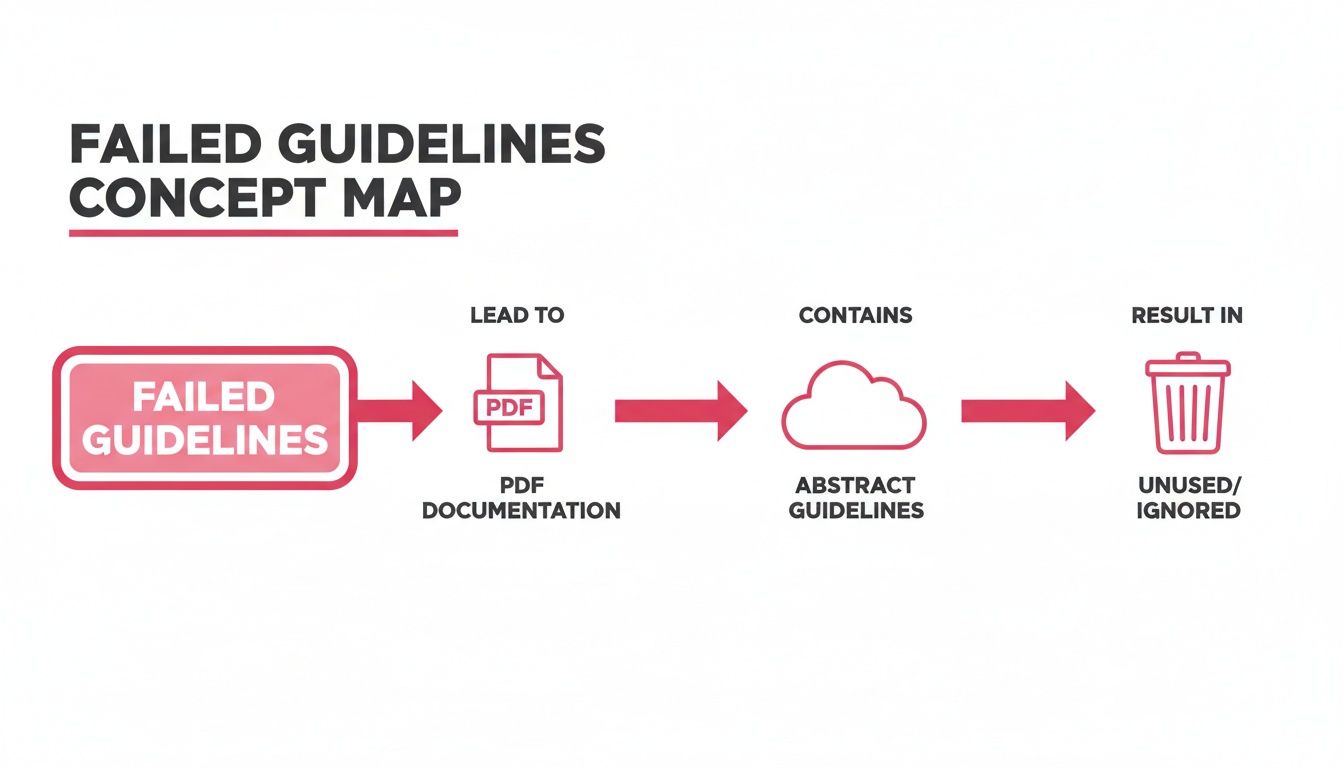
This happens because the guide describes a feeling without providing a mechanism. It tells your team what to be, but not how to do it.
The consequences are real. Inconsistent communication damages trust. A recent Australian survey revealed that 53% of consumers would switch brands if the digital experience doesn't live up to their expectations. A wobbly, inconsistent tone is a huge part of that experience. You can dig into the numbers yourself in these customer experience trends in Australia.
The fix is to move beyond adjectives and build a simple, actionable framework. Your tone of voice shouldn’t be based on loose ideas. It needs to be anchored to what you stand for, who you’re here to help, and the specific problems you solve.
A Practical Framework for Defining Your Tone
So, abstract adjectives don't work. The dusty PDF guide fails because it’s not practical. The way forward isn’t another list of vague descriptors. What you need is a simple, structured framework that gives your team a repeatable way to make decisions about language.
Instead of brainstorming adjectives in a vacuum, anchor your tone of voice to four practical pillars. Get your team together and answer these questions.
Purpose: Why does our communication exist? Are we here to educate, inspire, challenge, or reassure? Be specific about the job your words need to do.
Audience: Who are we really talking to? Go deeper than job titles. What are their biggest fears, frustrations, and goals? What kind of conversation do they want to have?
Personality: If our brand were a person, what three words would describe them? (We’ll come back to this—there’s a trick to making it work).
Language: What specific words and phrases do we use or avoid? This makes the framework a tangible, everyday tool.
From Vague Adjectives to Sharp Contrast
Let’s focus on the ‘Personality’ pillar, because this is where most guides fall apart. Listing a word like "Confident" is useless on its own. The breakthrough comes when you define it by what it is not.
Use a ‘We are X, but not Y’ format. This simple shift forces you to be specific and removes ambiguity, giving your team sharp boundaries to work within.
A Founder Moment: Putting It All Together
Imagine an AgTech founder trying to define their company's personality. They start with the word "Direct."
The vague approach: Our personality is Direct. (What does that mean? Is it rude? Is it blunt? Who knows.)
The structured approach: We are direct, but not blunt.
Suddenly, everyone gets it. It means getting straight to the point without being harsh. It means clear, honest communication that respects a farmer's time.
Look how that one small shift cascades into the other pillars:
Purpose: To give farmers clear, actionable data they can use today.
Audience: Time-poor farmers who value honesty and don’t like marketing fluff.
Personality: Direct, but not blunt. Supportive, but not patronising. Knowledgeable, but not academic.
Language: Use simple sentences. Avoid jargon. Start with the main point.
By mapping these four elements onto a single page, you create a guide your team will actually use. It’s no longer a dusty PDF; it’s a decision-making tool that builds consistency, momentum, and confidence.
Putting Your Tone of Voice Into Practice
A good plan is one thing, but putting it into action is another. It’s easy to feel a bit lost when you actually sit down to write an email or a website headline.
This is where your defined tone of voice stops being a theoretical concept and becomes a practical tool. You'll start to see how tiny shifts in wording and sentence length make your brand's personality shine through.
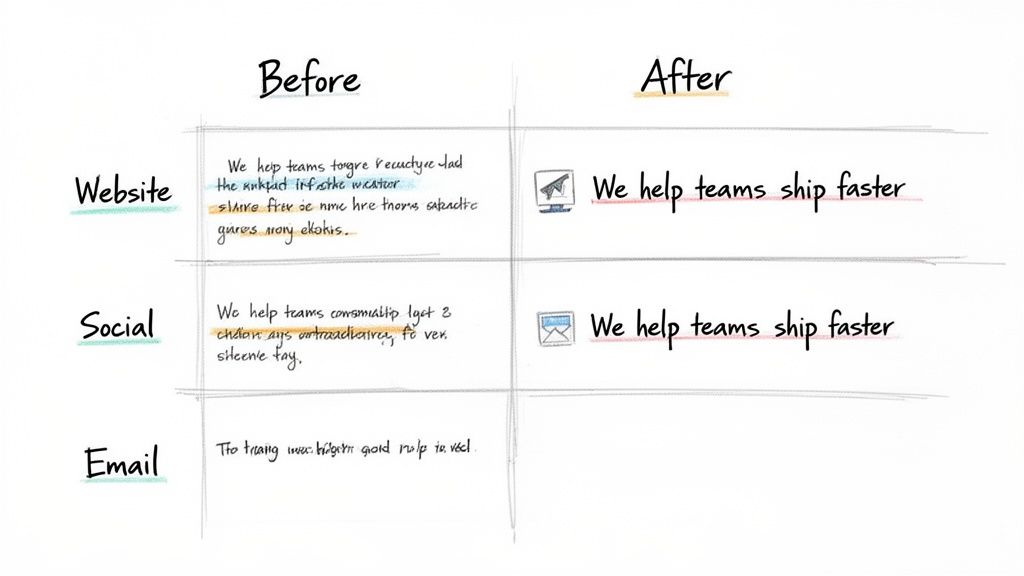
Let’s look at a quick example. A SaaS company has defined its personality as Confident, Clear, and Supportive.
Practical Application: Website Headline
Before (Full of jargon):"Leverage our innovative, synergistic platform to unlock transformative growth and streamline your operational workflows."
After (Confident, Clear, Supportive):"The simple, powerful way to manage your operations. We give you the clarity and control to grow your business with confidence."
The 'after' version does more than simplify the language; it actively embodies the brand's personality. It’s confident, clear about the value, and supportive of the customer. This is a massive help if you're trying to figure out how to write website content when you’re not a writer.
Practical Application: Social Media Post (Handling a Customer Issue)
Before (Robotic and impersonal):"We are aware of the issue impacting some users and our team is investigating. We apologise for any inconvenience."
After (Confident, Clear, Supportive):"We’ve spotted a bug affecting some accounts and the team is on it now. We know how disruptive this is—we'll post an update within the hour. Thanks for your patience."
See the difference? It’s professional but also human. It shows support by acknowledging the customer’s frustration, it’s clear about what’s happening next, and it’s confident a fix is coming.
Authenticity is huge, especially in Australia. Social media platforms like TikTok—with over 8.5 million Aussie users—show that genuine, relatable content works far better than polished corporate-speak. A consistent tone isn't just a 'nice to have'; it directly impacts your results.
How to Maintain a Consistent Tone of Voice
Defining your tone is a great start, but making it stick is where the real work begins. The goal isn't to micromanage every word. That just breeds fear and slows everyone down. Instead, you want to build a shared understanding and give people simple tools that make writing on-brand feel like second nature.
From Guide to Daily Habit
The trick is to weave your tone of voice guidelines into the work your team is already doing.
Here’s a simple plan:
Launch it properly: Don't just email a PDF. Run a short workshop to explain why this matters. Show 'before and after' examples so your team can feel the difference.
Make it practical: Turn your guidelines into simple checklists for different types of content (e.g., blog posts, sales emails, support replies). This makes it a tool, not just a document.
Coach, don't just correct: When you spot copy that’s off-brand, use it as a teaching moment. Ask questions like, “How could we make this sound more supportive?” or “What’s a clearer way to say this?”
This is more important than ever as customer habits change. In Australia, 33% of people now use voice search every day. That shift means they expect to interact with brands in a more conversational, human way. Your tone has to keep up. You can read more in the research on Australian voice search trends.
For a deeper dive, our guide to mastering tone in your writing offers more practical tips.
Start by Fixing This One Thing
If all this feels a bit messy, that’s normal. Most teams get stuck here because they've never had a clear process to follow. You’re not behind. You need structure.
Your next step isn’t to write a 20-page brand guide. Let’s make it much simpler.
Start by sorting out your brand personality before you touch anything else.
Get your leadership team in a room and focus on answering just one question using the ‘We are X, but not Y’ format we talked about earlier.
If our brand was a person, what three words describe them?Example: We are knowledgeable, but not academic.
That’s it. Starting with this single, powerful exercise will bring more focus and alignment than you can imagine. It’s the first real step toward defining a tone of voice that feels genuine and gives you the momentum to move forward with confidence.
When you're ready for clear direction and a practical marketing strategy that works, Sensoriium is here to help. Get in touch to find your clarity.