
What to do when your brand and your business feel like strangers
- Feb 11
- 12 min read
It’s a feeling most founders know well. The team is shipping product, everyone’s pulling their weight, but something just feels… off.
The marketing message doesn't quite line up with what the sales team is hearing from customers. Your website copy sounds a bit generic, failing to capture the real magic of what you do.
You’re not imagining it. This sense of misalignment is a classic growing pain. It happens when the day-to-day reality of your business outpaces the story you’re telling the world. This isn't a sign you've failed; it's a signal that the gap between what you do and what you say has become a problem.

This disconnect is almost never a marketing problem at its core. It’s a clarity problem. Your team is missing a central, guiding idea to rally behind, which leads to fragmented efforts that burn through time and money.
The solution isn't to just "do more marketing." Pushing harder on a fuzzy message only makes the confusion worse for your customers and your own team. The real fix is to pause and consciously build a solid bridge between your brand and your business strategy.
From Decoration to Direction
For a lot of tech companies, 'brand' can feel like window dressing—a nice logo, some brand colours, a clever tagline. But seeing it that way misses its true power. A strong brand isn't just decoration; it's a compass. It gives you the framework to make consistent decisions across the board, from product roadmaps to customer support scripts. If this feels familiar, you can explore how to fix this disconnect in our guide.
When your brand and business are truly locked in sync, you get:
Internal Confidence: Everyone on your team knows exactly what you stand for. They can talk about it clearly and consistently, whether they're in sales, engineering, or HR.
External Clarity: Customers get it. They instantly understand the problem you solve for them and why you’re the only real choice.
Real Momentum: Every single action—from a sales call to a software update—reinforces the same core promise. This is how you build deep trust and grow with purpose.
Why 'brand' is your most misunderstood asset
For a lot of founders, particularly in the tech space, the word ‘brand’ can feel a bit… soft. It often conjures up images of logos, colour schemes, and maybe a clever tagline. These are things that seem more like window dressing than a real driver of business growth.
It’s easy to file brand under ‘the fluffy stuff’ – something you’ll get around to once the product is flawless and the sales pipeline is pumping.
And that’s exactly where the missed opportunity lies. It’s a totally common way to see it, but it confuses the output with the asset itself.
Your brand isn’t just your logo. It's the central idea that organises your entire business. Think of it less like a creative project and more like a strategic tool for creating absolute clarity. It’s the promise you make to your customers, and your business is simply the sum of all the ways you deliver on that promise.
The engine and the steering wheel
When your brand and business strategy aren't aligned, things get messy. Customers get confused signals, your team starts pulling in different directions, and your growth stalls. The problem isn’t a lack of effort; it's a lack of a clear, unified direction.
I find a simple analogy really helps to frame this:
Your business is the engine. It’s your product, your operations, your team—all the raw power and capability you’ve built up.
Your brand is the steering wheel. It tells that powerful engine where to go, which turns to take, and what destination to head for.
You can have the most powerful engine on the market, but without a steering wheel, you’re just spinning your wheels and burning fuel. This is precisely where so many businesses get stuck. They pour everything into building a mighty engine but completely neglect the system that gives it purpose and direction.
This isn’t just a nice theory. In Australia, the top 40 most valuable brands are collectively worth a staggering US$156 billion, a 25% jump since 2023. They don't get there just by throwing money at ads; they do it by being meaningful and instantly recognisable, which helps them consistently take market share.
For tech companies, this proves that investing in a strong, clear brand creates a tangible competitive advantage. You can see the data for yourself and discover in the full brand value report how this plays out. To truly understand why brand is your most misunderstood asset, using tools for AI brand tracking can give you incredible insights into its actual performance.
When we start working with a team, this is the very first gap we close. We help connect the engine to the steering wheel, making sure every ounce of effort pushes the business forward with purpose and confidence.
You can learn more about what strategic branding involves and why it feels messy in our detailed guide.
The three gaps between your brand and business
When your brand and business feel out of sync, it’s rarely because of one big, catastrophic failure. It's usually a series of small, invisible fractures that quietly undermine your growth.
Most founders can feel the symptoms — things like confusing sales conversations or marketing that just doesn't seem to connect. But pinpointing the root cause is tough. Let's be honest, it's hard to see the picture when you're inside the frame.
The disconnect almost always shows up in one of three key areas. By giving these gaps a name, you get the clarity you need to start fixing them. This isn't about finding fault; it's about creating a simple map to guide your business back to true alignment.
Think of your business as the engine and your brand as the steering wheel. Together, they create real, directed growth.
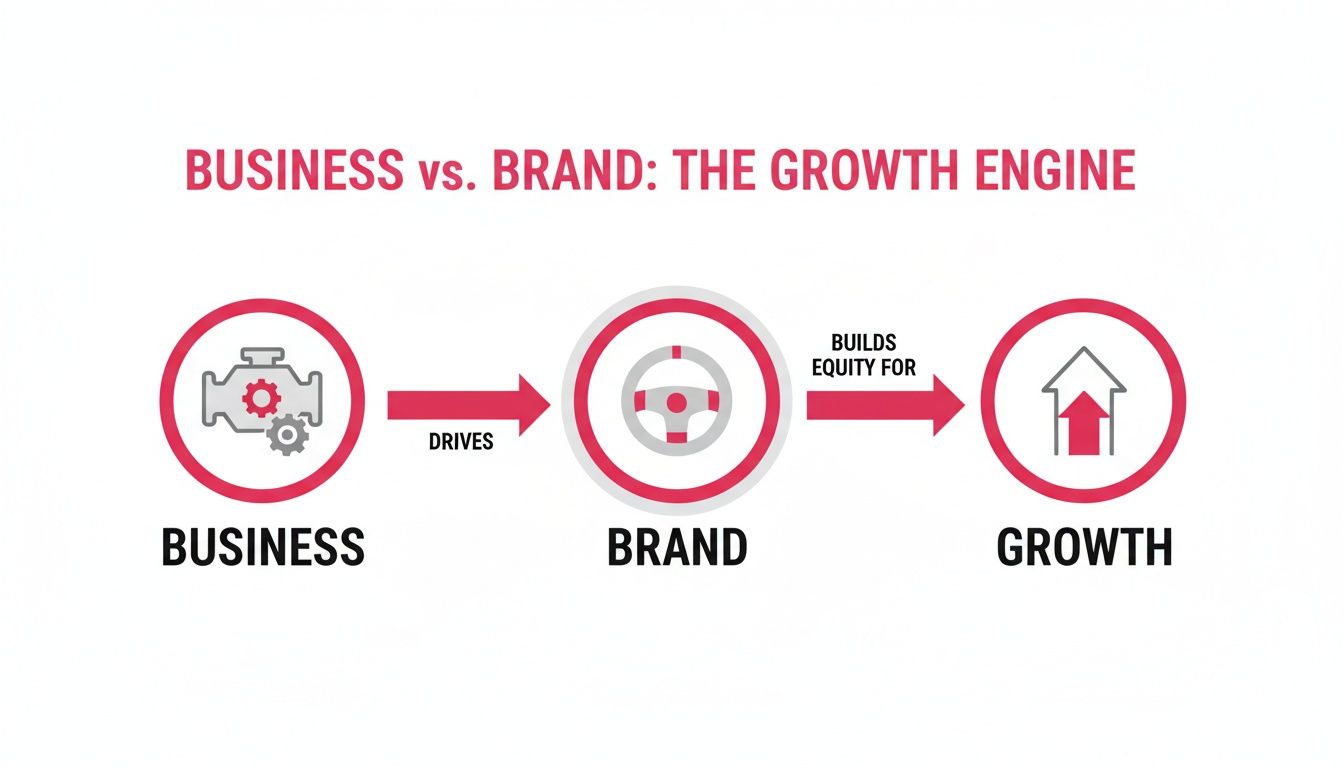
The crucial insight here is that a powerful business (your engine) without clear brand direction (your steering wheel) just burns fuel. It creates noise, not momentum.
The Positioning Gap
This is the most fundamental disconnect of them all. It’s when your internal belief about your value doesn't match what the market actually needs, understands, or is willing to pay for.
You might think you’re selling a sophisticated data analytics platform, but your best customers just see you as a simple, reliable reporting tool. This isn’t a small problem.
This gap is a silent killer of growth because it means you’re building and selling for a customer who doesn't really exist. It leads to product features nobody uses and marketing messages that fall on deaf ears.
The Messaging Gap
A messaging gap is almost always a direct result of a positioning gap. This happens when different parts of your business tell slightly different stories about who you are and what you do.
Your website might talk about empowering small businesses, while your sales team is busy selling enterprise-level features. Meanwhile, your social media is just posting generic industry news. This inconsistency creates confusion. And a confused customer never buys.
When we embed with a team, this is often the first thing we tackle. Why? Because consistent messaging is the bedrock of a trustworthy brand.
The Experience Gap
This is where the promise breaks. Your marketing might promise a seamless, modern solution, but the customer's actual experience is a clunky onboarding process, slow customer support, or a sales cycle full of friction.
This is the most damaging gap because it directly erodes trust. You've done the hard work of attracting a customer with a compelling brand promise, only to let them down with a business reality that doesn't measure up. It sends a clear signal that your marketing is just a facade, not a true reflection of your company's quality.
To help you get started, I've put together a quick reference table. Use it to spot the symptoms of these gaps in your own business.
Identifying Common Disconnects Between Brand And Business
The Gap | Common Symptom | What It Really Means |
|---|---|---|
Positioning | "Our sales cycles are long and we lose to 'do nothing' a lot." | Your core value isn't compelling or clear enough for your target market. |
Messaging | "Different teams describe what we do in completely different ways." | There's no single source of truth for your brand's story, leading to market confusion. |
Experience | "We get great feedback on our demos but see high churn after 90 days." | Your product or service delivery isn't living up to the promises your brand is making. |
Diagnosing which of these gaps is holding you back is the first real step toward building momentum. It gives you the structure you need to stop guessing and start building a brand that truly powers your business forward.
How a clear brand creates calm and focus
When your brand and business finally click into place, something amazing happens. That constant, low-level hum of chaos you find in so many growing companies just... fades. It’s replaced by a sense of calm and a sharp focus that works its way through the entire organisation.
This isn't some fluffy, feel-good idea about corporate harmony. It's the practical outcome of having a powerful filter to run every single decision through. Without that clarity, every choice becomes a massive debate, every opportunity seems urgent, and your team gets pulled in a hundred different directions at once.
A filter for every decision
Picture a classic founder scenario. You get a chance to move into a new market. It looks great on paper, and the potential revenue is hard to ignore. But is it the right move for you?
Without a clear brand, that conversation quickly gets bogged down in spreadsheets and financial projections. But with a strong brand, the discussion starts somewhere else entirely: "Does this actually line up with the promise we make to our customers?"
That one question changes the whole game. It shifts the decision from being purely opportunistic to deeply strategic, forcing you to think beyond the quick win and consider your long-term integrity. A well-aligned brand and business gives you the framework to say "no" to distracting opportunities so you can give a confident "yes" to the right ones.
A clear brand promise isn't just a marketing slogan; it's a practical tool that stops you from chasing shiny objects and keeps the business on course.
When we start working with a new team, getting this central idea locked in is the very first thing we do. It’s the foundation that makes everything else—from product roadmaps to sales scripts—more effective and focused.
This kind of alignment also has a huge impact on your team. It means you get:
Better Hires: You start attracting people who genuinely believe in your mission, not just people looking for their next paycheque.
Focused Roadmaps: Product development stops being about cramming in more features and starts being about delivering on your core promise.
Authentic Marketing: Your marketing stops sounding like a generic sales pitch and starts feeling like a genuinely helpful conversation.
Ultimately, getting this right builds confidence inside the business and trust outside of it. Your team knows exactly where they're heading, and your customers feel that consistency every time they interact with you. The chaos dies down because everyone finally knows which hill they’re supposed to be taking.
A practical example of brand and business alignment
All this talk about gaps and alignment can feel a bit abstract. Let's make it real. It’s one thing to discuss theory, but seeing it play out is where the penny really drops. I see this all the time—founders know something is off, but they can't quite pinpoint why their brilliant business isn't getting the traction it deserves.
Picture a growing Australian SaaS company. Their product is top-notch, the team is stacked with talent, and they've got a small base of loyal customers. The problem? Their sales pipeline is painfully slow. Deals that look like a sure thing just... fizzle out.
The culprit is almost always the same: their brand is completely generic.
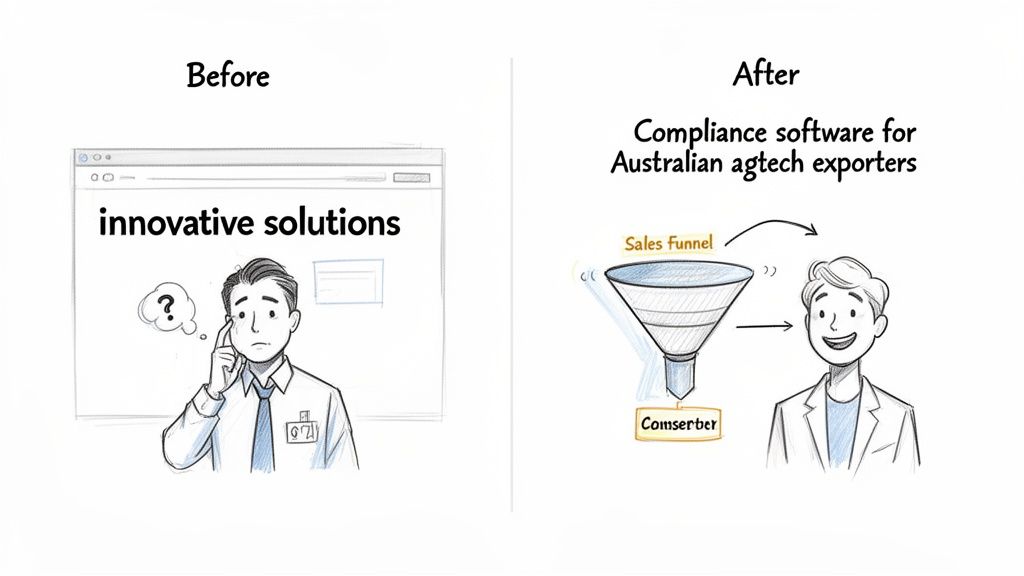
The messy 'before' state
Right now, their website is a wall of vague corporate jargon. It’s full of phrases that sound impressive but tell a potential customer absolutely nothing.
Without a clear story to anchor them, the sales team is adrift. They struggle to explain why their product is any different from the five other options on the market. Every salesperson ends up with their own version of the pitch, which just leaves prospects confused and unconvinced. Meanwhile, marketing is burning through cash on ads that get clicks but no qualified leads.
This isn't just a sales or marketing problem. It's a classic symptom of a business that hasn't given its teams the clear, unified story they need to communicate its true value.
The clear 'after' state
Instead of blowing the budget on a flashy rebrand, they do the hard work first. They get brutally honest about what they’re best at and who they really serve. After digging deep, they realise their sweet spot is in compliance for a very specific, underserved niche.
This small shift changes everything. They reposition the entire company around a single, powerful idea: 'The only compliance software built for Australian agtech exporters'.
That one sentence is a game-changer.
Their website copy suddenly has a pulse. It speaks directly to the headaches of agtech exporters, using their language and proving it understands their world.
The sales team now has a knockout story. They can walk into any meeting and confidently explain exactly why they are the only logical choice for that particular customer.
Marketing is finally attracting the right crowd. Their content starts resonating with a niche audience, which means fewer leads, but far, far better ones.
This is what happens when your brand and business strategy finally click into place. It’s not about getting a new logo; it's about giving your powerful business the clarity it needs to connect with the people who need it most.
In a crowded market where giants are spending billions on advertising, this kind of focus is your superpower. As you can see in Nielsen’s latest ad spend report, you can’t out-spend them. But you can out-smart them with precision.
Your first step is clarity, not a rebrand
When your brand and business feel out of sync, the knee-jerk reaction is to call for a ‘rebrand’. It feels like you're taking decisive action, a fresh start. But honestly, it’s often the absolute last thing you should be doing.
Slapping a new logo onto a broken system is just expensive decoration. It won't fix any underlying confusion. The real, meaningful work is almost always internal—getting brutally honest about what your business actually does best and who you do it for. The goal here is clarity, not a new colour palette.
Start with the truth, not the theory
Before you even think about spending a dollar on design, you need to ground your brand in reality. Marketing theory has its place, but the unvarnished truth lives inside your customer conversations. The most direct path to clarity is simply to listen to the people who already pay your bills.
This is where so many teams stumble. They don’t have a process for structuring these insights, so it feels messy and overwhelming. As a result, they skip this crucial step and jump straight into the creative work.
Instead, let's start with one simple, powerful action.
Schedule a meeting with your sales and customer success teams. Ask them this one question: “What exact problem do our best customers say we solve for them?”
Write down every single answer you get. You’re not hunting for perfectly polished marketing copy; you’re searching for the real, human language your customers use every day. This simple exercise gives you immediate momentum because it anchors the entire process in truth, not guesswork.
Truly aligning your brand and business means having an identity that’s crystal clear. For some practical inspiration, reviewing effective company bio examples can be a great place to see how other companies articulate their value.
This focus is non-negotiable. Even as new marketplaces emerge in Australia’s e-commerce scene, Google still commands 93% of all search engine usage. This just proves that being findable and clear is more critical than ever for Australian businesses wanting to capture demand.
If you’re ready to build this kind of clarity from the ground up, you might find our guide on using a brand strategy template that actually works really helpful.
Answering a few common questions
Even when you see the disconnect, it’s normal to have questions about how to actually bridge the gap between your brand and your business. The whole process can feel a bit vague and overwhelming, which is exactly why most teams kick this can down the road.
Let's clear up a few of the most common sticking points we see founders run into.
How long does this actually take?
This isn't some six-month, drawn-out academic exercise. Finding the core clarity you need to align your brand with your business strategy can often happen in a focused sprint over just a few weeks. The key isn't about time; it's about dedicated, structured thinking.
The real goal is to answer the hard questions about your positioning and messaging right at the start. While rolling these changes out across your website and sales materials will naturally take a few months, getting that foundational alignment sorted can happen surprisingly fast.
Can we do this ourselves?
You can absolutely start these conversations internally, but an external perspective is often what breaks the deadlock. Your team is usually too close to the product and the day-to-day grind to see the brand gaps clearly. You’re inside the frame, which makes it incredibly difficult to see the full picture.
This is where most teams get stuck. They’ve often never had someone come in to structure the work and ask the uncomfortable but necessary questions. An objective viewpoint provides the momentum you need to stop talking in circles and start making real progress.
What’s the difference between brand strategy and marketing strategy?
This is a big one, and the confusion is completely understandable. Here’s a simple way to think about it:
Your brand strategy is who you are and why you matter. It’s your core promise and the foundation of your identity. Your marketing strategy is how you tell people about it. It’s the plan of action you take to communicate your brand's promise to the right audience.
Without a solid brand strategy, your marketing will always feel a bit disjointed and inconsistent. There’s no central idea holding it all together. Once you get your brand and business properly aligned, your marketing becomes dramatically more effective.
If this feels messy, that’s normal. You’re not behind. You need structure. When you're ready to bring this kind of clarity into your business, that's exactly what Sensoriium does. We help you find the focus you need to grow with confidence.