
When to Hire a Marketing Digital Consultant for Your Tech Company
- Feb 13
- 13 min read
A marketing digital consultant steps in to provide expert strategy and direction when your marketing feels stuck. They are specialists in diagnosing why your current efforts aren't working and then building a clear, structured plan to connect with the right customers.
Your Marketing Feels Stuck, Not Broken
It probably feels like you’re doing all the right things. Your team is busy, the budget is being spent on ads and content, but the results are unpredictable. One month looks great, the next is dead flat. There’s plenty of motion, but no real forward momentum.
If this sounds familiar, you’re not crazy. It makes sense that you feel stuck.
This isn’t a sign your marketing is broken or your team is failing. It's a classic sign you've outgrown your current approach. Your team is skilled, but they're likely working in isolation. The content person creates blogs, the ads manager runs campaigns, and someone else posts on social media. Everyone is doing their tasks well, but no single strategy connects all that work back to a core business goal.
This is the exact point where that missing layer of senior strategic direction becomes crucial. Most teams struggle here because they’ve never had someone step in to structure the work.

The Shift from Doing More to Thinking Better
When things stall, the instinct is to do more. Launch another campaign. Write more blog posts. Spend more on ads. But this just creates more disconnected activity, not the clarity you need. The real shift isn't about increasing the workload; it's about elevating the thinking behind it.
Most teams hit this wall because no one has stepped back to answer the big questions first:
Who are we actually selling to, and what do they genuinely care about?
What is the one clear message that will connect with them?
How do all our marketing channels work together to guide someone from stranger to customer?
The problem is rarely a lack of effort. It's a lack of a clear, connective strategy. Without one, even a talented team ends up running in circles, burning time and money on activities that don't build on each other.
A Practical Example of a Missing Strategy
Imagine a SaaS company that sells farm management software. Their small marketing team is busy. They produce blog posts on regenerative agriculture, run Google Ads for "farm software", and post company updates on LinkedIn.
Individually, each action makes sense. The problem? They aren't connected.
The blog posts attract farmers interested in sustainability. The ads target farmers searching for generic tools. The LinkedIn page is mostly seen by existing connections. The audience, message, and goals are all over the place.
A marketing consultant provides the strategic glue. They would start by clarifying that the ideal customer is a mid-sized, forward-thinking farm owner struggling with data management. The entire strategy would then be rebuilt around that single focus, giving the team a unified direction for the first time. This is what creates real momentum and a predictable path forward.
Why Is It So Hard to Find the Right In-House Marketer?
You've decided it’s time to get serious about marketing. The obvious next step seems to be hiring a senior marketing manager. You craft the perfect job description, post it online, and wait for the ideal candidate to solve all your problems.
But they never quite show up, do they?
The people who apply have CVs that don't quite match, or salary expectations that make your eyes water. If this feels frustratingly familiar, you’re not imagining things. The market for senior marketing talent, especially in Australia, is incredibly tight.
This isn’t a flaw in your hiring process. It’s the reality of the landscape.
The Widening Skills Gap
The simple truth is there just aren't enough senior digital specialists to go around. Australia is facing a major shortage of digitally skilled workers—a gap expected to exceed 370,000 people by 2026.
Within that number is a shortfall of 130,000 'digital expert' workers. These are the exact strategic minds you’re looking for. This scarcity creates fierce competition, putting growing tech companies at a disadvantage. You can read more about the talent crisis facing Australian businesses on webcotalent.au.
This talent shortage pushes salaries up. An experienced digital marketing specialist in Australia can now command between $80,000 and $95,000. If they have in-demand skills in data or AI, you're looking at $115,560 or more. For most growing businesses, that's a huge outlay for one hire, before super, equipment, and other benefits.
The Specialist vs. Generalist Dilemma
Modern marketing isn’t one job. It’s a collection of highly specialised skills. You don't just need a "marketing person"; you need expertise across:
Strategic Positioning: Nailing your message and understanding your ideal customer.
Demand Generation: Building predictable systems to bring in qualified leads.
Content and SEO: Creating valuable content that gets found online.
Data Analysis: Knowing how to read the numbers to make smart decisions.
Finding one person who is a genuine expert in all these areas is next to impossible. You usually hire a generalist who’s okay at a few things, or a specialist who excels in one area while other critical parts of your marketing are ignored.
This is often where a different way of thinking, like bringing in a fractional CMO, can bridge that strategic gap without the full-time cost.
The search for that one perfect in-house hire often becomes a frustrating hunt for a unicorn. You're trying to fill a role that realistically needs the skills of three different people.
The Real Cost of a Bad Hire
The pressure to just get someone in the seat can lead to a rushed decision. And the cost of getting it wrong is massive.
It’s not just the salary you’ve paid. It’s the lost time, the confused team, and the six to twelve months of stalled momentum you can never get back.
This is why many founders turn to a marketing consultant. It’s not about giving up on building an internal team. It's a smart way to get senior-level strategic leadership in the door now, without the risk and heavy cost of a permanent hire. A good consultant provides the structure and clarity your business is missing, getting you moving while you figure out your long-term plan.
The Three Jobs a Great Consultant Actually Does
When you think about hiring a marketing consultant, it’s easy to get lost in vague terms like "strategy" or "guidance". But what do you really get when you need to fix the chaos and get moving again?
A top-tier consultant doesn’t just show up with a fancy slide deck. They perform three specific functions that your team probably can't right now. They untangle complexity, build foundational systems, and create momentum.
This decision tree can help you visualise when a consultant makes sense compared to other options.
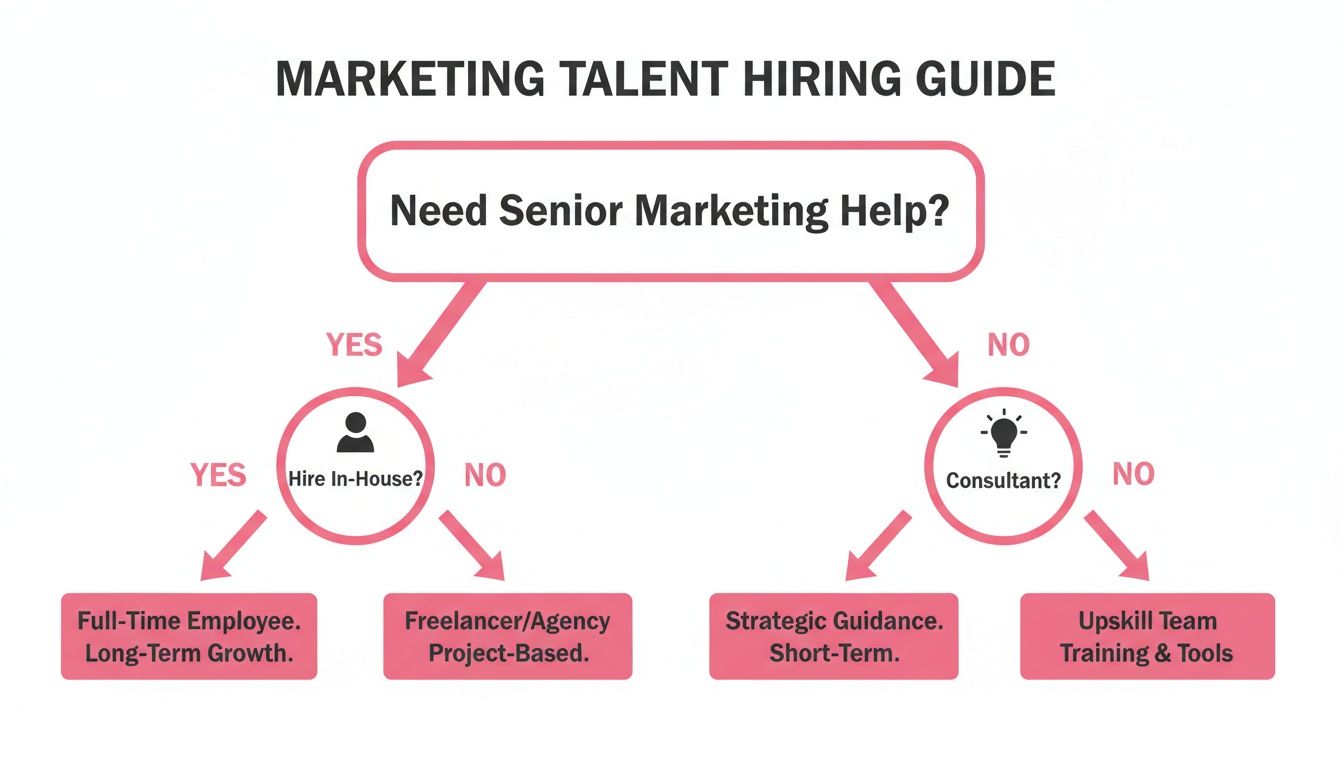
The main takeaway? A consultant is often the right move when the root problem is a lack of senior strategy, not just a shortage of people to do the work.
1. They Untangle Complexity
The first and most critical job is to act as a detective. When marketing feels stuck, it’s rarely one single issue. It’s usually a dozen small problems tangled together, and your team is too close to see the bigger picture.
A consultant’s value is their objective, outside perspective. They can step back and spot patterns your team is blind to, simply because they’ve never had someone map out how all the pieces connect.
Founder Moment: Imagine your AgriTech company generates lots of website leads, but the sales team complains they're all tyre-kickers. Your marketing team’s solution? Generate more leads. They double the ad spend. Now you’re just paying for twice as many low-quality leads, and everyone’s frustrated.
A consultant doesn't start by looking at the ads. They talk to both teams. They quickly find a messaging gap: the ads promise a simple, cheap solution, but the sales team is selling a complex, premium product. The consultant untangles this by rewriting the ad copy and landing page to qualify leads properly. Suddenly, lead quality improves, and peace between sales and marketing is restored.
2. They Build Foundational Systems
The second job is to be an architect. A consultant shouldn't just patch a problem and leave. Their role is to build the systems and processes that prevent the same problem from happening again.
This isn’t about creating complicated spreadsheets nobody uses. It’s about building simple, repeatable workflows that your team can run themselves long after the consultant is gone. When we embed with a team, the first thing we fix is often this exact gap in process.
The true measure of a consultant's success is that, eventually, you don't need them anymore. They should build the structure that allows your team to thrive on its own. A common example is developing a structured content strategy for social media that acts as a master plan, ensuring every post has a clear purpose.
3. They Create Momentum
Finally, the third job is to be a catalyst. When a business is stuck, inertia is powerful. A consultant’s job is to break it. They do this by focusing on a few high-impact 'quick wins' that deliver visible results, fast.
This isn't just for show. Early wins build trust, boost team morale, and create the momentum needed to tackle bigger challenges. It proves to everyone that change is possible and there’s a clear path forward.
When we start working with a team, one of the first things we do is find a small but meaningful gap we can fix within weeks. This might be clarifying your customer positioning or optimising one broken part of your website. By getting a quick win on the board, we build the confidence and energy needed for the deeper work ahead.
To dig deeper, we've outlined more about what a marketing consultant is and when you might need one in this guide.
How to Spot a Real Partner from a Sales Pitch
Trying to hire a marketing consultant can feel like navigating a minefield of buzzwords and over-the-top promises. Every conversation is slick, every pitch deck looks the same, and everyone seems to guarantee they can get you to the top of Google overnight.
It’s normal to feel cynical. You're looking for a partner who can bring clarity and structure, not just another sales pitch. The problem is, the real experts and the smooth talkers often sound alike at first.
So, how do you tell the difference? It comes down to asking better questions and knowing what to listen for.
They Diagnose Before They Prescribe
A huge red flag is a consultant who has a solution ready before they’ve asked a single meaningful question. They’ve already decided you need SEO or a social media campaign without understanding your customers, your team's skills, or what you’ve already tried.
A true partner operates like a doctor. They spend most of the initial conversations listening. They ask probing questions to understand the symptoms, diagnose the underlying issues, and get to the root cause of why your marketing feels stuck.
A consultant selling a solution is a vendor. A consultant who starts by deeply understanding your problem is a partner. They focus on getting the diagnosis right first, because they know that’s the only way to build a plan that works.
They Talk About Failure with Confidence
This is a powerful gut-check. Instead of asking for their biggest client win, try asking this:
“Tell me about a time an engagement went sideways or failed to meet expectations. What happened, and what did you learn from it?”
A salesperson will stumble. They might deflect, blame the client, or give you a polished story where they still came out the hero.
A real expert will welcome the question. They’ll answer with confidence because they know things don’t always go to plan. They'll be able to explain what went wrong, why it went wrong, and how it shaped their process moving forward. Their answer shows experience, humility, and a commitment to improvement—the exact traits you need.
They Prioritise Structure over Tactics
Pay attention to how they describe their approach. Is it a laundry list of tactics—more posts, more ads, more content? Or is it a structured process for building a solid foundation?
A genuine strategic partner will talk about things like:
Clarifying your positioning and messaging first.
Mapping out the customer journey.
Building simple systems your team can use.
Creating a clear measurement framework.
They understand that tactics without a solid structure are just expensive noise. This is usually where a sprint approach creates clarity quickly, focusing on fixing one foundational piece at a time.
Founder Moment: An agtech founder is interviewing two consultants. The first promises to “get you leads fast” with an aggressive ad campaign. The second says, “Before we spend a dollar on ads, we need to spend two weeks with your sales team to understand why your current leads aren’t closing. Then we’ll fix your messaging.”
The second consultant is the partner. They aren’t selling a tactic; they’re selling a process that leads to clarity and a sustainable result.
What Your First 90 Days with a Consultant Should Look Like
Bringing a digital marketing consultant into your business is a big move. You’re likely feeling a mix of excitement and uncertainty. What actually happens once you sign on? How do you get from feeling stuck to having a clear path forward?
The first 90 days are critical. This is where the work of untangling complexity and building momentum begins. It’s not about random acts of marketing. A seasoned consultant follows a deliberate, phased approach designed to deliver clarity and results, fast.
This initial period should feel calm and controlled. If it feels chaotic, something’s wrong. The point of hiring an expert is to reduce the noise, not add to it.
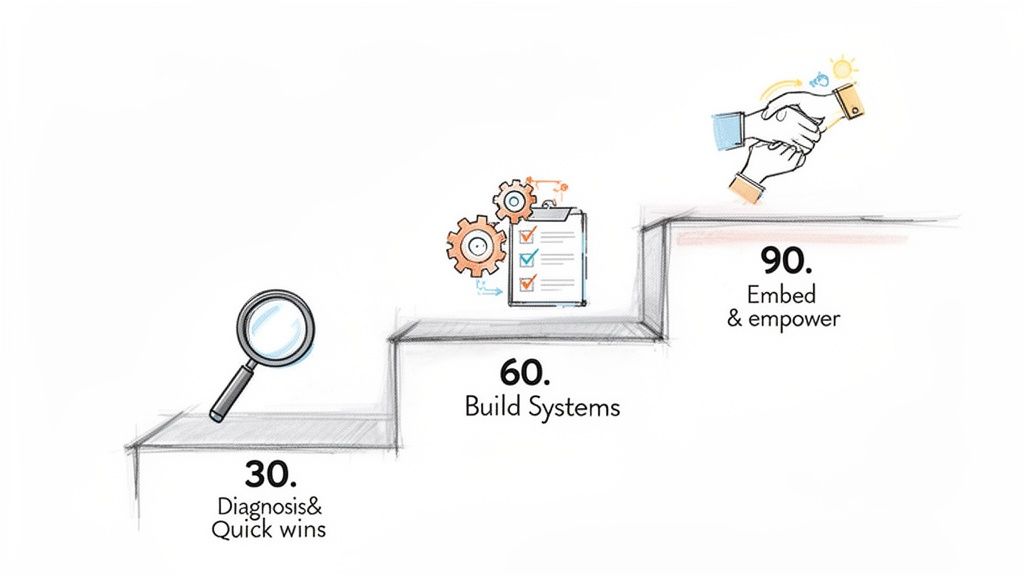
Month 1: The Diagnosis and Quick Wins (Days 1-30)
The first 30 days are all about deep listening and diagnosis. A good consultant won’t show up on day one with a pre-packaged solution. Their first job is to understand your business from the inside out—your team, your customers, your tech, and what you’ve already tried.
This phase is heavy on discovery. Expect them to spend time with your sales team, interview key staff, and dig into your analytics. They’re looking for the root cause of the problem, not just the symptoms.
At the same time, they should be hunting for a 'quick win'—a small, high-impact change that can be made swiftly to build trust and show immediate progress.
Founder Moment: Let’s say you run an AgTech company with a brilliant soil sensor. Your marketing feels flat. A consultant spends the first month talking to farmers and your sales team.
Diagnosis: They realise the website messaging is way too technical. It talks about "proprietary sensor algorithms" when farmers just want to know if it will help them use less water.
Quick Win: In week three, they rewrite the website's main headline to focus on the outcome: "Use up to 30% less water and increase your yield." It’s a simple change, but it immediately starts attracting more relevant enquiries.
This initial month sets the foundation for everything that follows.
Month 2: Building the Missing Systems (Days 31-60)
With a clear diagnosis, the second month is about building the foundational systems your business is missing. This isn't about shiny new tactics; it's about creating the core infrastructure that makes all your marketing more effective.
Depending on what they found, this could involve:
Clarifying your positioning and messaging: Nailing down a simple, powerful story.
Building a content engine: Developing a repeatable process for creating valuable content.
Fixing the sales-to-marketing handover: Creating a clear process for qualifying and nurturing leads.
This is where a sprint-based approach is incredibly effective. Instead of trying to fix everything at once, the consultant helps you tackle one foundational piece at a time. This disciplined focus is critical, especially when customer behaviour is shifting. For instance, nearly 6 in 10 Australians now use social media to research brands. Building the right systems ensures you can meet them where they are. You can find more insights in Kliq Interactive's latest B2B statistics report.
Month 3: Embedding and Empowering (Days 61-90)
The final month of the initial engagement is focused on embedding these new systems and empowering your team to run them independently. A great consultant works to make themselves redundant. Their goal is to leave your team more capable than they found them.
This phase involves hands-on training, documenting new processes, and setting up simple ways to measure what's working. The consultant transitions from 'doing' the work to guiding and mentoring your team.
By the end of 90 days, you shouldn’t just have a few successful campaigns. You should have a clearer direction, a more confident team, and a set of simple, repeatable systems that will continue to deliver results long after the engagement is over. The outcome is structure, momentum, and the feeling of finally being in control.
Your Best First Move Isn't Hiring Anyone
Before you start interviewing consultants, the most effective first move is to get your own thoughts in order. Hiring someone to manage chaos only creates more organised chaos. Real progress starts the moment you untangle your thinking.
The One-Hour Audit
Block out one hour in your calendar. Find a quiet spot with just a pen and paper and map out your current marketing reality.
Use these three simple prompts:
What’s actually working? Be specific. Which activities are bringing in leads you can trace back? What positive feedback are you hearing?
What’s definitely not working? Where is money leaking out with no return? Which channels feel like you're just throwing things at a wall?
What’s a total mystery? List the areas where you have zero visibility. This could be your website analytics or what happens to a lead after it comes in.
This simple act of mapping things out is the single most important step you can take. It immediately gives you a structured foundation for a productive conversation with any potential consultant. For specific projects, you can use tools like an essential website design brief template to formalise what's in your head.
If this feels messy or a bit confronting, that’s completely normal. You’re not behind. You just need structure. This exercise isn't about solving everything yourself. It’s about defining the problem with enough clarity that you can find the right person to help you solve it. To keep building on this clarity, a great next step is learning how to create a marketing plan that actually works.
A Few Common Questions Answered
It’s normal to have questions when you're thinking about bringing on a marketing consultant. It’s a big decision. Here are some straightforward answers to the most common things founders ask.
What's the Real Difference Between a Consultant and an Agency?
This is a big one. Think of a marketing agency as a team you hire to do specific tasks. You'd bring them on to run your Google Ads, manage your social media, or write your blog posts. They’re the extra set of hands.
A consultant, on the other hand, is all about senior-level strategy and structure. Their job isn’t just to do the work; it’s to figure out what work needs to be done in the first place. They build the systems, create the strategy, and make your internal team more effective. A good consultant fills the "what and why" gap, not just the "how."
Is This Going to Be Expensive?
It’s a significant investment, but you have to frame it the right way.
Compare the cost to hiring a full-time, senior marketing director. When you factor in a hefty salary, superannuation, benefits, and long-term overhead, a consultant is often a more cost-effective way to get that same level of expertise.
You’re buying senior leadership focused on solving your most valuable problems for a set period, without the permanent financial commitment of a new executive hire.
How Long Does a Typical Engagement Last?
While every business is different, most high-impact consulting projects are structured as focused sprints over three to six months. This timeframe is usually the sweet spot—it’s long enough to diagnose the real issues, build the right systems, and then embed those processes with your team.
The goal should never be to create a permanent dependency. A great consultant wants to work themselves out of a job. They solve the problem and empower your team, leaving you with lasting skills, confidence, and momentum.
If your marketing feels stuck and you’re ready for a clear path forward, Sensoriium can help. We provide the senior direction and structure your business needs to grow.